
Anyone who engages with LinkedIn professionally – meaning they have a content strategy and regularly publish posts there – repeatedly encounters advice that isn’t entirely perfect.
Okay, that was the diplomatic phrasing.
To put it more pointedly: Various myths are circulating that simply aren’t true. Or at least, ones that should be considered more carefully – and above all, tested.
We have done that in recent months. And in this podcast episode and on this page, we discuss three LinkedIn myths that, in our view, are simply not true:
- “It’s pointless to share posts”
- “You shouldn’t post links”
- You need many followers for reach
As always: This episode is an initial discussion. We are connected with many LinkedIn consultants and online marketing professionals. Therefore, we welcome feedback and a good discussion.
Jump Directly to your Favorite Myth


Myth 1: “It’s Pointless to Share Posts”
It is well known that there are three ways to interact with a post: liking, commenting, or sharing. It is frequently stated that sharing does not generate reach, and therefore one can simply refrain from it. It is supposedly better to comment.
Fabian conducted the test and shared ten posts in the past four weeks. The result: Two posts had approximately 80 views, five posts had between 400 and 800 views, and three posts had four-digit views (1600, 2000, 4000 Views).
The general statement that sharing brings no benefit is, in our view, incorrect. As always on LinkedIn, it depends on the content. If the shared post is interesting and relevant to one’s own audience, it will indeed be interacted with.
Our assumption: Many share posts from their Company Page. However, the posts there are often just typical PR contributions without real added value. It’s clear that this results in little reach.
From our perspective, one could even establish a LinkedIn content strategy that is based solely on sharing interesting content.
Furthermore, sharing engaging posts is also a form of recognition. It shows the other person that you value their posts.
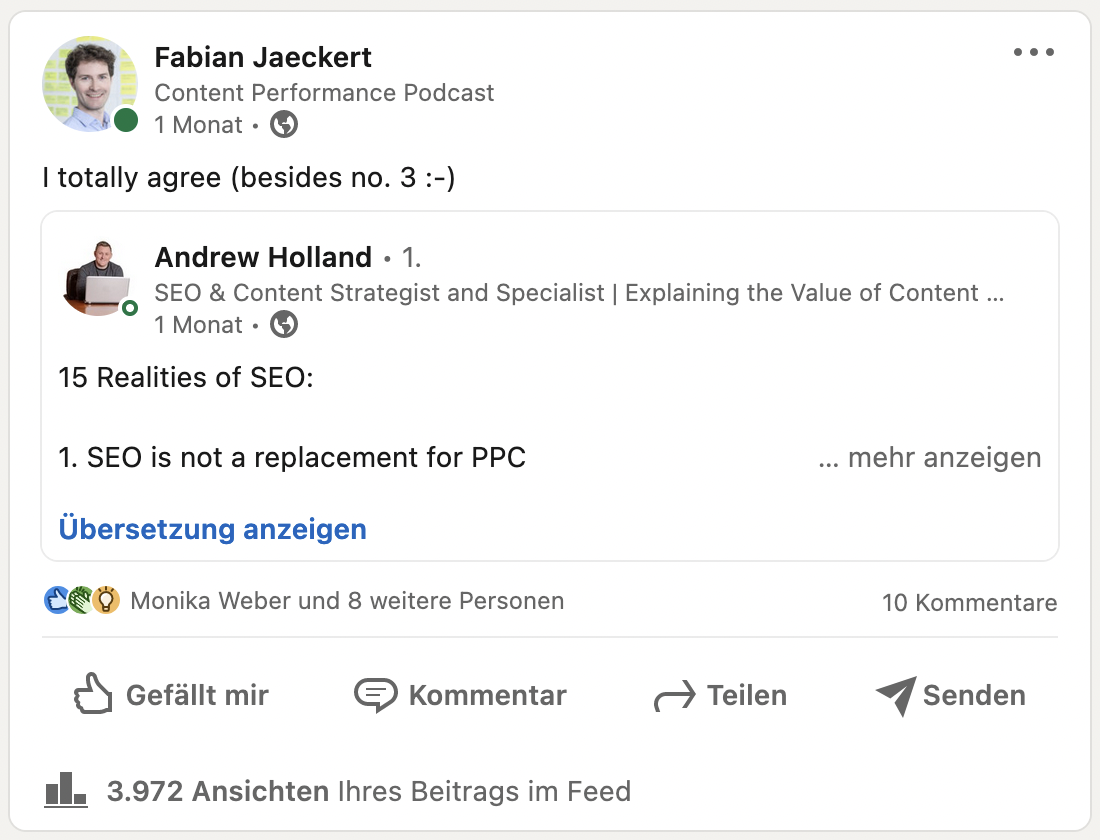
“Share or Like?” – One of several posts that Fabian has shared in recent weeks. He primarily shares posts from experts in the USA or posts with great added value for him – and thus potentially for his followers.
Myth 2: “It’s Pointless to Post a Link”
Another common statement often heard: One should not post external links, but only native posts. Meaning text, image, video – but without a link to the website.
The reasoning behind this: LinkedIn throttles reach because the platform does not want users to leave it. Or, conversely, from a user’s perspective: Users dislike it because they do not want to leave the very fast, high-performing app to continue reading on a cluttered, slow-loading website.
Indeed, posts with links often have little reach. However, in our view, this is due to the way it is often approached: Many publish teaser posts, following the motto: “You can read the 3 ultimate tips if you click here”.
However, this is simply annoying. After all, one could also post the three ultimate tips directly on LinkedIn. But the person publishing the post naturally has goals. They want to draw users to their website. However, that simply doesn’t work.
However, this does not imply that external links do not work, as Benjamin repeatedly observes. Here again, it’s about the content.
Example: If he explains and analyzes an article, a podcast, or a graphic from another expert, he always includes a link. After all, the source should also be acknowledged. The result: The posts almost always receive just as much reach as posts without a link.
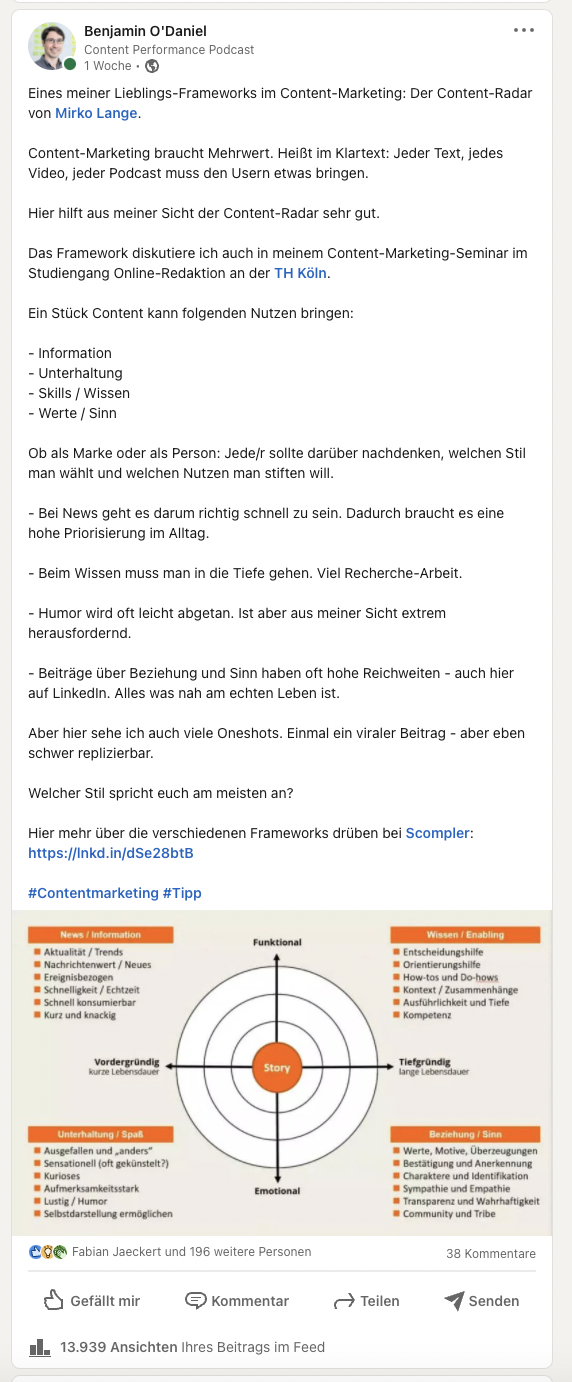
LinkedIn Myth 3: “You Need many Followers for Reach”
In every social network, followers are “artificially boosted”. That has always been the case and is also true for LinkedIn. Unfortunately.
This means: Many pieces of advice aim to build massive connections, typically via cold outreach or even automated tools.
The high number of followers makes a great impression on – at least the uninformed. And there is hope that one will naturally generate business from these thousands of contacts.
We are not fond of that approach. One might accuse us of not playing the LinkedIn game correctly. But for us, it’s about being connected with people who are genuinely interested in our content.
A KPI we often look at when considering LinkedIn influencers: How many followers does the person have – and what is the average reach of their posts? If a person has a six-figure number of followers, but their posts are only liked by one or two hundred people, there is obviously more appearance than substance.
Or, in other words: They are indeed followers, but also many inactive accounts – and not a strong community.
We both have approximately 2900 followers each (as of 01/2022). Fabian’s posts have a total reach of 400,000 annual views, and Benjamin’s posts have a total reach of 530,000 annual views. We exclusively post professional content and no emotionally charged, private posts (children, Corona, etc.).
And yes, client inquiries also come in. But only when the respective individuals deem it important – and not vice versa.
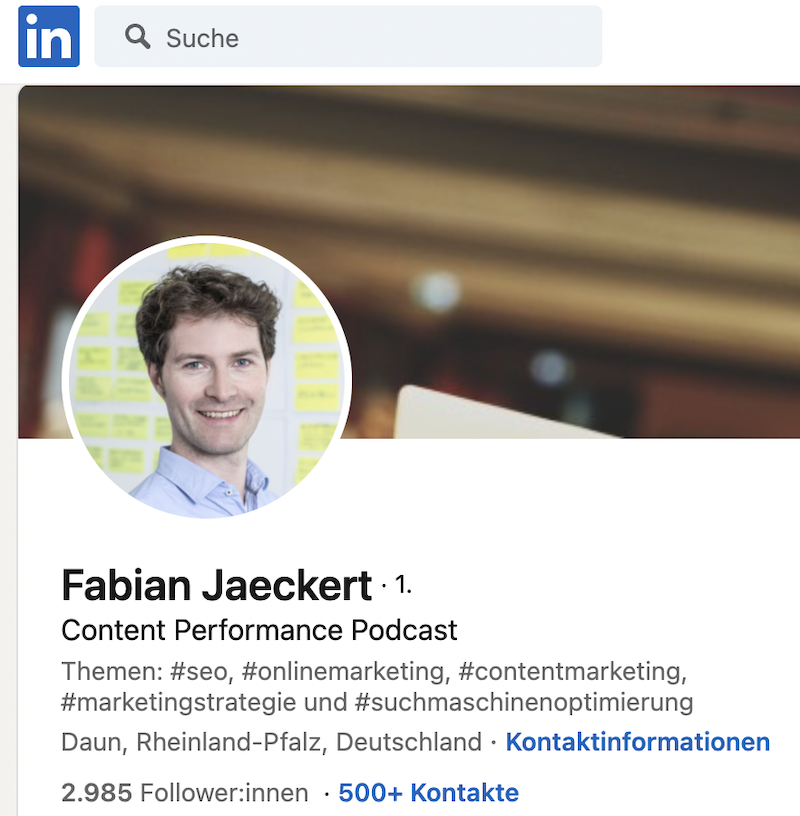
Fabian (and Benjamin) switched from “Connect” to “Follow” as the default a year ago (“LinkedIn Creator Mode”). We ourselves only send connection requests very sparingly if we have the impression that it might be a good fit.
Conclusion: LinkedIn is a social network. Automation often leads astray there – at least from our perspective. Incidentally, we think similarly about the LinkedIn SSI and the topic of LinkedIn B2B Influencers.
Deepen your SEO Knowledge: Every Monday via Email