

Ultimately, SEO is always about gaining more website traffic. Analyzing which keywords bring how much traffic can be done with Google Search Console.
Or so one might think. However, those who examine the data more closely will realize: The Google Search Console only displays a small segment of these keywords.
A large portion of the keywords that drive traffic are simply missing. We determined exactly which keywords these are in this SEO analysis. The results are important because they concern:
- Which types of keywords truly bring traffic in the end
- That one should not be solely driven by “search volume”
- That it is crucial to correctly assess the data basis
Ready for the deep dive? Then we suggest: Open your Google Search Console and follow the same steps on your website. This will help you understand it better. Feel free to send us your feedback via email or LinkedIn!


Domain Level: 75% of Keywords that Bring Website Traffic are not Displayed
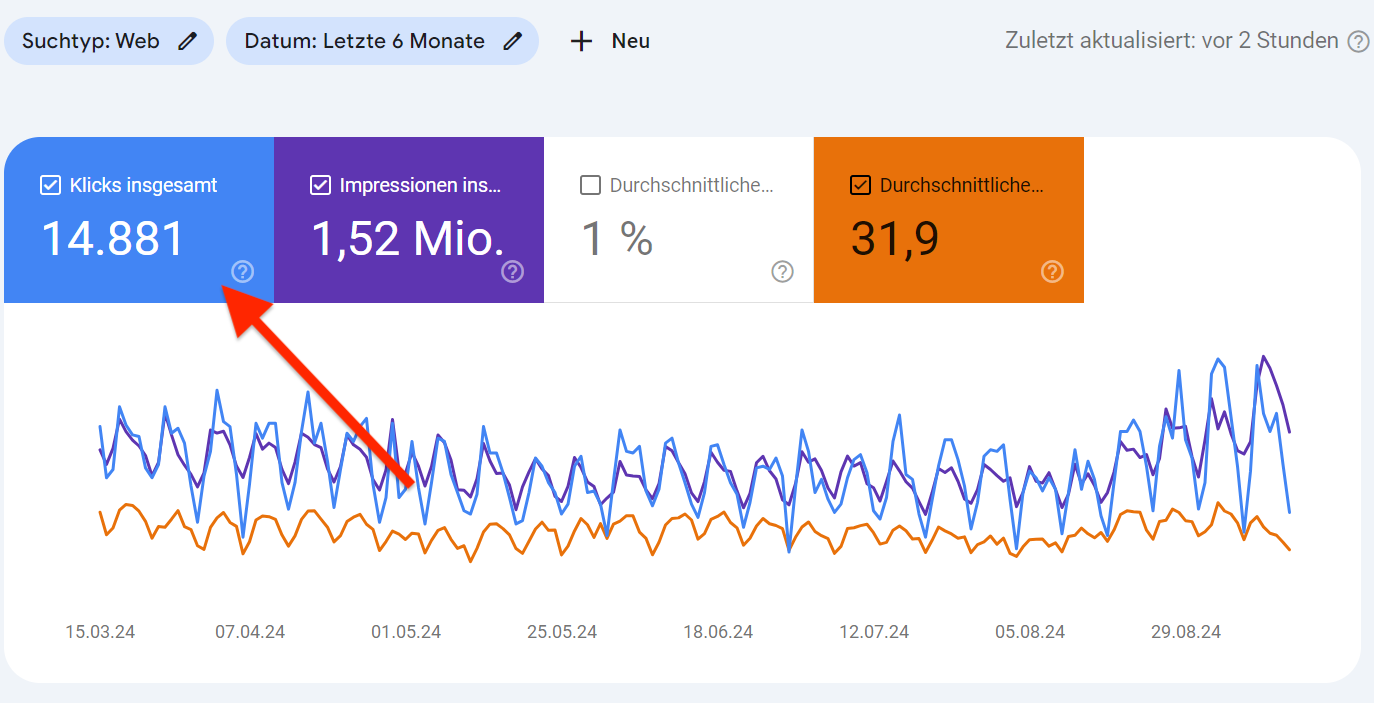
In the Google Search Console, the performance report shows how many clicks a keyword has. By default, 3 months are set. In this example (one of our own guide pages), we set 6 months to have more data as a basis. Below the chart, individual keywords are also displayed. You can also analyze pages and set filters there.
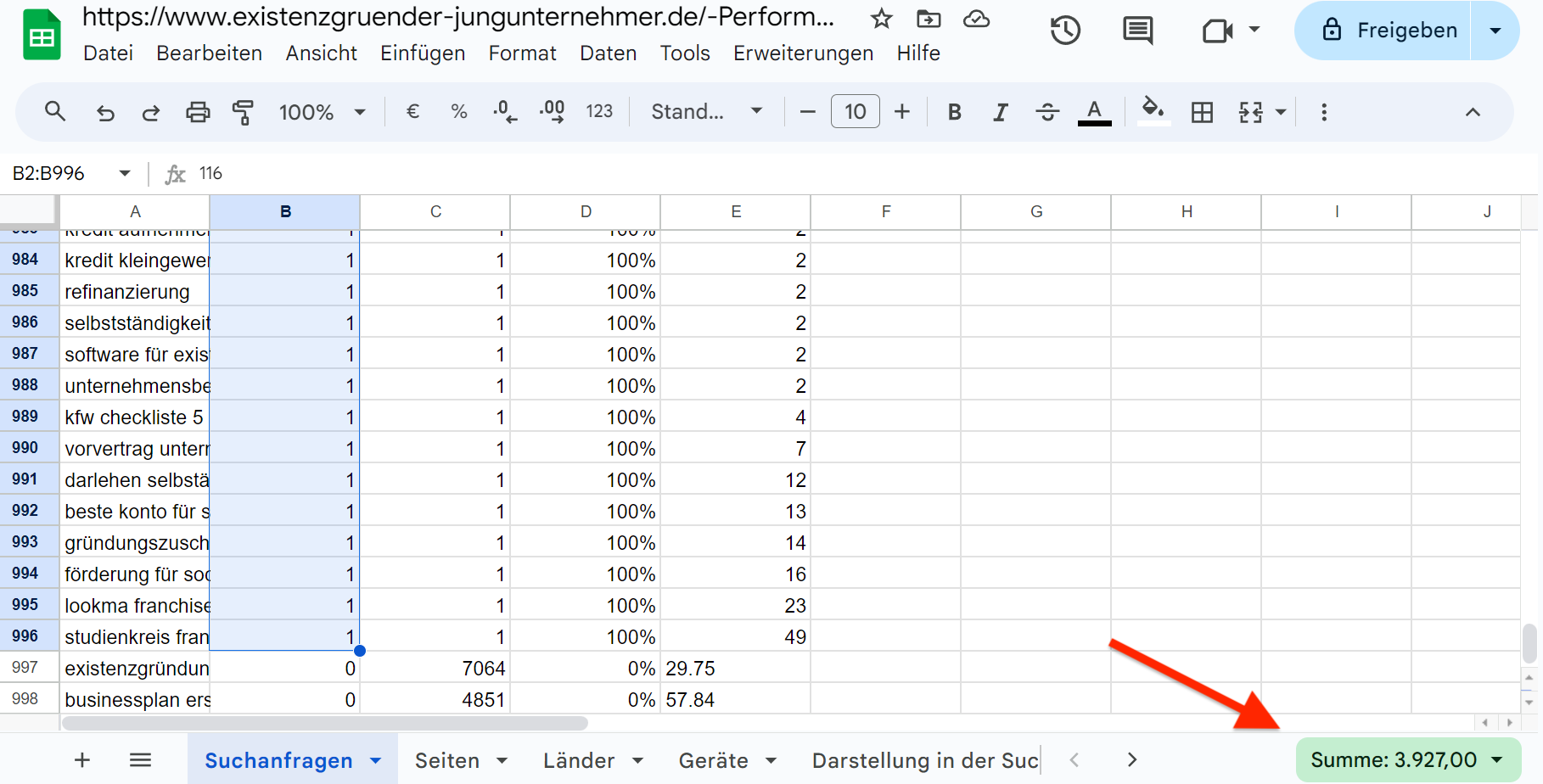
In the top right, there is an option to export this keyword data at the domain level. For example, to a Google Sheet. The second column always indicates how many clicks a respective keyword has generated.
Anyone who sums up all the clicks from the table will notice: Far fewer traffic-generating keywords are displayed than the total clicks the domain has received. Therefore, keywords that have brought clicks are missing.
And quite a lot. To be precise, it’s around 75 percent. We verified this on other domains as examples.
Conversely, this means: Therefore, one only knows 25 percent of their keywords that actually generate clicks. The rest remains unknown.
This is an important starting point. Ultimately, as SEO consultants, we want to know which search terms truly drive website traffic. Therefore, in the next step, we focused on determining exactly which types of keywords remain unknown to us.

Long-tail Keywords on a URL:
Here Too, there are 75% Dark Keywords
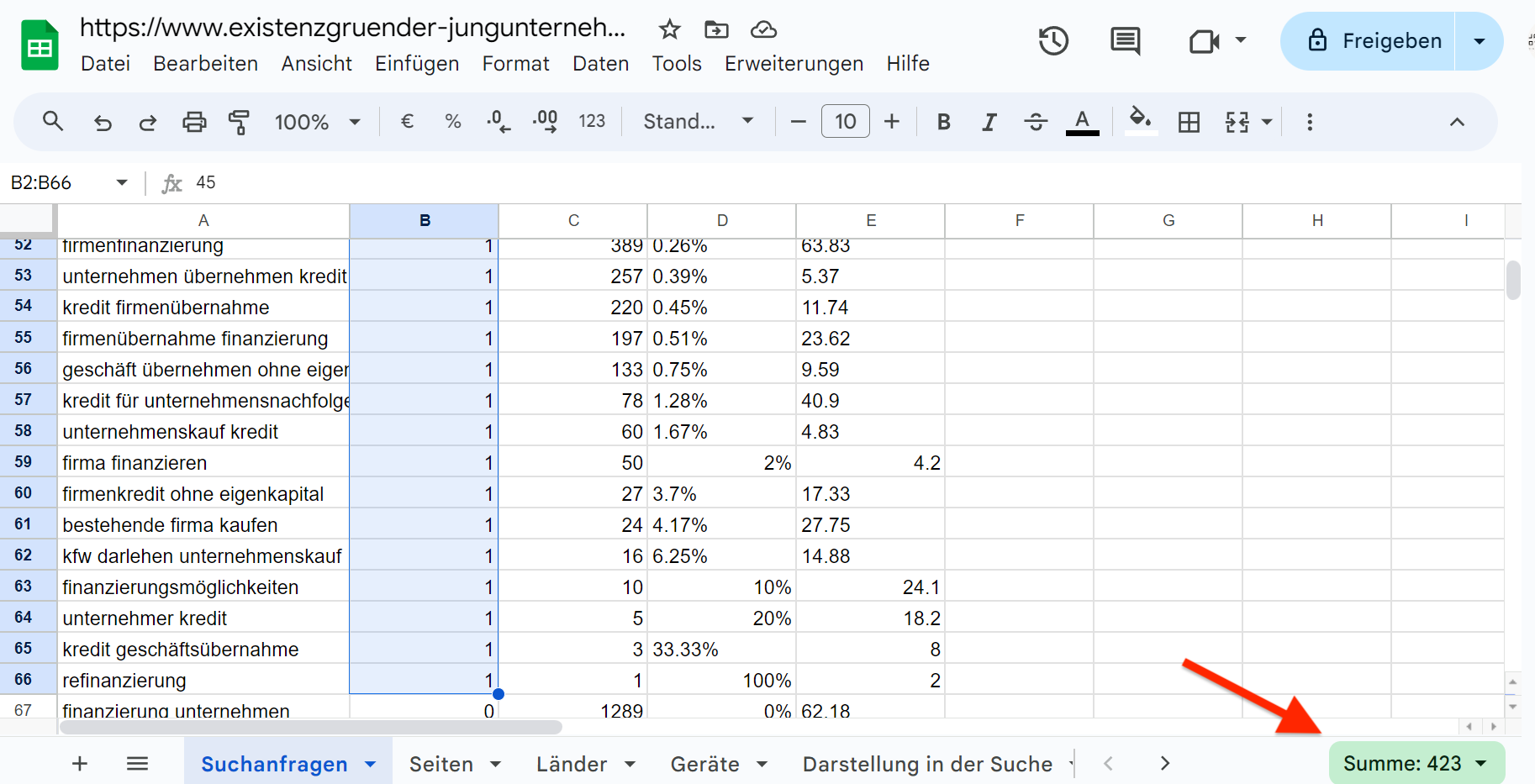
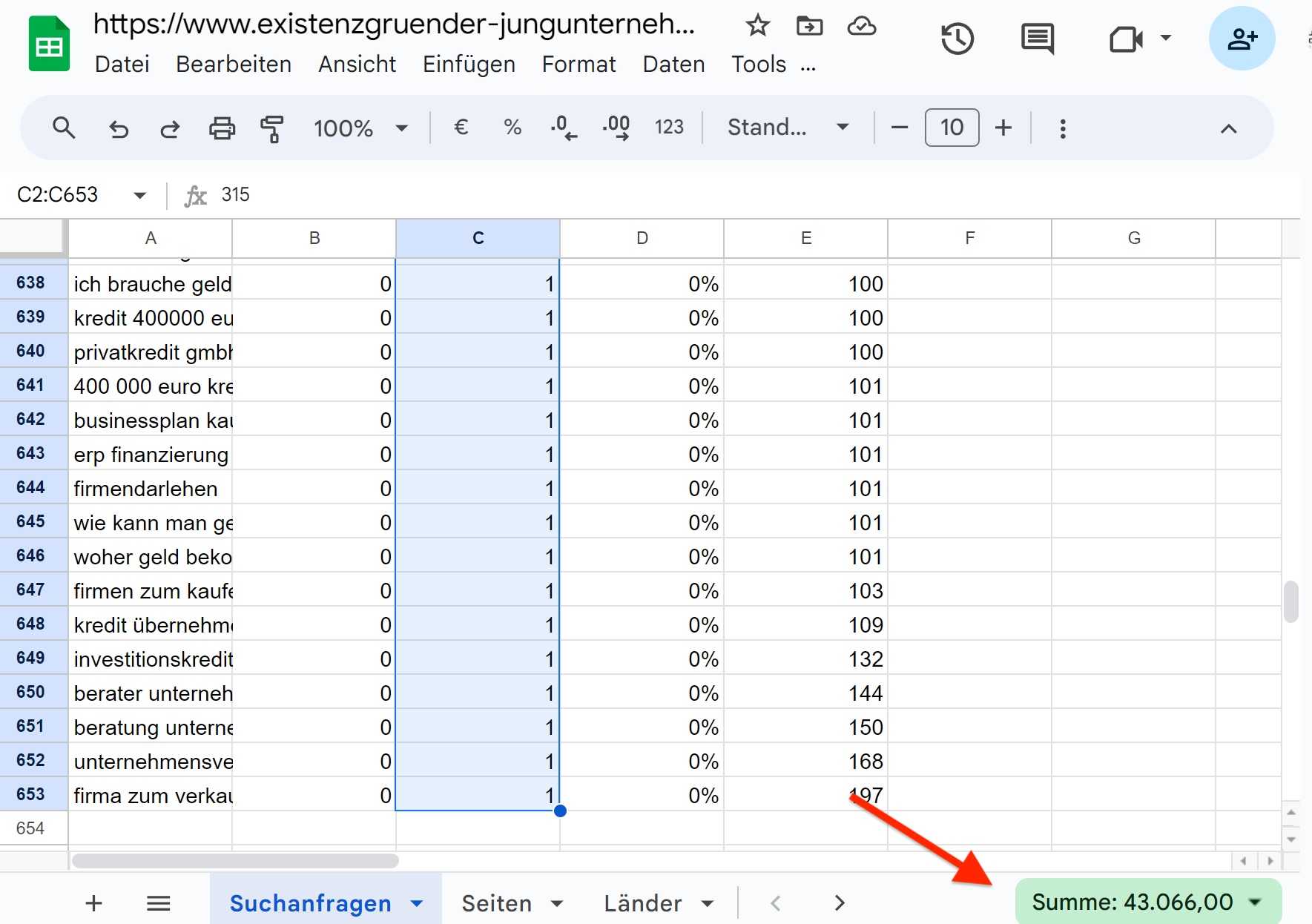
Subsequently, we examined a single URL using the same methodology. In this case, a guide article that received approximately 1600 clicks from specific keywords over 6 months. This was a long-tail keyword analysis. The keywords displayed to us here, when aggregated, only generated 400 clicks.
Thus, 75 percent of all clicks and keywords are also missing here. We do not know which search terms ultimately accounted for the majority of the success. We only see a small segment.
This fact entails consequences:
Keyword Evaluation: The long-tail is often neglected because SEO tools only show low search volumes for it. However, this example demonstrates that many unknown long-tail keywords collectively generate a significant amount of website traffic. The long-tail should receive greater focus.
Content Production: In the long-tail, it makes little sense to optimize for individual keywords. Ultimately, one does not know which phrasing will generate keyword traffic. From our perspective, it is better for known keywords to provide a general framework or pattern, and then to work with greater editorial freedom. Here, we observe a trend towards Ranch Style SEO and First Hand Experience.

Impressions in Comparison:
there are Only 33% Dark Impressions
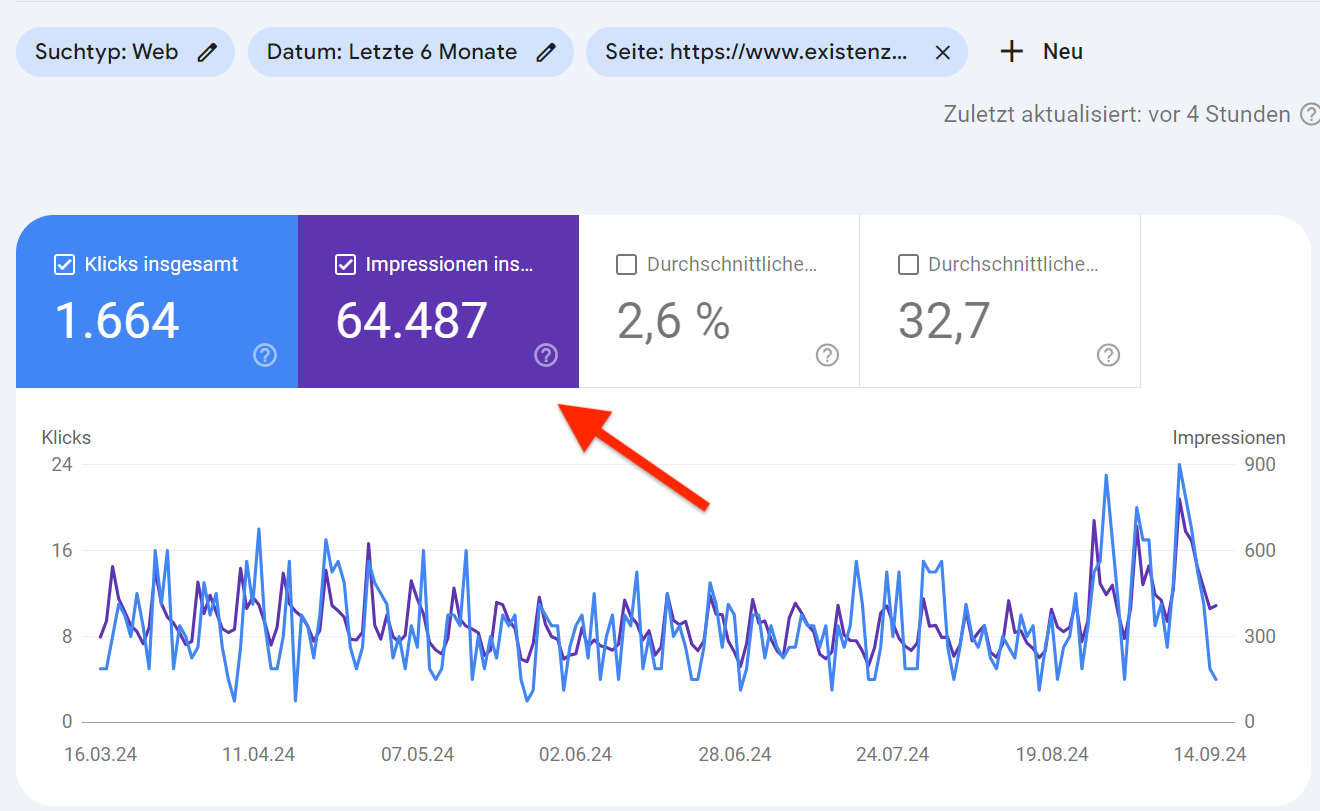
Following the same methodology, one can analyze impressions in the Google Search Console. It reveals that we receive a significant amount of information regarding which keywords generate how many impressions for our analyzed URL. The result: There are only 33 percent dark impressions. 66 percent of all impressions are known, both at the URL level and at the domain level.
When combining both data sets, meaning clicks with impressions, an interesting result emerges.
75 percent of all dark clicks are attributed to 33 percent of all dark impressions.
This means: The unknown keywords that generate clicks account for only a few impressions. Therefore, they are extremely niche long-tail keywords that are rarely searched for but are highly efficient.
We tested this at the URL level. There, we had 20,000 dark impressions, which resulted in 1200 dark clicks. That is 16.6 dark impressions per dark click. A Dark CTR of 6%!
In comparison, the known keywords are significantly less performant. Approximately 40,000 known impressions resulted in 400 known keyword clicks. That is 100 impressions per click. CTR: 1%
Here too, we tested the impressions in the Google Search Console using various examples and found similar results for similar content.
Short-head Keywords:
Here there are Only 25 Percent Dark Keywords
We also examined articles using the same methodology that rank for main keywords. These are single-word search terms with four- or five-digit monthly search volumes. We cannot and will not provide charts for this, as these are client projects.
The articles generate thousands of clicks, thus providing a valid data basis. When examining how many traffic-generating keywords are displayed here, a surprising result emerges: For content that ranks for short-head terms, 75 percent of all keywords that bring traffic are displayed. This is precisely the opposite of the long-tail example.
Thus, with short-head keywords, we are precisely informed about which search terms generate keyword traffic. The majority often pertains to the single word and is displayed accordingly.
If an article or URL ranks for a short-head term, precisely this single-word ranking generates the majority of the traffic. There are only a few unknown long-tail terms that additionally generate traffic. A very high dependency.
Furthermore, it should be noted:
There is a significant distortion in the keyword click data. Superficially, it appears as though the main terms generate far more website traffic than the long-tail. However, upon deeper examination, it becomes clear that this is because long-tail keywords are displayed only to a very limited extent.
Conclusion of the SEO Analysis
We Advise Marketing Managers on SEO

We are Fabian Jaeckert (right) and Benjamin O’Daniel. For many years, we have worked as consultants for marketing teams. We combine two worlds: Fabian is the technical expert, and Benjamin handles all topics related to content development.
For anyone seeking an SEO sparring partner or comprehensive SEO consulting, Fabian and Benjamin are the perfect choice. As an in-house SEO expert, I sought competent SEO support and found it with them. During a very pleasant introductory meeting, we jointly developed an approach to establish SEO among the individual stakeholders and thereby gain more internal visibility for the subject. Based on this initial discussion and a joint kick-off with the stakeholders, they developed a sound SEO and content strategy for a product area. Since then, they have both supported me as sparring partners during implementation.
The collaboration with Fabian and Benjamin is a great pleasure for me and all project participants, as they are masters of their craft and bring immense passion for SEO. This combination is infectious and motivates everyone to achieve peak performance.

“How can we improve our SEO visibility?”
This fundamental question underlies every project for which we are brought on board.
It often involves reviewing existing SEO and content strategies from an external perspective and developing new levers.
This is precisely what we specialize in.
We develop SEO strategies for companies and present them in a structured and understandable manner to the responsible parties in focus workshops. Subsequently, we support the in-house managers during implementation.
Sounds interesting?
We would be happy to arrange an introductory SEO meeting via video conference (30 min.).
Deepen your SEO Knowledge: Every Monday via Email