

SEO and GEO have many differences—but also similarities. When it comes to AI optimization, you can adopt a lot from SEO in terms of approach. What exactly—that is what we discuss in this episode. We share three tips that have proven effective in our GEO consulting.
We illustrate all of this with a concrete example to make it easy to understand. In the video, we also go into several SEO and GEO tools. We discussed the example in depth in an Academy workshop.
What similarities do you see between SEO and GEO? We look forward to your feedback!


Tip 1: Use keyword data
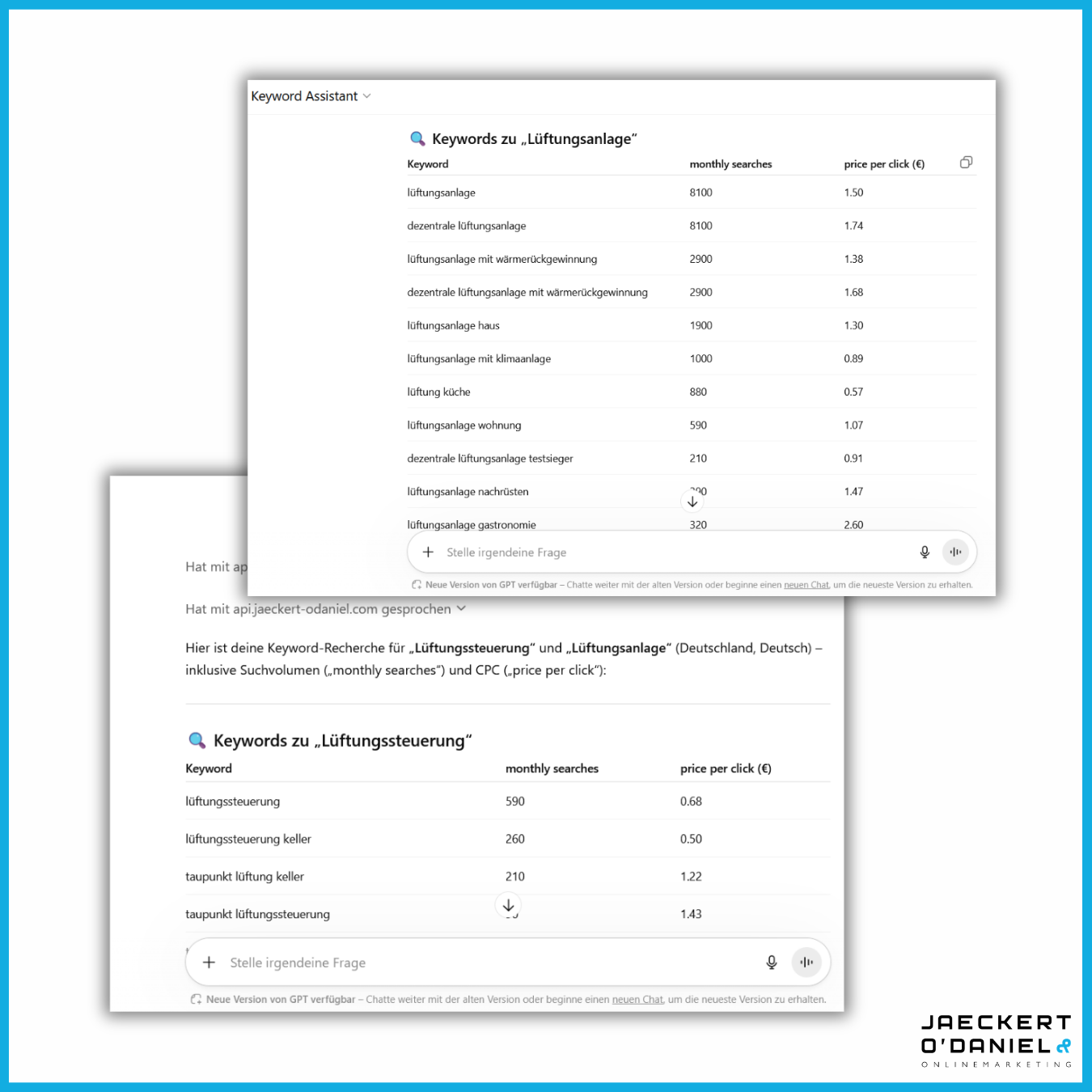
Several tool providers are currently trying to display search volume for prompts. The problem: there is no officially accessible data for this. The providers of AI systems do not disclose which prompts are searched how often. Unlike Google, which provides keyword search volumes in the Keyword Planner (so companies can run ads against them).
Search volume for prompts is therefore a data basis that is highly questionable. That is why we do not use it in our consulting. What we do instead: we review classic keyword data to select the right prompt terminology. Keyword data is definitely valid and provides a clear indication of how high demand is for a given term.
In our example, it is about “ventilation controls” and “ventilation systems”. The boundaries are fluid here. There are systems with controls. And there are controls with systems. A typical B2B problem: the terminology is not entirely clear—especially not for customers, who often use simple terms, while companies tend to use more complex ones.
This is also reflected in our keyword research tool: for ventilation systems, there are around 8,000 searches per month in Germany. Whereas for “ventilation systems” there are only around 600 searches. This has implications for our main prompt. We use “I am looking for a ventilation system…” and combine it with purchase-decision criteria (Here is an introduction to prompt research).
In parallel, we also test “I am looking for a ventilation system…”—also to determine differences in AI visibility (brands, sources).
Tip 2: Analyze the AI response page
A common approach in SEO is the so-called SERP analysis. This involves analyzing the search results page (Search Engine Results Page, or SERP for short). Specifically, it looks at integrations such as product grids, YouTube carousels, featured snippets, and many other elements that make up a search result. The goal of the analysis is to better understand your chances of gaining SEO traffic.
The same approach is also suitable for GEO. Here, we analyze the AI response that is generated from the prompts—i.e., the structure and the elements within the respective system.
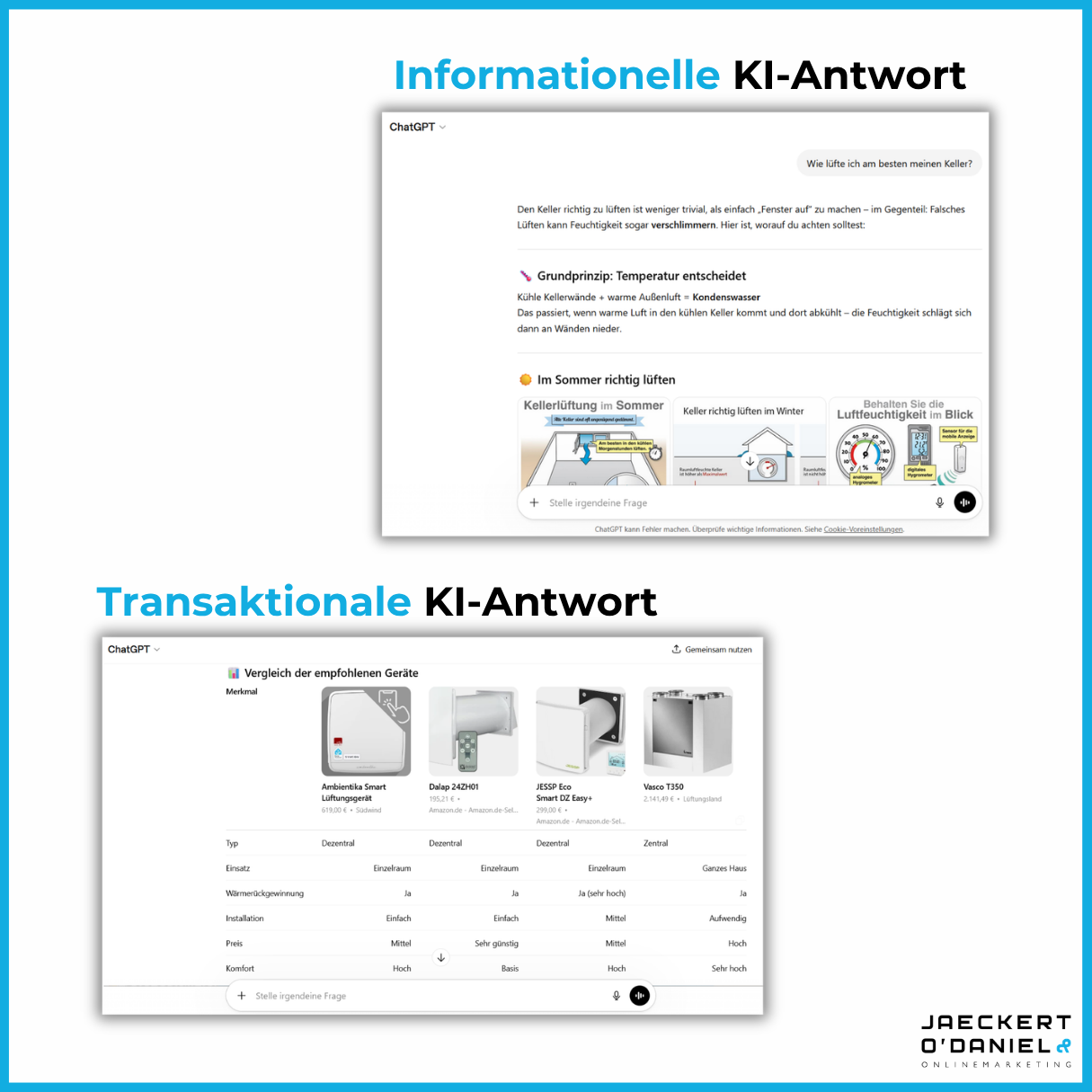
For example, with informational prompts in ChatGPT, you can see that no brands and no sources are mentioned. As a result, these prompts become less relevant for us as a marketing objective, because we can no longer be visible there.
In our example, this is the prompt: “What is the best way to ventilate my basement?” Here, ChatGPT generates graphics and provides specific tips—without mentioning products, brands, or sources.
It is completely different with transactional prompts, such as our example “I am looking for a ventilation system”. Here, the entire structure is completely different. Brands and sources are mentioned. Clear favorites are named and a comparison table of products is generated. Prices are shown, shops are linked, and reviews are displayed. Manufacturers of such systems should aim to appear in these AI responses.
Free GEO Online Training
- Current Developments in AI Visibility
- From SEO to GEO
- How to Optimize for AI Systems

Tip 3: Identify patterns in fan-out queries
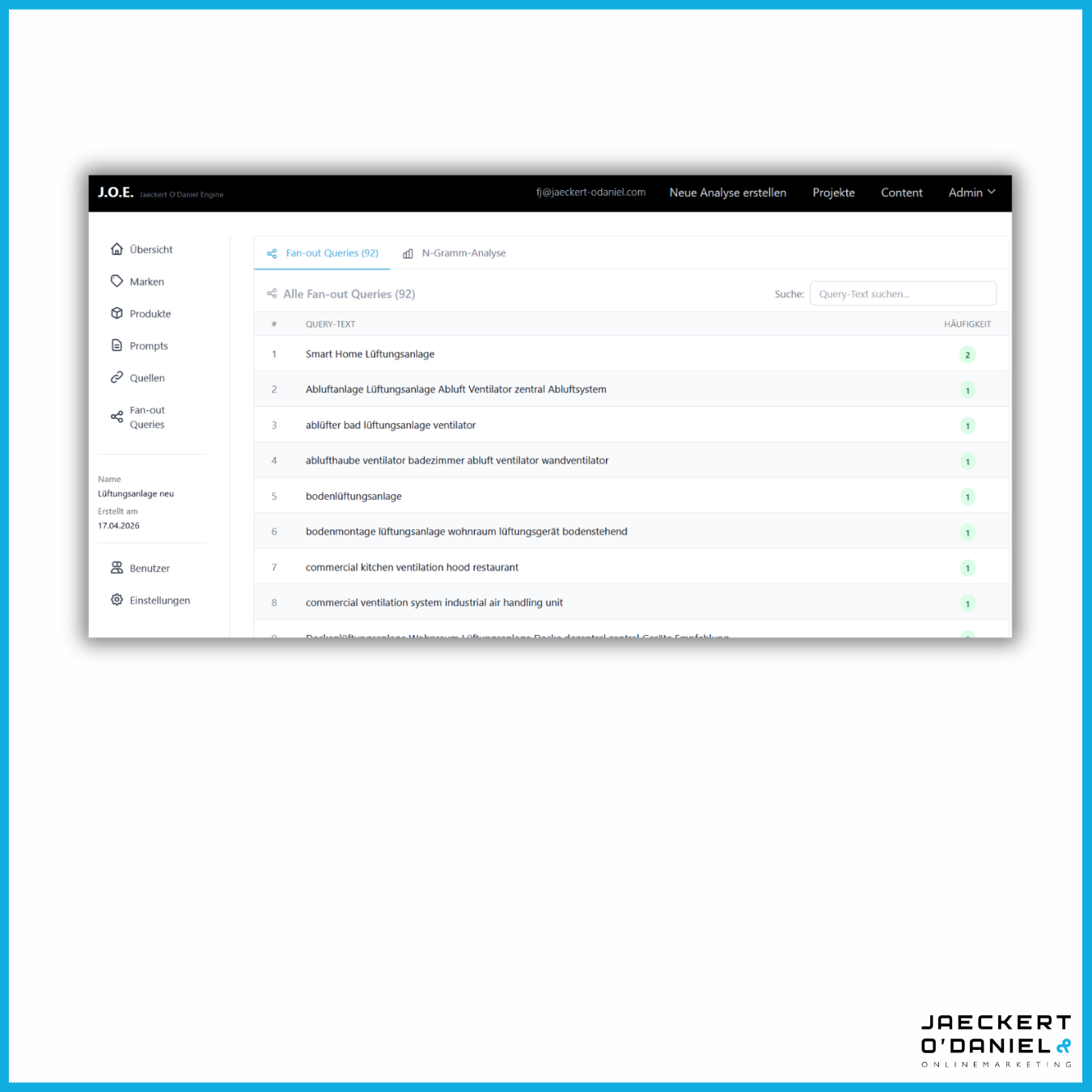
When users enter transactional prompts—i.e., they are specifically searching for products—AI systems increasingly draw on internet sources. This process is called query fan-out. AI systems break the prompt down into keywords and search for them in search engines. Websites that rank at the top are then used to generate the answer.
That is why analyzing the AI systems’ search queries is a crucial point. You can identify patterns—and use that for content production.
In our analysis, we repeatedly see that around half of all fan-out queries are in English. Accordingly, English content is displayed in search engines. For companies, this means: your content should always be available in English as well, at a minimum. Proper language markup (SEO craftsmanship!) is mandatory.
Our Conversations with SEO and GEO Professionals



Deepen your GEO Knowledge: Every Monday via Email
We Advise Marketing Managers on SEO & GEO
For anyone seeking an SEO sparring partner or comprehensive SEO consulting, Fabian and Benjamin are the perfect choice. As an in-house SEO expert, I sought competent SEO support and found it with them. During a very pleasant introductory meeting, we jointly developed an approach to establish SEO among the individual stakeholders and thereby gain more internal visibility for the subject. Based on this initial discussion and a joint kick-off with the stakeholders, they developed a sound SEO and content strategy for a product area. Since then, they have both supported me as sparring partners during implementation.
The collaboration with Fabian and Benjamin is a great pleasure for me and all project participants, as they are masters of their craft and bring immense passion for SEO. This combination is infectious and motivates everyone to achieve peak performance.

I look back with great satisfaction on the SEO project that we carried out with Benjamin and Fabian. Firstly, the collaboration was on a very pleasant, goal-oriented level. Secondly, the consultation was structured in such a way that we could immediately start with the implementation. We received very concrete optimization suggestions that were tailored to our internal capacities and therefore realistically implementable. Even though only a few months have passed, we can already see the first results of our work in the Google rankings. Traffic for our relevant keywords is steadily increasing, and we still have enough concrete work packages from Benjamin in the pipeline to boost our site. Furthermore, through the consultation, we have acquired so much internal SEO know-how that we can now optimize our site independently. And most importantly: Visitor numbers have doubled – with correspondingly positive effects on sales.