3 tips on how to combine SEO with GEO
SEO and GEO have many differences—but also similarities. When it comes to AI optimization, you can adopt a lot from SEO in terms of…


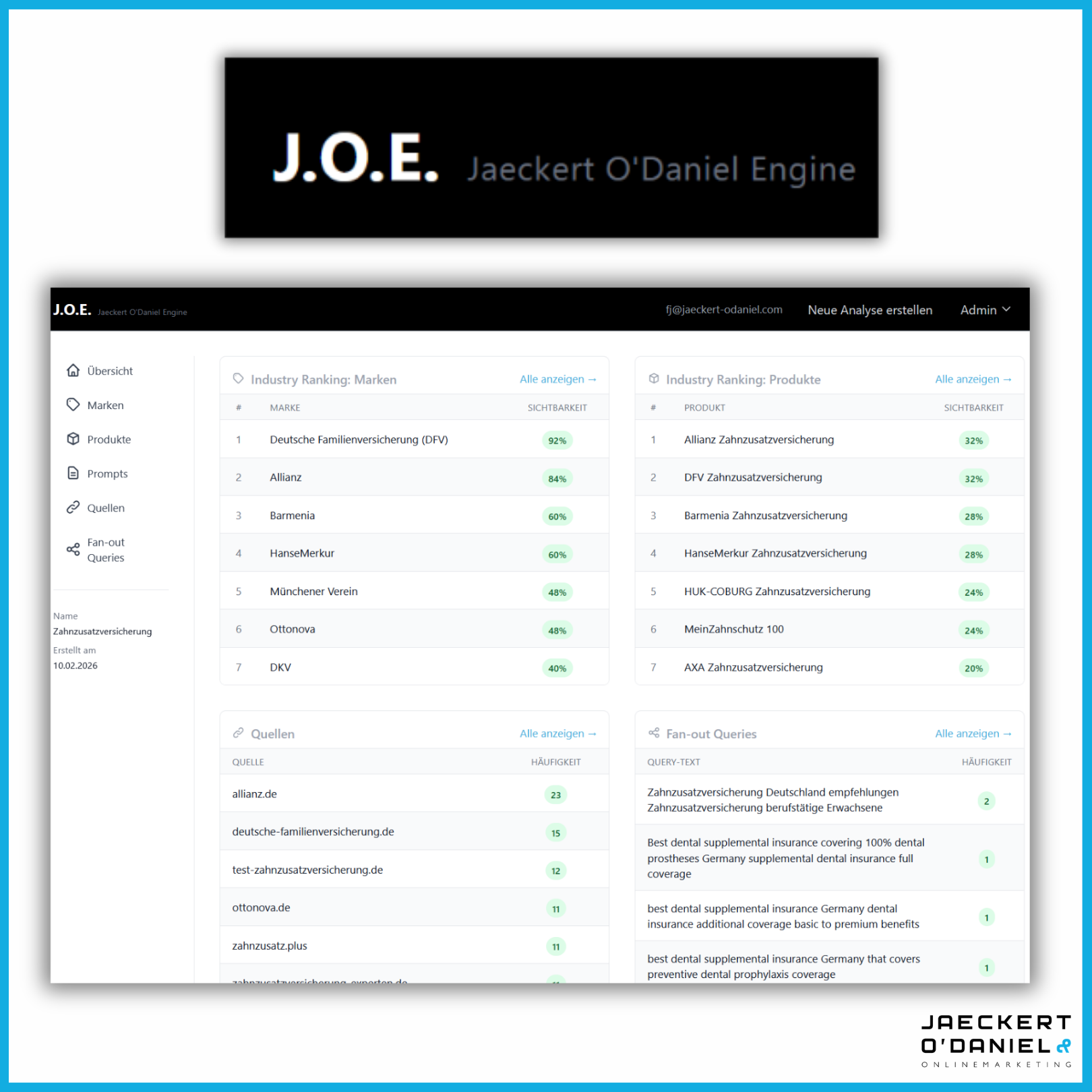
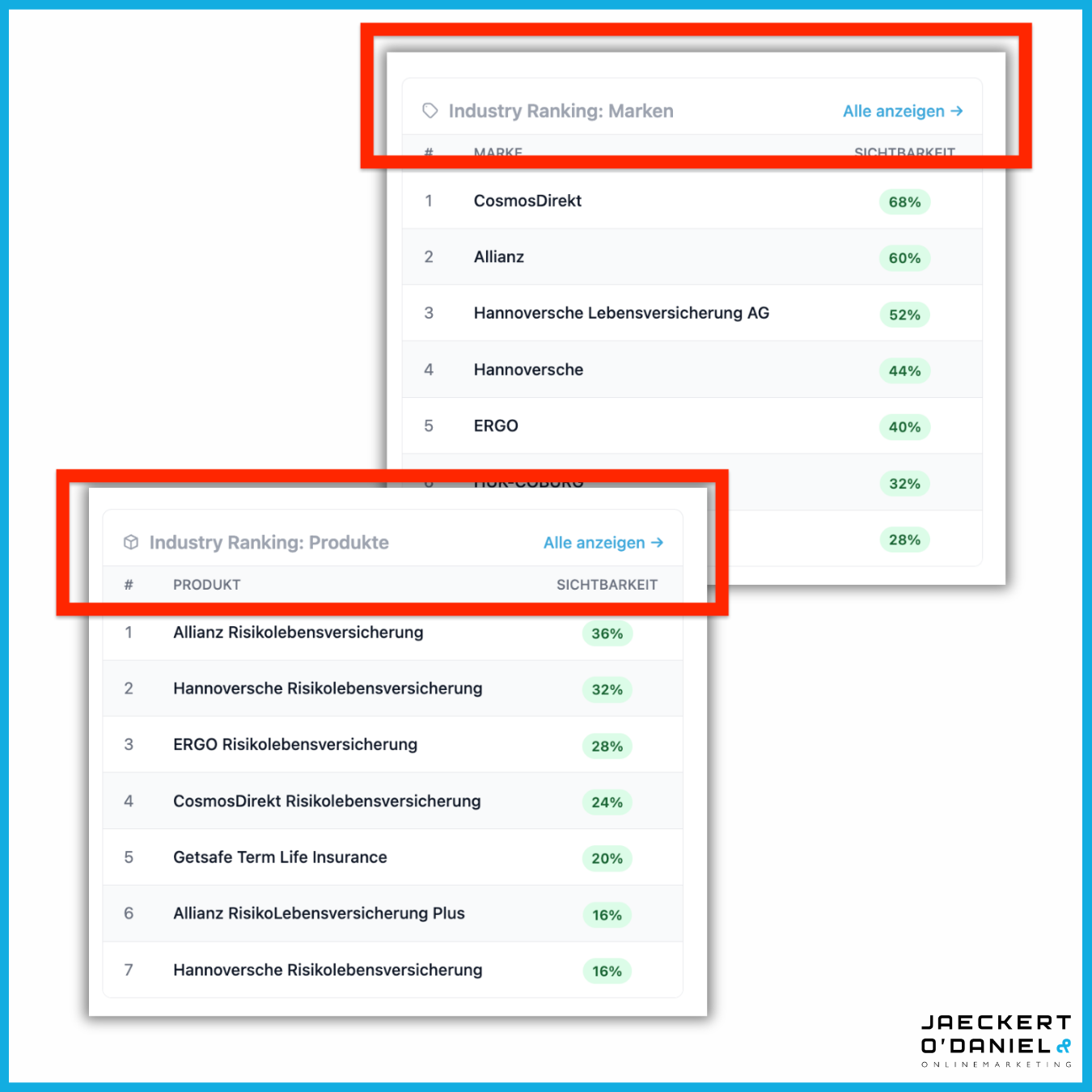
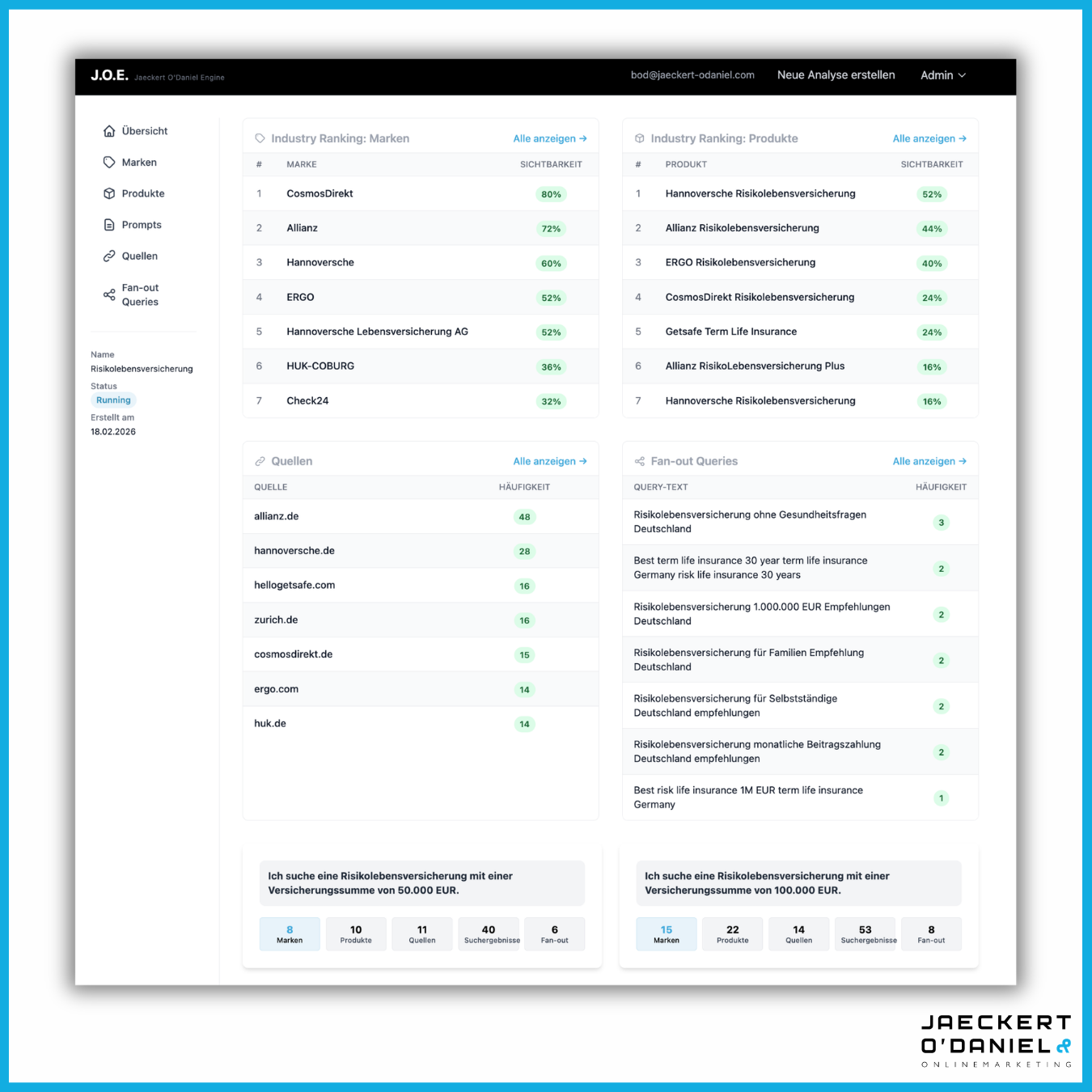
Is my brand mentioned? What sources does the AI use? What are the levers for more AI visibility? Chart from AI Analytics Tool J.O.E.
AI visibility is a completely new field in marketing. It’s about when and how companies are mentioned in AI systems like ChatGPT, Copilot, AI Mode, and other platforms. At their core, AI systems function similarly. They are language models (LLMs). However, there are many differences in detail, for example, in “grounding,” meaning when and how extensively the internet is used for AI responses.
AI systems are currently integrating into all platforms and devices. Billions of users worldwide already use AI systems to inform themselves about topics, products, and services relevant to them. ChatGPT alone, as the market leader, has over 900 million active users.
The terms for optimizing AI visibility are diverse: GEO, AEO, LLMO, ChatGPT SEO, AI Search – all these terms are currently used in the industry. Which term will prevail is still unclear.
First, a language model cannot be easily manipulated. Companies face the task of proving their relevance in a specific topic area. Then they will also be mentioned and recommended by the AI. What companies need is a GEO strategy.
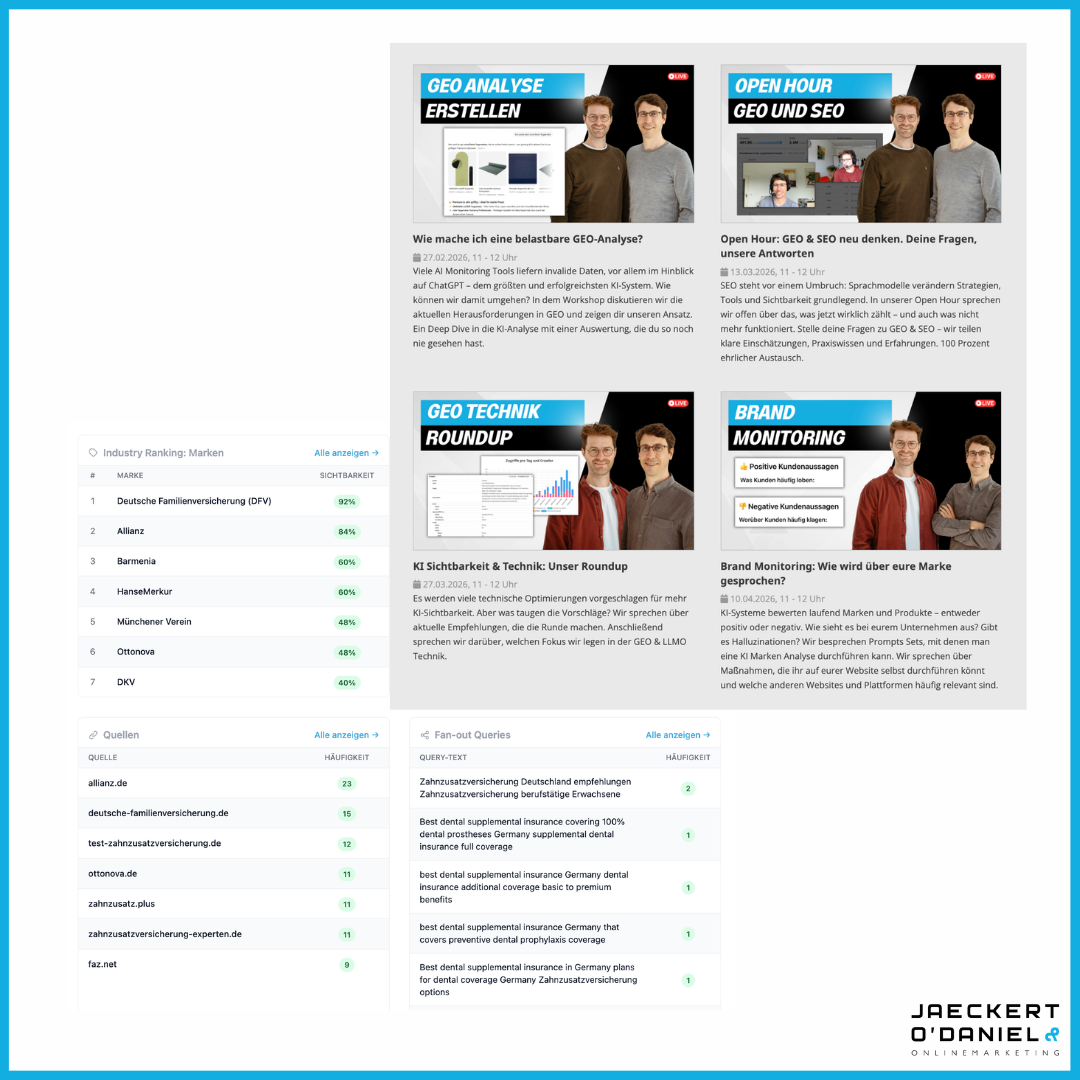
For this purpose, we have developed our GEO Academy. There you will receive access to AI analysis tools and live workshops. Plus recordings from past workshops. We are building a bridge from SEO to GEO.
We are Fabian Jaeckert and Benjamin O’Daniel. As GEO & LLMO consultants, we support companies in improving their AI visibility. As experts, we have spoken at conferences for many years (including Campixx, SMX, Rheinwerk). In our Content Performance Podcast, we discuss a topic related to AI visibility every week.
Fabian Jaeckert has been working in the SEO industry since 2004 and developed his own SEO tools back then. He specializes in tools, strategy, and technology. For our Academy, he has developed several AI analysis tools that all members can use. Benjamin O’Daniel has been working in the SEO world since 2011. He is a trained editor and copywriter and handles all topics related to content and digital relations. Since ChatGPT entered the market, we have been discussing the AI transformation and supporting our clients through it.
Our clients include renowned medium-sized companies and brands, both online shops and in the B2B sector. In our GEO Academy, we impart practical knowledge, GEO strategies, and discuss current topics.

Those who want to work on their AI visibility need clear goals. Traditional SEO metrics are becoming increasingly less relevant here. Instead, we, Fabian Jaeckert and Benjamin O’Daniel, propose new GEO/LLMO KPIs based on our work as GEO experts:
In our view, meaningful metrics and KPIs are the foundation for a successful GEO strategy. In our AI Visibility Tool, you can analyze precisely these KPIs and review them regularly if needed. You can use this tool as an Academy member.
Here we delve deeper into the topic:
More and more users are directly asking AI systems like ChatGPT for product recommendations – for example: “What is the best power bank for travel?” The results are compact, often limited to four to five options, and structured according to specific use cases (“best for frequent travelers,” “best with solar charging,” etc.). To appear in this selection with your product, you need to understand how AI responds to prompts – and how to integrate relevant decision factors into the query.
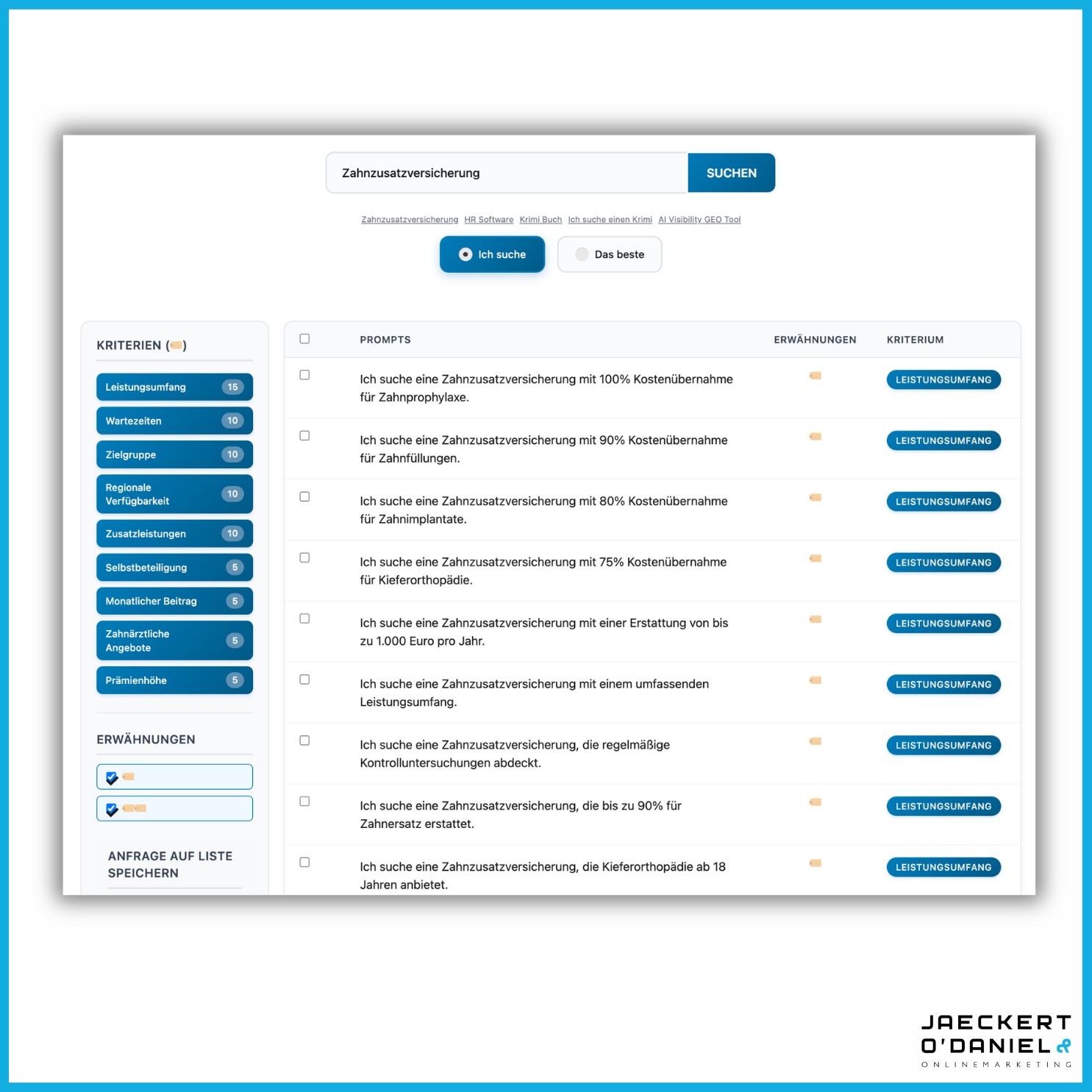
Prompt research therefore aims to analyze typical user questions and develop precise prompts that reflect real purchasing motives. Instead of optimizing for a general “best headphones,” the query should be specific – for example: “I’m looking for wireless headphones for jogging in the rain.” The clearer the prompt, the more targeted the AI’s product recommendation. This opens new avenues for gaining visibility beyond traditional search engines through Generative Engine Optimization (GEO optimization).
For this very purpose, we have developed our own Prompt Research Tool, which you can use as an Academy member (see screenshot). Here you enter your product and receive all the criteria that ChatGPT queries for its purchasing advice.
There are now numerous AI Visibility Tools on the market. These include Profound, Peec AI, Rankscale, Mentions, Finseo. We have also developed our own AI Analytics Tool – which, however, functions differently.
Because the tools on the market typically query prompts daily and create ongoing monitoring from them. Our AI Visibility Tool J.O.E., on the other hand, performs a deep analysis once – and creates a GEO analysis for you. On this basis, you already have deep insights. Afterwards, you can flexibly query additional prompts. This makes you more flexible.
Many Academy members also use several tools in parallel. As always, this is a question of budget and professional focus.
It is important that you can analyze your AI visibility at the prompt level. If you lack visibility for the most important prompts, it is often due to missing content on the website. You can identify precisely such content gaps with AI analysis tools. You can see if and how often the brand name appears.
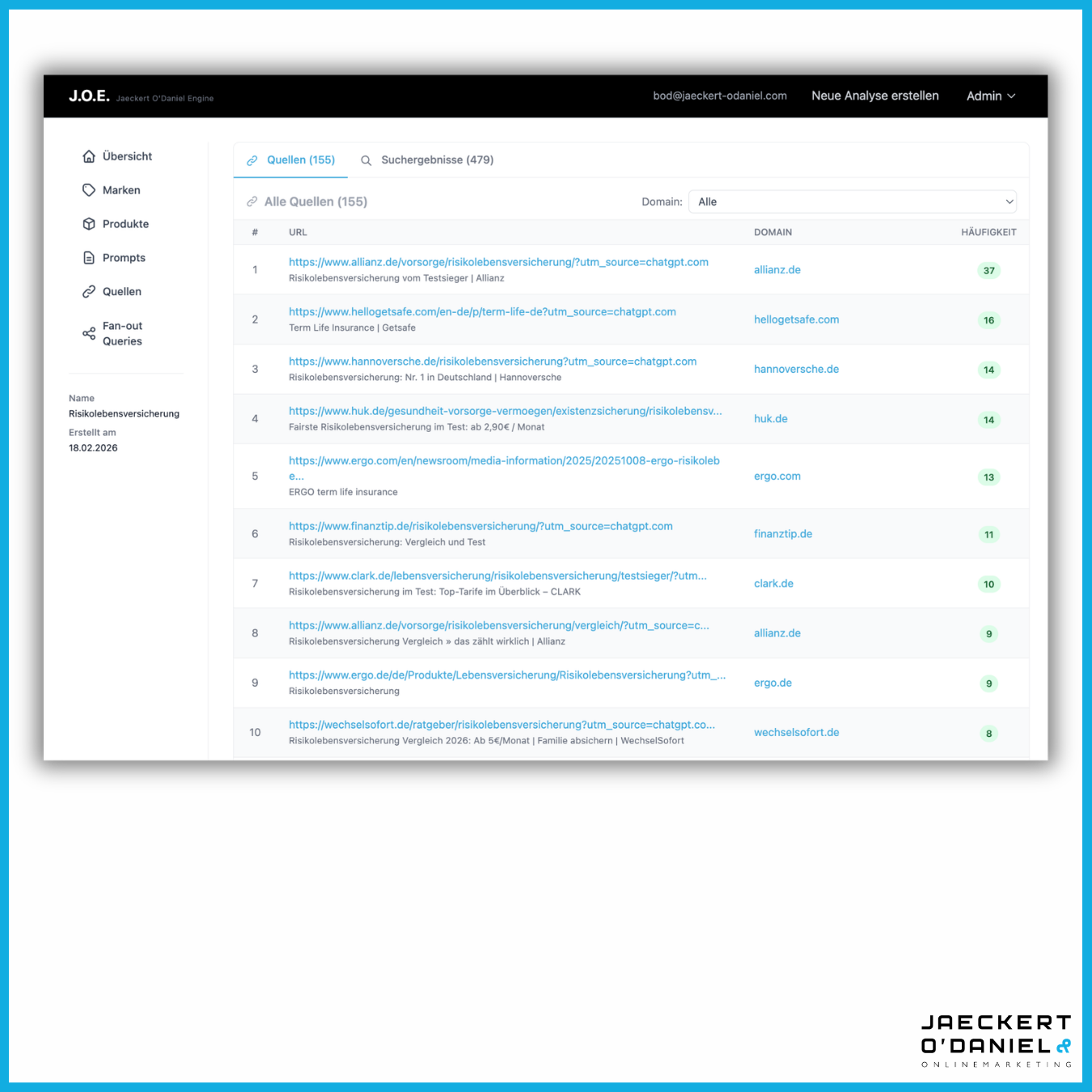
Another important report is the sources. Frequently mentioned domains such as manufacturer websites, comparison portals, or editorial contributions show which content is currently considered trustworthy. Companies can use this to specifically deduce where they need to be present with their content to be considered by AI. A tool thus provides not only visibility data but also concrete approaches for content strategy and GEO optimization – for example, by targeted building of mentions on domains that serve as sources for generative responses.
Marketing teams face the major challenge of fundamentally reviewing their content strategies. In the new AI-driven search world, generic SEO content is no longer sufficient to remain visible. Much content is interchangeable because it offers no real substance or genuine perspective. AI systems are themselves capable of reproducing general information. They only rely on trustworthy, well-founded sources that provide genuine relevance. Companies that continue to work with standardized content risk simply no longer appearing in AI responses.
For companies, this means: At the product level, they generally need to explain in much greater detail what their products and offerings can do. For content “around the product,” the goal is to differentiate oneself from generic AI content – with first-hand experience content based on one’s own experiences, real processes, or direct customer contact. This can include practical checklists, project reports, or expert assessments. Such content builds trust, clearly stands out from the uniform content, and is rated as more useful by AI systems. It is thus not only more resistant to interchangeability but also specifically increases the chance of appearing as a relevant source in generative AI responses.

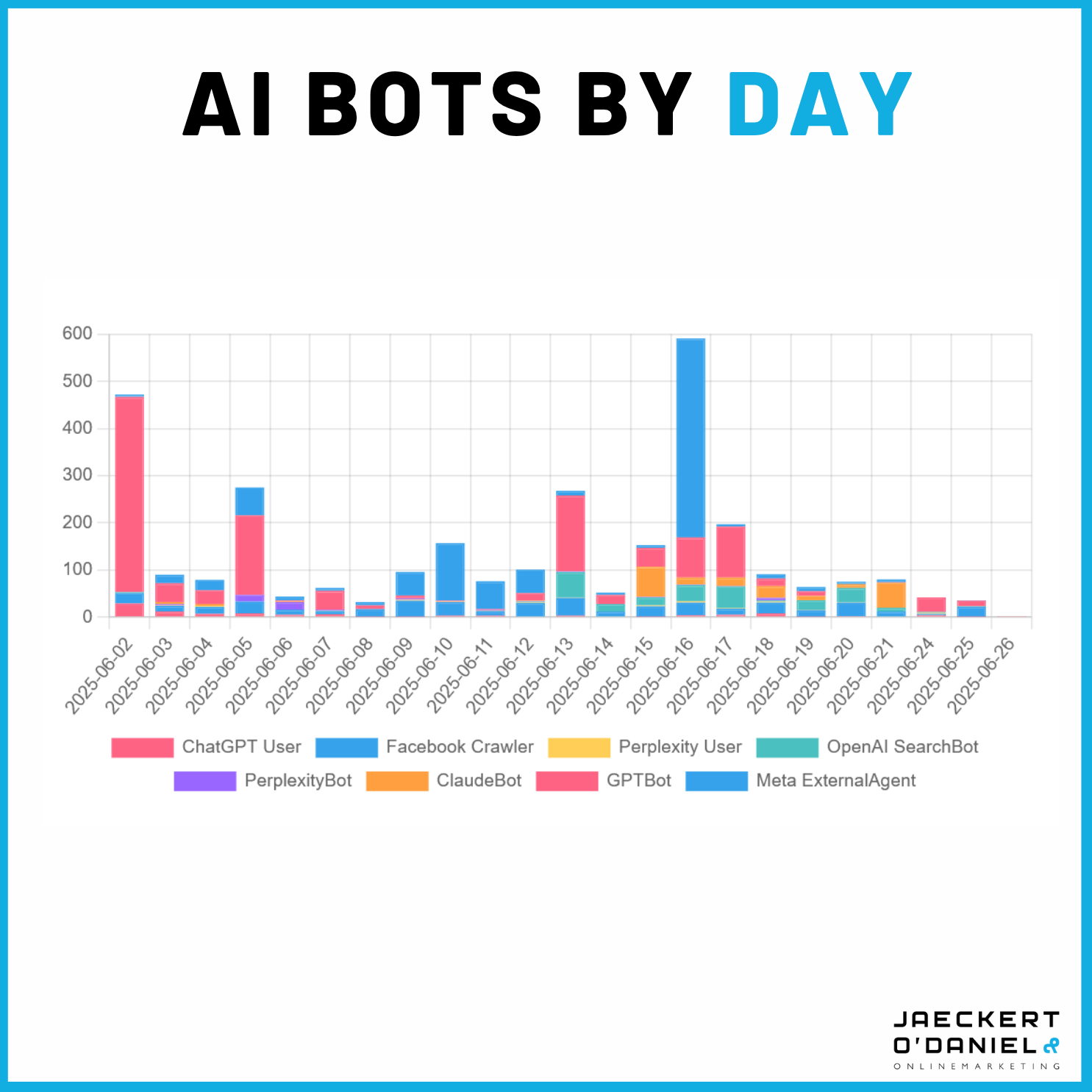
To understand the AI visibility of websites, it is no longer sufficient to use classic metrics like organic traffic or rankings. Logfile analyses are gaining importance instead: they show which AI bots (e.g., ChatGPT crawlers) access which pages how often and which content is actually processed in the AI. Only with this direct access to bot interactions can conclusions be drawn about which content is perceived and prioritized by AIs – an indispensable lever for effective GEO/LLMO.
Based on this, the KPI framework must be expanded. In addition to traditional traffic figures, specific AI metrics are needed: for example, an AI Citation Score, which measures how often one’s content appears in AI responses. Together with logfile insights (bot hits, crawl patterns), this creates comprehensive monitoring that directly shows if and how one is present in generative AI systems – and where technical or content-related adjustments for GEO optimization need to be made.
Many companies are currently relying on a well-known method: they are expanding or updating their schema markups – such as FAQ, organization, or article markup. The hope behind this: AI systems should be able to understand and pick up the content more easily. The motto being: “It can’t hurt.”
However, the legitimate counter-question is: If it has no measurable effect – why should we do it? After all, every SEO measure incurs effort and costs. Studies and tests show that structured data alone does not lead to more mentions in AI systems. This is because language models function differently from classic search engines: they analyze texts purely linguistically and break down information into the smallest building blocks – without relying on schema markup.
You are currently viewing a placeholder content from Default. To access the actual content, click the button below. Please note that doing so will share data with third-party providers.
More InformationOur analyses show that AI systems often access websites to obtain current information. Specialist websites (portals, blogs, affiliates) play a central role here. They discuss brands and products. AI systems, in turn, process this content for their AI responses. In addition to classic websites, user-generated platforms like Wikipedia and Reddit also play a role.
For marketing teams, it is therefore an essential task to identify these external sources with the help of tools and analyses and to initiate appropriate measures. This ranges from classic PR to affiliate collaborations to social media marketing. In our consulting, we often see that interdisciplinary teams are formed for this purpose.
In our Academy, you receive:
Are you looking for new tools? And for suitable further training? With us, you get both. With access to our Academy, you can start immediately.
You research suitable prompts for a business area and create an initial GEO analysis. In our workshops, we show you how to do this – and what measures you can derive from an analysis. Structured, understandable, honest.