

What sources do AI systems draw on when generating their answers? At the forefront: Wikipedia. We see this time and again in consulting projects. This can turn out well – or go completely wrong. For example, when the AI makes a negative judgment based on the Wikipedia article.
Who in companies actually takes care of Wikipedia? What can and may one change – and where does one immediately encounter resistance from the community?
We are talking about this with Jörg Niethammer. The well-known SEO expert has been a volunteer Wikipedian for over 15 years. That means: He writes, checks, and controls Wikipedia articles – as one of thousands of other helpers. In the interview, he tells us how companies, but also experts or parties, fail at Wikipedia. Why you don’t get anywhere with advertising messages.
Topics on this Page


About our Guest Jörg Niethamer
Jörg Niethammer is Strategic Search Manager at the Hansgrohe Group. He has been a well-known SEO speaker at conferences for many years. We have already spoken with him here in our podcast about international SEO.
He has been working for Wikipedia for almost 20 years as one of numerous volunteer editors. In March 2006, as a student, he edited his first article. Since then, around another 1,700 articles have been added. Sometimes it was a few paragraphs – other edits were at the level of a bachelor’s thesis. He has also completely rewritten around 30 articles. He continuously monitors around 300 articles on his Watch List, especially articles from his region and areas of interest. “Everyone can participate in Wikipedia,” emphasizes Jörg, who is also not integrated into official Wikipedia structures, but participates purely voluntarily as a private individual.
Due to his many years of experience, Jörg offers freelance services to create and optimize Wikipedia articles – in accordance with Wikipedia guidelines. The guidelines are a central point that many companies and public figures do not understand. This is where we start in the conversation.

When is Wikipedia Used by AI?
Through our GEO Consulting and our GEO Academy, we have already analyzed numerous different projects and topics. Across the board, we notice that Wikipedia is also repeatedly used as a current source. Sometimes even instead of the official website.
In addition, the basic models of the AI systems are also based on Wikipedia content. This is because, as a rule, the entire Internet was evaluated for the basic models.
Why this is the case – one can only speculate about that. There is no publicly documented AI algorithm. However, our impression is that companies often do not provide enough relevant content on their own website. The AI then decides at this moment that the Wikipedia article has the most substance.
Wikipedia articles are always written in a uniform, understandable language. The articles are factual. They provide very structured information about the company and its offerings. “There is no complex marketing language like on many corporate websites,” says Jörg. In addition, Wikipedia can be crawled very easily. “There is no Javascript or other Blink Blink. The internal linking is extremely good.”
And ultimately, there is a quality assurance that is based on relevance criteria – and not on advertising messages. “It is a reliable source, even if there is more and more vandalism,” says Jörg in the interview.

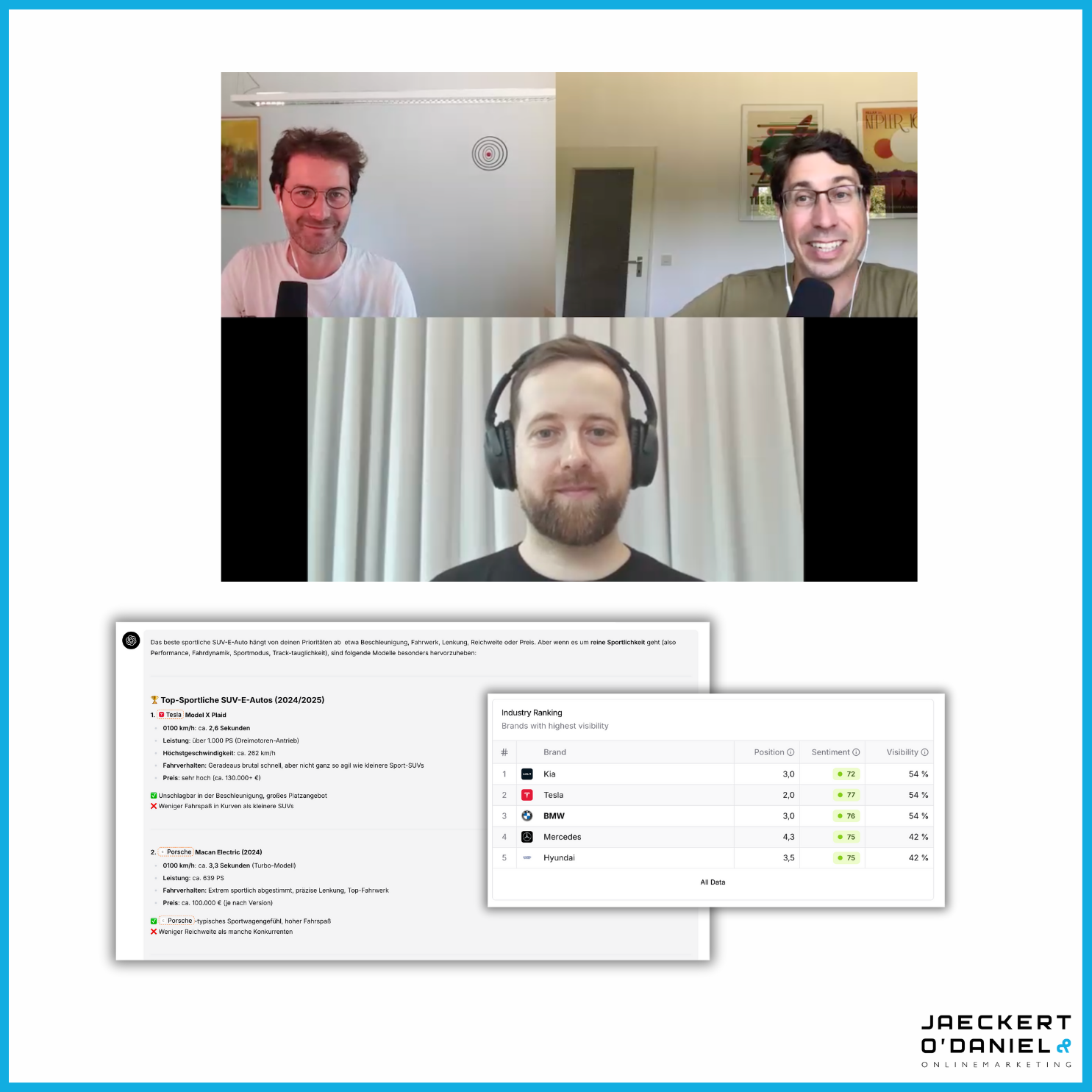
We discovered the example here in preparation for an Academy Workshop. It is not uncommon for Wikipedia to be used for product-related AI answers.
Free GEO Online Training
- Current Developments in AI Visibility
- From SEO to GEO
- How to Optimize for AI Systems

What Can Companies Do for Their Wikipedia Article?
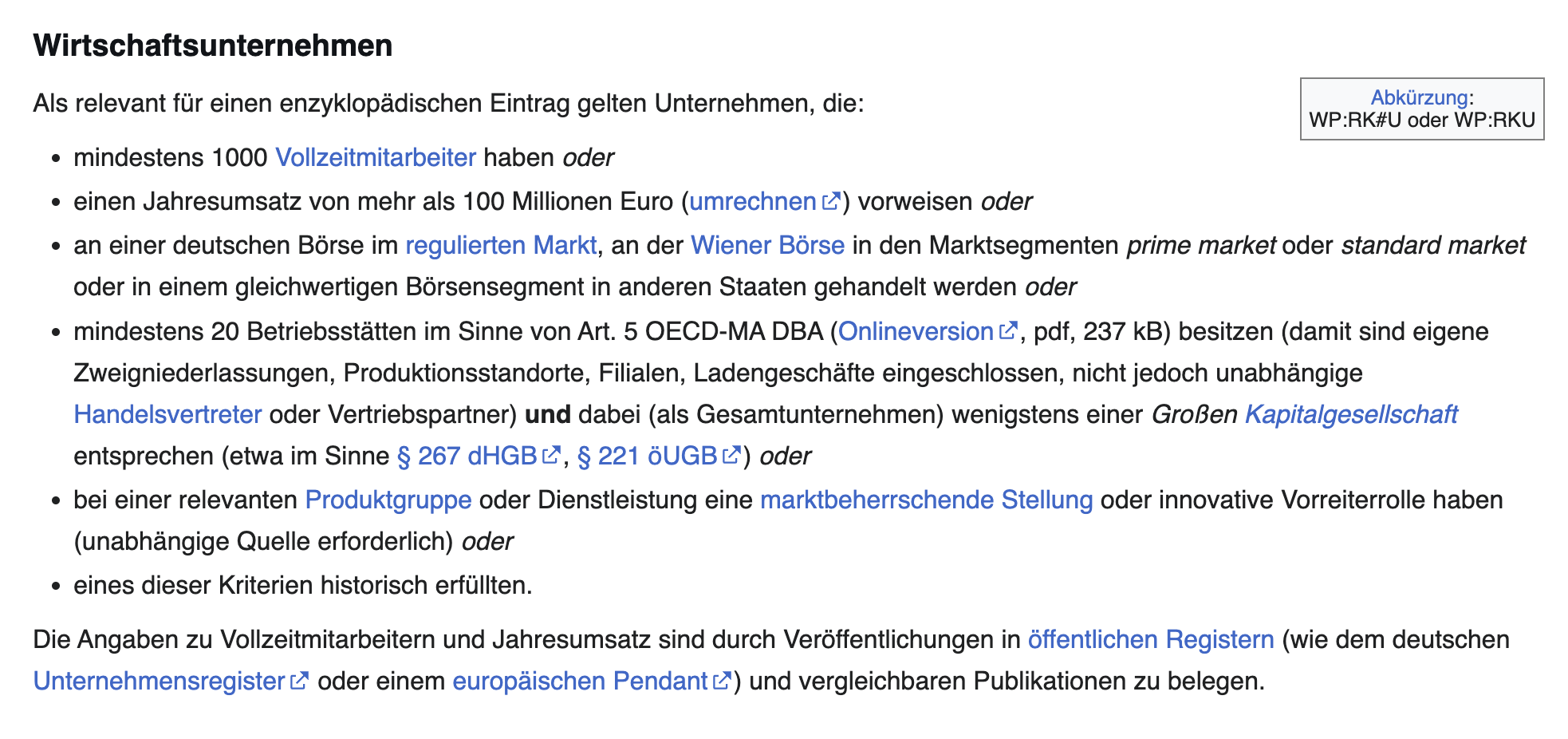
Most companies are not allowed to have a Wikipedia article. The basis for this decision is the relevance criteria of Wikipedia (see screenshot). For example, companies must have at least 1,000 full-time employees or generate over 100 million euros in revenue. In the further course of the relevance criteria, various industries are discussed in more detail. Clear rules also apply to foundations, associations, or individuals.
All companies that fall under these rules often already have a Wikipedia article. This article can accordingly be edited by anyone. “However, many companies do not look at the rules. They hire SEO copywriters or PR agencies who formulate polished articles. As soon as the articles are online, Wikipedians see it on their watchlist and the articles are often undone or reformulated within seconds.”
Wikipedia has a guide to the formulations. In summary, it is a clean, clear, neutral language. Companies must therefore above all hold back with their messages. Keyword stuffing or advertising links are also of no use.
Our Conversations with SEO and GEO Professionals


Deepen your GEO Knowledge: Every Monday via Email
We Advise Marketing Managers on SEO & GEO
For anyone seeking an SEO sparring partner or comprehensive SEO consulting, Fabian and Benjamin are the perfect choice. As an in-house SEO expert, I sought competent SEO support and found it with them. During a very pleasant introductory meeting, we jointly developed an approach to establish SEO among the individual stakeholders and thereby gain more internal visibility for the subject. Based on this initial discussion and a joint kick-off with the stakeholders, they developed a sound SEO and content strategy for a product area. Since then, they have both supported me as sparring partners during implementation.
The collaboration with Fabian and Benjamin is a great pleasure for me and all project participants, as they are masters of their craft and bring immense passion for SEO. This combination is infectious and motivates everyone to achieve peak performance.

I look back with great satisfaction on the SEO project that we carried out with Benjamin and Fabian. Firstly, the collaboration was on a very pleasant, goal-oriented level. Secondly, the consultation was structured in such a way that we could immediately start with the implementation. We received very concrete optimization suggestions that were tailored to our internal capacities and therefore realistically implementable. Even though only a few months have passed, we can already see the first results of our work in the Google rankings. Traffic for our relevant keywords is steadily increasing, and we still have enough concrete work packages from Benjamin in the pipeline to boost our site. Furthermore, through the consultation, we have acquired so much internal SEO know-how that we can now optimize our site independently. And most importantly: Visitor numbers have doubled – with correspondingly positive effects on sales.