October 18, 2021Fabian Jaeckert
SEO Audit: Examples, Tools, Approach
Many websites have grown over years and have a complex structure. Technology, content, strategy: everything interlocks when it comes to SEO. A systematic review helps. A so-called SEO audit.
We have been carrying out SEO audits like these for many years. For B2B websites, publishers, portals, and online shops.
In this article we describe three concrete SEO audits. How we proceeded, and what it delivered.
Because an SEO website audit should always lead to concrete measures for optimizing the website. Those can be technical recommendations, or recommendations about the content.
In the podcast episode on this, we discuss a request for proposals for an SEO audit. In many requests for proposals, central requirements are often not named. That follows from the nature of the thing. After all, the companies and organizations are looking for an agency for an SEO audit, and are not experts themselves.
SEO audit: 3 examples and background
What is an SEO audit?
An SEO audit takes place as part of search engine optimization (SEO) and is an analysis and assessment of a website, and of how it ranks more successfully in the Google ranking.
From our point of view, an SEO audit includes, among other things:
- An audit of the indexing of the website
- An analysis of the existing rankings
- An audit of the keywords covered
- An analysis of the existing content
- An analysis of the website structure
What matters from our point of view: it is not about automatically checking every parameter. It is about analyzing the right things for a specific question, and deriving recommendations for action from that. When we create an SEO website audit, we always plan a presentation alongside it. In that workshop we explain in person, using concrete examples on the website, where we see problems and which solutions we would take.
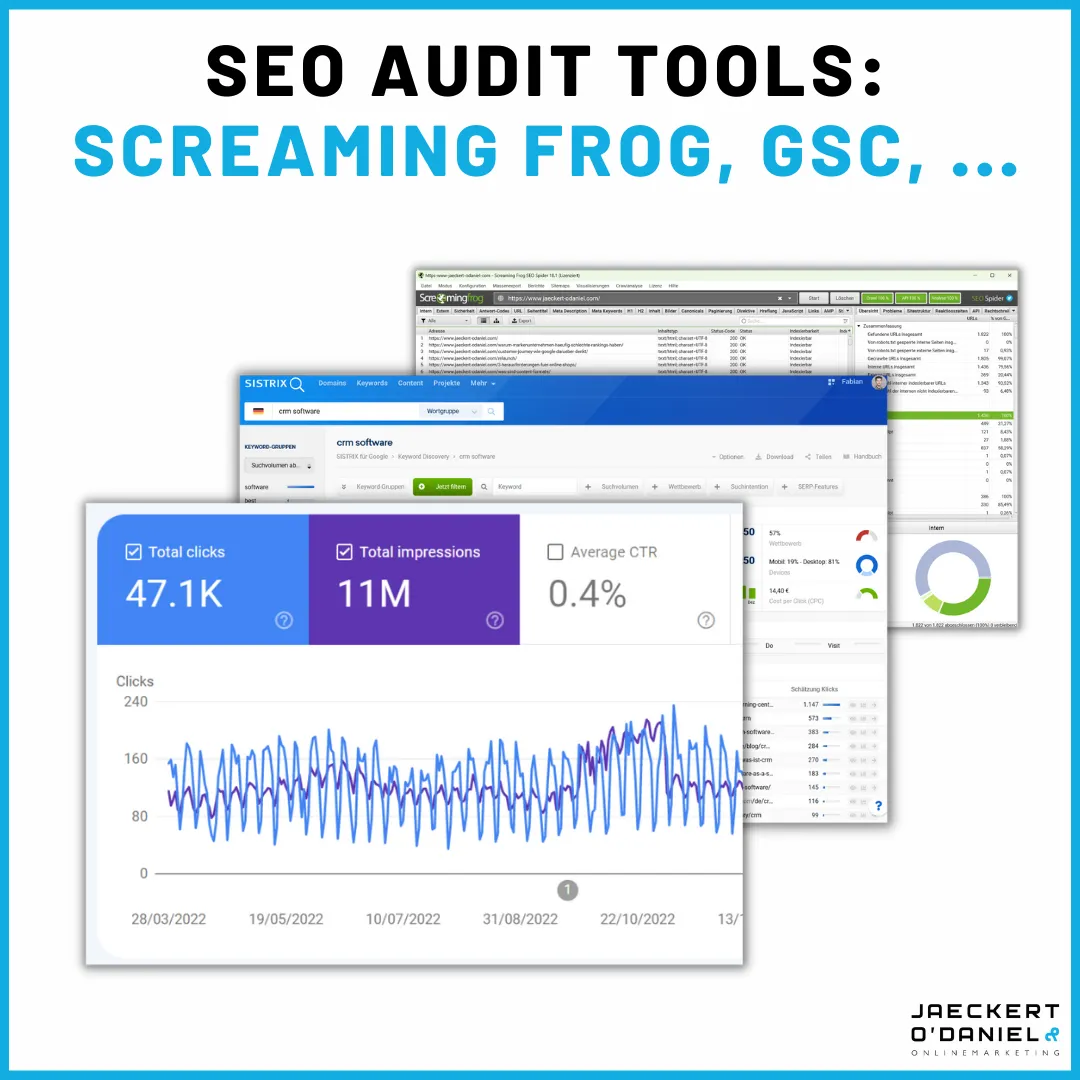
When we carry out an SEO audit, we use various SEO audit programs. These include Screaming Frog, Google Search Console, Google Analytics, and SEO suites such as Sistrix or SEMrush.
Technical SEO audit: an example
We often create a technical SEO audit when the website is very large. This is often the case with publisher portals or online shops, for example.
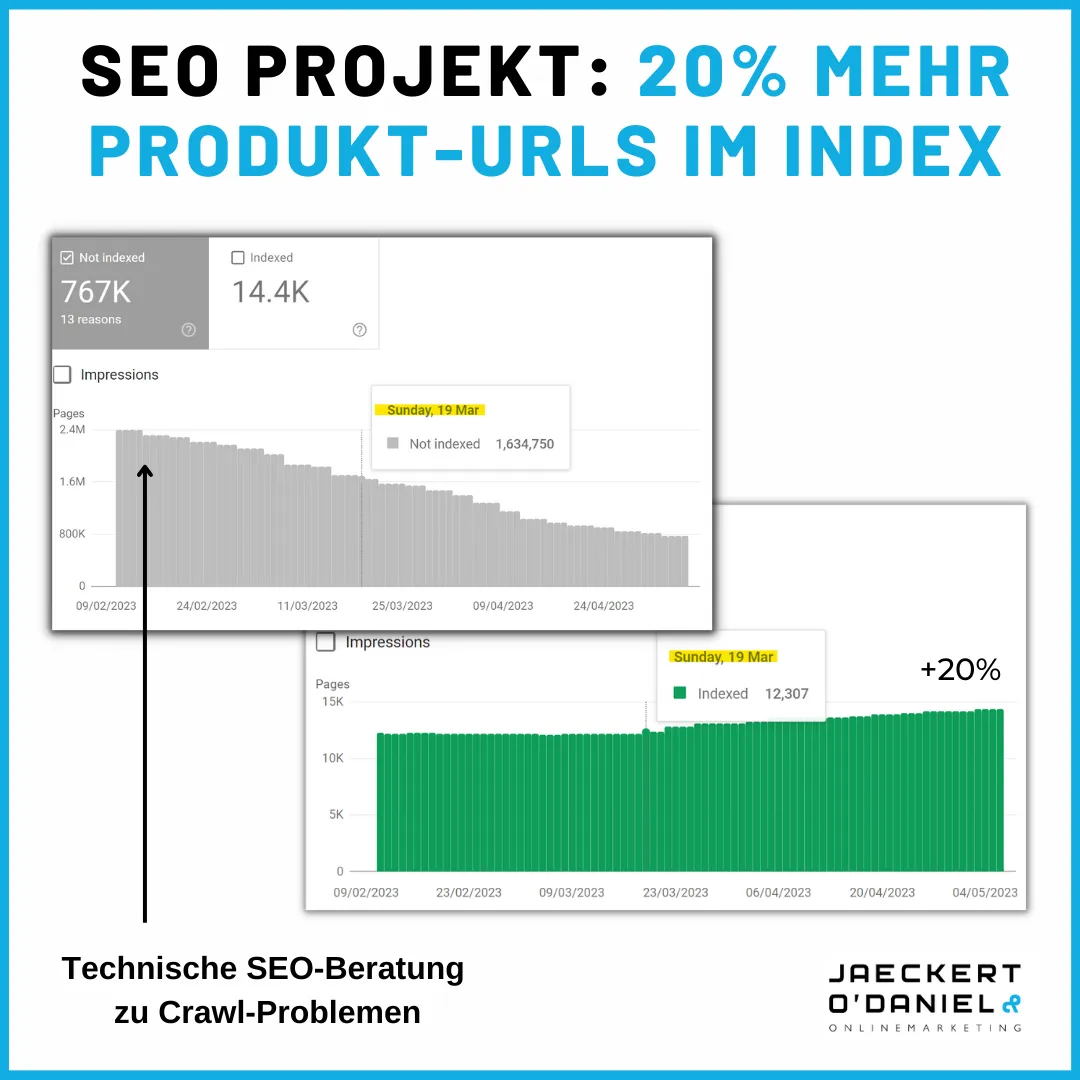
In this example, an online shop had several million faulty pages in the Google index. As a result, thousands of important shop pages were not indexed by Google.
In a technical SEO audit we identified the causes of this and gave recommendations on how the indexing problem can be solved.
The cause was a combination of several technical errors. To carry out the technical SEO audit we were given access to Google Search Console and also worked with our own SEO audit tools, including Screaming Frog.
The result of the technical SEO audit: the indexing of pages without added value fell significantly over a period of months. At the same time, thousands of important pages were now indexed. Traffic rose significantly.
Why SEO audits are so demanding
Relevance
You can find technical errors or content shortcomings on every website in an SEO audit. But is the particular error or shortcoming really important? Is it a central lever that actually improves the Google rankings? From our point of view, that is a decisive question. It is not enough to identify weaknesses. You also have to prioritize them. We always care about a sensible and efficient use of resources, whether in-house or with the IT service provider, who, by the way, should always be in the workshops as well.
Clarity
Many of our clients complain that they have already had SEO website audits carried out, and received an endlessly long report as the result. In automated reporting or reports like that, nothing is prioritized. And certainly nothing is explained. We take a completely different approach: in a workshop we explain our approach, our findings, and the measures that are coming up. For that we share our screen and go through the website and the tools together. Afterwards we answer questions.
Impact
In SEO it is rare that a single small optimization produces the big traffic miracle. There are around 200 ranking factors that contribute to whether a website ranks successfully at the top of Google. That is why it is important, in an SEO audit, to analyze the weaknesses and then optimize them step by step. We usually see the first effects within three to six months after our recommendations are implemented. Here too we stay alongside you as advisors, to analyze the effects and give further recommendations for action.
SEO content audit: an example
An SEO content audit often comes up when a website has created a lot of content, and the question now is how to achieve better rankings and more traffic with that content.
That is the case with publishers, for example, but also with corporate websites that rely on glossaries or extensive magazine strategies, for example.
There are various ways to carry out an SEO content audit. In this example, a publisher had created hundreds of articles in one specialist area. We analyzed the keyword set with a view to a recurring keyword taxonomy and derived recommendations from that on the scope and the kind in which individual topics should be worked on.
We also analyzed existing articles in terms of content and created a content template and a checklist with which the existing content could be revised. After the SEO audit we met the content owners at regular intervals (once per quarter) to discuss the optimizations and improvements and to define further measures.
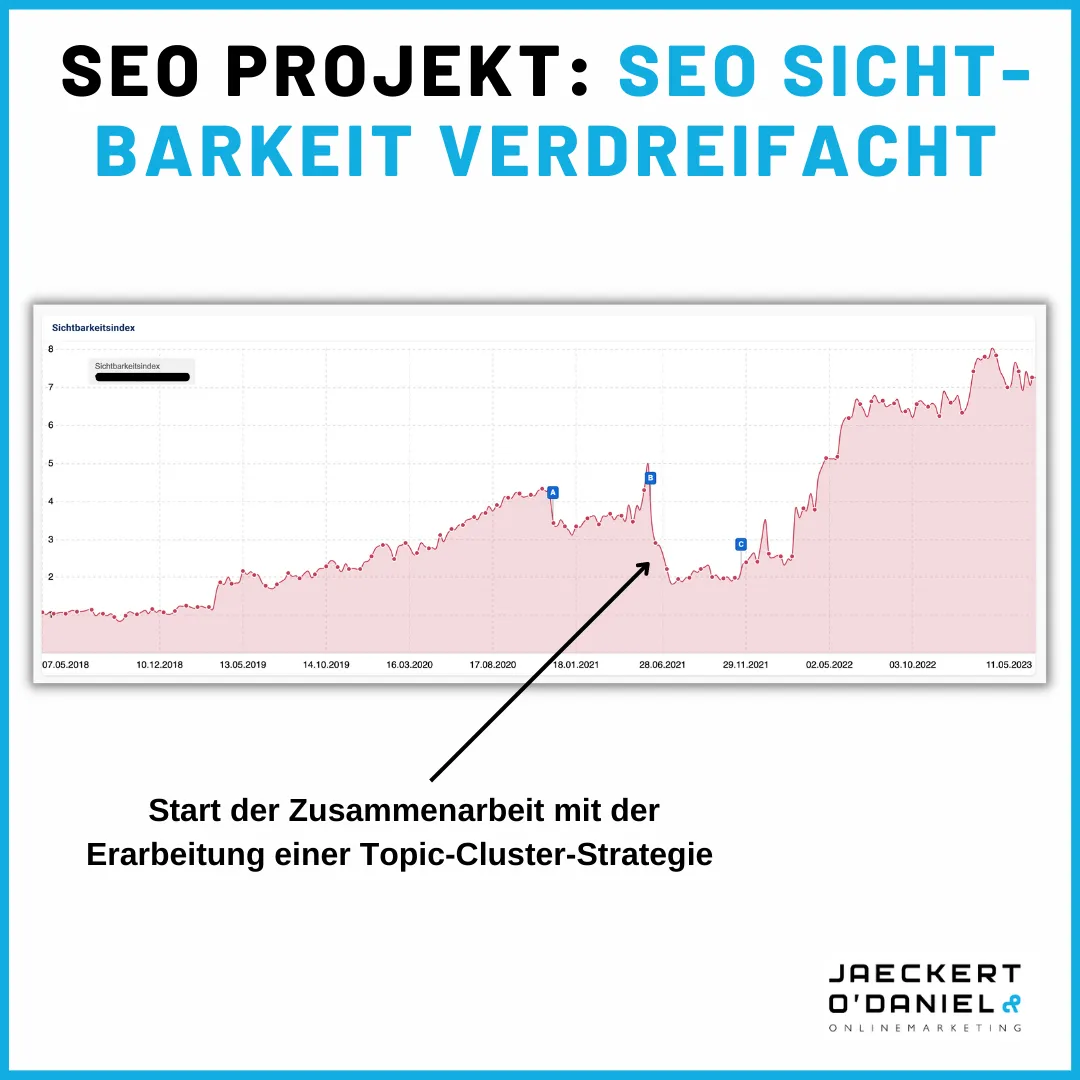
The visibility index at Sistrix quadrupled, with a comparable effect on the SEO traffic of the website.
SEO website audit: an example
In an SEO website audit, the entire website is systematically analyzed against all essential SEO requirements. As in this case of a specialist publisher.
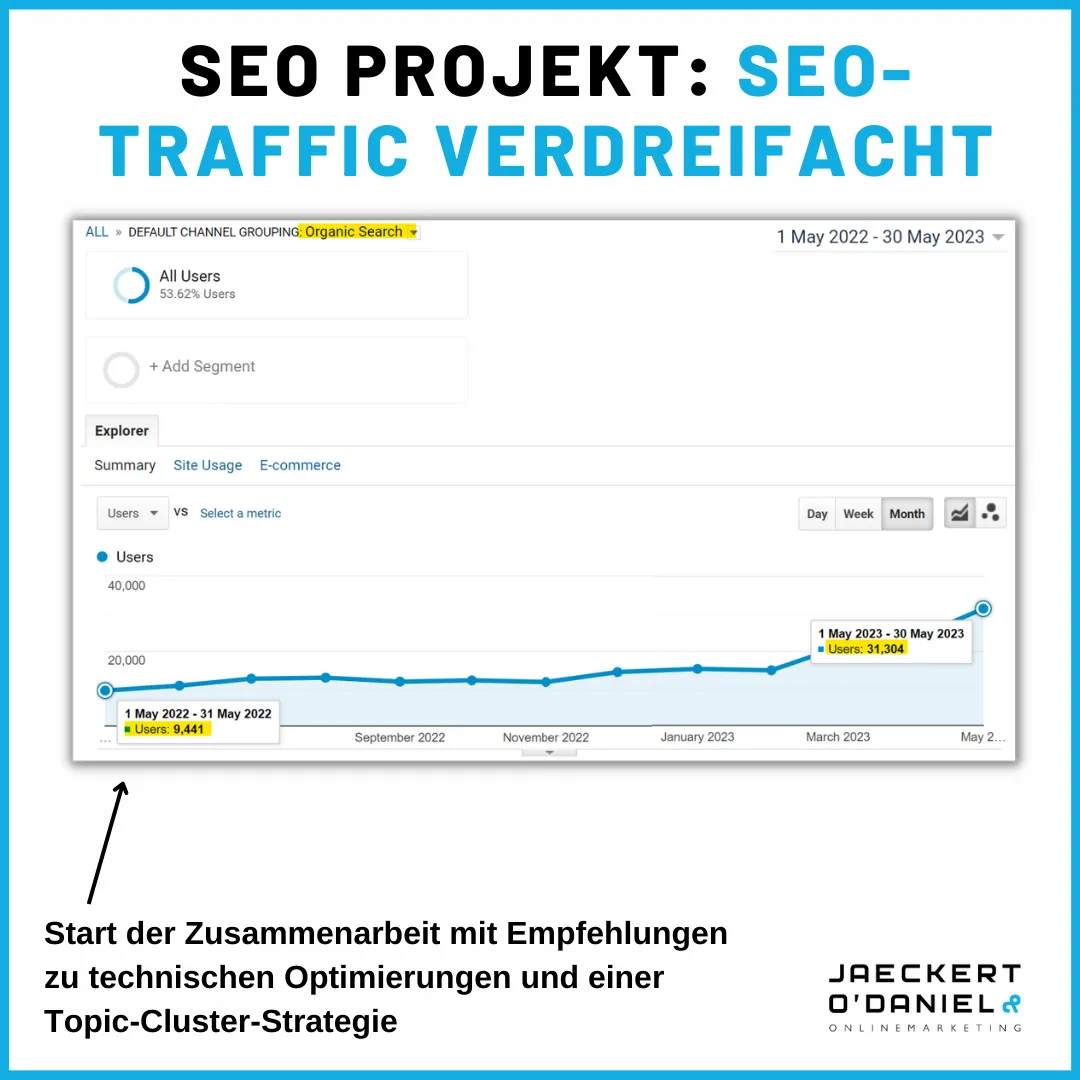
We started with a technical SEO audit. That produced a series of technical optimization opportunities that the publisher could apply on its most important website, and also on other websites in the group.
We then designed a topic cluster strategy aimed at building articles on relevant, evergreen topics. The goal behind it was to build stable SEO traffic.
After that, in several focus consultations, we tackled further topics such as Google Discover, keyword research for new articles, SEO reporting, and more.
We deliberately kept the workshops via Zoom very open. Numerous editors joined, and also other publishing staff who were interested in the topic.
Our SEO audit service
For more than ten years we have worked as SEO consultants and carried out SEO audits. Our clients include startups, brand companies, portals, and long-established mid-sized companies. Here are some references.
For successful search engine optimization we combine technical know-how with an understanding of content and marketing. Fabian Jaeckert (right) is a technical search engine optimizer. Benjamin O’Daniel is a trained editor and a content marketing professional.
After our SEO audit we usually support the in-house owners in implementing the measures.
We can meet for an SEO introduction (30 min.) by video conference. There we can also talk about the costs. We work with fixed prices.

After a website relaunch, we as a brand wanted to tackle SEO. For this, we specifically sought support. Benjamin and Fabian developed technical optimizations and an SEO strategy with a content roadmap. Many thanks for your valuable input.
 Anja HornBarilla Deutschland GmbH
SEO audit: on-page or off-page?
SEO on-page audit
On-page SEO means everything that takes place on a website itself. Accordingly, an SEO on-page audit focuses on technical analyses, content optimization, or the creation of new content with an SEO focus. The examples we describe in this article are SEO on-page audits. In nine out of ten cases we consider it sensible to start with an SEO on-page audit. Only after that should you, if needed, also tackle the off-page area.
SEO off-page audit
Off-page SEO means all topics outside the website that are relevant to the Google ranking. That is above all external linking. In an off-page SEO audit, the external link structure is analyzed. Either with a view to purchased backlinks and further measures that do not comply with the Google guidelines. Or with a view to building new, guideline-compliant links. For information: we take the approach of White Hat SEO.
Example of a request for proposals for an SEO audit
In the example we discuss in the podcast, a tourism marketing organization puts an SEO audit out to tender. The occasion is an extensive relaunch that was carried out. Now the company wants to achieve more visibility for its region. For this, an SEO audit is to be carried out as a “baseline measurement”, in order to derive SEO measures from it.
The proposed parameters are sensible in principle. But this is exactly the problem we mentioned above: the greatest potential lies in keywords for which the website does not yet rank. For that, in-depth keyword research has to be carried out, also with a view to the competition and the chances of good rankings and traffic. But that is exactly what is missing.
“Content optimization” implies that content already exists for all relevant keywords. From our experience, that is almost never the case. New content has to be created. That needs concrete instructions.
At the same time, the request for proposals for the SEO audit also contains very unspecific terms such as “user-friendliness”, where it is not clear what exactly is meant. There is a risk of talking past each other.
9,000 euros were budgeted for the SEO audit, and it is also said that the cheapest provider wins the contract. That makes it even more likely that keyword research, which from our point of view would be a central requirement, is not carried out at all. Because with that you will certainly not be the cheapest provider.
Another sticking point: the SEO audit is supposed to serve as a model for a series of further websites. But how large these websites are, who is responsible for them, and how they are set up in ranking and content is unclear.
From our point of view, an SEO audit put out to tender like this will probably produce a general list of optimization suggestions. From our point of view, far too little for a field as contested as travel, in which large travel portals and travel companies are active.
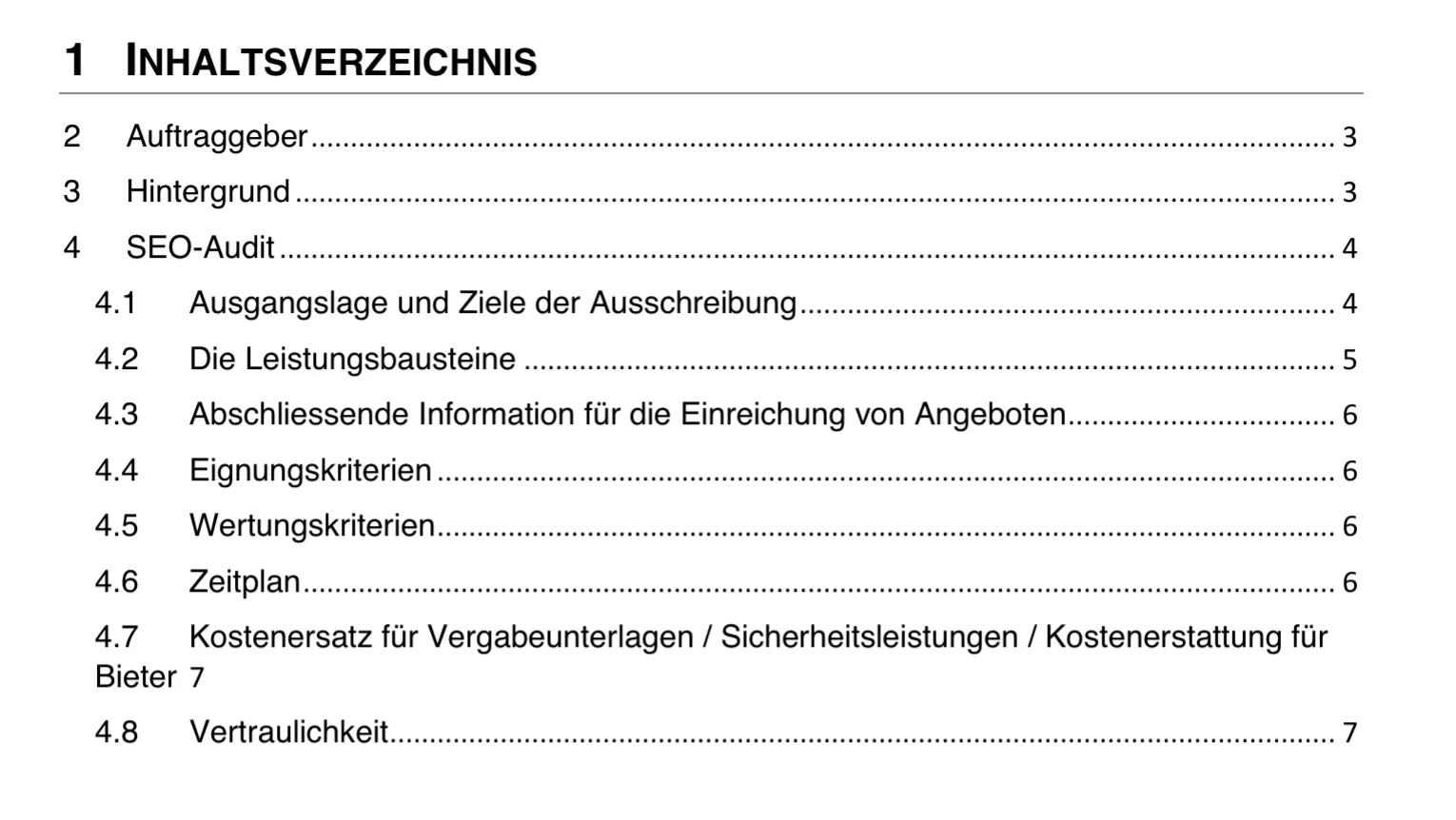
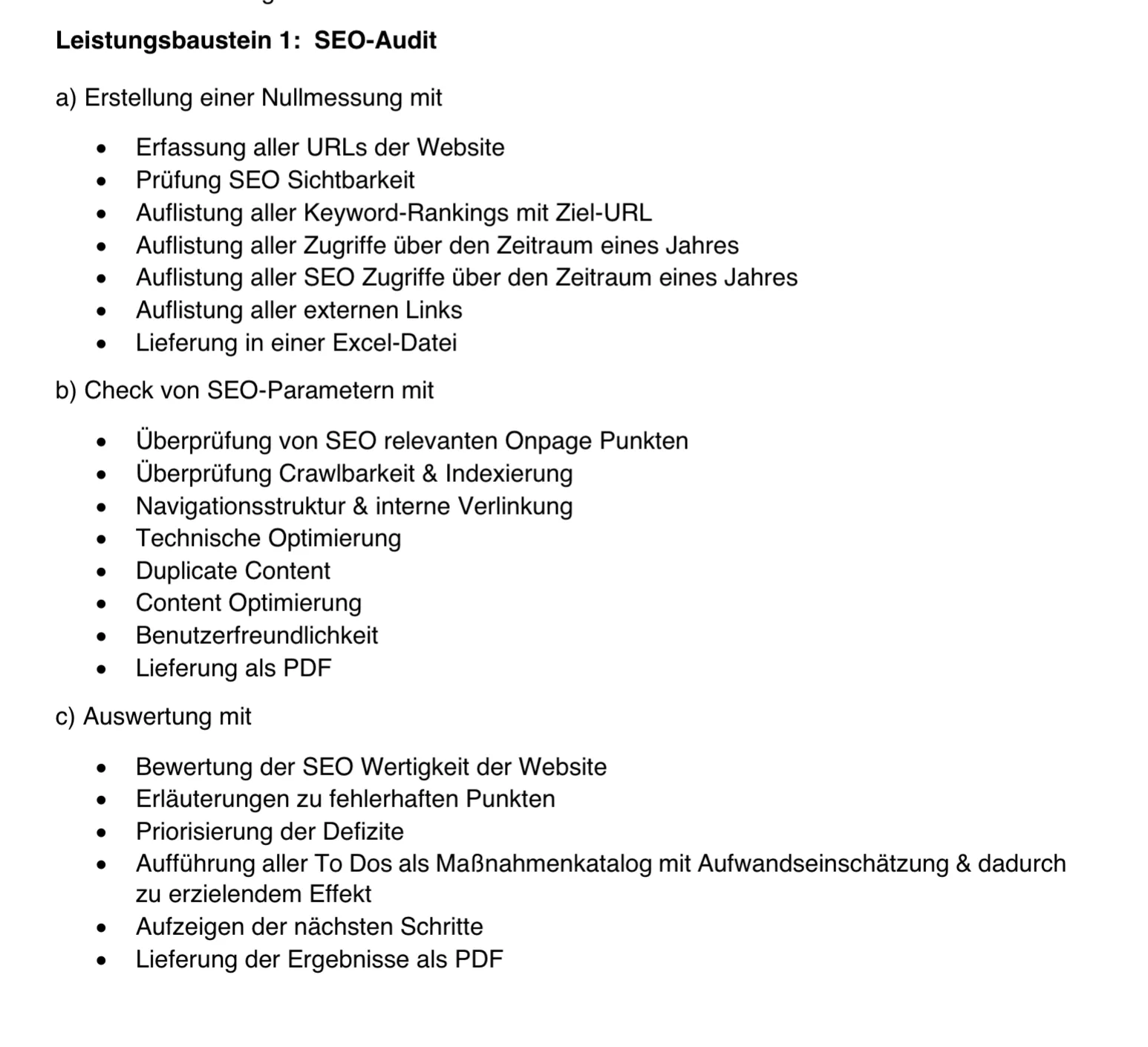
Here is an excerpt from the 7-page request for proposals. The request for proposals was passed to us by one of our podcast listeners. We ourselves do not take part in tenders like this. We also do not name the organization here, because we are concerned with the fundamental problem and not with criticizing individual companies or organizations.
SEO audit: tips and strategies around SEO, via our mailing list

Frequent questions about SEO audits
When is an SEO audit necessary?
Many companies have a website that has grown over years. Often the responsibilities have also changed again and again. Frequent occasions for an SEO audit are losses of traffic, stagnation of traffic, or a relaunch. SEO audits in advance are especially sensible when rankings have already been built successfully and larger changes are planned.
SEO audit for one website or several?
Many mid-sized companies have not just one website, but several websites in parallel. Either microsites for campaigns, subdomains for individual business areas, or completely independent domains, for example when the business areas are very far apart or even cannibalize each other. An individual look at whether and how websites should be merged makes a great deal of sense here.
How should we explain the SEO audit to IT?
By bringing IT on board. We ourselves bring technical understanding, and we do without a “blame game”. It is about which requirements Google places on website operators and how you implement them efficiently. We recommend that IT, whether in-house or an external service provider, should always be involved.
Our interviews with SEO professionals from the industry

SEO as a Growth Strategy: Interview with Kevin Indig

SEO for a Software Company: Interview with Beat Köck

Twice as Visible as Airbnb: Interview with Dominik Schwarz

1 Million Users a Month with the Right Content Strategy: Interview with Jan Brakebusch

How to Build a Successful Startup: Interview with Johannes Kliesch

The Art of Crawling: Interview with SEO Markus Hövener

The SEO Strategy of Reishunger.de: Interview with Benni Uhlmann

How to Anchor SEO in a Corporation: Interview with Frederic Cremer of innogy C3