
In the SEO world, we observe an interesting pattern: optimization for AI systems is considered a sub-discipline of SEO.
According to the motto: Let’s keep doing this for a bit.
This view is based on three central arguments – which we criticize in this article. From our point of view, the extent of the change is greatly underestimated here. A little adjustment is not enough.
In the future, everything will revolve around visibility and relevance in AI systems. The “old Google” plays an important, but subordinate role.


1. Argument: “AI systems play only a subordinate role”
Recently, a number of studies have been published emphasizing that AI systems play only a subordinate role compared to Google. For example, the Cloudflare study (discussed here by colleague Christian Kunz from SEO Südwest). However, the crucial factor is the comparison metric: traffic share is used every time. That is, from which sources clicks on websites originate.
However, this perspective has several drawbacks:
- Incorrect Metric: In AI systems, users generally no longer need to click. They receive their answers directly in the AI chat. Therefore, AI systems will consistently generate less traffic.
- Unknown usage: ChatGPT (and other AI systems) has been in the top spot in the download charts of the app stores for months. What takes place in this app is not measured.
- Google is also changing: Google is also transforming into an AI system. Be it via the AI Mode, which has already been rolled out worldwide. Or via its own AI app, Gemini.
It is completely clear that the use of AI systems is still comparatively in its early stages. But it is a completely distorted view if you look at the pure traffic figures of today – and base your future strategy on them.

2. Argument: “Those who do SEO automatically do GEO as well”
How to optimize for visibility and relevance in AI systems – the industry is still in its infancy here. Recommended measures include, for example, the “GEO optimization” of content. This involves focusing on understandable language, short paragraphs, and keywords – precisely the same measures as in SEO. One argument for this is: those who rank high in Google are more frequently cited as a source.
This argumentation also has several weaknesses:
- AI Functionality: AI systems can inherently “understand” and structure complex texts. They do not require “bite-sized” texts for this.
- Search as a Sub-Function: The search function in AI systems is a subordinate function. Therefore, SEO is a part of GEO.
- Grounding Process: Sometimes the AI activates grounding, i.e., searching within the framework of AI answer generation. However, a series of search queries are then made, evaluated, and further processed. The process is significantly more complex. The old formula “Top Ranking = Traffic” is only partially applicable.
More on this in our article: GEO Texts are Not SEO Texts.

Free GEO Online Training
- From SEO to GEO
- How to Optimize for AI Systems
- Open question round

3. Argument: “SEO is measurable. AI optimization is not”
It is emphasized that in SEO, rankings and traffic are measurable. In contrast, in AI systems, the answers are different each time. There is nothing to adhere to in an analysis. Here, too, several counterarguments can be found:
- Rankings become worthless: Since the introduction of AI Overviews, it is clear: even those ranking first suffer significant traffic losses. Many users are satisfied with AI summaries and click significantly less often. Rankings already convey little meaning.
- Empty Keywords, Dark Keywords: In practice, it is repeatedly observed: some keywords supposedly have very high search volume – but deliver hardly any traffic. The reasons for this are manifold: Google Ads, Google integrations, bot traffic. Conversely, in the long-tail sector, 75% of keywords are not visible (
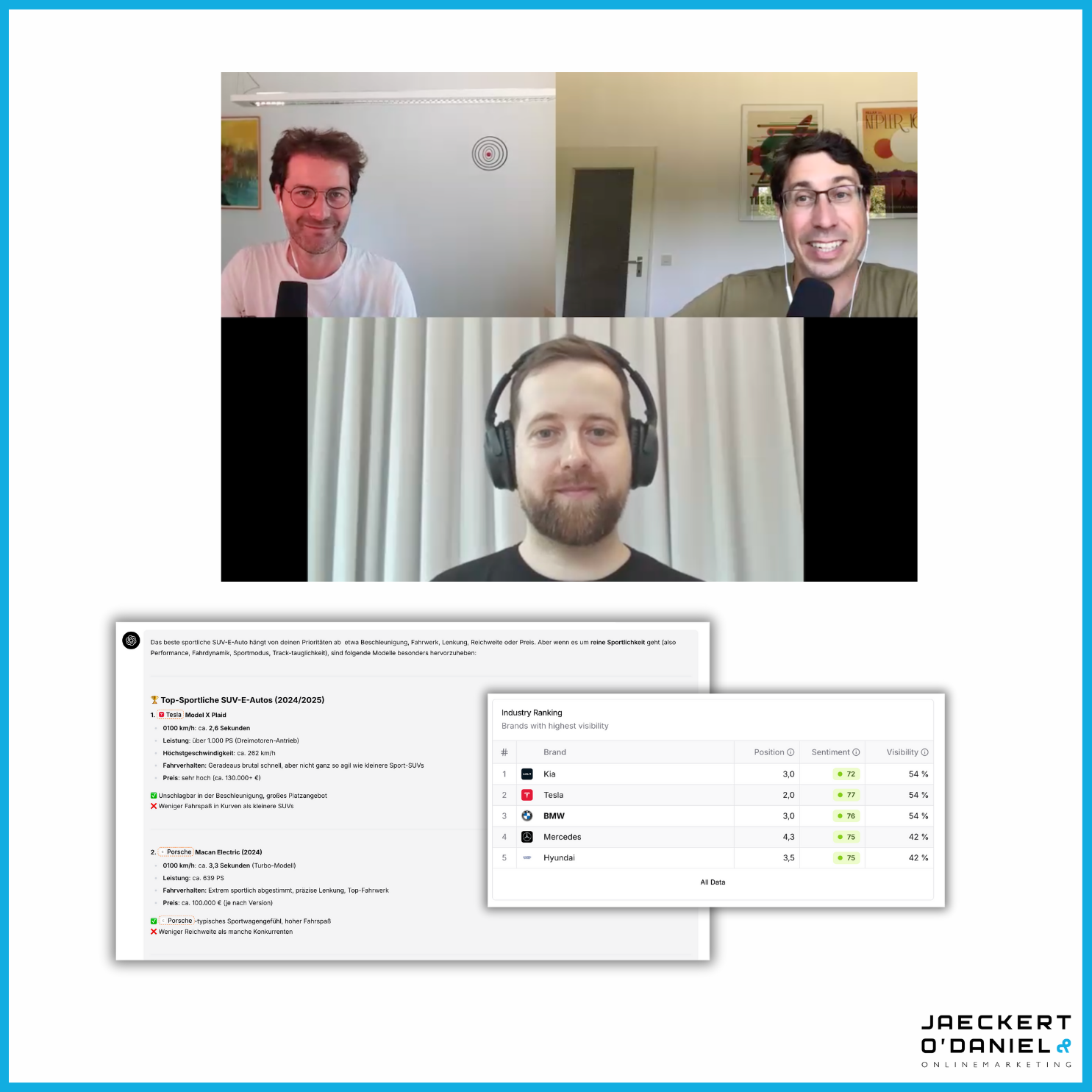
Dark Keywords ). Many aspects in SEO have long ceased to be so clear. - AI Visibility Analytics: Even if AI systems do not always provide the exact same answer: those who measure their prompts over a longer period receive comparable answers and stable industry rankings. Learn more about KPIs in GEO & LLMO here.

Current Study: ChatGPT is Increasingly Used for Search
OpenAI’s Research Team, in collaboration with a Harvard economist and the National Bureau of Economic Research (NBER), has produced a study. For this purpose, 1.5 million prompts were anonymously evaluated. It is the first study to deeply demonstrate how ChatGPT is being used.
Three Key Findings:
- Private Use: Private use is steadily increasing. The share of non-work-related messages has risen from 53% (June 2024) to 73% (June 2025).
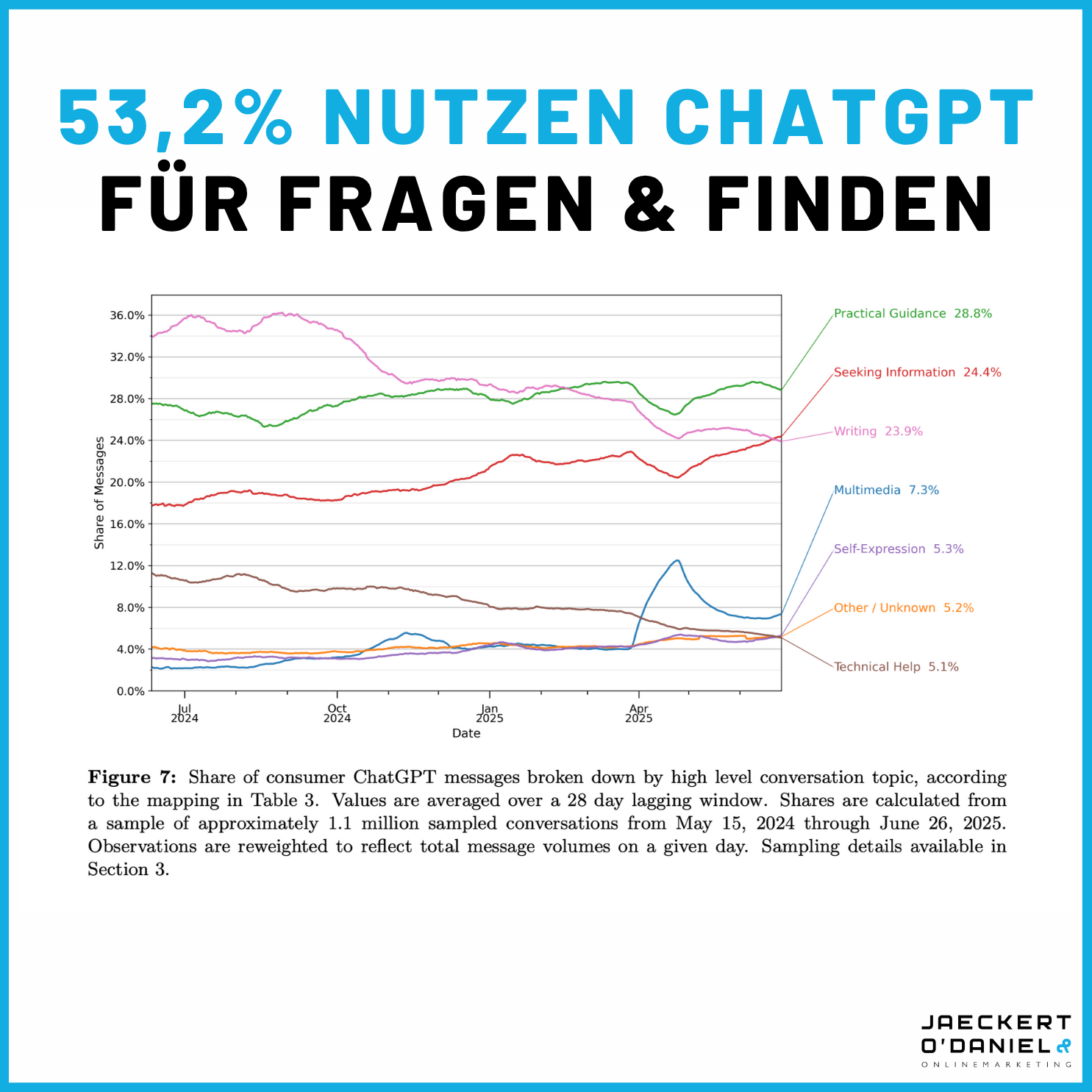
- Usage like a search engine: In private use, “Practical Guidance” and “Information Seeking” account for 53 percent of usage (page 15). Both are typical activities that one would otherwise have carried out via Google.
- Search is increasing: “Information Seeking” is growing – from 18 percent to 24.4 percent in one year. Searching for products is a part of this (“Purchasable Products”). Many integrations such as the shopping feed have only been around for a short time.
In particular, highly educated people use ChatGPT for search and decision-making. ChatGPT provides them with tailored answers and new ideas. The information for this comes from the language model and the integrated search (“Grounding”).
According to the study, around 10 percent of the world’s population already uses ChatGPT. It must be added that ChatGPT is only one AI system of many. Other AI systems are also on the rise.
Click here for the study (PDF document and press release from OpenAI.)
Your Input in GEO & LLMO: our Newsletter

We Advise Marketing Managers on SEO
For anyone seeking an SEO sparring partner or comprehensive SEO consulting, Fabian and Benjamin are the perfect choice. As an in-house SEO expert, I sought competent SEO support and found it with them. During a very pleasant introductory meeting, we jointly developed an approach to establish SEO among the individual stakeholders and thereby gain more internal visibility for the subject. Based on this initial discussion and a joint kick-off with the stakeholders, they developed a sound SEO and content strategy for a product area. Since then, they have both supported me as sparring partners during implementation.
The collaboration with Fabian and Benjamin is a great pleasure for me and all project participants, as they are masters of their craft and bring immense passion for SEO. This combination is infectious and motivates everyone to achieve peak performance.

I look back with great satisfaction on the SEO project that we carried out with Benjamin and Fabian. Firstly, the collaboration was on a very pleasant, goal-oriented level. Secondly, the consultation was structured in such a way that we could immediately start with the implementation. We received very concrete optimization suggestions that were tailored to our internal capacities and therefore realistically implementable. Even though only a few months have passed, we can already see the first results of our work in the Google rankings. Traffic for our relevant keywords is steadily increasing, and we still have enough concrete work packages from Benjamin in the pipeline to boost our site. Furthermore, through the consultation, we have acquired so much internal SEO know-how that we can now optimize our site independently. And most importantly: Visitor numbers have doubled – with correspondingly positive effects on sales.