

Whether it’s ChatGPT, Google AI Mode, or Perplexity, all AI systems access external sources. These sources significantly influence the content of AI responses. They are a crucial factor in determining whether a brand is mentioned or remains invisible.
This gives rise to a new field in AI optimization: AI Reputation Management or AI Source Optimization.
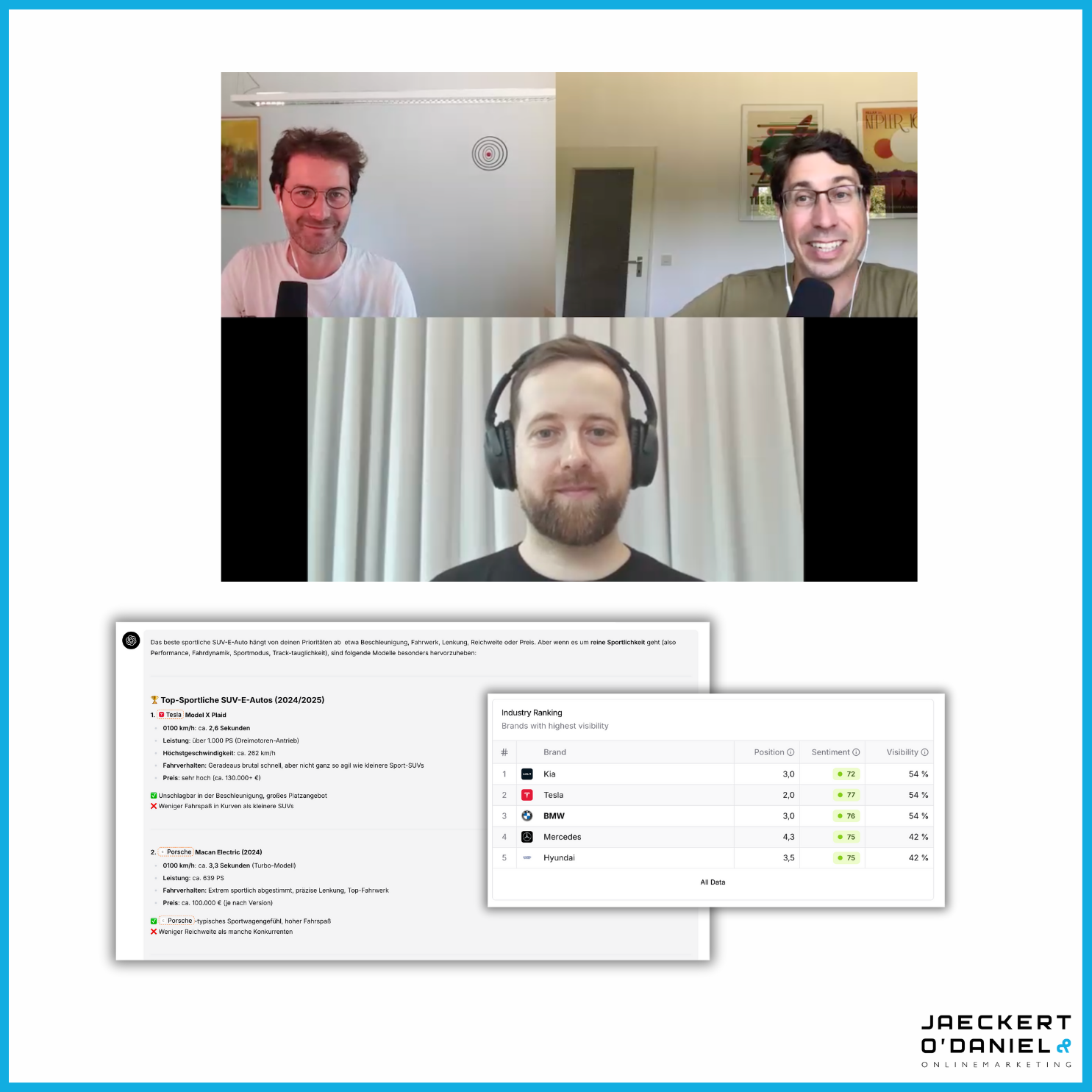
But who is responsible for this? PR, SEO, Social? We discuss this in our podcast. Each discipline possesses its own strengths and weaknesses. It is still far from clear which industry will take the lead in this area of responsibility.


What is AI Source Optimization?
When we discuss AI Source Optimization, we refer to the targeted effort applied to the sources that language models utilize for their responses. Every AI, be it ChatGPT, Google AI Mode, or Perplexity, enriches its output with external information.
These “grounding sources” co-determine which brands, products, or experts appear in responses. Therefore, the initial step in AI Source Optimization is to understand which model systematically utilizes which sources.
For this, the source landscape of prompts must be analyzed. It involves recognizing patterns and identifying which specific publishers or platforms influence relevant AI responses. Those who are present in these sources – in a structured, credible, and consistent manner – increase their chances of being cited or referenced by AI systems. The specific sources vary each time.
The term AI Reputation Management points in a similar direction. However, its focus is on the impact or objective – specifically, enhancing reputation.
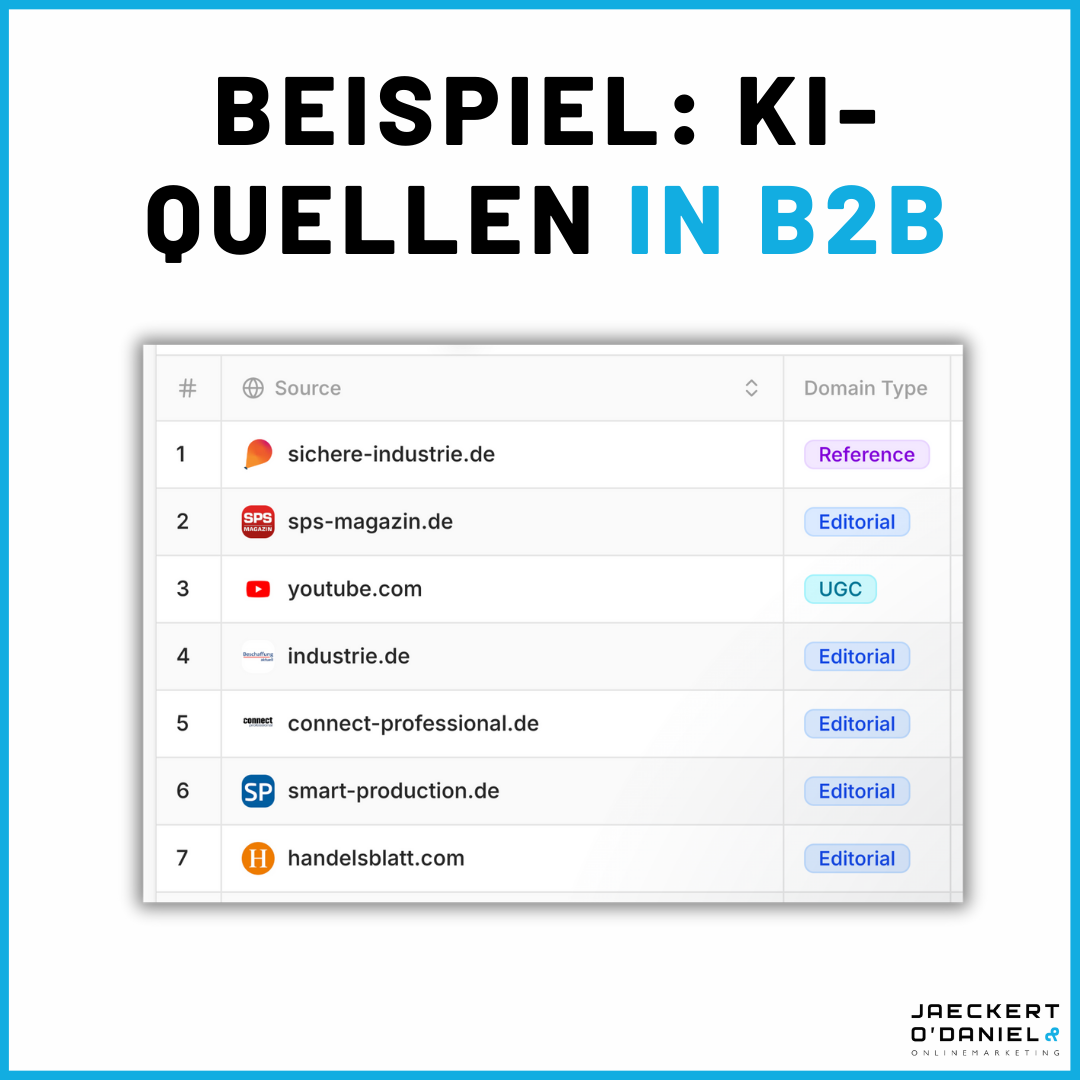
In our Academy Workshop, we delved into the topic: Using a B2B example, we established prompt monitoring for an industrial company, analyzed sources (see screenshot), and subsequently derived optimization measures.
Off-page SEO: Old Metrics, Spammy Methods
Off-page SEO professionals appear at first glance to be the natural candidates for AI Source Optimization. They are familiar with search result competition, operate in a data-driven manner, and possess experience in engaging with external websites. Many also bring a technical understanding.
However, this is precisely where the problem arises. The entire off-page logic is founded on outdated SEO off-page metrics: External websites are assessed based on Domain Authority, and the goal is to acquire follow links.
The primary off-page objective is to strengthen one’s own website. However, this is irrelevant for AI Source Optimization. The sources utilized by ChatGPT, AI Mode, or Perplexity operate based on relevance. Mentions in the correct context are crucial – not the backlink.
Furthermore, traditional link-building methods, such as cold email outreach, are already a dead end. At best, they are ineffective and deleted as spam. At worst, they damage brand reputation. Off-page SEO has always had its drawbacks.
Unfortunately, the boundaries between legitimate and fraudulent practices are often blurred. For instance, we recently received an email from a Head of SEO at a major portal offering backlinks. The email turned out to be a forgery, a clear case of identity theft.
AI Source Optimization moves in precisely the opposite direction. It necessitates robust relationships with multipliers from journalism and the creator economy, along with a strong editorial understanding. We do not believe that off-page SEO will assume leadership in the field of AI Source Optimization.
PR: Strong Candidates – if They are Willing
PR professionals have always operated precisely where AI visibility originates: within public perception, in editorial contexts, and through robust relationships with journalists and specialized editorial teams.
They are familiar with their industry media, cultivate contacts, and pitch topics strategically and with finesse. Their objective is to secure relevant mentions – precisely what is crucial for AI systems.
However: Many PR professionals are very “classically” oriented. Many still lack a digital focus. What they require is not a complete career transformation, but rather a methodological upgrade: understanding prompt setups, analyzing sources, identifying gaps, and integrating these insights into their existing operational models.
This also necessitates new approaches. It is not merely about promoting one’s own messages, but rather about strategically addressing visibility weaknesses based on thorough analyses.
For us, PR professionals represent the natural cornerstone for source optimization. However, publishers constitute only a portion of AI sources. These also include numerous niche websites, platforms like YouTube, and user-generated content. In these areas, PR professionals often lack extensive expertise.
Free GEO Online Training
- Current Developments in AI Visibility
- From SEO to GEO
- How to Optimize for AI Systems

Conclusion: who Will Reinvent Their Role?
Within the scope of our AI consulting, we conduct numerous workshops. We observe the following patterns:
- Interdisciplinary Teams: A single individual centrally manages and coordinates the AI project. They are the central point where all efforts converge, ranging from technical optimizations and content enhancements to source optimization. These roles are often filled by marketing managers, SEO managers, or even affiliate and media professionals.
- Individual departments such as PR and Social also participate in the workshops. They handle source optimization within their respective domains and develop concrete action plans.
- Internal Communication: The new interdisciplinary AI teams, in turn, also communicate the topic internally within their company. Ultimately, AI visibility affects every department, from product development to HR and sales.
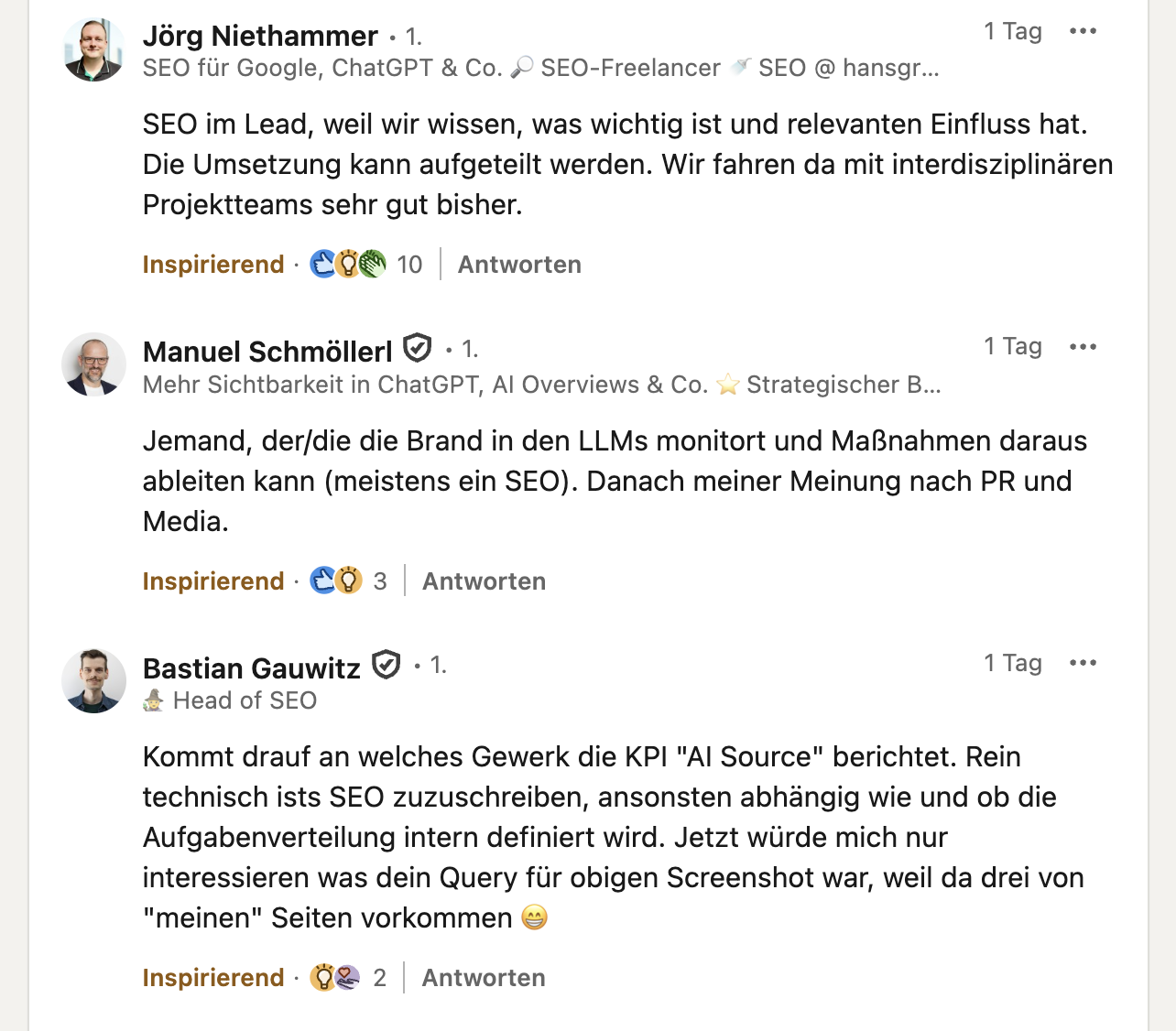
A similar pattern has also emerged in this LinkedIn discussion.
Formerly SEO, Today GAIO/AEO: our Interviews on the Transformation



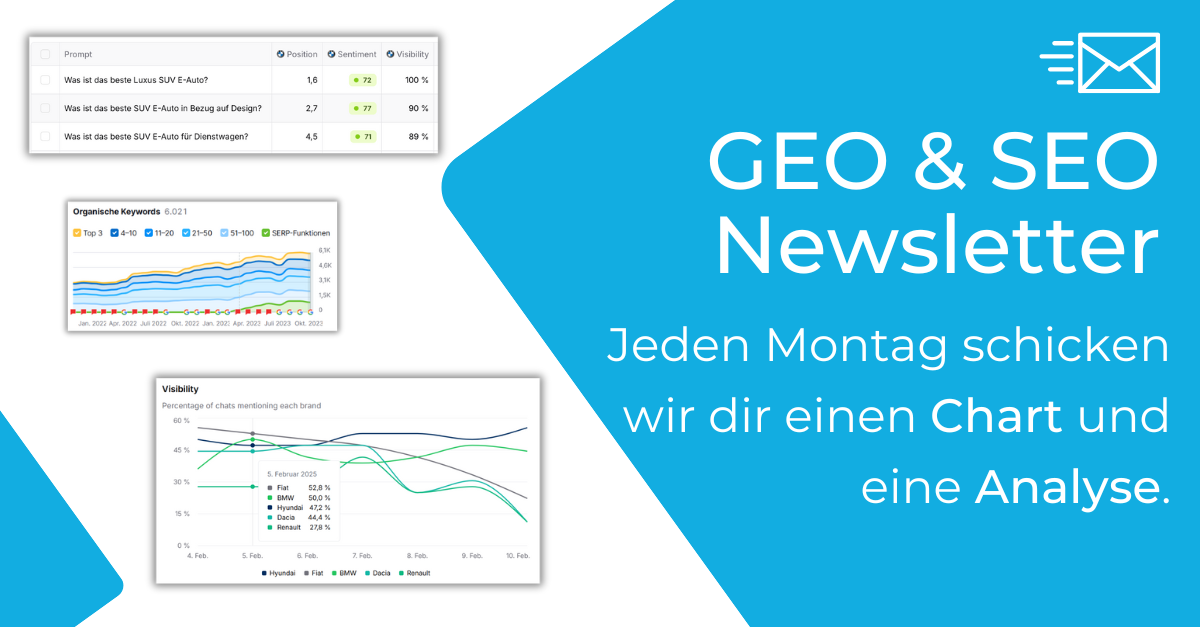
Further Insights into AI Visibility: Every Monday via Email
We Advise Marketing Professionals on AI Visibility
For anyone seeking an SEO sparring partner or comprehensive SEO consulting, Fabian and Benjamin are the perfect choice. As an in-house SEO expert, I sought competent SEO support and found it with them. During a very pleasant introductory meeting, we jointly developed an approach to establish SEO among the individual stakeholders and thereby gain more internal visibility for the subject. Based on this initial discussion and a joint kick-off with the stakeholders, they developed a sound SEO and content strategy for a product area. Since then, they have both supported me as sparring partners during implementation.
The collaboration with Fabian and Benjamin is a great pleasure for me and all project participants, as they are masters of their craft and bring immense passion for SEO. This combination is infectious and motivates everyone to achieve peak performance.

I look back with great satisfaction on the SEO project that we carried out with Benjamin and Fabian. Firstly, the collaboration was on a very pleasant, goal-oriented level. Secondly, the consultation was structured in such a way that we could immediately start with the implementation. We received very concrete optimization suggestions that were tailored to our internal capacities and therefore realistically implementable. Even though only a few months have passed, we can already see the first results of our work in the Google rankings. Traffic for our relevant keywords is steadily increasing, and we still have enough concrete work packages from Benjamin in the pipeline to boost our site. Furthermore, through the consultation, we have acquired so much internal SEO know-how that we can now optimize our site independently. And most importantly: Visitor numbers have doubled – with correspondingly positive effects on sales.



Social Media: Strong Platform Expertise – but an Inappropriate Focus
Social Media professionals possess a highly relevant skill for AI Source Optimization: They understand platform cultures. Many can effectively “game” platforms like TikTok, LinkedIn, or Instagram by mastering format structures, trends, and interaction logics.
This keen understanding is invaluable for AI sources, as some of the most significant AI references – such as Reddit or YouTube – are precisely such community-driven platforms. Those who understand the platform mechanics there can more quickly generate relevant signals and foster authentic, credible mentions. Collaborations with creators can also be crucial for enhanced AI visibility.
However, the critical drawback lies in their focus. Most social media teams primarily operate on platforms that are virtually absent from AI sources: Instagram, Facebook, TikTok. While these are vital channels for brand communication, reach, and community building, they currently rarely appear in our AI monitoring projects.
The sources that AI systems actually utilize often fall outside the traditional social media portfolio: Reddit, YouTube, specialized forums, and niche communities. It is precisely in these areas that operational experience is frequently lacking, as these platforms are seldom part of daily business operations.