November 7, 2022Fabian Jaeckert
30 Articles or 300 Articles: Two SEO Playbooks Compared
In SEO it is always about producing content as purposefully as possible, and then optimizing it. But how much content does it actually have to be?
In this podcast episode we discuss two different playbooks using an example that we also show in our SEO Academy.
One playbook is about producing a manageable number of articles and focuses above all on the main terms. We took 30 articles here in order to discuss a concrete number. These 30 articles are created with a lot of effort and then optimized further and further.
The other playbook is about producing 300 articles. It does not stop at the first 30 articles. You keep publishing, even at the cost of quality and of not finding time for optimization rounds.
What are the basic assumptions behind them? What advantages and disadvantages do the two SEO playbooks have? We discuss that in the podcast.
SEO playbook 1: publish 30 articles
Pro
For top results you need the best content. That is what you work on with this playbook. Motto: less is more. But done properly. Skyscraper articles with different content formats such as graphics, video, podcast, checklists. With these very extensive content pieces you concentrate on the keywords with high search volume. Because you have a manageable number of articles, you have a lot of resources for continuous optimization and also for organic, clean link building (white hat SEO).
Contra
On the short-head terms the competition is very strong. Even with very extensive content there are no guarantees. The fewer horses you have in the race, the bigger the losses when a piece of content does not land. Also: many head terms do have high search volume. That does not automatically mean that there is also a lot of traffic there. That has to do with the SERP layout, as Kevin Indig also explained recently on our podcast. And it is not cheaper either, keyword SEO costs.
SEO playbook 2: publish 300 articles
Pro
With many articles you can go very well into the long tail and produce content there that fits the specific search intent of users. You can test more and gather experience on which keywords the domain has a good chance of ranking for. You have more horses in the race and thereby minimize the risk of failure. You also build much stronger topical authority.
Contra
So many more articles, that of course costs more time and effort. You need entirely different processes and resources. There is also the risk that you pump out so much content as an end in itself, without really paying attention to performance. Analysis needs resources too. Sooner or later you will also have to go into optimization here.
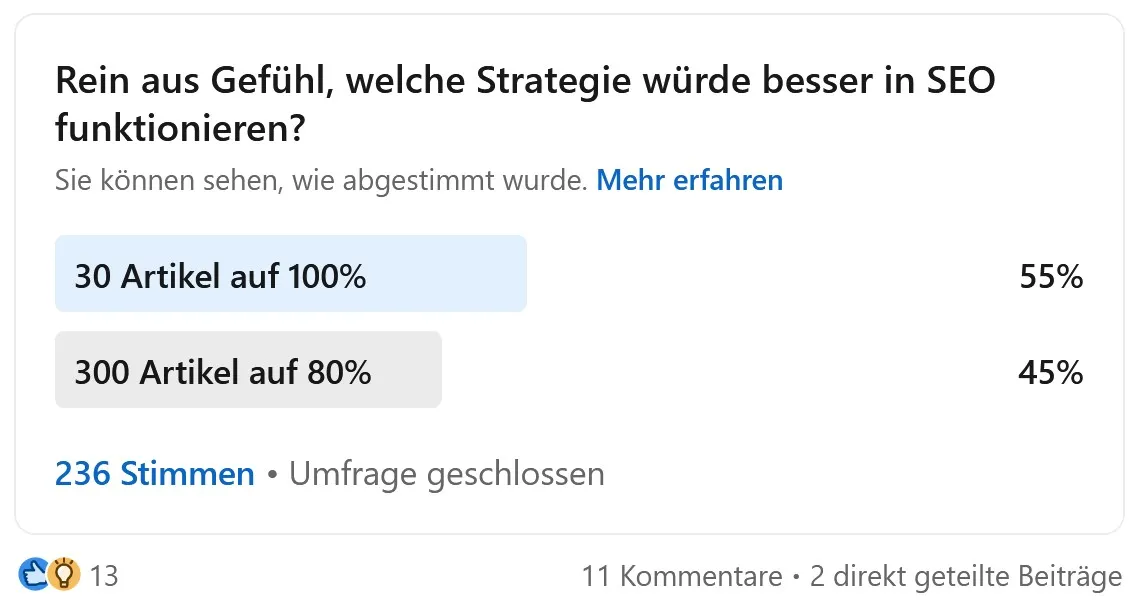
Over 200 SEO and content experts on LinkedIn could not agree on one playbook :-)
Deepen your SEO knowledge: by email every Monday

We advise marketing leads on SEO

We are Fabian Jaeckert (on the right) and Benjamin O’Daniel. For many years we have advised mid-sized companies on how to get more visitors through Google and turn that traffic into inquiries and sales.
With Jaeckert O’Daniel, it quickly became clear to us that we had made an excellent choice in selecting potential partners for our online marketing project. Their expertise and, above all, their ambition to thoroughly immerse themselves in our specific industry topic to provide us with the best possible support, are precisely what is now propelling us forward.
 Tobias ReitmeierF.EE Group
Marketing managers have many projects on their desk. They know that search engine optimization matters. But the concrete implementation, above all developing a solid SEO strategy, is very hard for them.
That is exactly what we specialize in. We develop SEO strategies for companies and present them to the people in charge in a structured and understandable way. After that we support the in-house leads during implementation.
Sound interesting?
We can set up an SEO intro meeting by video conference (30 min.).
SEO playbooks from practice: our interviews

How user testing works: interview with Astrid Kramer on UX and SEO

SEO for a software company: interview with Beat Köck

How dm increases its SEO visibility: interview with Philipp Hassinger
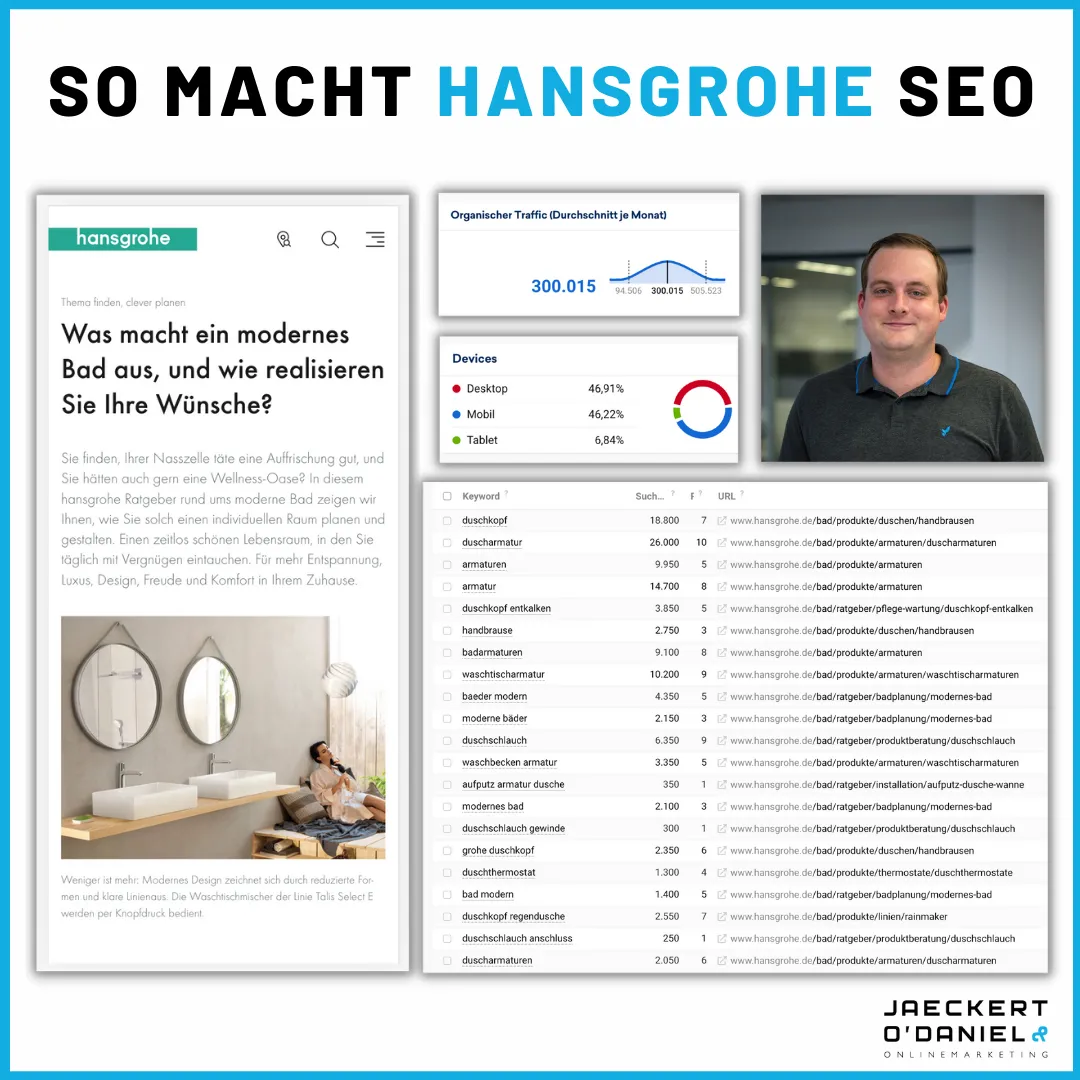
How Hansgrohe does SEO in 40 countries: interview with Jörg Niethammer

Hubspot's SEO strategy: interview with Jenny Lapp

Twice as visible as AirBnB: interview with Dominik Schwarz

1 million users a month, with the right content strategy: interview with Jan Brakebusch

How Südwestrundfunk (SWR) works on search experience: interview with Sarah Stein