
Google has now truly rolled out its AI Overviews in Germany. An AI answer now appears prominently for numerous search terms. The entire “old” Top 10 completely drops out of the visible area, neatly separated by a blue line.
What are the consequences for SEO? We discuss this in our podcast episode in a deep dive and here in this article as a summary. We look at studies, current impressions – and describe our personal assessment.


On how many Keywords are AI Overviews Displayed?
In the USA, AI Overviews have been live since mid-2024. At that time, Google initially rolled out the AI overview very aggressively, but then scaled it back after a PR scandal due to many incorrect AI answers. Consequently, numerous studies have emerged from SEO experts and SEO tool providers. The well-known SEO consultant Kevin Indig conducted a meta-study that summarizes the results. In summary, it can be said that AI Overviews have so far been displayed for less than 10 percent of all keywords.
Whether this will remain the case, however, is unclear. In the course of the ongoing March 2025 Core Update, AI Overviews were also rolled out globally and apparently on far more keywords than before. Kevin Indig reports on LinkedIn that projects he manages are losing between 10 and 20 percent of SEO traffic. Since Kevin primarily advises large digital platforms in the USA, it can be assumed that these are major SEO projects.
Our samples in the German-speaking search area show that AI Overviews are present for numerous keywords. We recommend that our clients query relevant and high-traffic search terms and check the Google Search Console to see how their SEO traffic is developing.

On What Type of Keywords are AI Overviews Displayed?
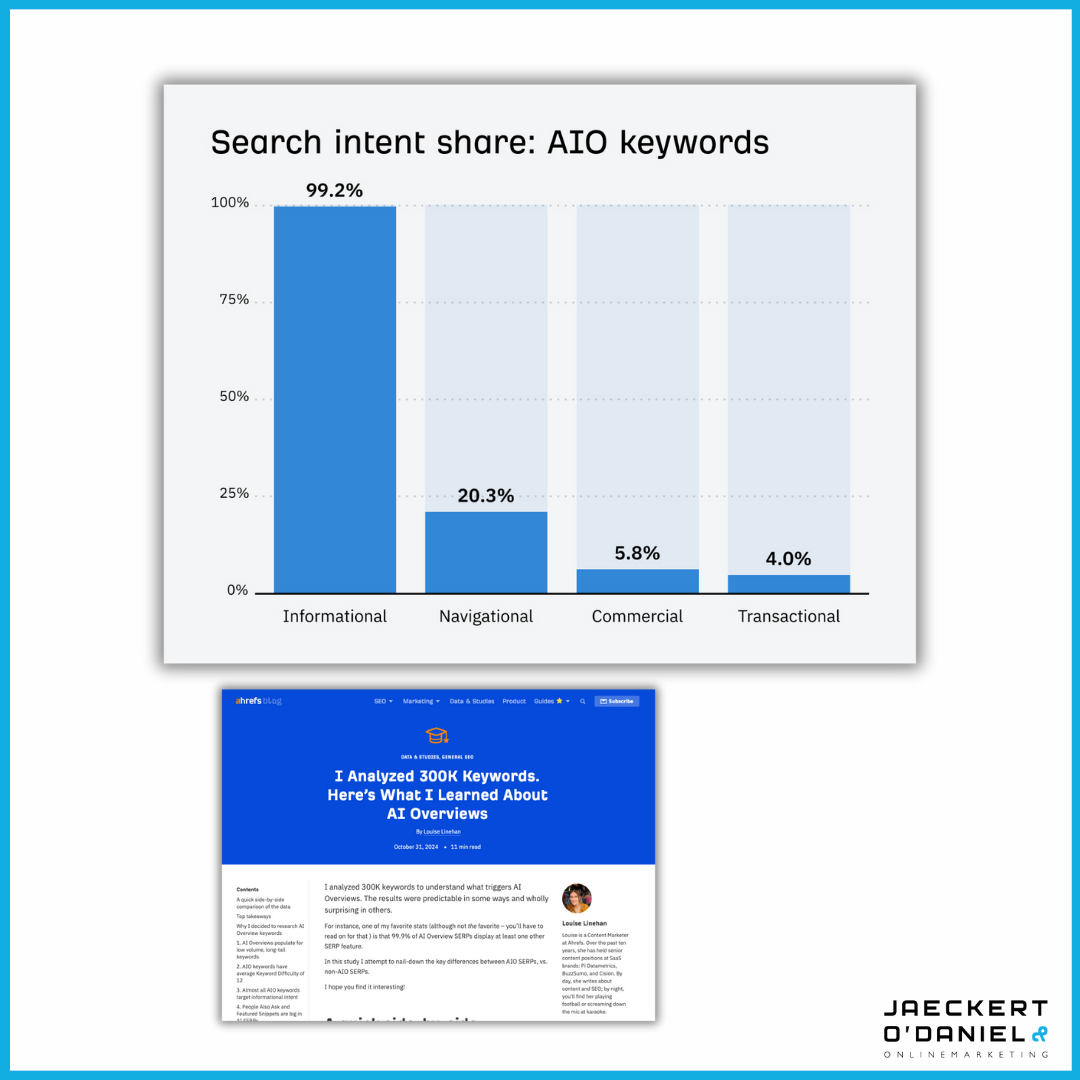
Google’s new AI overview is primarily found for informational keywords – and especially in the longtail. AI Overviews are very rarely displayed for transactional keywords related to products and services. For example, this excellent study by Ahrefs states this.
In Germany, we can only partially confirm this pattern through samples. We have not yet encountered AI answers in e-commerce environments or in the travel sector. It is quite different, however, in the health or finance sectors. Here, we find AI Overviews in both the longtail and the shorthead, i.e., for single-word terms that are often very general.
It can be stated: AI Overviews are displayed across all topic areas. However, the transactional sector currently appears to be barely affected.
The fact that AI answers are also displayed in the health and finance sectors shows that Google seems to be taking it seriously this time. Previously, the platform has always communicated very high quality standards here (“Your Money, Your Life”) and also had to face harsh criticism during the previous PR scandal.
How Do AI Overviews Affect Click-Through Rates (CTR)?
Generally, it can be said: Click-through rates (CTR) from search results have been declining for years. On the other hand, we are still miles away from a “zero-click” era. CTR studies, such as those by Sistrix, show that click-through rates are around 10 to 15 percent in top positions – and this does not change significantly with AI Overviews either.
However, making general statements here is very difficult – for the following three reasons:
- Firstly, links or sources are also provided in the AI Overviews. Clicks from these are not specifically reported in the Google Search Console. The sources in AI Overviews are often similar to the “classic” Top 10.
- Secondly: Click-through rates also vary greatly depending on the topic area. As part of our SEO consulting, we conduct many SEO audits and identify potentials. Here, we always see projects with extremely high click-through rates of over 20 percent.
- Thirdly: The specific content that is displayed as a source in the AI answer or among the Top 10 below it also leads to varying click-through rates. For example, anyone who only offers a definition that is very similar to the AI answer will likely receive very few clicks.
It will also become clear here which links will be displayed more prominently as sources in AI Overviews in the future – and how one can specifically optimize for this.
“Transactional Keywords Remain Very Important”

Anyone who looks at the AI Overviews gets the impression: The entire “old” Google has slipped down. If users accept the AI offering, i.e., expand it and work with it, the Top 10 below will no longer play a role.
Simple SEO strategies like building glossaries will bring little traffic in the future. At the same time, many areas are not affected at all. Transactional keywords, in particular, remain extremely relevant. Google will also act very cautiously here. Companies should therefore know their transactional keywords in depth. Here, we almost always see great SEO potential.
Online shops work with far too few category pages because they have not yet developed their keyword set in depth. Or they have not yet grasped the product grid as an opportunity. B2B companies generally do not have optimized landing pages – and instead spend five- or six-figure sums on Google Ads.
“Companies Must Bid Farewell to SEO Content”
If AI generates all general answers, every marketing manager must ask themselves: Why should users still click on our content? The answer is: One must offer more than generic texts that treat a topic generally.
In practically every company, there is a great deal of experience and expertise. Regarding the specialized topics, target groups, and their problems. Exactly this must also be reflected in the content. First-Hand Experience Content is the key. Then users will also have a reason to click on the result.
New conceptual approaches are needed here. The old SEO content is no longer sufficient. ChatGPT can help as a productivity tool here. But pure ChatGPT content on a website – for example, to rank with a glossary – will have no future.

We Advise Marketing Managers on SEO
For anyone seeking an SEO sparring partner or comprehensive SEO consulting, Fabian and Benjamin are the perfect choice. As an in-house SEO expert, I sought competent SEO support and found it with them. During a very pleasant introductory meeting, we jointly developed an approach to establish SEO among the individual stakeholders and thereby gain more internal visibility for the subject. Based on this initial discussion and a joint kick-off with the stakeholders, they developed a sound SEO and content strategy for a product area. Since then, they have both supported me as sparring partners during implementation.
The collaboration with Fabian and Benjamin is a great pleasure for me and all project participants, as they are masters of their craft and bring immense passion for SEO. This combination is infectious and motivates everyone to achieve peak performance.

I look back with great satisfaction on the SEO project that we carried out with Benjamin and Fabian. Firstly, the collaboration was on a very pleasant, goal-oriented level. Secondly, the consultation was structured in such a way that we could immediately start with the implementation. We received very concrete optimization suggestions that were tailored to our internal capacities and therefore realistically implementable. Even though only a few months have passed, we can already see the first results of our work in the Google rankings. Traffic for our relevant keywords is steadily increasing, and we still have enough concrete work packages from Benjamin in the pipeline to boost our site. Furthermore, through the consultation, we have acquired so much internal SEO know-how that we can now optimize our site independently. And most importantly: Visitor numbers have doubled – with correspondingly positive effects on sales.

Deepen your SEO Knowledge: Every Monday via Email