April 12, 2021Benjamin O’Daniel
Content Marketing Manager: What They Do – and Why They Are Urgently Needed
Content marketing managers are responsible for a company’s content. They develop, plan, create, and maintain digital content. Content marketing managers often work at the interface between product departments and IT.
On this page and in the podcast episode we talk about why, from our point of view, many more content marketing managers are needed. But also about what they earn and what the areas of responsibility look like in concrete terms.
The job profile of the content marketing manager is developing strongly. That is why, as always: what you read here and the podcast episode are a first take. We welcome feedback. Preferably via LinkedIn.
Three frequent questions about the content marketing manager job
What is content marketing?
Content marketing means that companies create informative or also entertaining content that fits their subject areas, but in which the products are not the center. Content marketing is a cross-cutting discipline that is especially important in search engine optimization and for social media. For that they need content marketing managers. More here about content marketing in general.
How do I become a content marketing manager?
There are no established degree or career paths for content marketing managers. Either people come from content (for example newspaper, blog, TV, radio) and learn online marketing on top. Or they come from marketing and learn how to create content. Graphic designers also often move into the topic. There are certificate courses and some master’s programs. Above all, though, you learn through practice.
What does a content marketing manager do?
A content marketing manager takes on strategic tasks and operational tasks. These include defining content goals, developing content formats, producing texts for the website, newsletters, and social media, but also analyzing metrics and deriving optimizations from them. Each company has its own requirements, depending on how large the online team already is.
Many people would gladly hire a content marketing manager right away
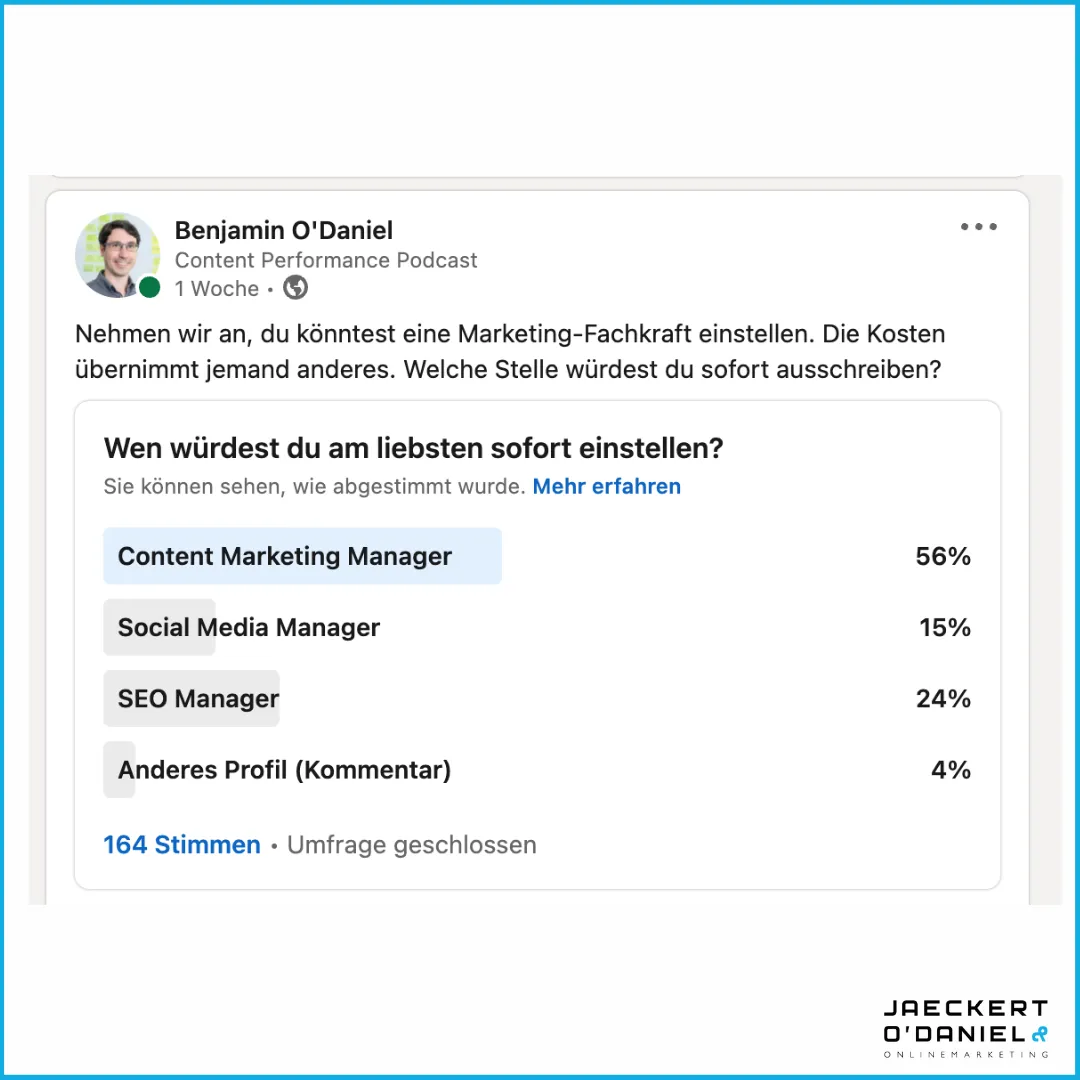
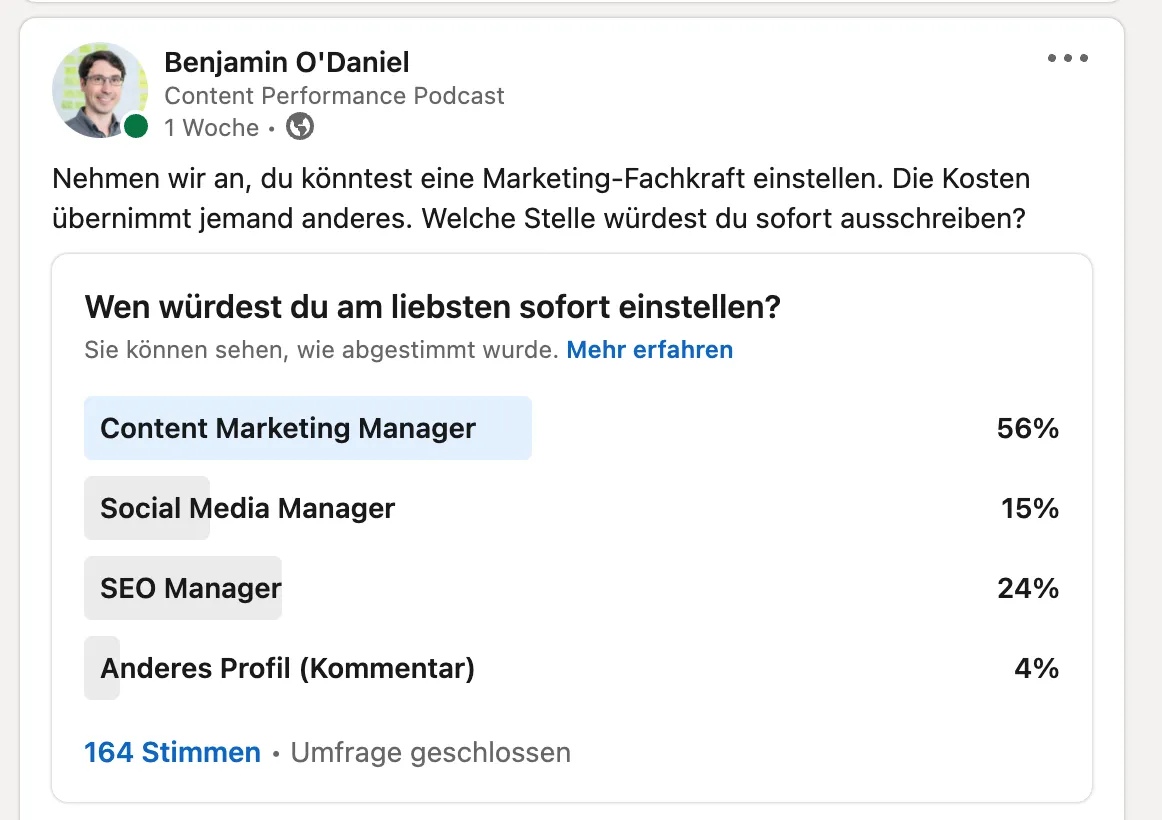
More than half would hire a content marketing manager right away if money were no object. That is what a small survey on LinkedIn by Benjamin found. Here is the discussion. That it costs no money was a deliberate twist in the survey. Because that way the cost barrier is deliberately switched off.
In the discussion, many people also emphasized once again that the tasks are too varied for a single position. Understanding of content is growing in many companies. At the same time, content production is often outsourced completely to freelancers. They do good work. But the question still arises whether companies do not also need content marketing specialists internally, in addition.
But you have to invest for that
Anyone who invests in content pays more than they earn at the beginning.
No Google ranking = no visitors.
No LinkedIn followers = no views.
No newsletter subscribers = no readers.
Every piece of holistic content produces effort, for little return in the short term.
But what does it look like one, three, five years later? Then content is extremely profitable. Research, production, distribution: everything goes much faster.
Network effects set in. Good content gets around. The content delivers real results. Reach, trust, inquiries. And at the same time it is very cheap. Because you do not pay for every click.
That is why: with every piece of content, always keep the coming years in mind as well.
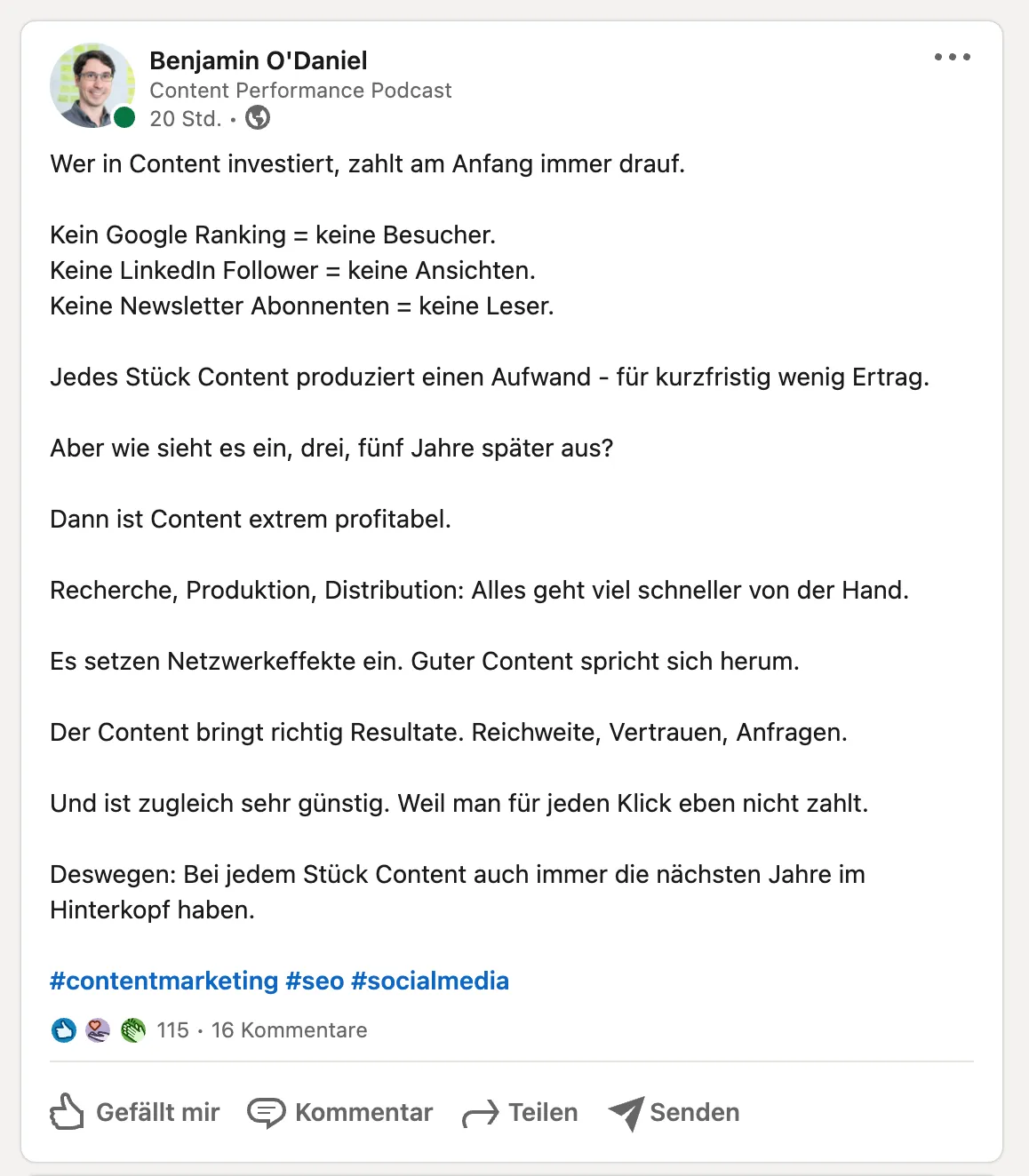
Benjamin posted this. Here is the feedback. On LinkedIn we are connected with our listeners, among them many marketing professionals from the various disciplines.
The content marketing manager job profile – a distinction
Content managers
A content manager is mainly responsible for entering digital content into the content management system. It is therefore usually not a role in which you create content yourself. It is one in which you process the content that has been created. For that you need, among other things, deep knowledge of content management systems such as Typo3, Drupal, or also custom-built systems. The content manager role is often advertised for very extensive websites.
Online marketing managers
Online marketing managers often look after online marketing campaigns above all. For example Google Ads campaigns or social media campaigns on Facebook, Instagram, and LinkedIn. For that they create ads and monitor the campaigns (costs, conversions, and so on). Large campaigns need ongoing maintenance and optimization.
Content marketing managers
Content marketing managers have a clear focus on the content. They are often responsible for creating and coordinating content. They often have a competence focus in one of the big genres: text, photo, video, or audio. The content they create is then pushed through campaigns. Or it gains organic reach through search engine optimization.
Sounds interesting. But my training was completely different…
Welcome to the club! In practice the various profiles we have described here blur together. On top of that comes plenty of project management, for example when it is about a relaunch of the website or about coordinating external agencies.
In fact there is no regulated training and career path for content marketing managers. There are also no professional associations, cooperatives, or anything similar.
For comparison: in the skilled trades, which have existed for 2,000 years, there are more than 130 different apprenticeships. In digital marketing, numerous professions are emerging in parallel right now. Specialization is increasing.
At the same time, many companies are still right at the beginning. They lack background knowledge. That is why job ads often list their maximum demands. That in turn unsettles applicants.
Our experience: there is no creative techie who writes outstanding texts and can program at the same time and knows every web analytics tool like the back of their hand. Just as, in the skilled trades, a roofer does not also do plumbing. The point is to advertise the right position.

Benjamin O’Daniel works as a content marketing consultant with a focus on SEO. Or as an SEO consultant with a focus on content. That is a matter of opinion :-) He completed an editorial traineeship at a daily newspaper after his studies, is also an online marketing manager, and worked for many years as a copywriter. He teaches content marketing at TH Köln in the Online Editorial degree program. One example of a career path among many.
Content marketing and SEO: what is the role of search engine optimizers?

“A search engine optimizer does not have to be able to write themselves. But they need a feel for good content.” Fabian published this statement here. Again with a lot of feedback.
The background: in the SEO scene, content is still often smiled at. Or seen purely quantitatively (X words, XY keyword density). But when does a piece of content really grab the user? When is the content really good in substance? A trained “content person” has a completely different instinct for that. And as an SEO you can learn a lot from that.
But the quote also drew contradiction. Many content marketers can certainly do SEO marketing as well, for example keyword research. SEO, though, still consists of many more topics that are also more clearly technical, such as crawling, Core Web Vitals, and deep analyses, for example on large portals.
Online marketing from practice: our podcast interviews with professionals from SEO, content, and other disciplines

The new role of the marketing manager: interview with Ben Harmanus of Hubspot

SEO case study: how Urlaubsguru works – interview with Sascha Blank

Clubhouse content strategy: interview with Paula Lotte Thurm

How software companies grow successfully: interview with Christian Twardawa

Community management in companies: interview with Vivian Pein
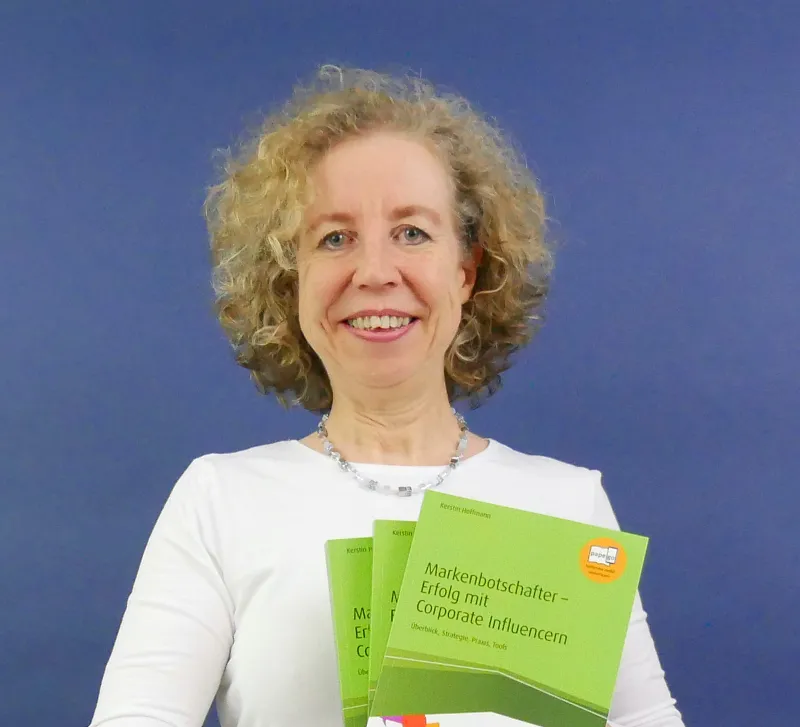
How do you become a personal brand without crude self-promotion? Interview with Kerstin Hoffmann

How to build a successful startup: interview with Johannes Kliesch

How to write better website texts: case study with Daniela Rorig
Tips, examples, and webinars on SEO and content marketing via our mailing list


Tasks of content marketing managers: the six big areas of responsibility
Develop
Creating content spontaneously, just like that: that usually leads nowhere. Content marketing has to be developed strategically. From the goals, through content formats and processes. On top of that: the content marketing wheel turns very fast. You should continuously scan new developments in the market, for example how various platforms change.
Plan
Who does what by when: these questions are often put off. But content should and must be planned. Which content pieces should be created in the year, per month, and per week? Who takes this on? How long does it take to produce a piece of content, from research, alignment, and the writing process to putting it online? This should be recorded in an editorial plan.
Create
Creating content takes time! High-quality content cannot be automated. Content marketing managers need a substantial part of their working time for this operational task. Tip: block entire mornings for it. No emails, no meetings, no phone calls. Concentration on the writing. Always keep in mind, and also communicate it clearly: every piece of content is an asset for the company.
Coordinate
Many content marketing managers coordinate digital projects in their companies and organizations. On the one hand external service providers such as web agencies. But also, internally, projects with specialist departments, which often want content online as well but have no understanding of digital content. It is an interface role, for which you need the corresponding soft skills, such as listening, moderating, and finding flexible compromises.
Analyze
Content marketing managers should be comfortable with the common web analytics tools. They do not have to be techies. But they need to understand and evaluate the metrics, for example Google rankings, website traffic, conversions. Typical tools here are suites such as Sistrix, SEMrush, and Ahrefs, but also Google Search Console and Google Analytics. The feedback came here on LinkedIn.
Optimize
With SEO and content marketing you have to keep at it. Reach does not appear on its own. In concrete terms, one example: if a subpage already ranks well on Google, you should analyze the rankings and keywords and work on them. A jump from position 8 to position 3 has a massive effect on traffic. A better Google snippet can clearly increase the click rate and therefore the SEO traffic.
Requirements profile of a content marketing manager
This requirements profile of a content marketing manager is meant as an example. The requirements include:
Qualification
- Degree (such as marketing, journalism, design)
- Training in a content field (such as an editorial traineeship)
- Experience in a content genre (text, TV, photo, video)
Professional skills
- Operational knowledge of content creation
- Understanding/knowledge of brand communication
- Understanding/knowledge of online marketing
- Understanding/knowledge of SEO
- Understanding/knowledge of social media
- Understanding/knowledge of content management systems
- Understanding/knowledge of project management
Social/personal skills
- Conceptual ability
- Self-organization
- Creativity
- Openness to continuous innovation
- Ability to work in a team
- Empathy
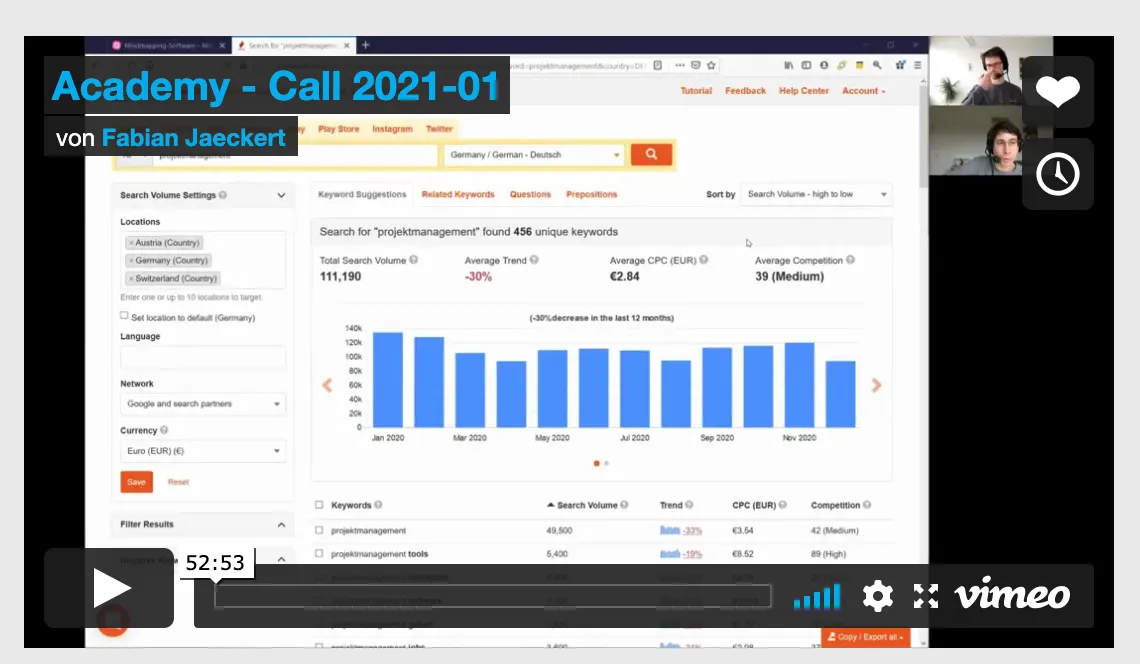
An example from our SEO Academy. There we show how we work with SEO tools in day-to-day work. Using concrete examples, we show how to develop an SEO strategy and steadily improve a website’s Google ranking. Many content and marketing leads are in our Academy, and they deliberately pick up the topic of SEO. In our SEO concepts we also show marketing teams how to integrate SEO into their content marketing processes.
Salary: what does a content marketing manager earn?
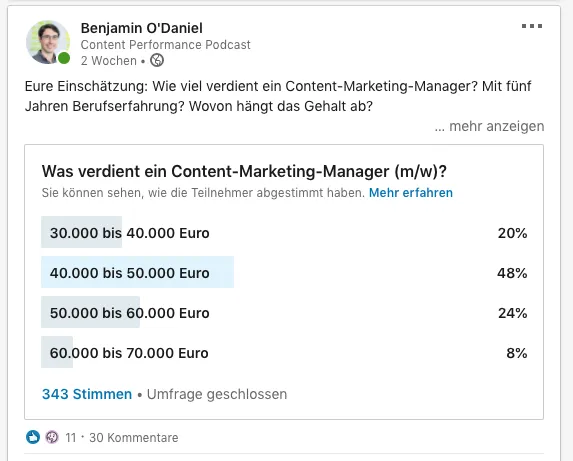
The LinkedIn survey was conducted in April 2021.
Content marketing managers often earn between 40,000 and 50,000 euros gross. That is what a survey we did some time ago found.
The survey is not representative, though. It also differs clearly from other surveys. Content marketing expert Robert Weller writes here that content marketing managers earn around 36,000 euros gross.
In general: it depends on the experience and skills of the applicant, and on the employer. Smaller companies pay less than larger companies. Agencies often pay the least. In the south of Germany pay is higher than in the east.
Our experience: it depends on your own mindset and how you define your role. If you aim to bring the company reach and revenue (traffic, conversions, leads), can point to successful projects, and deliver numbers, then you have a good negotiating position. That is not so easy, though, because many other factors and departments play a role.