June 28, 2021Benjamin O’Daniel
Writing Website Texts: 5 Levels
Writing website texts: at first glance, that sounds like a simple matter. But anyone who has ever sat in front of an empty Word document knows: website texts do not write themselves.
Often there is nobody in the company responsible for the website texts. Sometimes the managing directors write them. Sometimes marketing writes them. Often, though, individual specialist departments do. And quite often, freelancers are commissioned.
The result: the website texts do not meet the requirements. Specifically, the requirements of users – and of search engines. In measurable results, that means: the website texts do not rank well on Google and lead to too little visibility.
On this page and in the podcast episode, we talk about what, in our view, makes a professional homepage text. For that, we present five levels that a website text must meet. We also give concrete writing tips.
Writing website texts: our experience in companies
Who writes the website texts?
Even though everyone thinks that anyone can write: producing a professional text efficiently is a craft. Marketing managers, though, often have a business-administration background and are strong in project management. As generalists, they steer many marketing projects (ads, social, flyers, website, presentations). Managing directors actually have better things to do. And specialist departments often write texts that are hard to understand. Freelance journalists and copywriters are not easy to find.
When do you write website texts?
When a website is newly developed or a relaunch is due, the texts have to be written or revised accordingly. Here we often see websites that look very polished in design. But nobody talks about how the website texts are then shaped and put in place. The technical term for this is content management. The result is that there is no layout for longer, more informative website texts. But exactly those texts often rank very well on Google.
Who approves the website texts?
When you write website texts, it is often about every single word. Decision-makers often want a say in what can be read on central pages. That leads to many rounds of corrections. And quite often, tiring questions of taste are discussed. The result: homepage texts are often written in a very general and short way. That leads neither to Google rankings nor to conversions. The actual problem behind this: there are no clear templates for how a website text should be written.
3 examples of a good website text
How do you write a website text? There are very different perspectives on this question.
The first step depends on where the text is placed on the website. Or, put more technically: on which page type within the website structure. Three examples:
Writing landing pages: A landing page is a product page on a website. An offer is presented there. So if you write a website text about products or services, you should apply copywriting techniques. What are the benefits of the offer? What content or functions does the product provide? Users expect simple, clear wording here, and it can also be kept short.
Writing guide articles: Many websites have guide sections. A blog, for example. Here you should think more like an editor. That means explaining complex things simply. This should specifically not be promotional, but above all informative. The same applies if you have set up a glossary on the website, for example.
Writing an About us page: Every website should also have a section in which the company is introduced. This is mainly about transparency. Explain the history. Name the unique selling points. Show the people who lead the company. The website texts here do not have to be novels. It is mainly about presenting the information well.
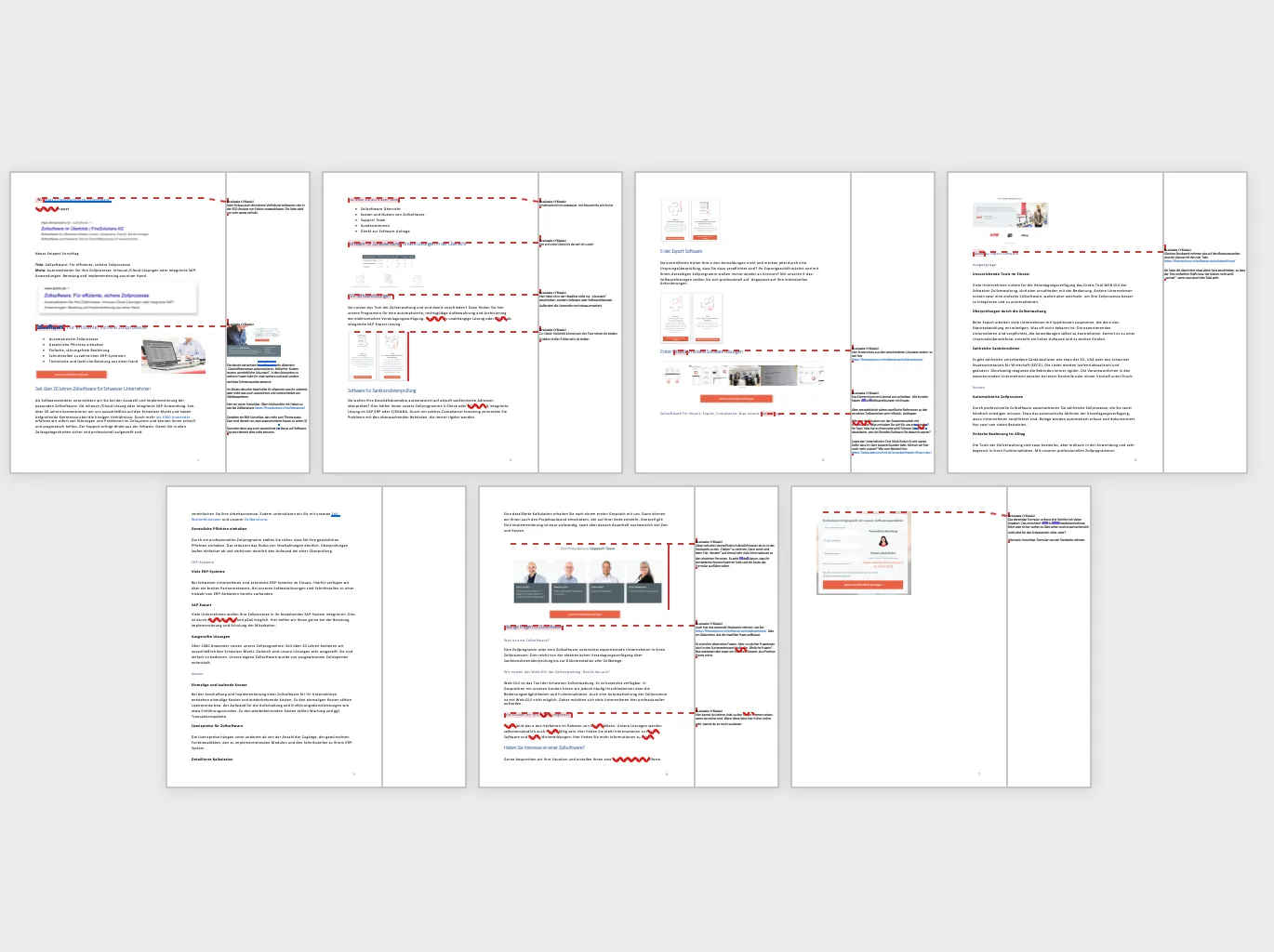
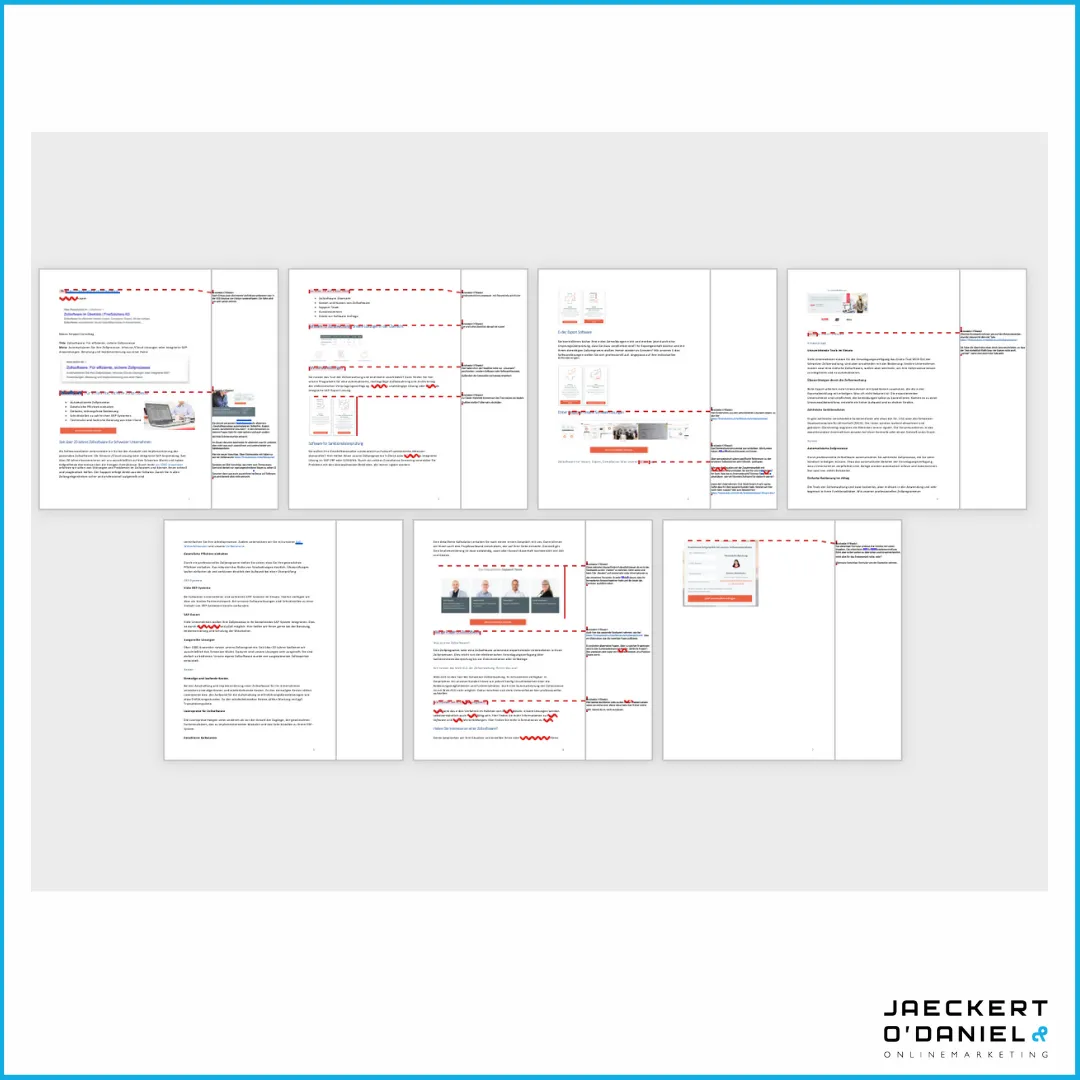
Here is an example of a website text from our practice. It is a draft in which an existing subpage was extended and built out by several paragraphs. Existing sections were taken into account, and new keywords were added within the text. New calls to action were developed, a new benefits argument, images were selected, and comments were left in the right margin for the graphic on how to implement the text visually. For the photos, in our view, you need a strategic approach to image SEO.
Writing texts for websites: 3 tips for wording
Active wording
Anyone who writes website texts quickly slips into bureaucratic language. You think you have to become formal. Users love the opposite: clear language with active wording. Professionals also clarify the tone of the texts beforehand. For example, an informal or a formal form of address. Casual and humorous. Or more factual and informative. Depending on the target group.
Short sentences
The more people write website texts, the longer the sentences get. You try to fit every exception into the sentence as well. The result is often very long sentences. The problem: website texts are read differently from a book, for example. Users scan pages. They try to grasp the meaning quickly. Short sentences have a clear advantage here.
Concrete examples
Many company website texts are packed with empty phrases. Companies describe themselves as innovative, solution-oriented, efficient. But what does that mean in concrete terms? It is better to work with concrete examples. Show the most innovative product – and use it to explain how you work. Users understand that this is an example.
Writing website texts vs. homepage texts
Website
By website we mean the entire web presence. That is, all directories, sections, and formats you find on a website. A website can consist of one to five pages – but also of hundreds or thousands of pages.
Homepage
In specialist usage, homepage can mean the whole website, but also only the start page of a website. That is the page that appears for a domain when you enter www. and .de at the end. The start page itself often has little homepage text.
What do successful website texts achieve in concrete terms?
In a great many companies, what website texts achieve is not really measured. That leads to discussions about general judgments of taste.
In our view, the success of content, and therefore of a website text, must always be measured. The basis for this is the individual subpage (URL). The metrics are:
- Google ranking of an individual URL
- CTR / click-through rate of an individual URL
- Traffic of an individual URL
- Conversions of an individual URL (e.g. leads)
- Time spent on an individual URL
On the basis of data like this, you can assess whether a website text is really good, meaning it delivers concrete results that contribute to the company’s marketing goals, such as generating more reach, visibility, or revenue.
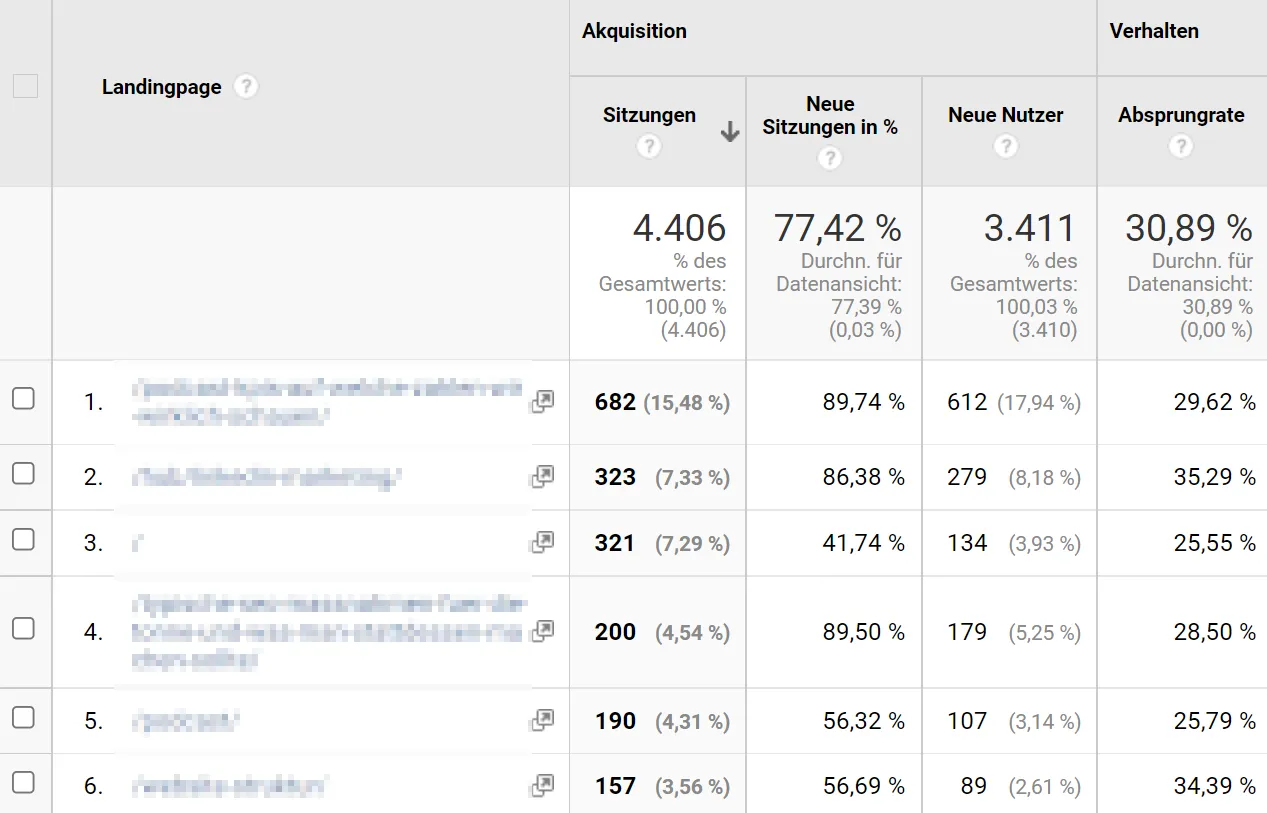
Different URLs generate different amounts of traffic on a website. Every text on the individual subpage is based on keyword research, but also on subject-matter research and on working out the topic.
The 5 levels of a website text when you write
Copywriting
Landing pages with a good headline, and product benefits with the aim of encouraging a purchase: that is the world of copywriting. This is about arguing in a promotional way – and as far as possible without the typical empty phrases you find in every advertising brochure out there.
Journalistic writing
When it comes to guide articles or glossaries, a much more sober style is called for. Journalistic forms such as the feature or the report come very close to this. Promotional argument stays in the background – at least in the core of the text.
Subject-matter writing
Subject-matter writing is about the actual content – and not about formal criteria. In companies, the individual specialist departments have the expertise. Sales, support, and marketing do too. If not, the person responsible for the text needs briefings here.
UX Writing
How do you write the text for individual buttons? Newsletter notices or smaller paragraphs? This is about microcopy, which also has a lot to do with the CMS. A text also has to be fitted into the system and the design. The question is whether a content manager does this, or the person responsible for the text.
Semantic Writing
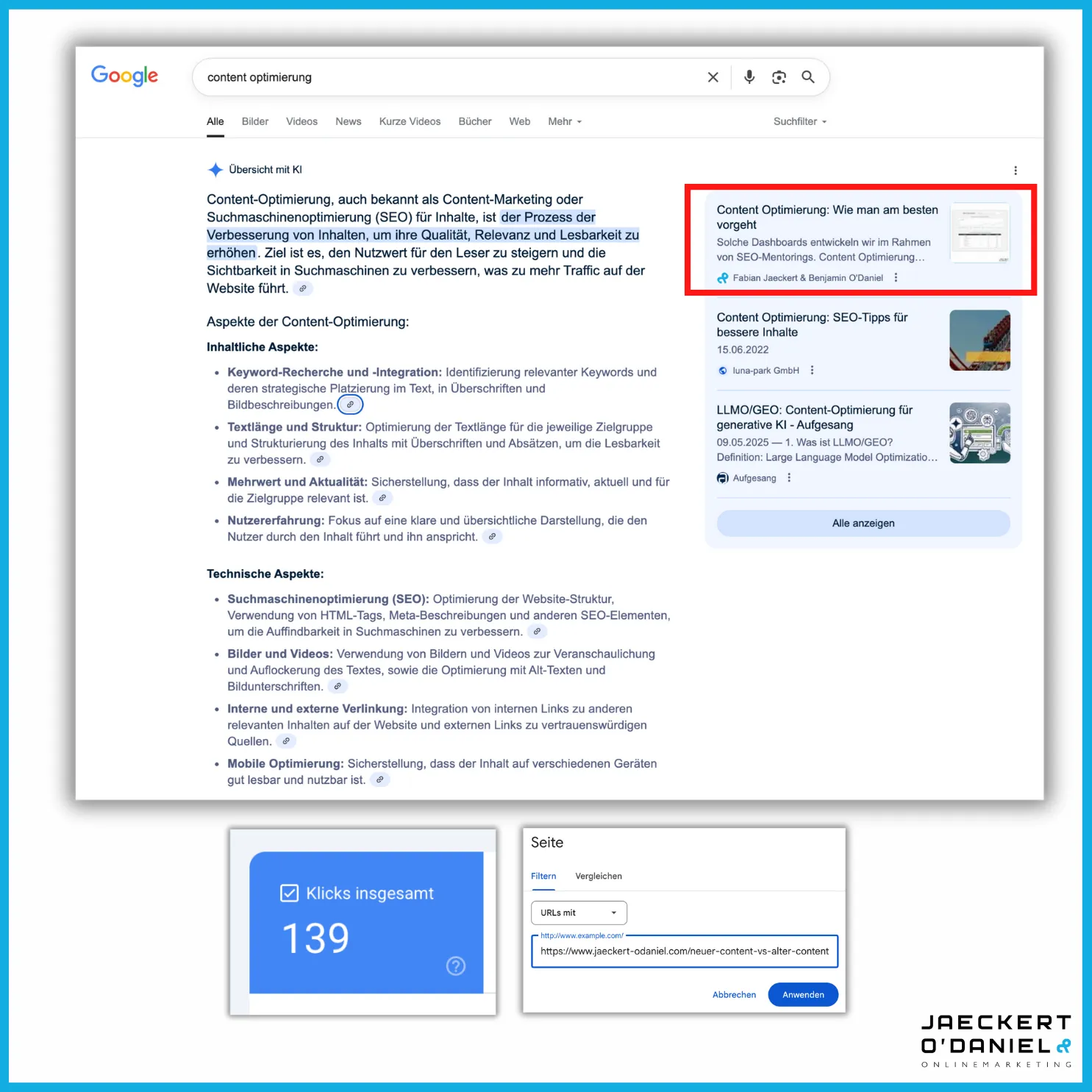
Semantic writing is a sub-discipline of content SEO. It is about understanding why Google lists certain search results right at the top. How the homepage texts are structured and worded. How the algorithm recognizes and registers quality. Example: a featured snippet, that is, a highlighted box at position 0.
And the keywords?
Meeting the keyword requirement for homepage texts means, in our view, above all knowing the keywords and thinking about which search intent sits behind them. And turning the answer into content that takes the keywords into account and, at the same time, is always readable and high quality.
SEO requirement for a website text – an example
When do you get a highlighted box like this on Google? When the quality of the website text behind it is right.
Featured snippets are sought after. Because the highlighted search result brings many clicks and therefore traffic. The example here shows what matters:
- The search query is clearly worded. And Google expects an equally clear answer.
- In the box: three sober sentences. Each sentence contains one statement. With concrete figures and a source as evidence.
- The extracted passage sits in the middle of the text – and not right at the front. The keyword “Kosten” does not appear in the box.
The algorithm recognizes the context and the quality of the text. The websites in the positions behind do not provide this compact information – and that is why they rightly do not stand right at the front.
The only drawback: the text dates from the previous year. The study is even older. The text would need to be updated. So that it continues to be the best result for users and so that the featured snippet is kept.
If this is not done, it gives competitors a clear path to capture this snippet.
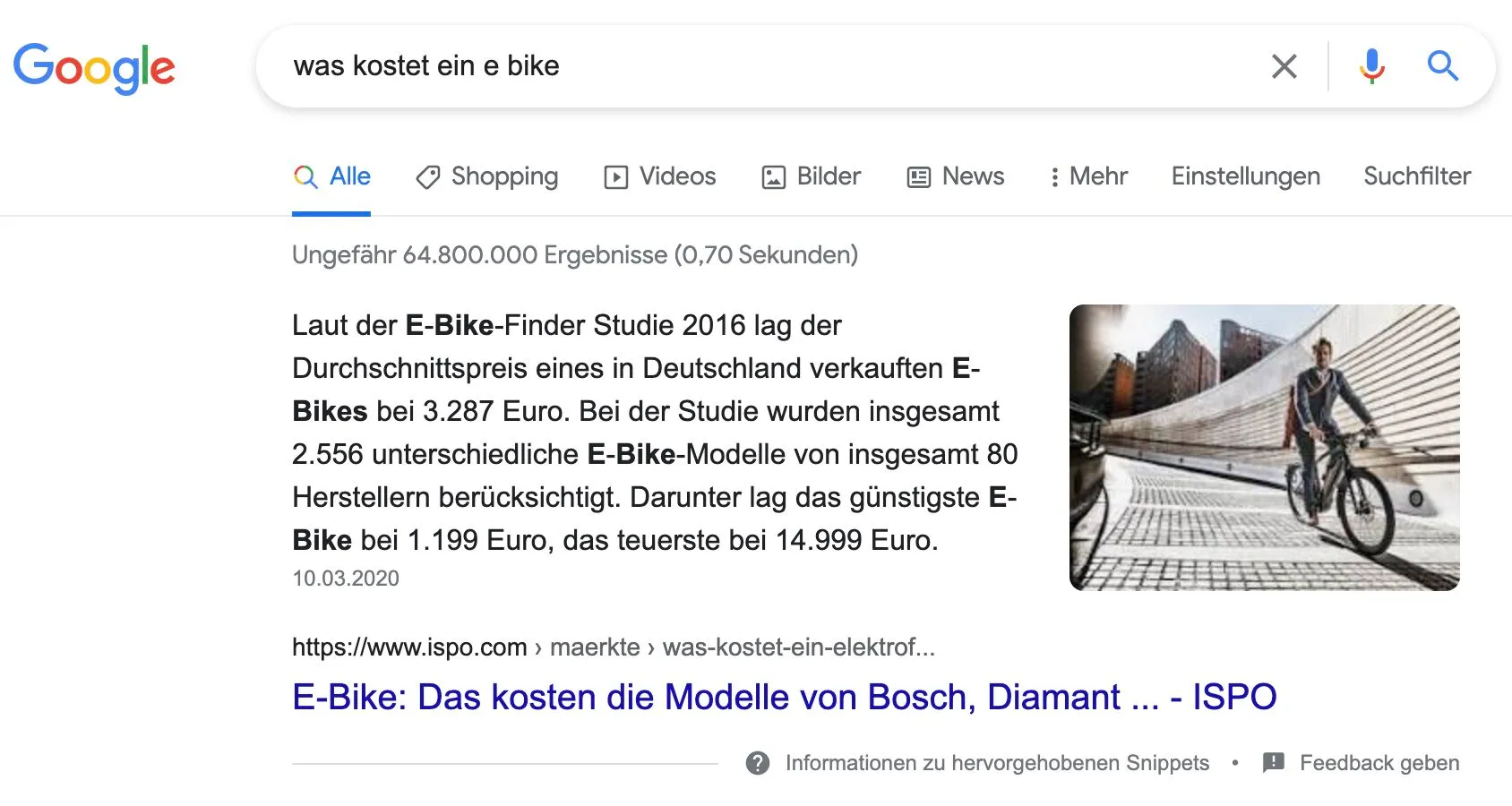
Benjamin presented this example of semantic writing on LinkedIn. Here is the post and the discussion. Another example of SEO and user requirements is headings. Understandable H1 and H2 headings in website texts lead to a longer time on page, better rankings, and more conversions. Benjamin discusses that in this LinkedIn post. More on what H1 and H2 headings mean.
Tips on content and SEO, plus webinars – via our mailing list


Writing good website texts – if only it were that simple
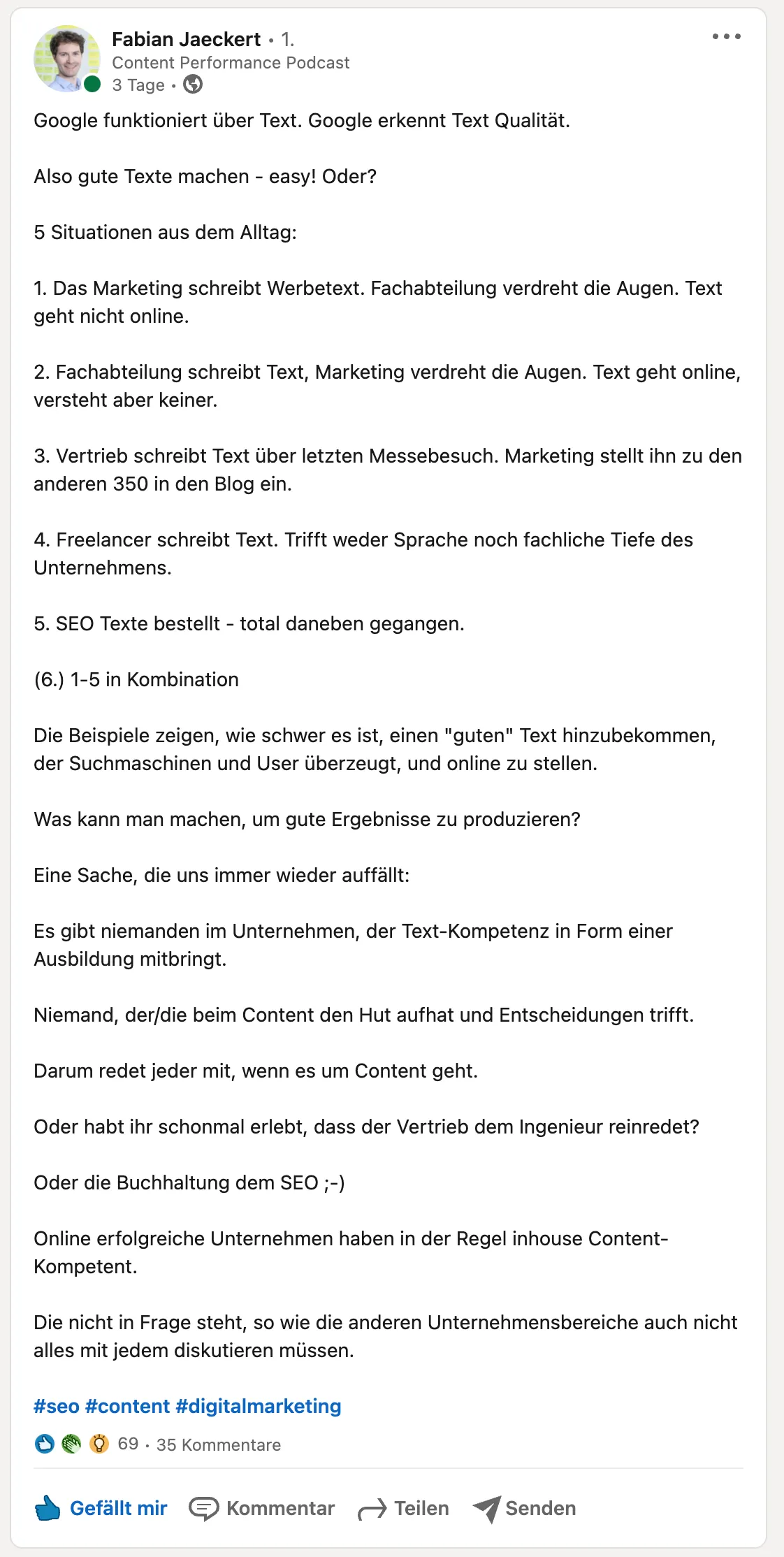
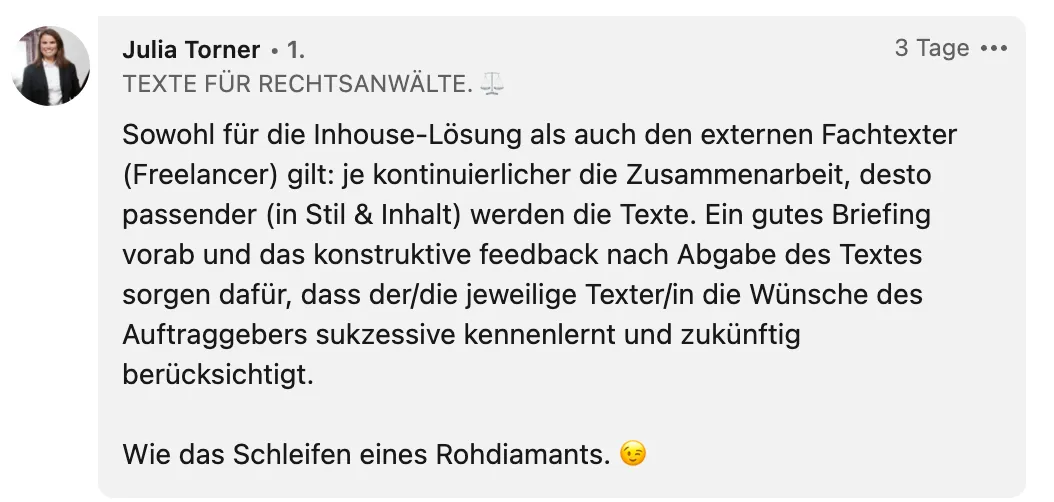
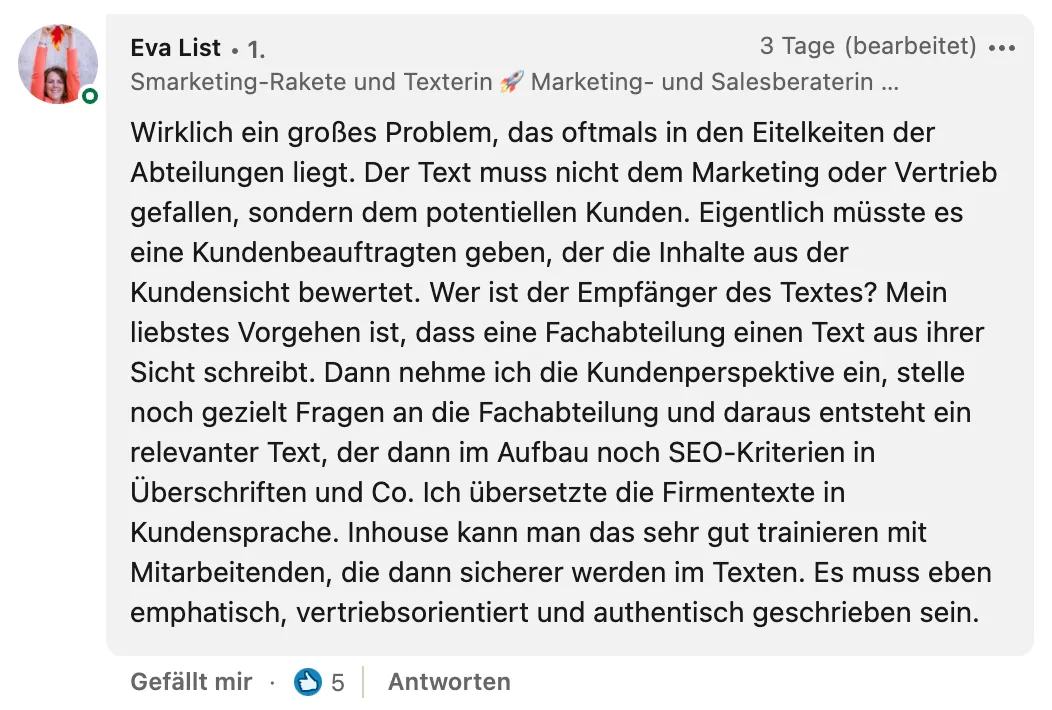
Good website texts do not fall from the sky. Fabian wrote here on LinkedIn about the situations we experience day to day (see the screenshot as well). Under the post there are many good comments from experienced marketers and freelance copywriters.
The conclusion of the discussion: alongside the craft of writing, you need good processes (briefings, interviews, correction rounds) and, above all, a constructive communication culture when the different trades and departments work together.
External copywriters can reach that subject-matter depth as well. For example, if they have specialized in a particular field as a matter of principle (which is rarely the case). Or if they work for one client on a regular basis.
Having website texts written: why freelancers alone are not the solution
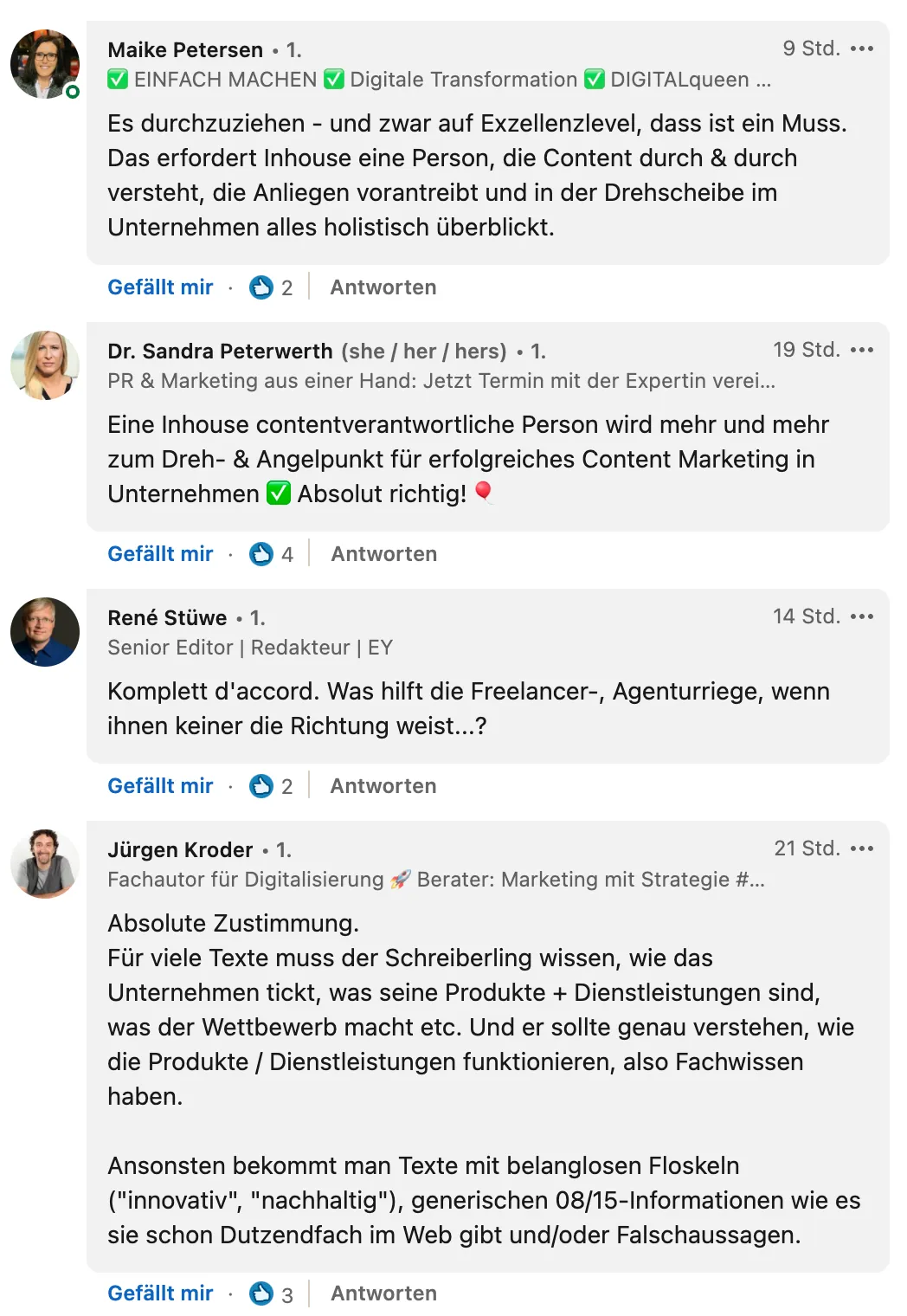
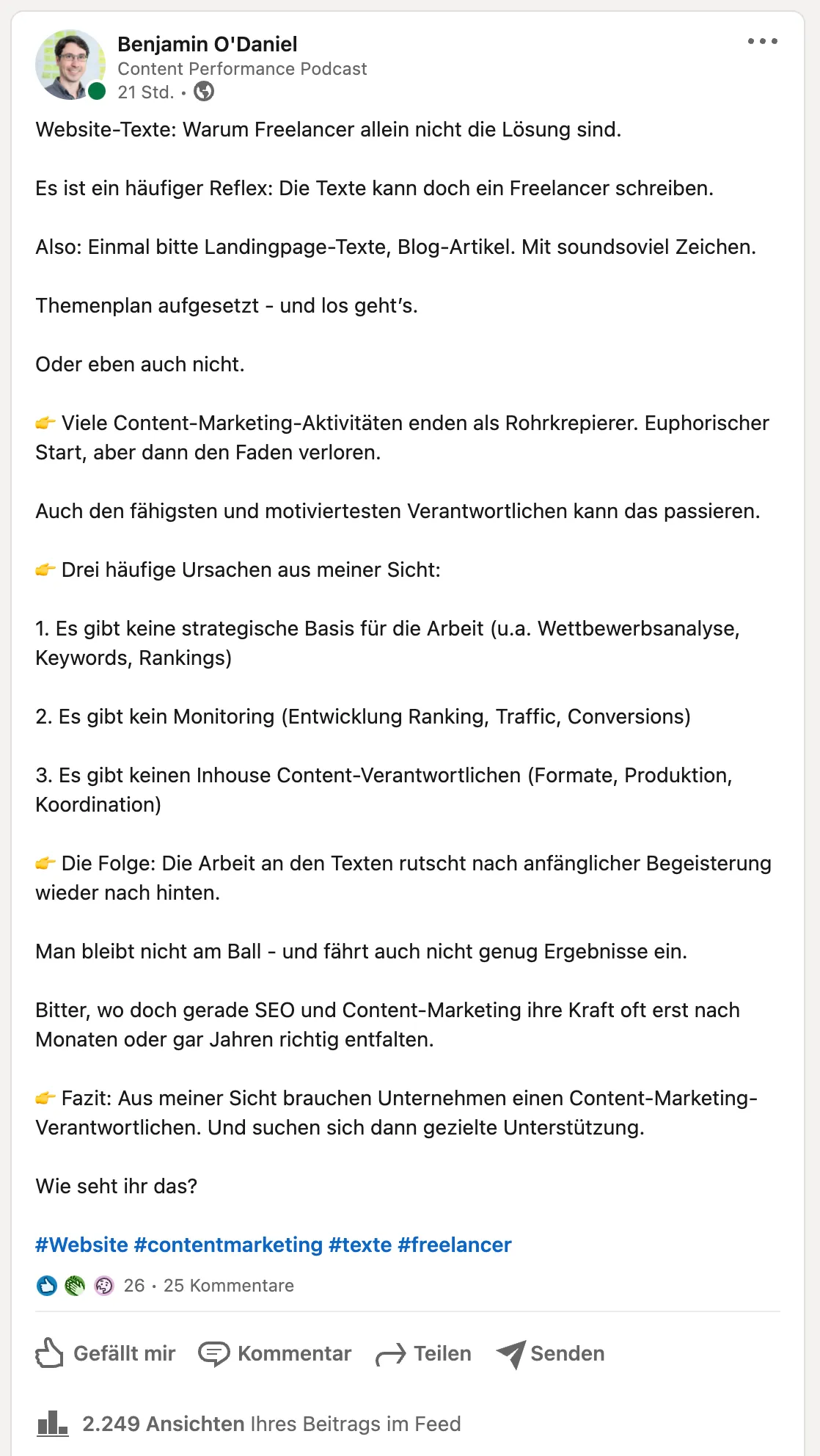
Benjamin also opened the discussion in his LinkedIn post on whether it is enough to outsource website texts and all content marketing activities. Our experience: many content marketing projects of this kind get stuck.
The conclusion of the discussion: there also needs to be someone responsible internally for the website content. Either content marketing managers, online marketing managers, or marketing and PR professionals in general, who then also get a relevant time budget for it.
Our podcast interviews with professionals from the field

How to write better website texts: case study with Daniela Rorig

How user testing works: interview with Astrid Kramer on UX and SEO

SEO as a growth strategy: interview with Kevin Indig

SEO for a software company: interview with Beat Köck

Community management in companies: interview with Vivian Pein

How do I become a LinkedIn influencer? Interview with Jens Polomski

How do I become a personal brand – without crude advertising for myself? Interview with Kerstin Hoffmann

How to build a successful startup: interview with Johannes Kliesch