May 16, 2022Fabian Jaeckert
Local SEO: How Sixt Ranks Successfully for Hundreds of Cities
Many companies have regional locations across Germany. How can you implement that on the website? So that each location has targeted visibility in the search engines? And for the generic terms that are not connected to the company?
We discuss that in the podcast episode and on this page, using an SEO case study on “local SEO”. The example is the car rental company Sixt, which has rental cars, vans, and also carsharing offers in its portfolio.
The case study takes place as part of our SEO duels. There we analyze well-known companies with regard to their SEO strategy, for example the rankings of Allianz or how Rewe is set up in SEO.
A short note up front, so there is no disappointment: we are not talking here about how purely local companies, which have their business in one city, optimize their Google rankings.
Here we are concerned with platforms and companies that have numerous locations in Germany or around the world.
What is local SEO?
Local SEO is a subfield of search engine optimization (SEO for short). It is about users entering search terms with a city on Google, and companies wanting to be visible there.
Local Google rankings are very valuable. Because anyone who searches for a product or a service in combination with a city or region is already very far along in their customer journey.
Users no longer want to know something in general. They are looking for a solution on the spot.
Local Google rankings therefore bring very relevant traffic and often also have a very good conversion rate, for example into a contact form.
An example: around nine million people move within Germany every year. Many of them move on their own and rent a van.
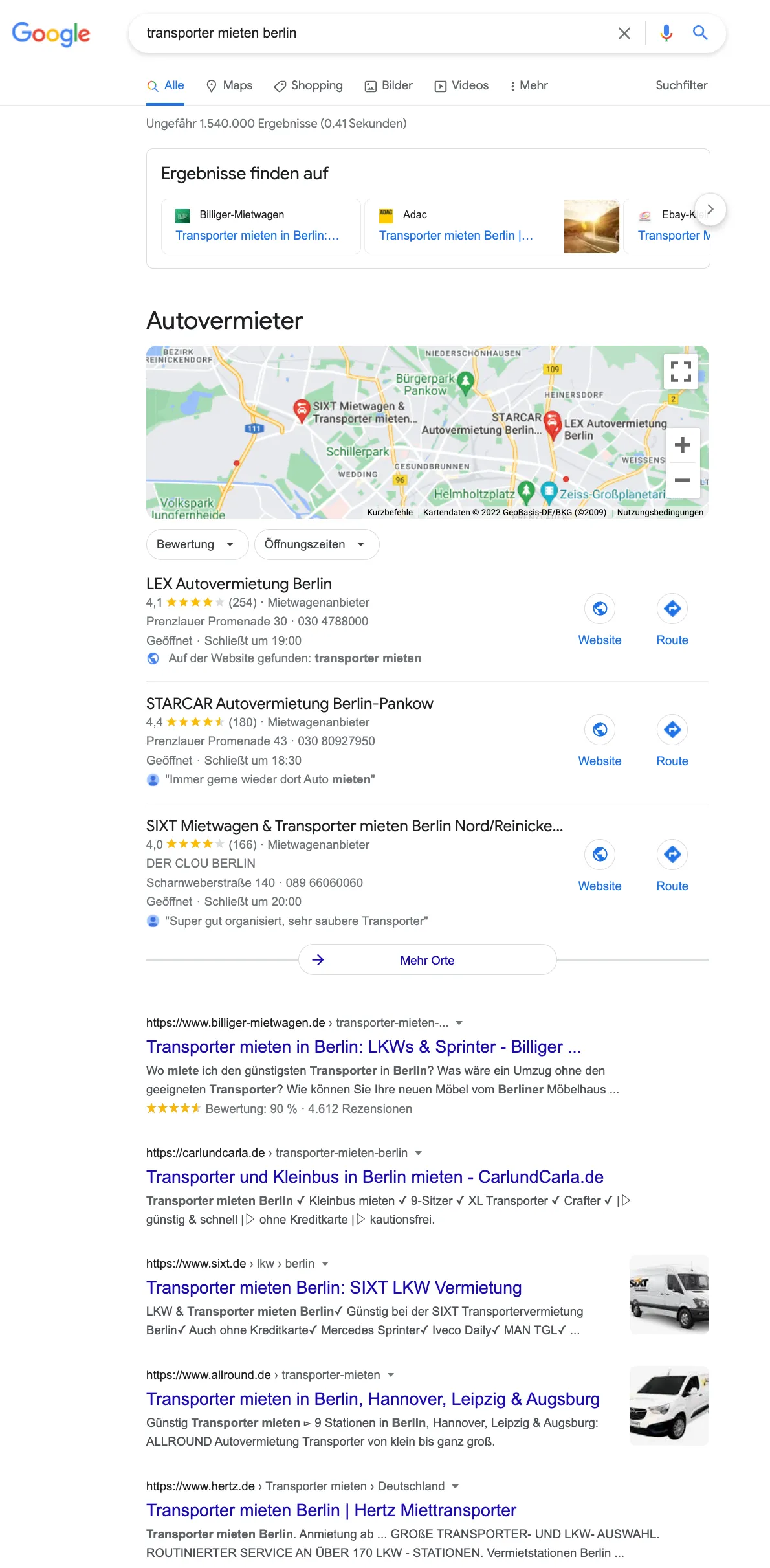
For a local search “Transporter mieten Berlin” (rent a van Berlin) you see a Google Maps integration and, below it, the organic results. Here you find further platforms alongside Sixt and Hertz.
Anyone who does not immediately find the right rental company in the Maps result, or who wants to look into it first, clicks the first results.
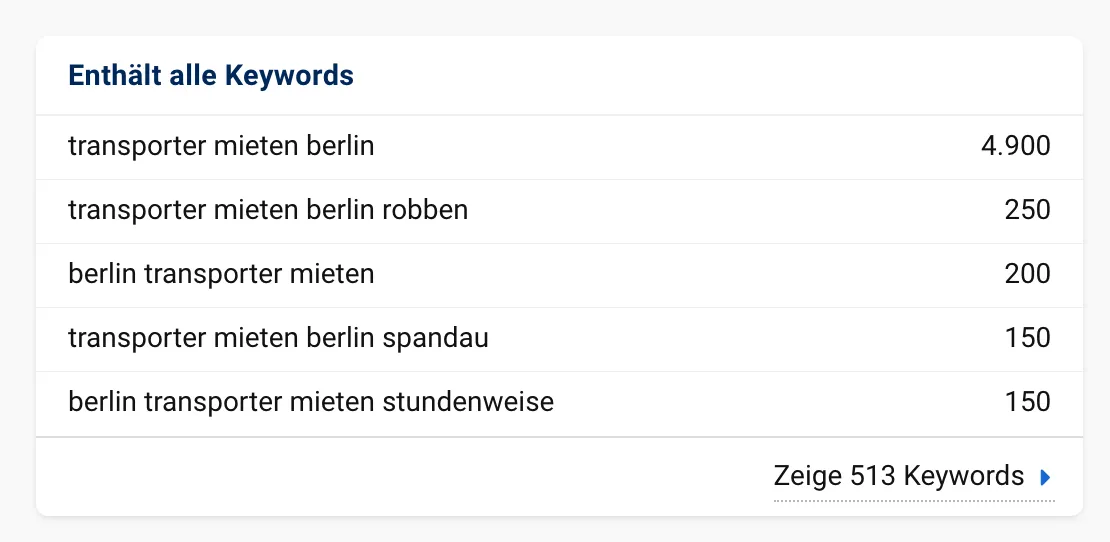
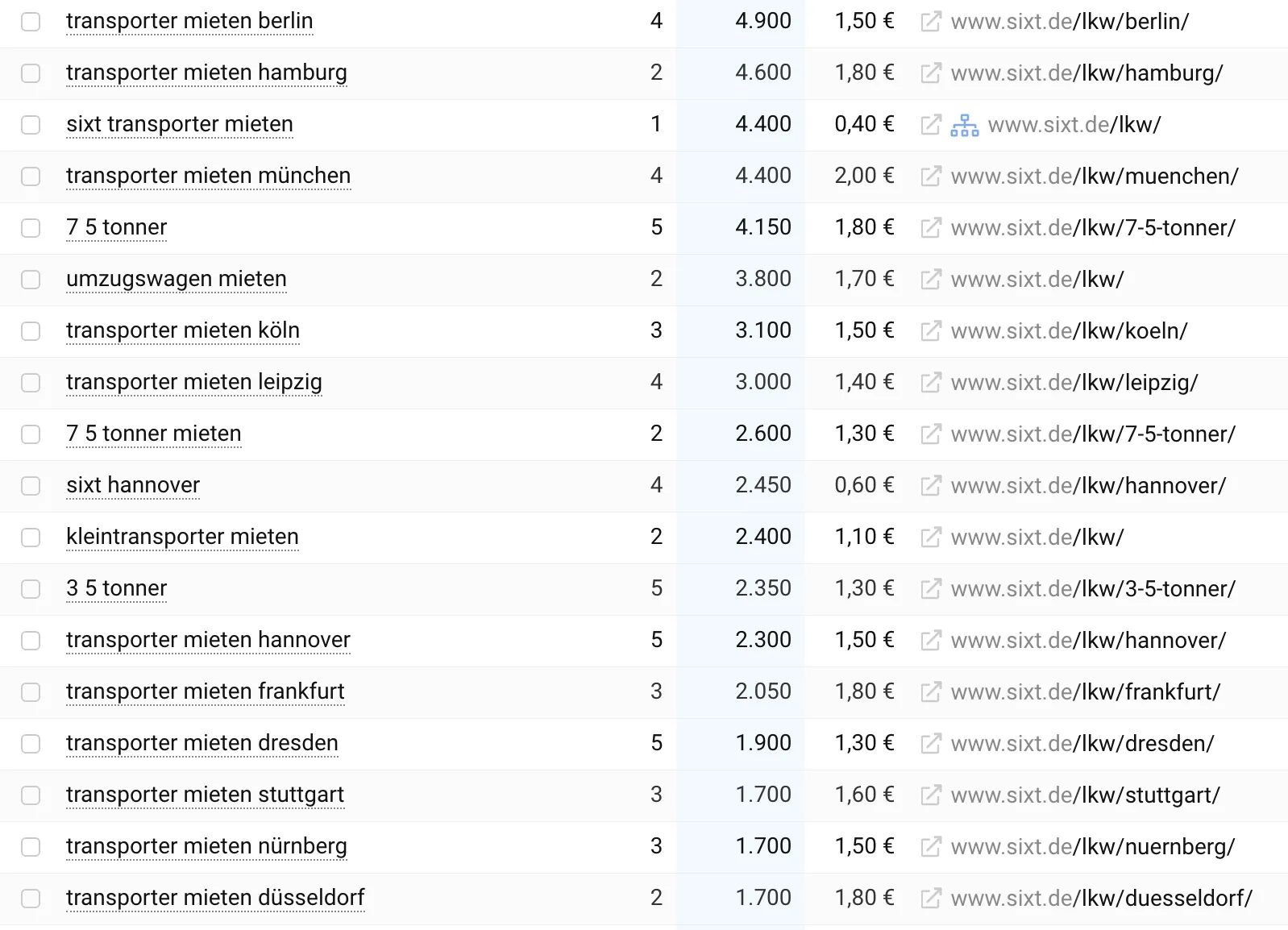
According to the SEO suite Sistrix, almost 5,000 users search for that alone. Anyone who achieves top rankings here and in hundreds of further cities has correspondingly very valuable SEO traffic on their website.
3 challenges in local SEO strategies
The spam problem
Google itself is very reserved when it comes to local SEO strategies. There are several critical statements that point in the direction of proceeding “with a sense of proportion”. The reason: for such regional search queries there were, and still are, often spam approaches. Websites rank at the top for such search queries without having a regional offer at all. Users are then often passed through a “doorway page” to central product pages. Google rates such doorways as spam.
Technical implementation
Anyone who does SEO always has the goal of ranking at the top for relevant search terms. Combined with a geographic strategy, this quickly becomes complex. If you combine, for example, 5 relevant keywords with 500 cities, you have 2,500 separate URLs that have to be generated. The question immediately arises of how you develop this in an automated way. A solution also has to be created for internal linking, an important SEO ranking factor, for local SEO.
Content quality
Anyone who has hundreds or thousands of regional pages immediately faces the question of which content is shown there. Google itself expects unique content here. Unique content with a real regional connection. Many companies with geographic strategies, however, rely on automated content solutions or on cheap texts from text platforms. This approach was often successful as well, at least in the past. Often at the expense of quality for users, though.
Deepen your SEO knowledge: every Monday by email

Local SEO case study: how the car rental company Sixt proceeds
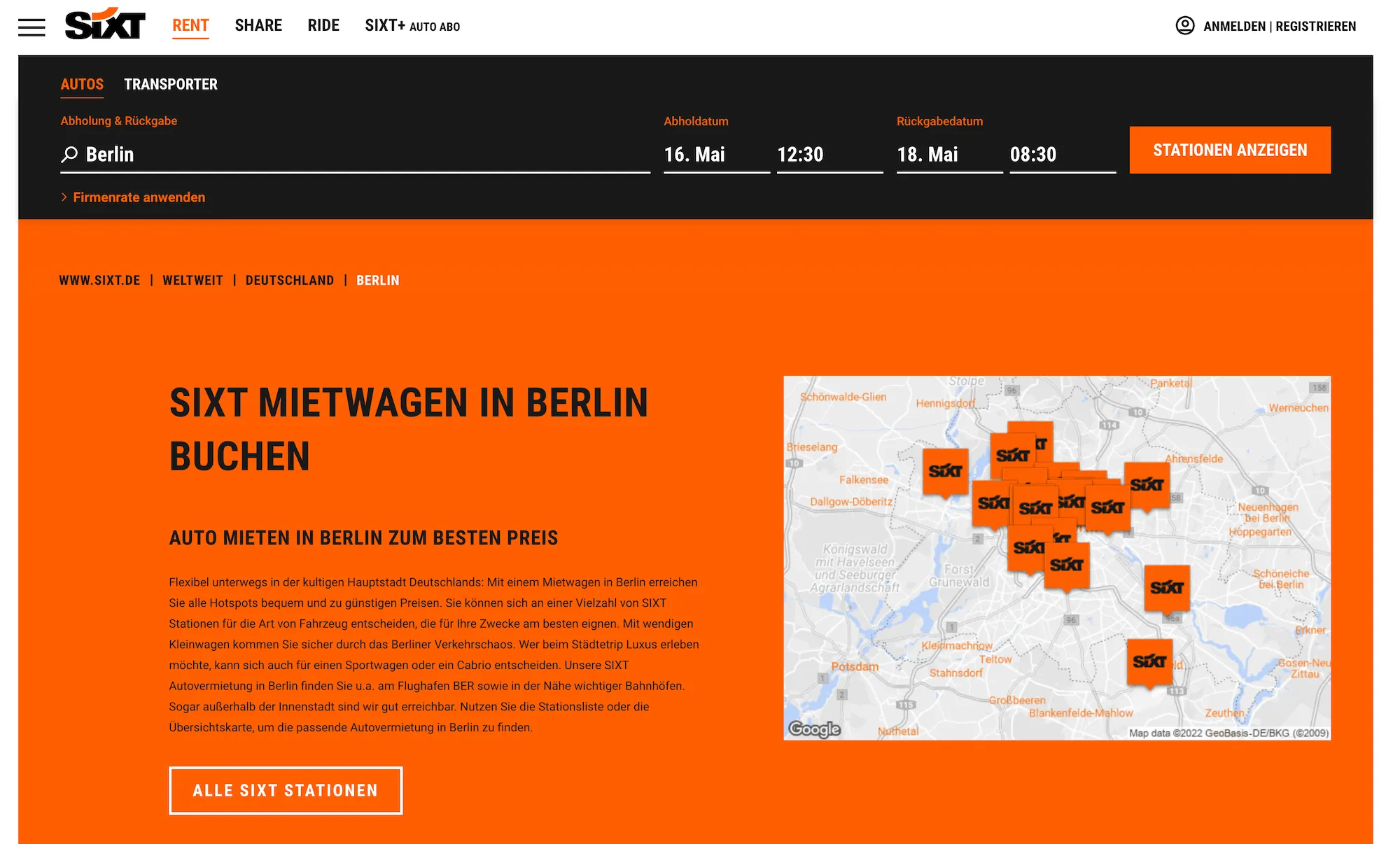
In its SEO strategy, Sixt connects its products with a regional approach. The special thing: the company does not have only a single page per city. It has its own geographic strategy under each important offer.
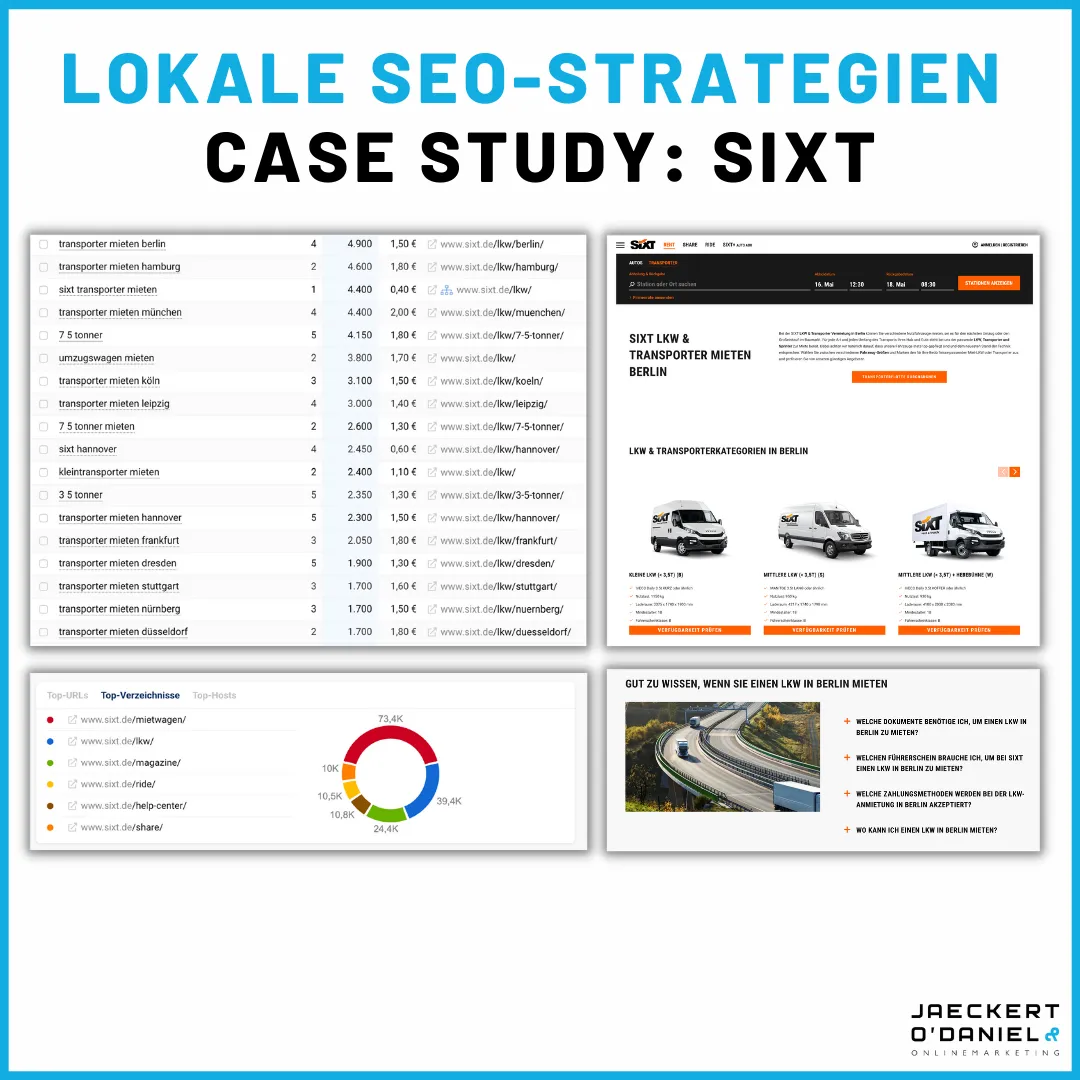
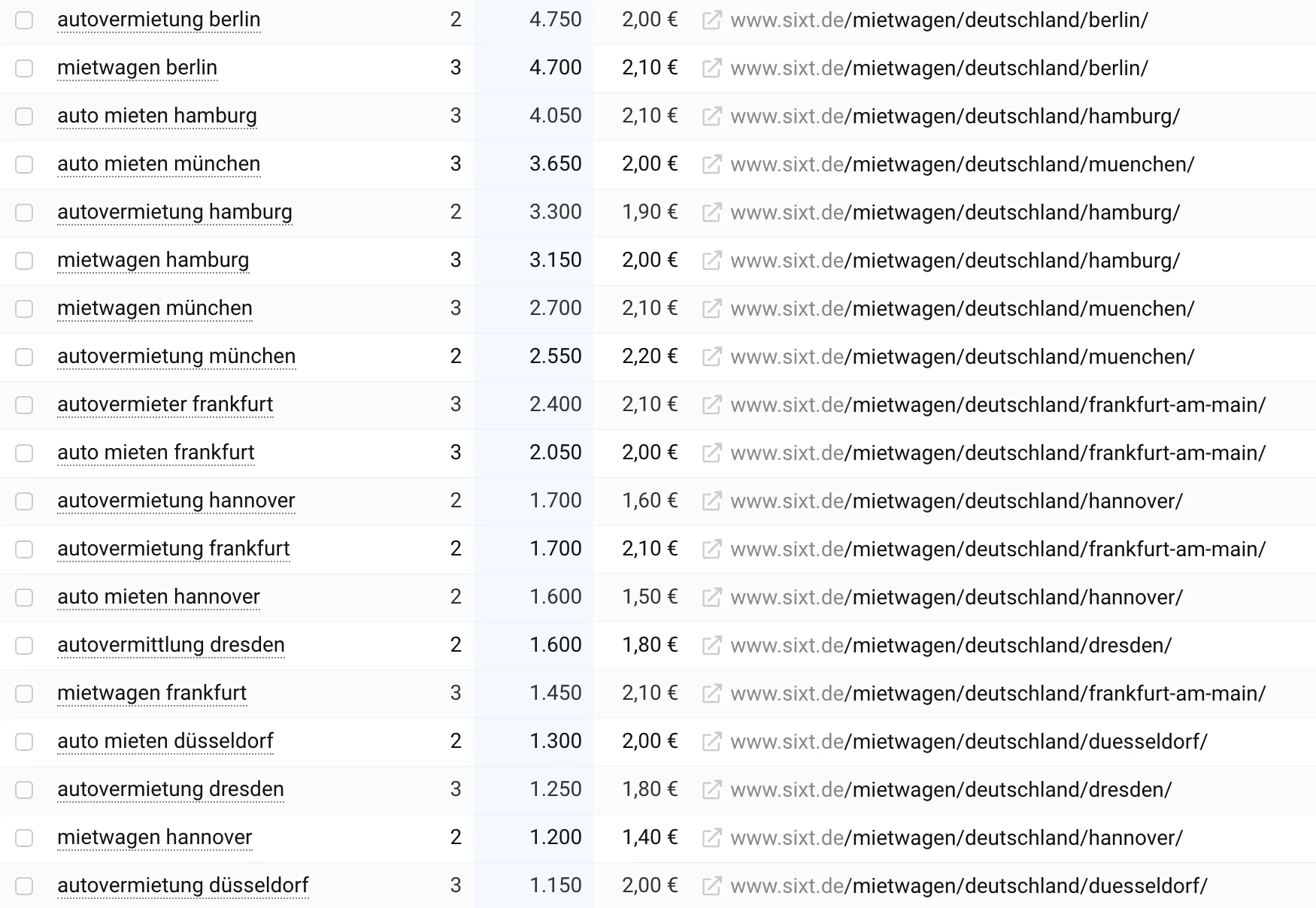
In concrete terms: in the “Mietwagen” (rental cars) directory there are hundreds of regional pages, all of which rank on Google. An extract of that can be seen in the chart. The keywords here are “Mietwagen München”, “Mietwagen Berlin”, and so on.
There are also regional pages for the van/truck offer, which target the keyword “Transporter + Stadt”.
There are separate regional pages for services such as limousine service and airport transfer as well.
You can also see very well in the ranking extracts what is typical for SEO. Each individual city has “only” a four-digit search volume. And smaller cities have a three-digit search volume per month. But volume makes the difference. And the very specific search intent. Because anyone who enters “Transporter mieten Düsseldorf” has a very specific interest.
On the regional pages themselves, the essential search intents are covered, from the most important topics through to ever more specific interests.
In an interactive tool you can check car and date and receive the offers of the regional locations. Below that there is a map for all users for whom it is more important to visit a location that is as close to them as possible.
Details follow after that. For example offers for business customers and frequent questions, for example where the station can be found at the airport.
You do not find a lot of text on these pages. From our point of view, that is not decisive either. What matters is to cover the search intents and to offer content formats that are as scalable and high-quality as possible, such as the interactive tool.
The prices in the charts are the click prices you pay per click in Google Ads. From that you can also determine an equivalent value of organic SEO rankings. Because for the organic visitors, no money is transferred to Google per click.
Lasting SEO traffic is a central value driver.
Our interviews with SEO professionals from the industry

How User Testing Works: Interview with Astrid Kramer on UX and SEO
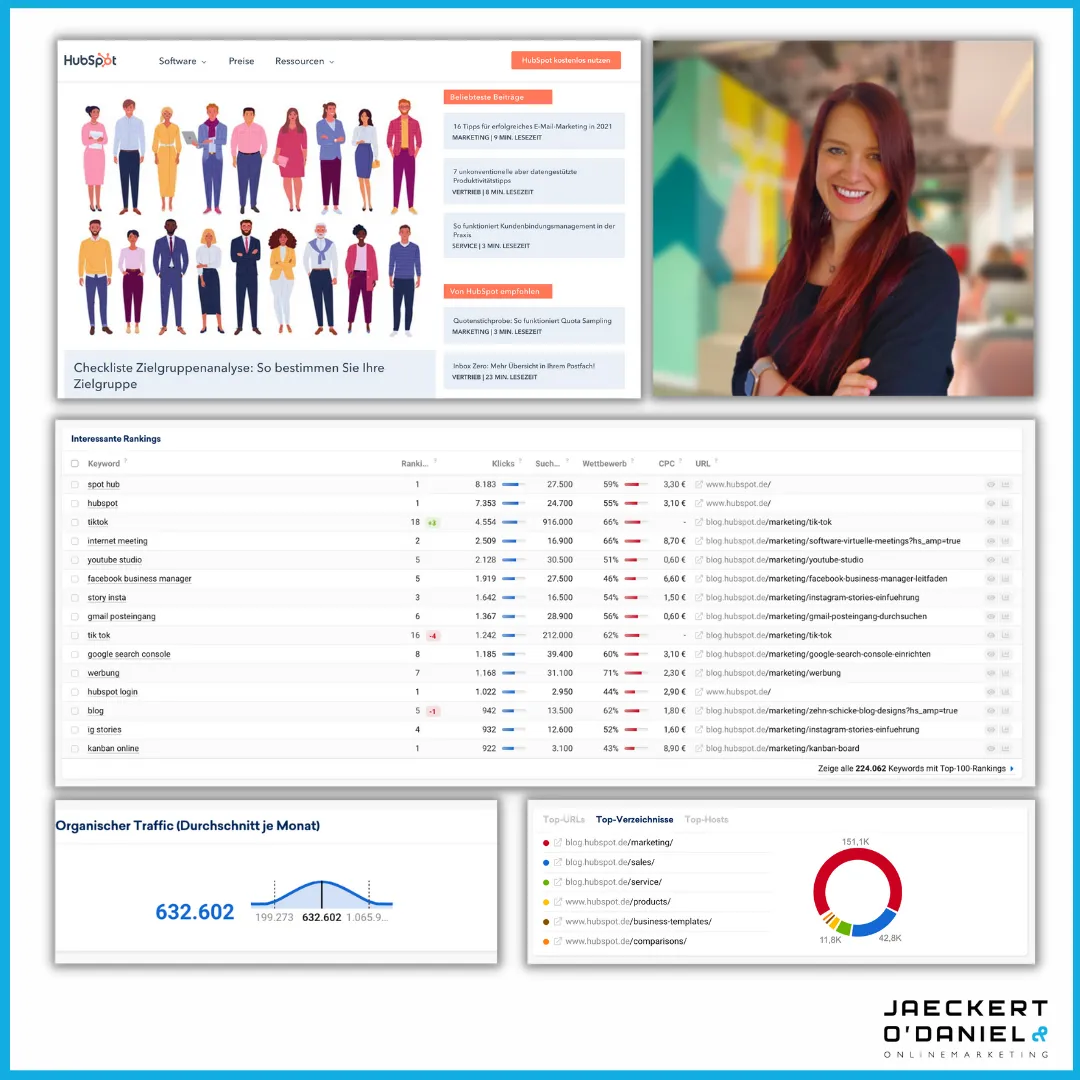
Hubspot's SEO Strategy: Interview with Jenny Lapp
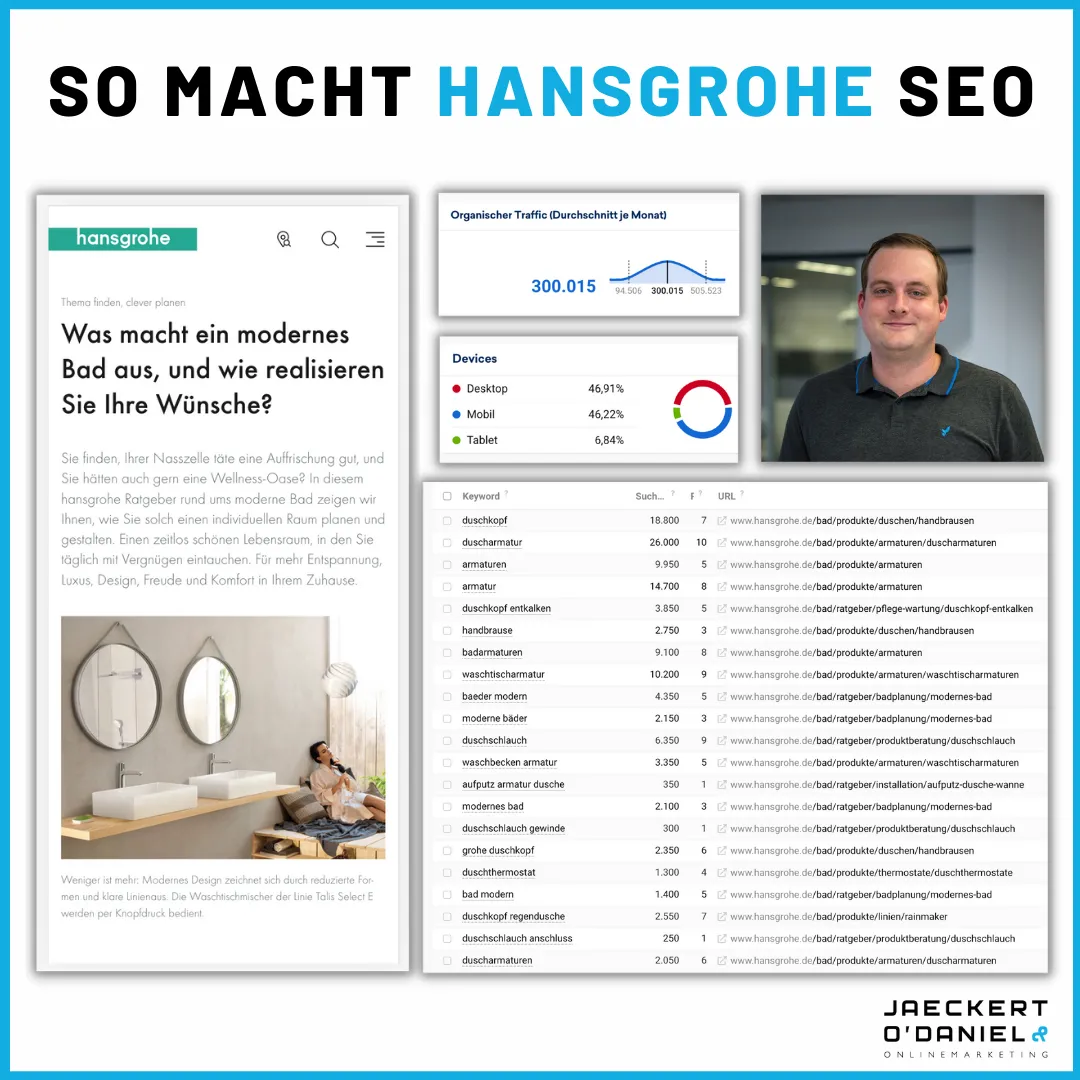
How Hansgrohe Does SEO in 40 Countries: Interview with Jörg Niethammer
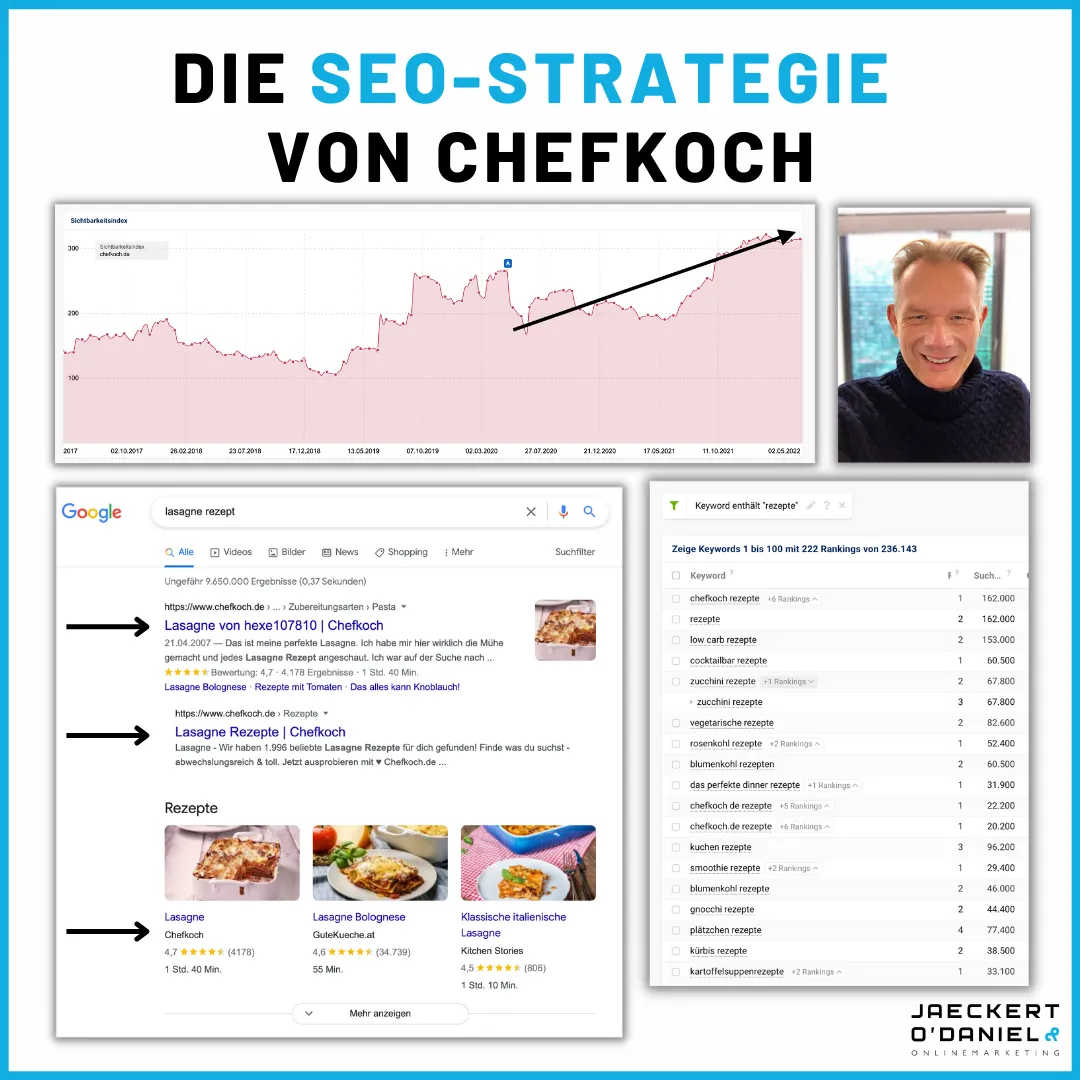
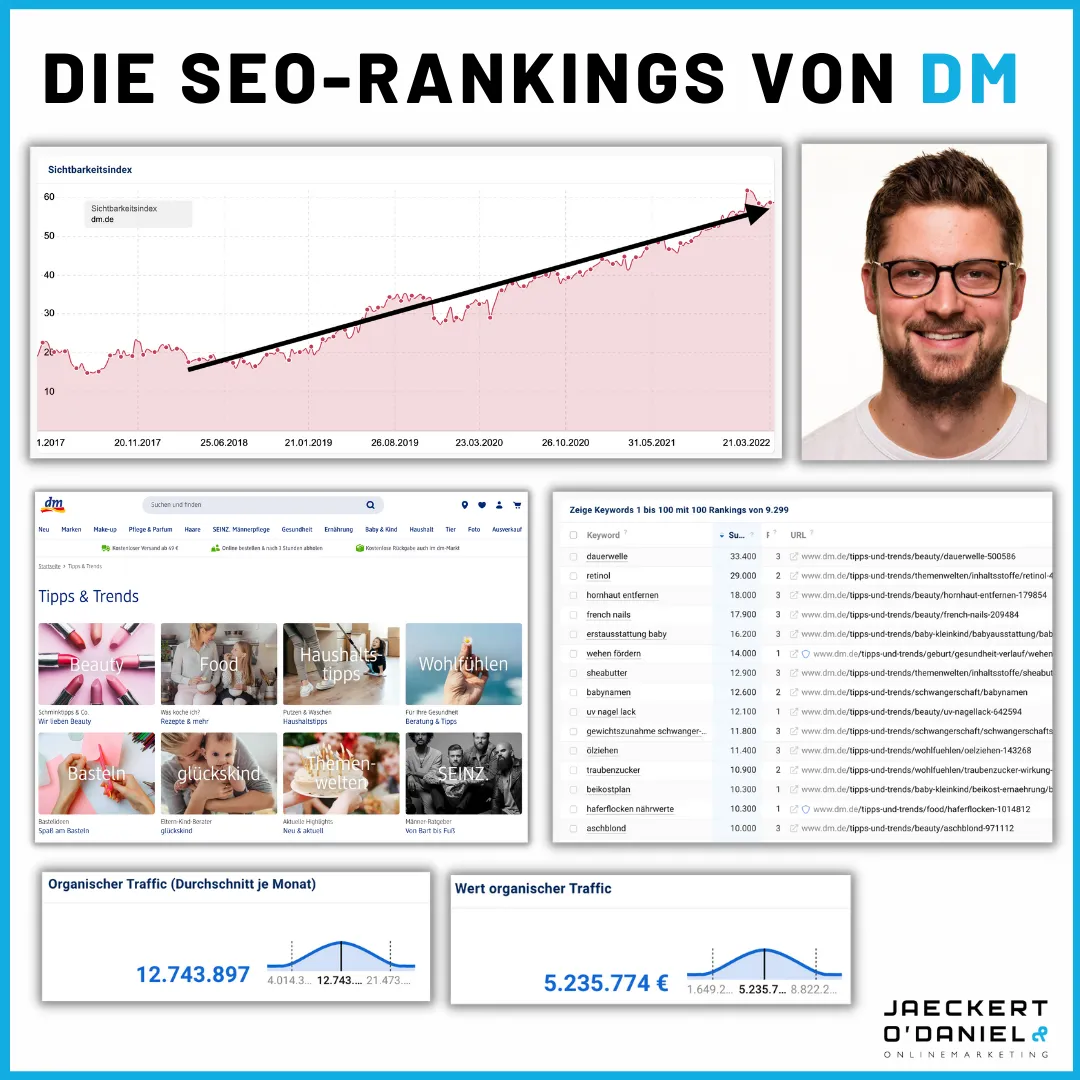
How dm Increases Its SEO Visibility: Interview with Philipp Hassinger

SEO Quality Assurance: How to Protect Your Rankings - Interview with Gianna Brachetti-Truskawa
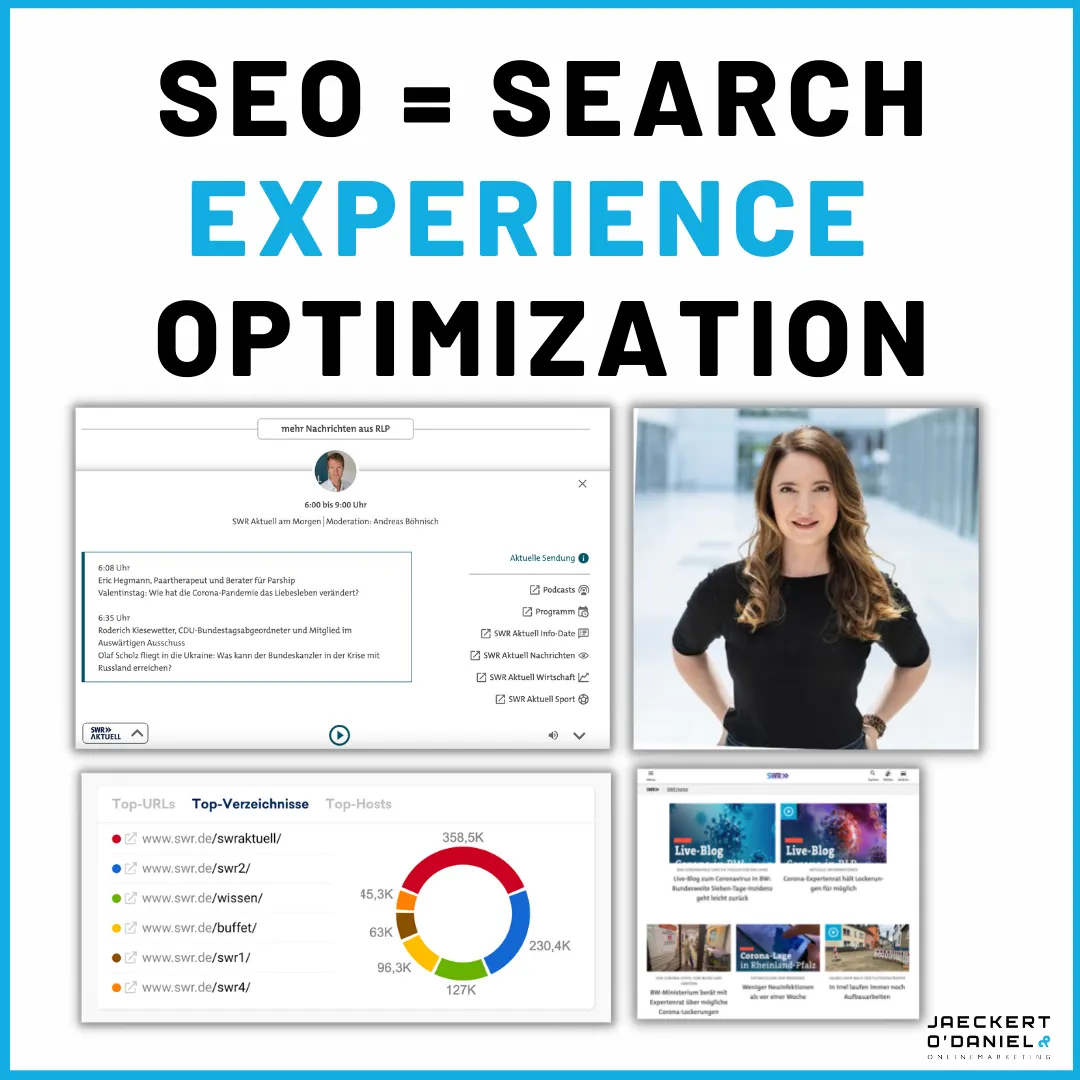
How Südwestrundfunk (SWR) Works on Search Experience: Interview with Sarah Stein

How Reishunger Uses Its SEO Traffic: Interview with Benni Uhlmann
We develop SEO strategies for brands

We are Fabian Jaeckert (on the right) and Benjamin O’Daniel. For many years we have advised mid-sized companies on how to get more visitors through Google and turn that traffic into inquiries and sales. So that the website becomes a measure that supports sales. Through high-quality content.
With Jaeckert O’Daniel, it quickly became clear to us that we had made an excellent choice in selecting potential partners for our online marketing project. Their expertise and, above all, their ambition to thoroughly immerse themselves in our specific industry topic to provide us with the best possible support, are precisely what is now propelling us forward.
 Tobias ReitmeierF.EE Group
Such a regional approach is one way of proceeding among many. Every SEO strategy is about developing your website structure and your content on the basis of search data. So that you cover the demonstrable information needs of potential customers.
Many marketing teams, however, have numerous projects on the table. They know that search engine optimization is relevant. But the concrete implementation, above all developing a well-founded SEO strategy, is very hard for them.
That is exactly what we have specialized in. On the basis of an SEO audit, we then develop a viable SEO strategy and present it to the people in charge in a structured and understandable way.
After that, we accompany the in-house leads as a sparring partner during implementation, when needed.
Sounds interesting? We can set up a 30-minute SEO introduction by video call.