April 13, 2020Fabian Jaeckert
Podcast Statistics: Which Numbers We Actually Look At
With podcasts, everyone looks at the downloads, that is, at podcast reach. Yet this single figure helps little.
There are some hidden figures that say much more about quality and content performance.
In this episode and on this page we discuss listener numbers and our personal KPIs, and how we measure success.
Podcast statistics: the topics on this page
Podcast: typical expectations of the medium
Reach?
For many people in charge, reach, that is the listener numbers, is the decisive criterion. That applies to podcasts produced and marketed by classic publishers. But often also to corporate podcasts produced in a marketing context. In our view that falls short. A podcast is a deep-dive medium. Listeners dive in deep and stay a long time. With us, more than an hour per month (source: Podcast iTunes Analytics).
Sales tool?
A second mistake: a corporate podcast is seen not only as a marketing tool, but also as a sales channel. The result: the content is too promotional, too focused on the company. In our view a wasted opportunity. There is much more in a podcast if you place the medium in the context of content marketing. It is also about being personally visible as a podcast host in social media, and seeking the conversation with the audience there.
Podcast listener numbers
More than 10 million people in Germany actively listen to podcasts, about 4 million even to a show every day. That is the finding of a study by Goldmedia together with the host Podigee (source). Podcasts are therefore not a niche. On the other hand, use is not as widespread as video or general website consumption.
Seeing your own podcast listener numbers? If only it were that simple…
User
A simple calculation example: a podcast with many episodes gets 50 downloads. Was the podcast downloaded by 50 different people, or by one person who downloaded 50 episodes? Both variants are possible. We quite often see a listener download many episodes from us. The download on its own is therefore a very fuzzy number.
Time span
Some podcasts have a strong long tail, especially when they were produced to be timeless. Our online marketing podcast is knowledge-oriented. We deliberately do not discuss news. Listener numbers therefore rise strongly over a longer period. Example: a podcast has 500 downloads on the first day. But several thousand downloads in total over a year.
Dwell time
A podcast can have very large listener numbers. But how intensively is the audio format consumed? Example: when an Instagram star starts a podcast, it lands at number 1 in the iTunes charts immediately. The followers simply download the podcast. But do the users also listen, and if so, what percentage of the episode? Questions of content performance like these are hardly asked.
Podcast listener numbers: statistics from Apple, Spotify, and Podlove
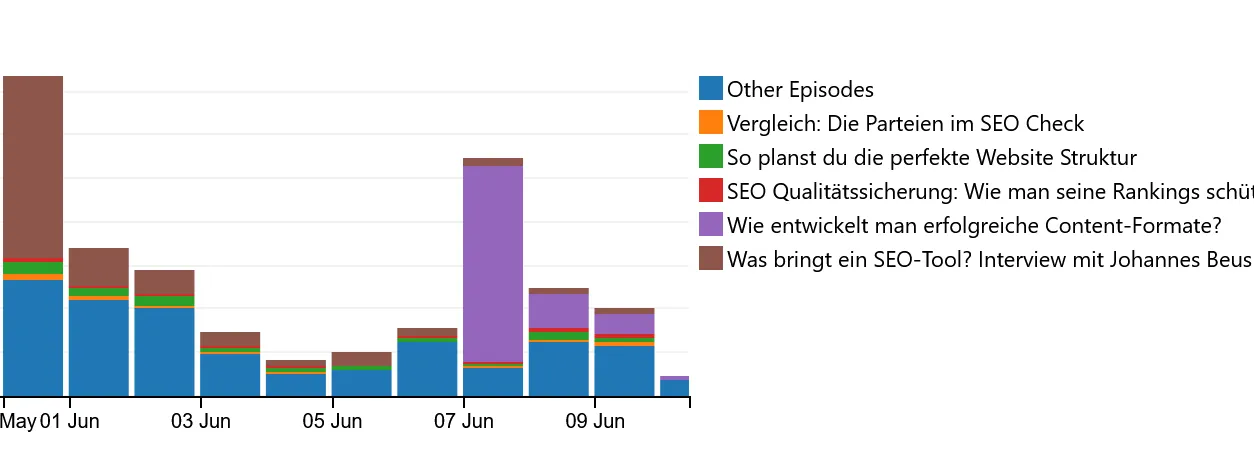
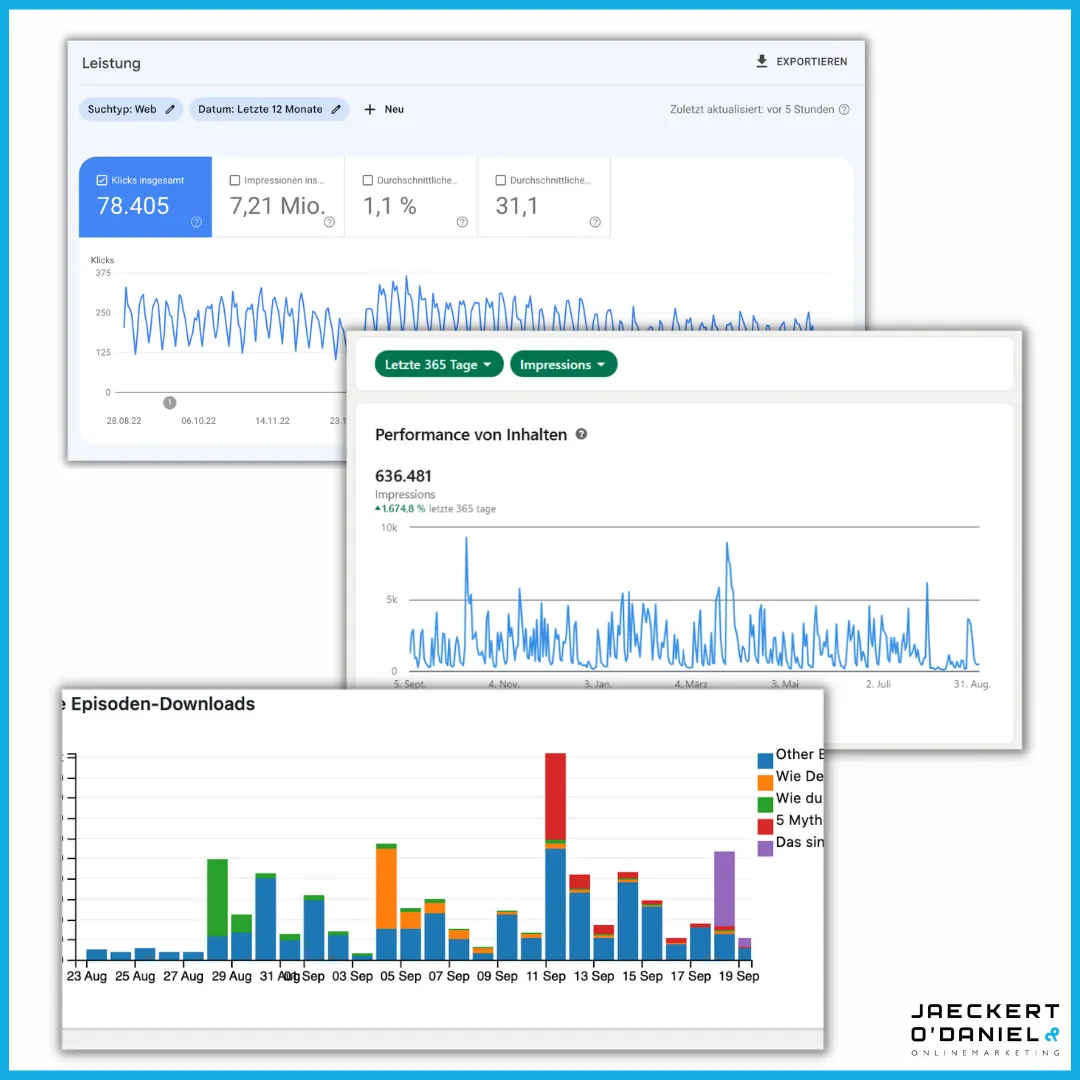
In Podlove, a plugin for WordPress, you get the download numbers displayed. We always publish on Mondays, as you can see clearly here. Because then the downloads go up automatically, since the smartphone loads the new episode automatically. The “Other Episodes” are always interesting too, earlier episodes that are also loaded. For example when someone newly starts with our podcast.
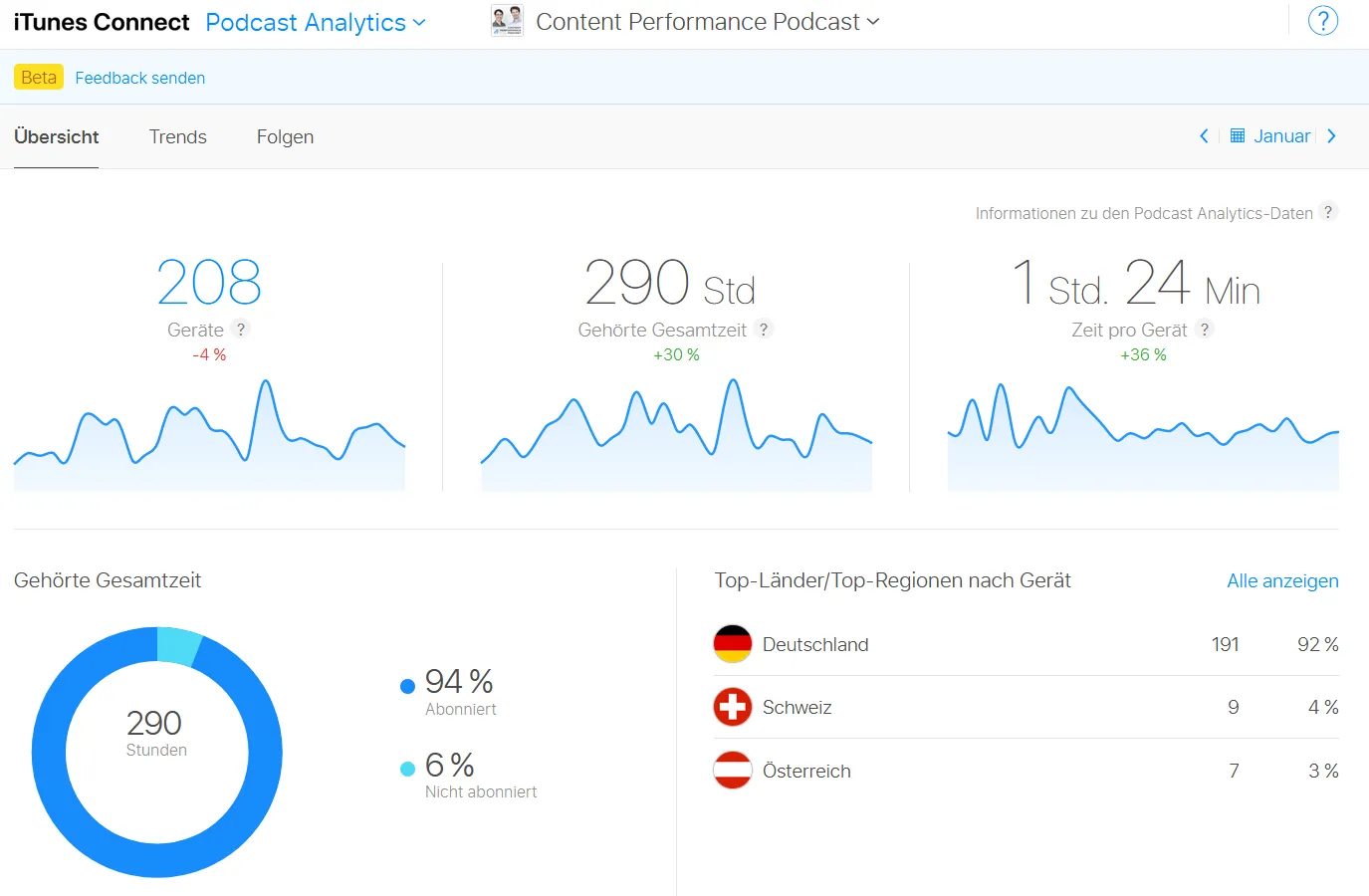
Listening time is an important metric for us. More precisely: listening time per month per device. We personally know no other medium in which users give someone so much attention. Podcast listeners are very loyal. The chart comes from Podcast Analytics in iTunes Connect.
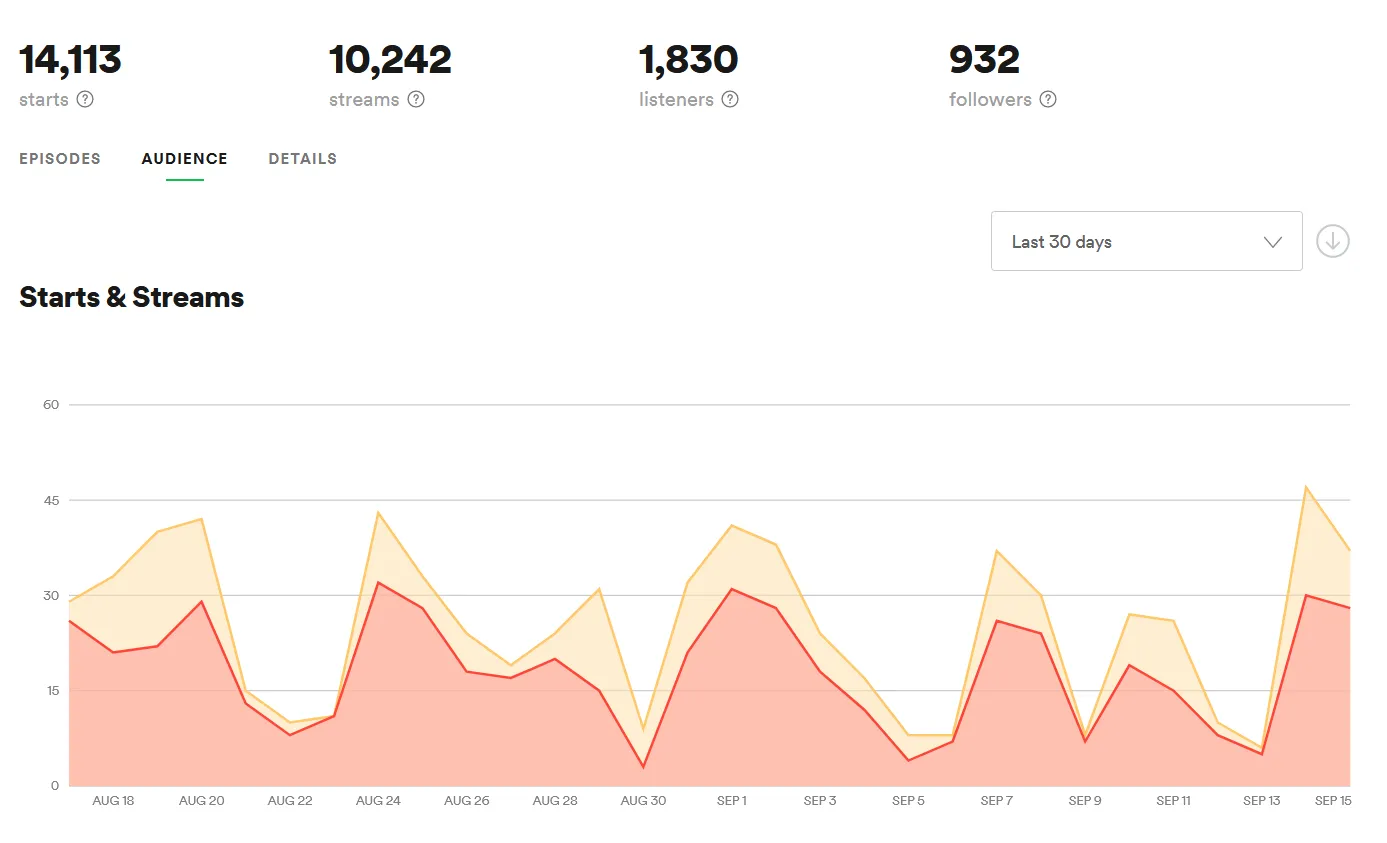
Only started, or listened to the end? Spotify distinguishes between “Starts” and “Streams”. You can see that in Spotify for Podcasters.
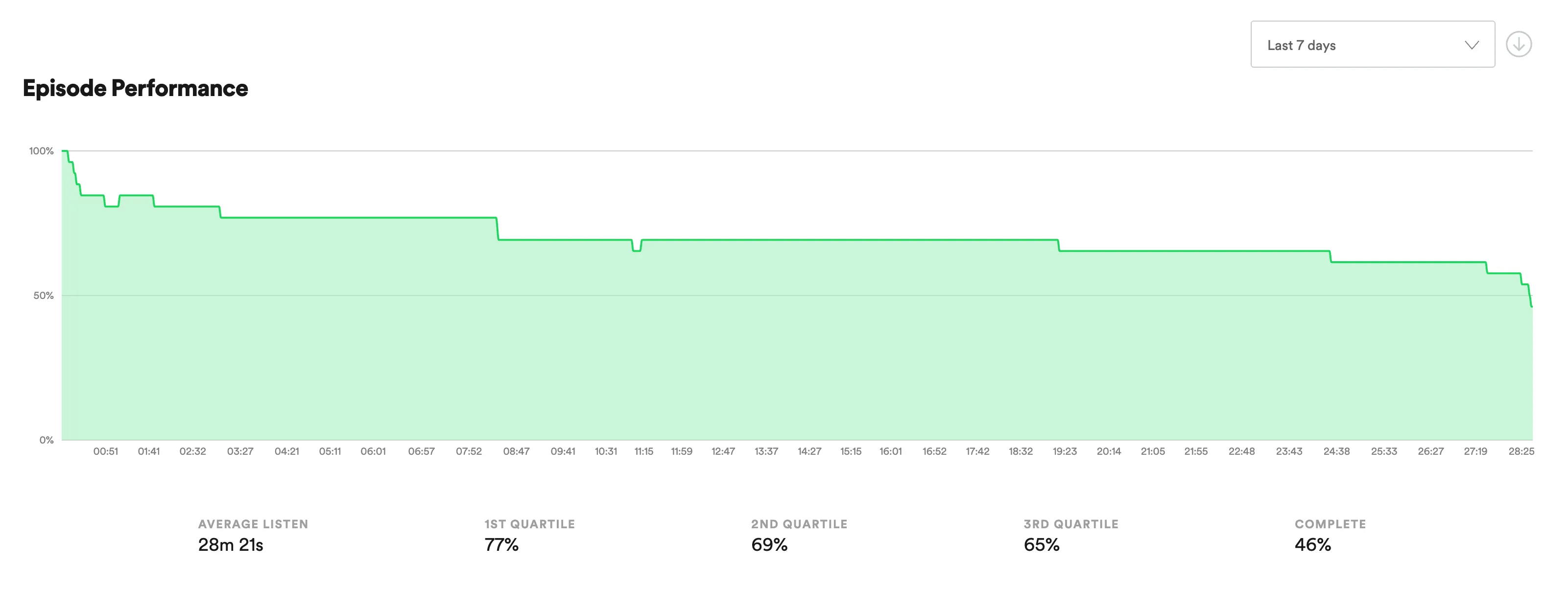
Dwell time within an episode is an important metric for us too. It shows us how long listeners stayed with it. We compare this with other episodes.
How do I get more listeners for my podcast?
Since 2017 we have published an episode of our Content Performance Podcast every week. It is a specialist podcast in the marketing category. There we share our knowledge from practical work as SEO consultants.
We advise many active podcasters. Because Google traffic is a valuable channel for getting more listeners for the podcast. The two channels complement each other very well.
Do you want more visibility on Google too? In our SEO Academy we share our practical knowledge. We show how to develop an SEO strategy, work efficiently with SEO tools, and develop high-performance content. Explained clearly. Fully remote. With live calls.
We are happy to meet you and introduce our SEO Academy (30-minute Zoom call).
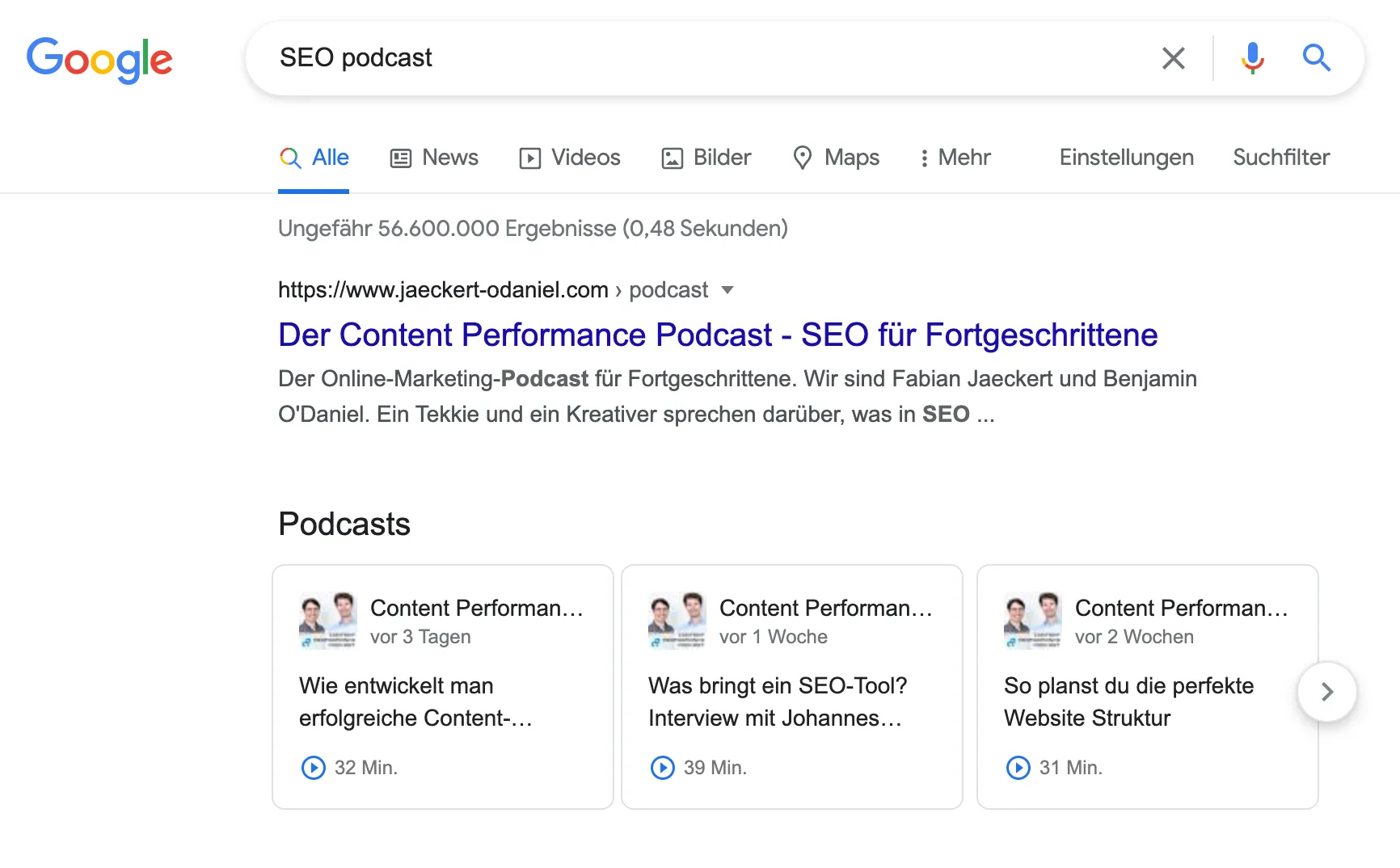
In Google search we rank at the top for numerous terms. Both in connection with podcast and with other specialist topics. That is how new listeners come across us.

Experts on our podcast: a selection


Twice as visible as Airbnb: Interview with Dominik Schwarz

1 million users a month with the right content strategy: Interview with Jan Brakebusch

Are you relevant enough for Google? Interview with Olaf Kopp on the entity model

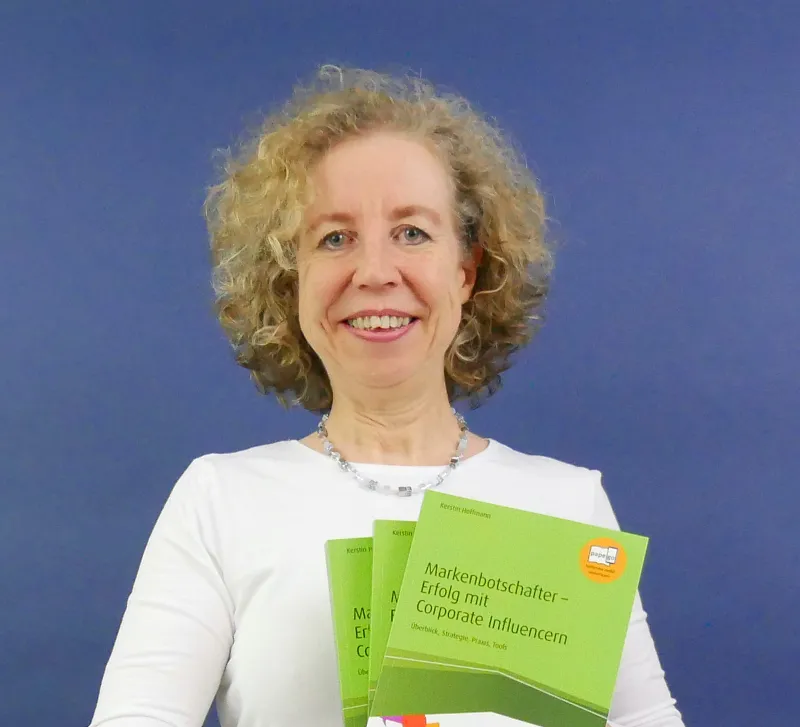
How do I become a personal brand without clumsy advertising for myself? Interview with Kerstin Hoffmann

How to build a successful startup: Interview with Johannes Kliesch

Content design: examples from practice. Interview with Robert Weller
Podcast listener numbers: how we look at the topic
Our goals
With our podcast we pursue a number of business goals. We can show what we know. We make numerous new contacts. We get smarter through our interviews and our listener feedback. And we receive very good inquiries. Many of our customers today already knew us beforehand through our podcast and choose us quite deliberately. Our podcast is therefore also a sales tool, but at the same time much more.
Our KPIs
For downloads we look at the first day and compare that with the previous episodes. We also look at how many downloads we achieve in four weeks and in a quarter, and compare that. Another central metric is dwell time, which you can determine via iTunes Podcast Analytics and Spotify Analytics. That way we see when users drop off, and draw conclusions about the editorial structure of the episode.
We share our expertise here too