June 23, 2025Fabian Jaeckert
B2B Marketing in Upheaval: Gilbert Schwartmann on Budgets, Channels, Customers
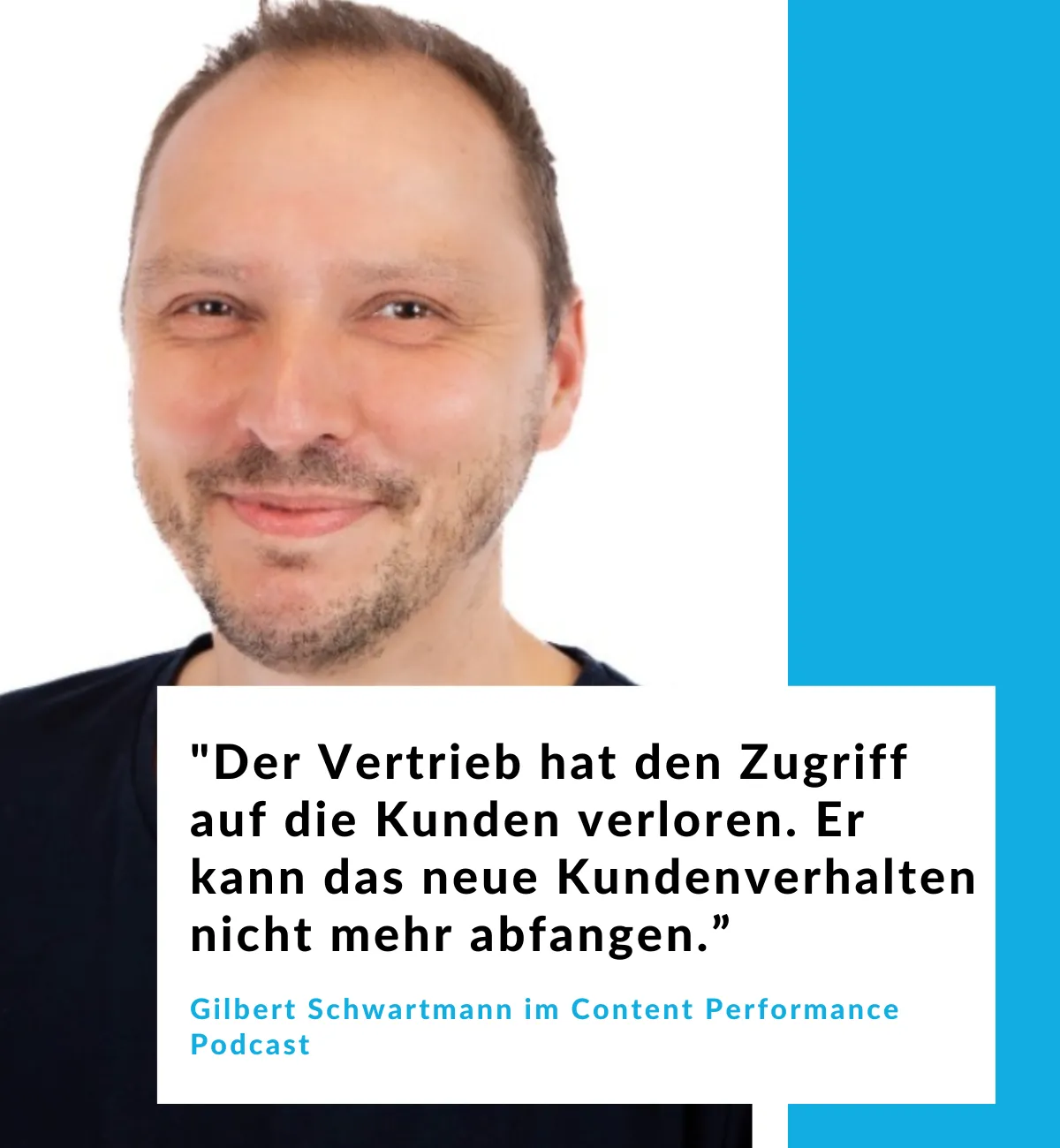
It used to be easier in B2B. You made an annual plan, agreed growth targets, and sent sales out. But that is over. “Sales has lost access to the customer,” says Gilbert Schwartmann. Marketing is in a similar position. Traditional channels perform worse and worse.
What are the reasons behind that? How does B2B marketing have to change? We talk about it with the experienced B2B marketing consultant, who has already held several leadership roles in industrial and software companies. We talk about budgets, calculation, the marketing mix, and customer behavior.
As always: the deep dive in the podcast, the summary here in the article, and the discussion over on LinkedIn.

Our guest: Gilbert Schwartmann
Gilbert Schwartmann is an independent B2B marketing consultant. In parallel, he is responsible for marketing at Bobcat in Europe. Bobcat is an international mechanical engineering company that sells wheel loaders. Before that, Gilbert worked as Head of Marketing and Vice President Marketing for companies in industry and software.
On LinkedIn, Gilbert also shares many of his impressions of B2B marketing and points to interesting sources and studies.
How high are B2B marketing budgets in Germany?
A certain share of a company’s revenue goes into marketing. Here Gilbert puts the range at 0 to 5 percent. In his experience, software companies sit between 2 and 5 percent. In industry, by contrast, the revenue share is often well under 1 percent. The BVIK budget study found that the revenue share averages 0.5 percent.
A worked example: if a company makes 20 million in revenue, the average marketing budget in industry is 100,000 euros, excluding personnel costs. In the software sector, the budget is calculated at 300,000 to 400,000 euros.
This budget is often spread very one-sidedly across a few pots. A large share of this spending flows into trade fairs and Google Ads, even though the costs and click prices keep getting more expensive. Gilbert’s experience matches, among other sources, the BVIK study, which reaches a similar verdict.
“The great majority of B2B companies are set up very one-sidedly for new-customer acquisition,” says Gilbert. “That worked for a long time. But it no longer does. Because the customer journey in B2B has changed completely.”
How is the customer journey in B2B changing?
Over the course of his career, Gilbert has spoken very often and regularly with the people responsible in sales. What he hears more and more: many customers no longer respond to calls. Others show up completely unplanned with large orders. The next customers already know everything and made their decision long ago. Sometimes sales only takes the order (which anyone could do). Sometimes it has no chance at all. “There is a great deal of confusion in sales.”
The cause behind it: the customer journey has changed completely. Customers inform themselves across every channel and platform, including long before the actual purchase decision. Gilbert’s impression is also confirmed by analyses from Gartner and the McKinsey Pulse study.
AI systems now make customers even better informed. They run deep research in ChatGPT, for example. For Gilbert it is clear: “Sales has lost access to customers. It can no longer catch this new customer behavior.”
For this new customer journey, companies need better content on more organic channels. That includes their own website for Google and AI systems, but also LinkedIn, newsletters, or YouTube. Yet this is exactly where most B2B companies are still relatively at the beginning.
So marketing is needed even more. To build reach and relevance, but also to be concretely co-responsible for new-customer business.
What does that mean for the people responsible for marketing?
Whether a company grows is decided in marketing. But the role that follows from that for marketing is completely unclear in many companies.
What is often still missing is a clear strategy, from the target group through the channels to a clean line of argument. Marketing should also communicate offensively what percentage of new-customer business and of total revenue it carries. “Many decision-makers in B2B companies do not realize at all that marketing is a revenue factor.”
After that, the channels should be developed in depth. Both in terms of content and in terms of the numbers. His rule here is: “Own your numbers.” Know your own numbers, both the potential and the limits.
From here we go deeper in the podcast. Feel free to listen in, via Apple Podcasts, Spotify, and the rest.
Deepen your SEO knowledge: every Monday by email

We advise marketing leads on SEO, content, and AI
For anyone seeking an SEO sparring partner or comprehensive SEO consulting, Fabian and Benjamin are the perfect choice. As an in-house SEO expert, I sought competent SEO support and found it with them. During a very pleasant introductory meeting, we jointly developed an approach to establish SEO among the individual stakeholders and thereby gain more internal visibility for the subject. Based on this initial discussion and a joint kick-off with the stakeholders, they developed a sound SEO and content strategy for a product area. Since then, they have both supported me as sparring partners during implementation.
The collaboration with Fabian and Benjamin is a great pleasure for me and all project participants, as they are masters of their craft and bring immense passion for SEO. This combination is infectious and motivates everyone to achieve peak performance.
 Regina BiskopDeutsche Kreditbank AG
I look back with great satisfaction on the SEO project that we carried out with Benjamin and Fabian. Firstly, the collaboration was on a very pleasant, goal-oriented level. Secondly, the consultation was structured in such a way that we could immediately start with the implementation. We received very concrete optimization suggestions that were tailored to our internal capacities and therefore realistically implementable. Even though only a few months have passed, we can already see the first results of our work in the Google rankings. Traffic for our relevant keywords is steadily increasing, and we still have enough concrete work packages from Benjamin in the pipeline to boost our site. Furthermore, through the consultation, we have acquired so much internal SEO know-how that we can now optimize our site independently. And most importantly: Visitor numbers have doubled – with correspondingly positive effects on sales.
 Mark MaudererDigital Marketing Manager, Bierbaum Proenen
Our conversations with marketing professionals in the industry
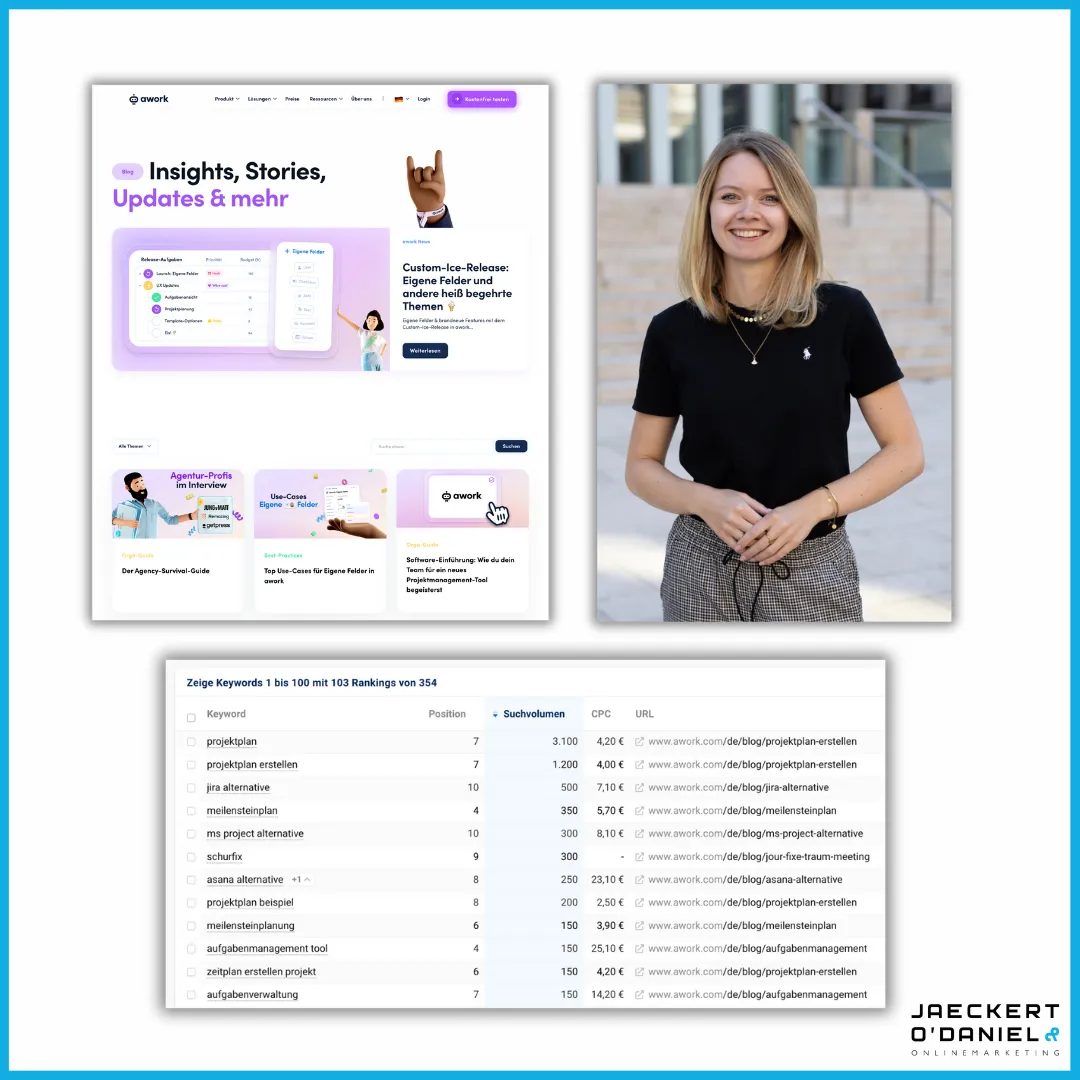
How the SaaS startup awork builds its SEO visibility: interview with Ayla Grzegowski

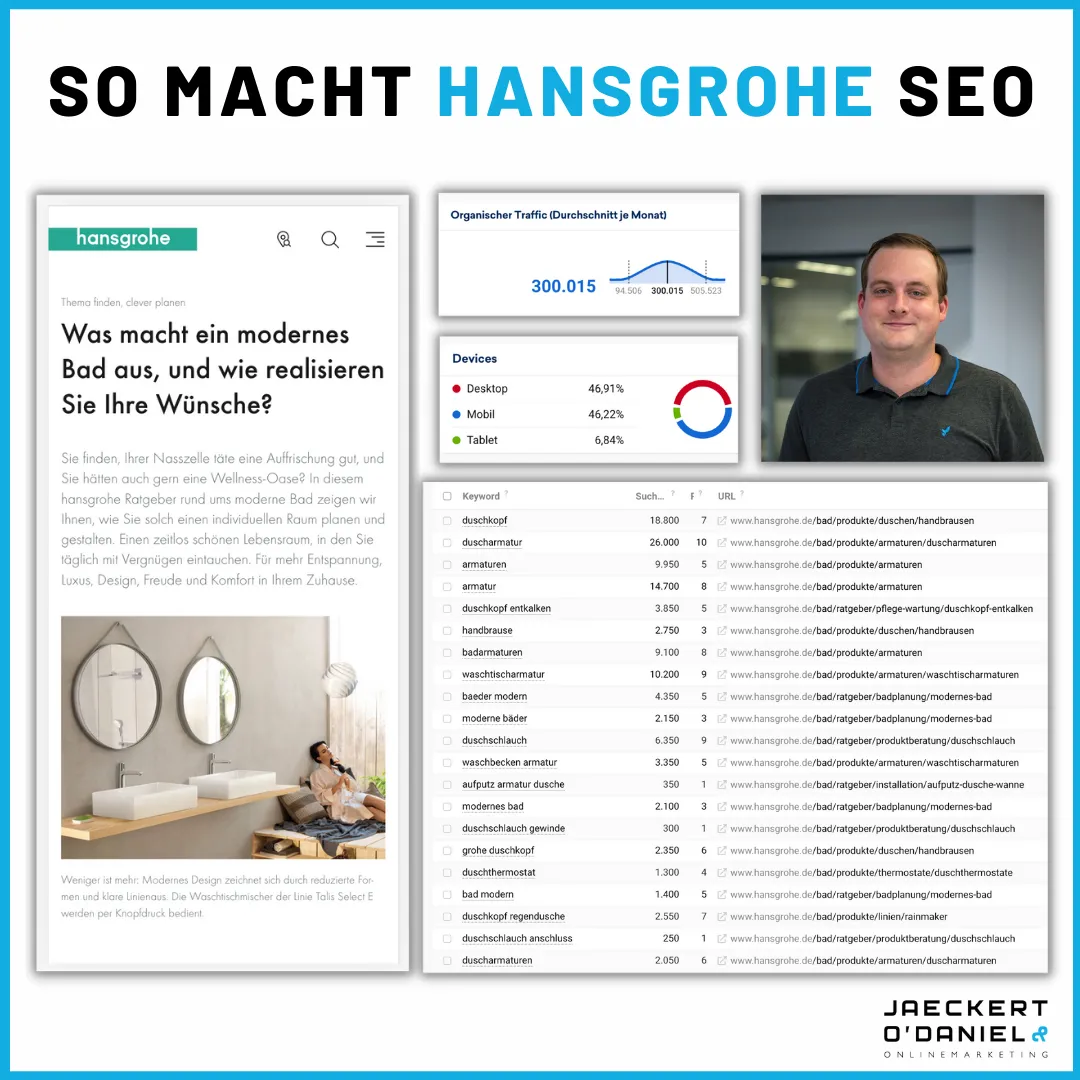
How Hansgrohe does SEO in 40 countries: interview with Jörg Niethammer


SEO for software companies: interview with Lisa Karasch