August 24, 2020Benjamin O’Daniel
How to Think About SEO and Social Media Together
Search engine optimization and social media are often seen as two different worlds. And it is not rare for managing directors and marketing leads to ask themselves which channel they should invest in.
But SEO and social media interlock, on three levels: in the discussion about ranking factors, in the content strategy, and in the KPIs.
We talk about that in this episode and on this page. In the end it is about high-quality, relevant content that addresses users, and thus potential customers, and convinces them.
SEO and social media: how the discussion often goes
Ranking factors: social signals and SEO
There are over 200 ranking factors for why a page is at the front. In the SEO industry it has been discussed for many years whether social signals are also a ranking factor. Example: a blog article that is shared often on social media (social shares) is also at the front in the Google ranking. That is not the case, though. Google has said very clearly for years that social signals do not flow into the algorithm. However: from our point of view the question is wrong, or posed too narrowly. It leads to writing social media off, along the lines of: we do not need that for SEO. The opposite is the case.
Working world: different personalities
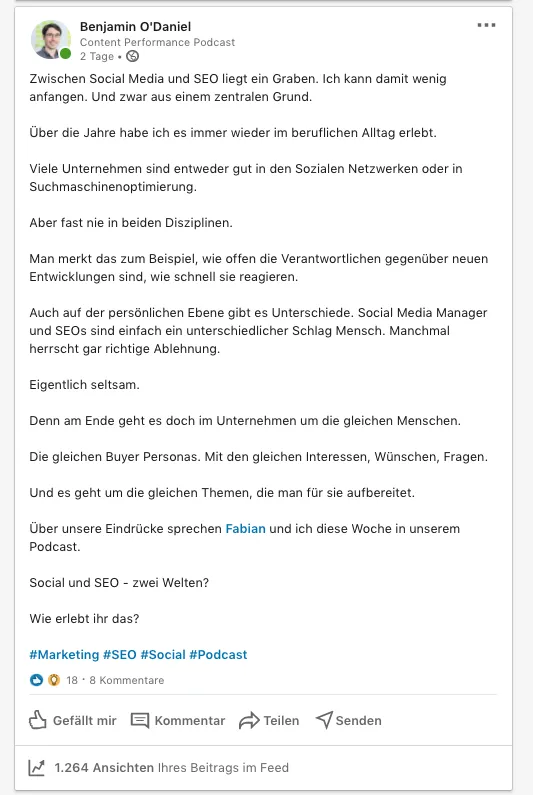
Our subjective view: social media managers and community managers are simply a different kind of person from search engine optimizers. SEOs are technically oriented and strongly driven by numbers. They are often measured by SEO traffic and revenue. Personally, many SEOs like to fly “under the radar”. Social media managers, by contrast, are more creative personalities, work visually and with people, and spark discussions. That also creates interpersonal friction, or even an ice age between these two groups.
KPIs: wrong expectations of the respective channel
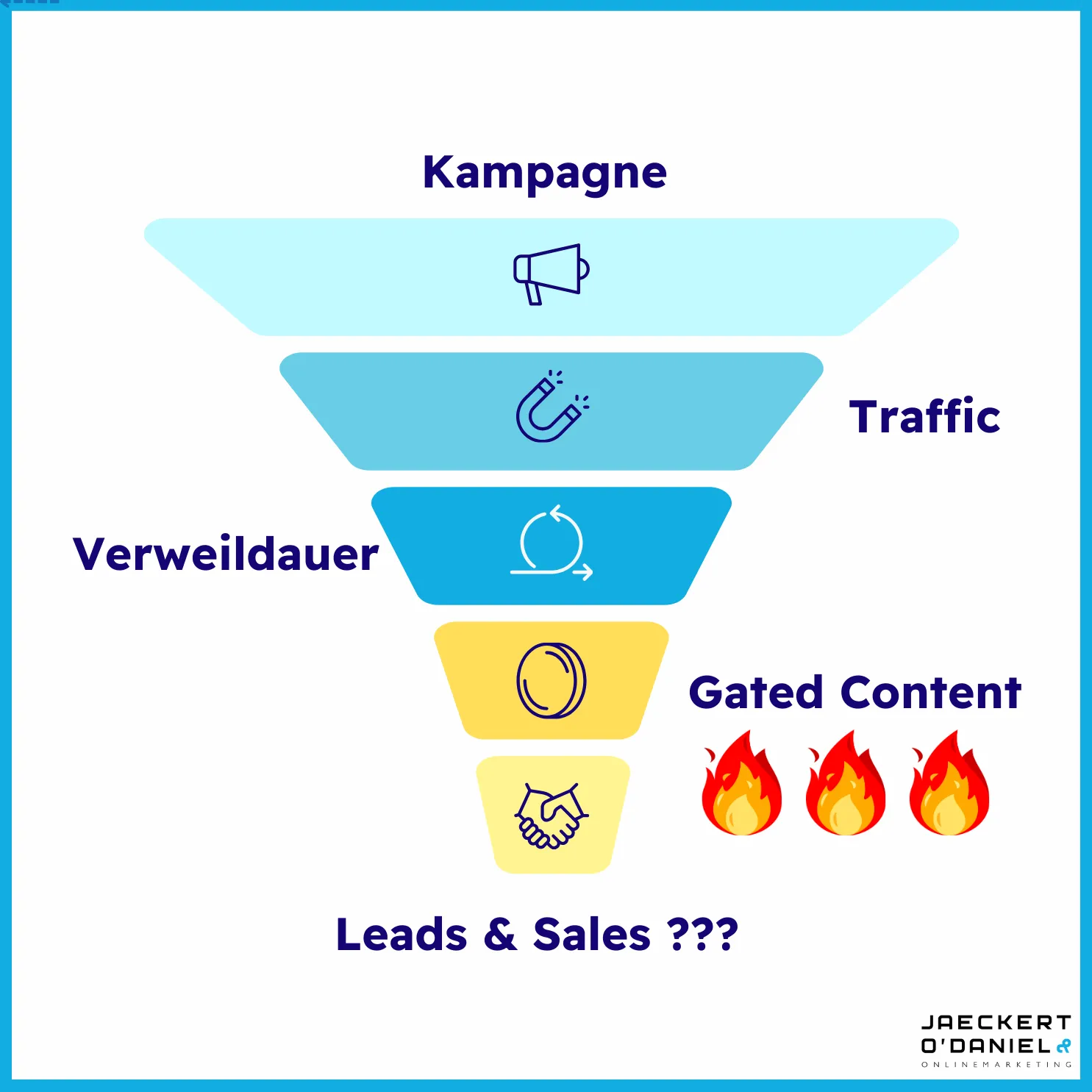
A common classification: social media is at the upper end of a funnel (“top of the funnel”) or at the beginning of a customer journey. The value is attention and reach. SEO, by contrast, is often placed at the lower end, when it is about concrete leads or sales. But that too is only a very rough template. After all, with SEO you can also optimize for informational topics, depending on the search intent. And the fact that social less often leads to direct sales is an argument that likewise cuts short the value of social networks.
Search engine optimization and social media: why both worlds belong together
Ranking factor branding
Brands have a ranking bonus. In the SEO industry this is called brand search. The search engines often show brands in the top results, because that guarantees good quality. How do companies become brands? Through strong social media measures and by building the channels. Social therefore pays into the brand, and the brand in turn into the ranking.
A unified content strategy
Whether on social or on the website: it is about the same people. The same target groups, or buyer personas, are addressed, and so the arguments are very similar too. Every piece of high-quality website content is also a treasure trove for micro content on social media.

KPIs are converging
An interesting parallel: both on social media and in SEO, metrics that measure content performance now play a role. Concretely, this is for example about click rates, dwell time, and bounce rates. In the end it is always about this: does the content piece “work” in the respective channel?
Social media and SEO: practical examples and tips, through our newsletter

SEO and social: an example
For many years we have worked as SEO and content consultants. We create SEO concepts, give SEO courses, or are brought in as a sparring partner. Here is more on our view of successful search engine optimization.
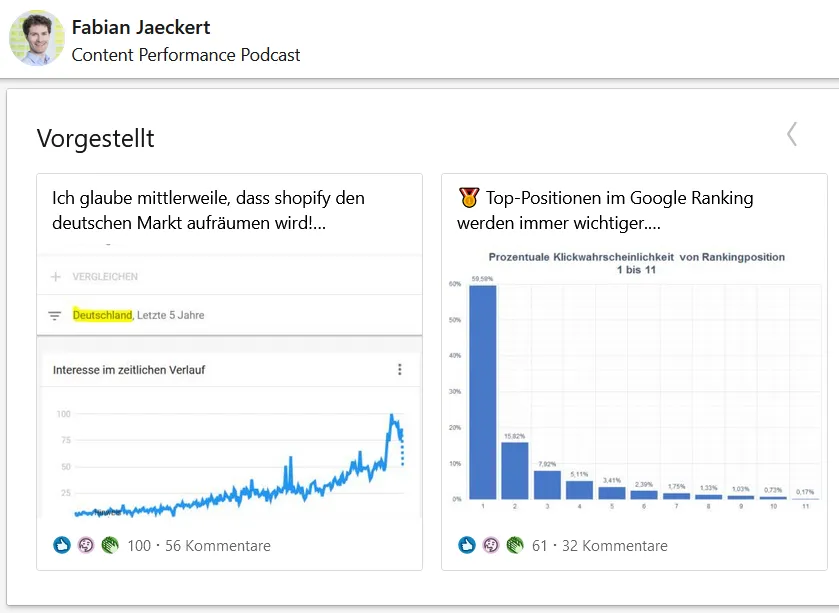
At the same time we are active on LinkedIn, share our knowledge there, and discuss with our podcast community. Here too we see a direct connection between LinkedIn activity and brand search. And here too this applies: they are the same people, namely online marketing professionals.
By the way: you can connect with us on LinkedIn.
Tips from experts on SEO and social media: a small selection
Interviews on SEO
How do I do SEO for a software platform or a software company? Kevin Indig and Beat Köck answer that question in the interviews with us. Dominik Schwarz talks about how brand communication and SEO interlock. Jan Brakebusch explains how SEO works in healthcare, and why YouTube is so important.
Interviews on social media
What does professional community management look like? Vivian Pein explains that in conversation with us. Specifically on the LinkedIn platform, Jens Polomski shares many insights. How do I become a personal brand? Kerstin Hoffmann answers that in the interview. Johannes Kliesch is the example of a startup founder who sees social media communication as a core task.


SEO for a software company: interview with Beat Köck

Twice as visible as Airbnb: interview with Dominik Schwarz

1 million users a month with the right content strategy: interview with Jan Brakebusch


Community management in companies: interview with Vivian Pein

Tip: who would personally share their SEO content on social media?
Often content for the website is created without care. Old SEO texts are still around in large numbers, even though hardly anyone reads these texts. At the same time, practically all specialists are on LinkedIn with professional accounts.
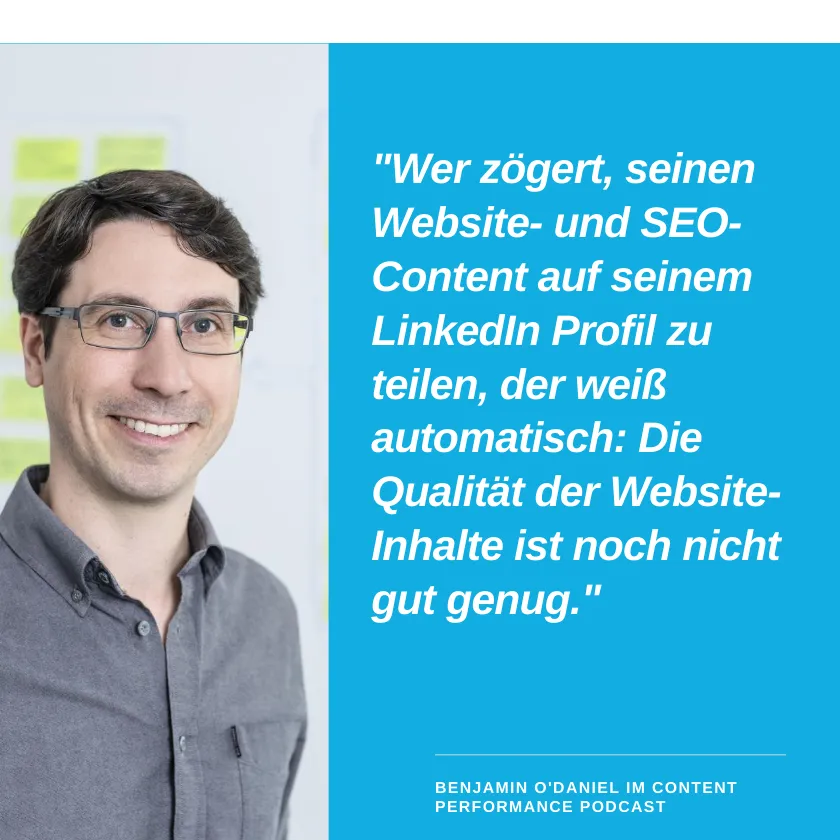
So a thought: anyone who hesitates to share their website and SEO content on their LinkedIn profile automatically knows the quality of the website content is not good enough yet. You do not want to stick your neck out for it yourself.
The reverse is: anyone who hesitates has to keep working on their website content. Until you personally stand behind it too.
SEO and social: our discussion with our listeners
SEO and social media: our experience
Benjamin: Today we talk about how to think about SEO and social together. #00:00:25-0#
Fabian: Yes, think about them together. Normally they are always seen as two worlds, right? #00:00:29-0#
B: Yes, exactly. And somewhere they are two worlds too, but they have quite a lot of connections. And actually, we thought beforehand that we really have to start with a confession, namely that we ourselves, the two of us, have really learned quite a lot about this over the last three years. #00:00:48-0#
F: Yes, that is true. Especially on LinkedIn we are pretty active by now, right? But you were already out and about quite a lot on Twitter before, right? #00:00:53-0#
B: Exactly, I had been active on Twitter for longer too, although I have pulled back quite a bit there. But still, I think that we also did an episode earlier about SEO versus social, so to speak, and there I think we rather dismissed social a bit (laughs), at least looking back, as far as I remember. #00:01:19-0#
F: I mean, we also rated the different forms of traffic, right, what does it do for me as a business? #00:01:22-0#
B: Exactly. #00:01:23-0#
F: But there is a lot more behind it. #00:01:25-0#
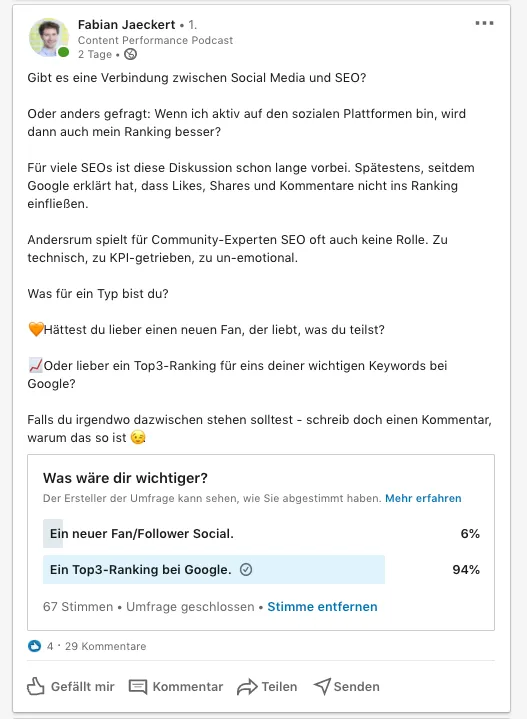
F: Yes, the first discussion that is always had in this area is also whether it is a ranking factor at all or not, or whether social signals flow into the algo. That is always how it goes. But I think the discussion often stops there. People always discuss whether it is, one says yes, the other says no, and then they go their separate ways. Yes, so I think that is the first thing we should maybe talk about. #00:02:12-0#
B: Yes, I think so too. So there is always the discussion that, I don’t know, two hundred ranking factors or so flow into the Google algorithm, and how important the social signals are among those two hundred factors. And then people say, we ran this test and that test, and in the end it turns out that social signals are not important at all, so they are not an important ranking factor, so backlinks, for example, are much more important. #00:02:41-0#
F: Yes exactly, we first have to define a bit what that even means. So social signal means someone gives a like on a post, or it already has to be a share somehow, so a URL has to be shared and someone then likes it, and then the question is whether the URL gets a bonus because it got a like on some social network.
That would be the definition where I would now say you can read that out by machine. Or a website is linked with a domain, and this connection, for example a Facebook page or something, then has so and so many followers or fans, and the more fans it has, the more the domain as a whole benefits in the ranking. Those would be, for example, two starting points where I would say, as an SEO, you can read that out, you can measure it, and you could consider whether that might be a ranking factor. #00:03:35-0#
B: And what do you say to that? Is that then, are social signals an important ranking factor? #00:03:40-0#
F: Well, Google says no, very clearly. So from Google’s side it is actually pretty unambiguous, and I would actually join that. I would say it is not a ranking factor. #00:03:53-0#
B: Exactly, and that is okay too. But I think that is why I always get so annoyed about this discussion. I think the answer is then right, but the question is wrong. #00:04:03-0#
F: Yes, that is how it is. #00:04:05-0#
B: So you have asked yourself the wrong question, so to speak, and because of that you then say okay, social signals do not flow into the algorithm, and what follows is writing social media off. #00:04:18-0#
F: So it is not important for me as an SEO. #00:04:20-0#
B: Exactly, bye. That is why I can safely not devote myself to this topic. And that actually already leads, I think, to the next topic. This is all again, I don’t want to say crystal ball, but it is a felt situation, namely I also have the impression of why social media and SEO are so often two worlds that do not really interact with each other. I think there is often a different kind of person behind it. So the social media and community managers I know, a lot of them for example, they think nothing of ads, you cannot talk to them about sales or leads or anything like that, that totally annoys them. They want to make cool content and interact with their community. I think you also noticed that in the conversation with Vivian Pein and Kerstin Hoffmann. And I will try to make it a bit pointed now. And the SEO is a bit the nerd who sits behind his five screens, yes, and does traffic analyses, yes, and works in Excel (laughs), and who also looks really hard, I think, at these hard KPIs. And those are simply two different types. #00:05:44-0#
F: Yes, I see it that way too. But even if, of course, exceptions prove the rule, these guys often have a technical background, because SEO is always seen as very technical. That means you also have to deal with the technology. And that is one thing, that is this nerd background, if you want to call it that, and the other is of course that SEO is a performance channel in some way. You look in and see that you get a lot of sales and leads via organic search traffic, and that means you grow up as an SEO by being measured on how much revenue you make, for example. And that is now an aspect that is not argued via social that often, yes, because there are maybe simply other ways in there too.
So I also see it that way, that in social it is maybe rather the people I will now call the creatives who work, so also the ones who deal creatively with content and with artwork and so on, because that is of course hugely decisive for success in social, whether you can handle content well and visual elements and images. #00:06:57-0#
B: But I find another aspect interesting. The social media and community managers are also really quite far out front with their own person. And the SEO managers, I find, from their history, yes, they like to fly under the radar. So when I remember how we started working together years ago, that was also your mindset, right, if I may blurt this out here, this “I want to fly under the radar”, or do you not see it that way? #00:07:29-0#
F: Yes, that really was the case back then. So we talked about it in the preparation, and I have to say you are touching on a point that I have already suppressed a bit, but it really was the case earlier that as an SEO you rather did not want to go public, because of course you also partly worked with grey hat methods, and somehow there was always the latent danger, or well, you had somehow thought, well, if I now stand out negatively in SEO and expose myself too far, let’s say, then I am a bit burned, because then every project that I then team up with, or that then goes in connection with my name, Google says yes, that is the spammer anyway, he only does nonsense, so let’s take him down. I have never actually seen that this really happened, but this mindset, rather not putting yourself too much in the public eye, rather working in the background, rather working with tricks and knacks, that existed, and it actually still exists today with many colleagues, who then rather say, well, SEO is a secret science, I will rather hold back. #00:08:40-0#
B: Yes, and the third, or I also just find it an impression from the last few months. We deal with so many different companies, and there I also often have the impression that the companies are either good at social or good at SEO, but rarely both. So an example: then there is an online shop operator who has understood influencer marketing really well, and influencer relations, and for whom, I will say, the whole company is based on that. And then he talks to us and says yes, but when I look at online shop SEO, then there are some SEOs before me who do, no idea, the typical link buying and I don’t know what else, yes, and he has no access to SEO, so to speak. And conversely, his SEO-driven competitors have no social channels at all. And you notice from that somehow, I think sometimes too, these are all anecdotes now, that there are rarely companies that are really properly good at SEO and good at social media. They are two different online marketing worlds. #00:09:52-0#
F: Yes, but those are then the really successful ones. #00:09:55-0#
B: Those are the really successful ones, and we will talk about that in a moment too, why that is also super necessary and how you think about it together. But last I would like to throw in a third point, namely this KPI discussion. You already said earlier, yes, search engine optimization has simply always been measured by revenue, by traffic and revenue. Yes, how do you look at this KPI discussion? #00:10:19-0#
F: So in general it is the case that social media is rather seen at the beginning of the funnel, often. That means you create attention and reach there, that means not that much selling takes place there yet. Now, if you really sort it according to this scheme, according to this funnel scheme, yes, the further you then slip down, the closer you are to the sale. And search engine optimization is then a bit further down, because the customer is already specifically searching for a product or a service. If you sort it that way, it is logical that social traffic does not convert as well as SEO traffic, because the people are not that far yet. But that is, I think, also thought much too short, because it is not only about bringing traffic to your own site. Social media is also substantially more. It is also about creating reach on the platform itself. That means, if you take the pure KPIs there, how much traffic the individual channel brings me, SEO always has the big advantage that the traffic is directed to the website. And with social you can also be very successful without now proactively generating a lot of traffic to your own site. That means there is simply already a huge discrepancy there in measurability and in evaluation. From that I also always find this killer argument pretty unfair toward the social media colleagues, because apples are often compared with oranges there. #00:11:54-0#
B: Yes. So I also had, in my time when I was still on my own, so to speak as a freelance, I will say, content marketing manager, and we were not yet working together, so I will say ten years ago, I for example built a Facebook social media channel for a customer. That was still “the hot new thing” back then, and there was a huge amount of engagement on it, yes, and a huge amount of interaction, and we built a whole lot of new contact points, so to speak. And then the exact argument kept coming: yes, and how many sales come through that now. And that is really, I think, as you say, then you really make life hard for the people responsible for social media with that discussion. #00:12:41-0#
F: That was frustrating, wasn’t it? #00:12:42-0#
B: Yes, super frustrating. And again, by the way, it is actually not an aspect we want to discuss at length now, but it is also an SEO strategy to go for informational keywords, and on informational keywords you do not necessarily sell that much either, yes. But it is still an important contact point (laughs). So this “social media is at the top of the funnel and SEO is at the bottom of the funnel”. You already notice, it is a dead end, and we have talked enough about that now. Now we would like, I think, to span the arc further again and say how you can think about search engine optimization and social together. So, and I would really like to start there again now with this discussion about the topic of whether it is a ranking factor or not. You said earlier that social signals are not, but dot, dot, dot. #00:13:36-0#
F: But, exactly. Maybe one or the other still wants to ask why it is not, so is it only because of Google, because Google says that it is not. I think you also always have to look: there are also a whole lot of industries and areas in which there are no social signals at all. Yes, and Google is interested in really taking signals into their ranking that are also, for the most part, somewhat generally valid. And if you move in science, or also in many other areas, nothing at all is happening socially. That means no relevant signals come in for Google at all. And they are also often signals that are then delivered by other companies, by Facebook, by LinkedIn, by Twitter. So I think there are many question marks that I, as a search engine, would put on data like that, on such signals. From that I cannot well imagine that the one like, or that the fan, is evaluated by Google and played back into an algo, and it is also not our experience that it is that way. #00:14:35-0#
B: It was the wrong question, I threw that in earlier, right? #00:14:42-0#
F: Exactly. #00:14:43-0#
B: So how do you look at it then? #00:14:44-0#
F: The question is whether social media is a ranking factor. I will just name it a bit more bluntly now. And I think that activities in social networks are a ranking factor, definitely, I think, but not directly, only indirectly, because branding is a ranking factor and because brand search is a ranking factor. And because it is important to build your own brand in order to get more weight at Google overall, and that is something every SEO in 2020 simply has to know, that it is also the company’s task to do brand building online and that this brand building has a positive effect on the rankings. That is simply important. And for me, social networks are insanely important for building my brand online, so it is also important for search engine optimization, yes. But not directly, in the sense that I say this one like now somehow gives me a ranking bonus, but that you say we built our brand intensively this year and we notice that in our rankings, so rather through the back door. #00:15:58-0#
B: And that also confirms, so to speak, that brands have better chances of ranking. #00:16:03-0#
F: Exactly, there was a concrete update, that was a very long time ago, where you could also see a real connection, that Google prefers brands a bit in a certain way, where brands really also won in this update, also in SEO traffic and in ranking. That was a very long time ago already, but it has also solidified more and more, because that also makes sense. You can already assume more of a brand that it does not rely on spam techniques, if you look at this spam component alone. But brands are also automatically linked better, for example, if you look at that on the link level. They usually have a higher domain popularity than sites that do no brand building. Those are a whole lot of aspects that have a positive effect on the ranking when you work on your brand. And since many companies also expand their brands on social networks, that of course then also has a direct effect on the ranking through that. #00:17:07-0#
B: I also find it logical from the user’s point of view, yes. So if I now enter a generic term, no idea, jeans or e-bike or I don’t know what, yes, all possible terms that come to mind for products or product categories, then Google says, yes, what do I show the user at the top. And if I show the user the relevant brands at the top, I can hardly do anything wrong, yes, so then it is definitely a good search result that the user sees there. So I have to work on belonging to these brands that play in the category, and then I also have a chance to rank better, yes, because Google simply says, with this website I cannot do anything wrong. That, I think, is totally logical. #00:17:58-0#
F: Exactly, but we have also often talked about that recently. We did an episode on ranking factor branding, we talked with Olaf about entities, it came up there, it kept coming up that it is important to also trigger brand search, yes, that if you are Levi’s, you then also have to be searched in combination with jeans in order to come forward for the generic term jeans, in order to signal to Google, okay, this combination of brand and generic term belongs together, it ultimately forms this topic entity in the search space, so that. #00:18:36-0#
B: Yes, and social media is good for that, for this brand building, and that is the huge value that is created there. So the discussion about social media and ranking factor, that is actually the right question, if you like, I think. #00:18:51-0#
F: Yes, and as a basis you of course need your keyword strategy for that.
#00:18:54-0#
B: Yes, exactly. That is, so to speak, always the pivot anyway, yes, that you have a keyword strategy. By the way, we also did an episode on that recently, keyword research, why we always discover potential, so if you want to take up this keyword topic again, that is the episode. And ranking factor branding, those are the two actually nice episodes where we go into it more deeply again. The next thing that I would actually like to discuss again is the content level. Is that okay for you if I jump in there now? #00:19:24-0#
F: Yes, sure. #00:19:26-0#
B: So actually, if you look at it, it is one world, because they are also the same people. So on social media I want to address potential customers, on my website I also want to address potential customers, those are the same, yes, so I have the same buyer personas, the same ones. That means it is also the same argumentation, or a similar argumentation. The topics that, I will say, result from a keyword research do not only result in that. There is not only the content for the website. Topics for social media also result from it, because I know that these are relevant topics for my buyer personas. And that is why it also makes total sense to develop a coherent content strategy for it, and not to say, yes, someone does something on social media, tinkers around a bit there, and then there are others who somehow do these SEO texts on the website, yes. So that is nonsense, because they are the same people. #00:20:33-0#
F: How would you approach that from the content side, strategically, so if on the one hand you are an online shop and on the other a customer who does not have an online shop, or a project that is not based on an online shop? #00:09:08-0#
B: Yes, so very concretely now. We are fans of content hubs, that from a keyword strategy you define a set of relevant topics for which you then create subpages, so that you do not think in the hamster wheel, so to speak, that you always have to make new content, but you build a coherent content hub and with that you get into the ranking. And you also improve this content hub continuously, and from these pages, that is higher quality. We just did high performance content last week. That is high-quality content, qualitatively high-quality content, and from this content, from a large topic page for example, you can of course also break out micro content for social media. So let us assume I make a topic page about sneakers for my website, yes, because I am, no idea, I sell sneakers, and then I do the topic of cleaning sneakers or something, yes. Then I make a super cool artwork there, yes, then that is a super content piece for social media too, which I of course also have to prepare in a way that suits social media, yes, so that the formatting and everything that is important for the social algorithm of the respective platform, I of course have to understand and take into account. But in principle I have prepared a topic that I then distribute across the various channels. #00:22:14-0#
F: And there it grows together again, in that the topics that are played online, that result from the search terms, and that the SEO has then researched, also become inspiration for social, or for the marketing team, so there too it interlocks again, and also the other way around. #00:22:29-0#
B: And the other way around. If I now, so I think, personally with us it is the case that we discuss many topics on social media, and a huge number of qualified comments simply come out of that, because we are of course connected with people who really also have professional experience and who also work operationally in the field. And when every, also criticism, yes, also when we get headwind for a particular position that we represent, then that also flows back into how we design a topic page, for example, yes, or how we think about a topic. So that is, so to speak, usually a person who prepares the topic. #00:23:11-0#
F: Yes, and that makes the content relevant again, by playing this whole discussion back in, and all the feedback. #00:23:20-0#
B: Yes, so that, I think, is still the content world. #00:23:24-0#
F: Yes, and then ultimately, how can I determine the quality of my content, do you have another tip for that? #00:23:31-0#
B: Yes, so I think, what I at least notice is, once you have written something properly for the website, yes, and you have also taken the keywords into account and everything, yes, do I dare to post this page on social media now with my personal profile? #00:23:51-0#
F: The complete content hub page? #00:23:52-0#
B: For example a content hub page, or if I have also written a blog article, or whatever. It does not always have to be a content hub. Do I dare to post that on social media? If I do not dare, or there is some block in me, then something is wrong with the content, because then I do not want to be connected with it through my person. And that, I think, is also a quality signal for website content. So I mean, you see that super often in general, yes. Then marketing managers make a whole lot of content and so on, but that has, so to speak, no connection. And yes, it is a quality metric, so to speak, whether I dare to post it with my personal profile. #00:24:40-0#
F: I like that. #00:21:41-0#
B: So, the last thing that we now, we are already pretty far, but what I would really still like to discuss quickly is this topic of KPIs, because somehow that is also close to my heart. And earlier we did this typical customer journey model, yes, there social media is at the top of the funnel and SEO at the bottom of the funnel, and I somehow think, so I have the impression, that by now very similar metrics are applied to social and to SEO. #00:25:14-0#
F: Mhm (agreeing). #00:25:15-0#
B: And I would like to explain that briefly, so with the example of LinkedIn. In the discussion about LinkedIn content strategies, dwell time and engagement are now discussed super often as a ranking factor, and you have that in SEO too. So in SEO, dwell time and bounce rate are also discussed, yes. The platforms try to measure a content quality. #00:25:45-0#
B: Via user signals, exactly. And I actually find it much more exciting to see that, to say okay, there are actually similar metrics, and they all rely on content quality. #00:25:59-0#
F: Yes, I think so too. That goes in a similar direction, because it also makes sense. Google also has a clear focus on satisfying the user. And the user sends out many signals with which they signal whether they are satisfied or not. So it makes sense, I think. We just talked about whether social signals are ranking factors, but with the user signals I have to say that I do have the impression that Google draws on them, however they do it, whether they confirm it now or not. And the social platforms, especially LinkedIn, also communicate that very openly, by the way, in a developer blog, which ranking factors they work with, and they really laid out very clearly again recently how something like dwell time, or how long a post is in the visible area, is also an important factor for them. Exactly, so that is, I think too, converging. And I think, you just said that KPIs in social media are also important, that we talk about them, and I think I also know why, because this measurability that we SEOs have is also a big advantage when you are well measurable, because, also when it comes to budgets and so on, you can always say exactly, look, you also have a return on investment. And I think the colleagues from social media absolutely have to start dealing with this measurability, dealing with it in a positive way. #00:27:32-0#
B: I also have to say, many professional social media managers of course also use monitoring tools themselves, and those are then also professional tools that of course also cost a few hundred euros a month, and you also have a super level of professionalization there. Only, if you are always driven only toward the sale, so to speak into the sales prison, I think every social media manager maybe hits the roof. That is also a theory. That is exciting. #00:28:00-0#
F: We SEOs are working on that too, yes, or at least that is something that is also very close to my heart, that in SEO we also move a bit away from this sales thinking. Yes, so I think there too it is converging. It is also important to measure micro conversions. I also have to look: SEO is not the one-way street that often leads from the click directly into the cart and to the purchase. People also ask, yes, why do I only have a conversion rate of one percent or of two percent, what about the other 98 percent of people who are on the website, are they all unimportant to me. Yes, those are topics that we SEOs also have to deal with, how we can also interact with these people, what content these people want who maybe do not want to buy directly. Those are all topics that are also important for us, and those are topics that the social media colleagues have been dealing with for a much longer time, because there it is also about how my content works, how the engagement is, how my fans develop, and so on. Those are not hard sales that it is about there either. #00:29:05-0#
B: Yes, let us make our roundup a bit of an opening for discussion now. As I said, maybe we still see some things totally wrong, or you have your own opinion on it. Yes, we are very much up for the discussion on LinkedIn. I would say the conclusion is: social media is a ranking factor, they are the same people, so it is also about the same content, and if you look at the KPIs, the whole thing is also converging. That is our opening for discussion, so to speak. We are very glad when you connect with us and we discuss it together. #00:29:41-0#