May 29, 2023Benjamin O’Daniel
The new Google AI search in comparison
Google presented at its I/O keynote 2023 how the AI language model will be integrated into search in the future.
In just under 10 minutes, using three examples.
We looked at those 10 minutes more closely and analyzed them:
- How is the “Generative Search Experience” structured?
- How does the new search differ from the previous search results?
- How is it likely to affect traffic?
We discuss that here in overview, and in depth in the matching podcast episode as well. This much is clear: sooner or later, everything comes down to AI optimization. Here is an overview of GEO, LLMO, and AI optimization.
New Google vs. old Google
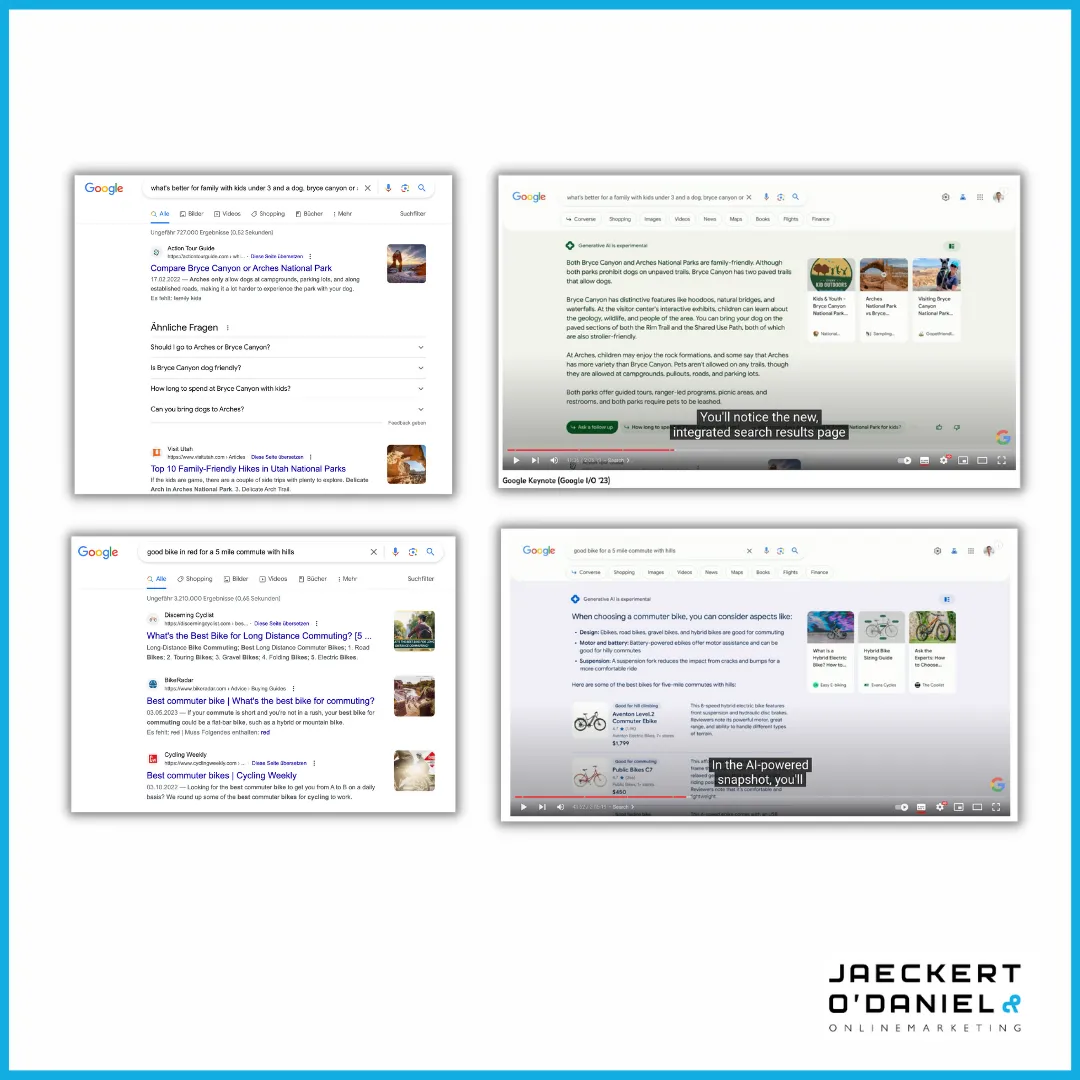
This is where the “Search Generative Experience” is presented
The presentation lasts more than two hours in total and covers many Google products. But the decisive part starts at minute 40. That is where it is about the only central main product that billions of people use: search.
Here Google shows, with three examples, how language models will be integrated into search in the future and generate answers automatically.
Two examples come from the travel industry (comparing national parks and watching whales) and another example discusses the search for the right bicycle.
We compared these examples by entering exactly the same queries into current search.
The first example: a personalized long-tail query
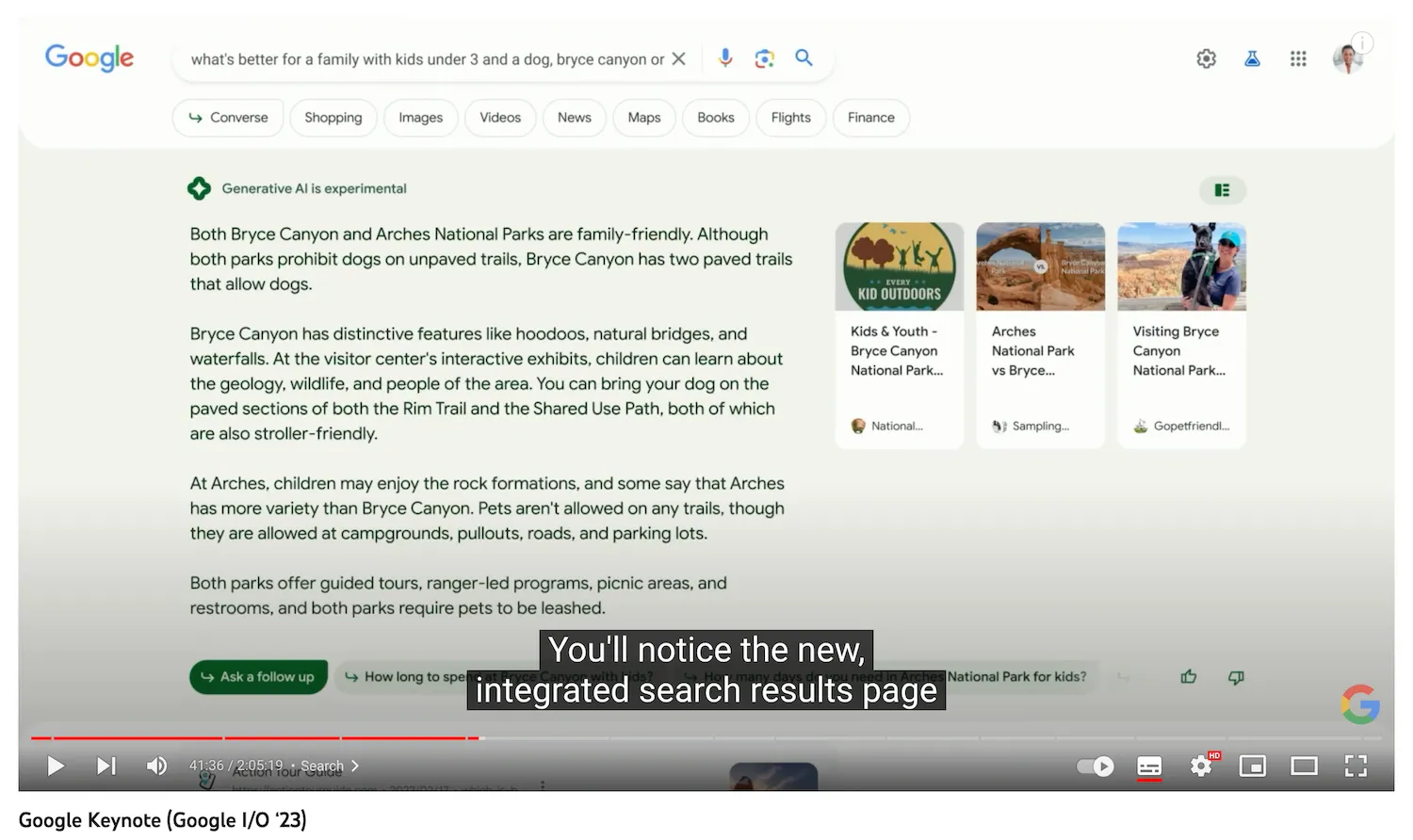
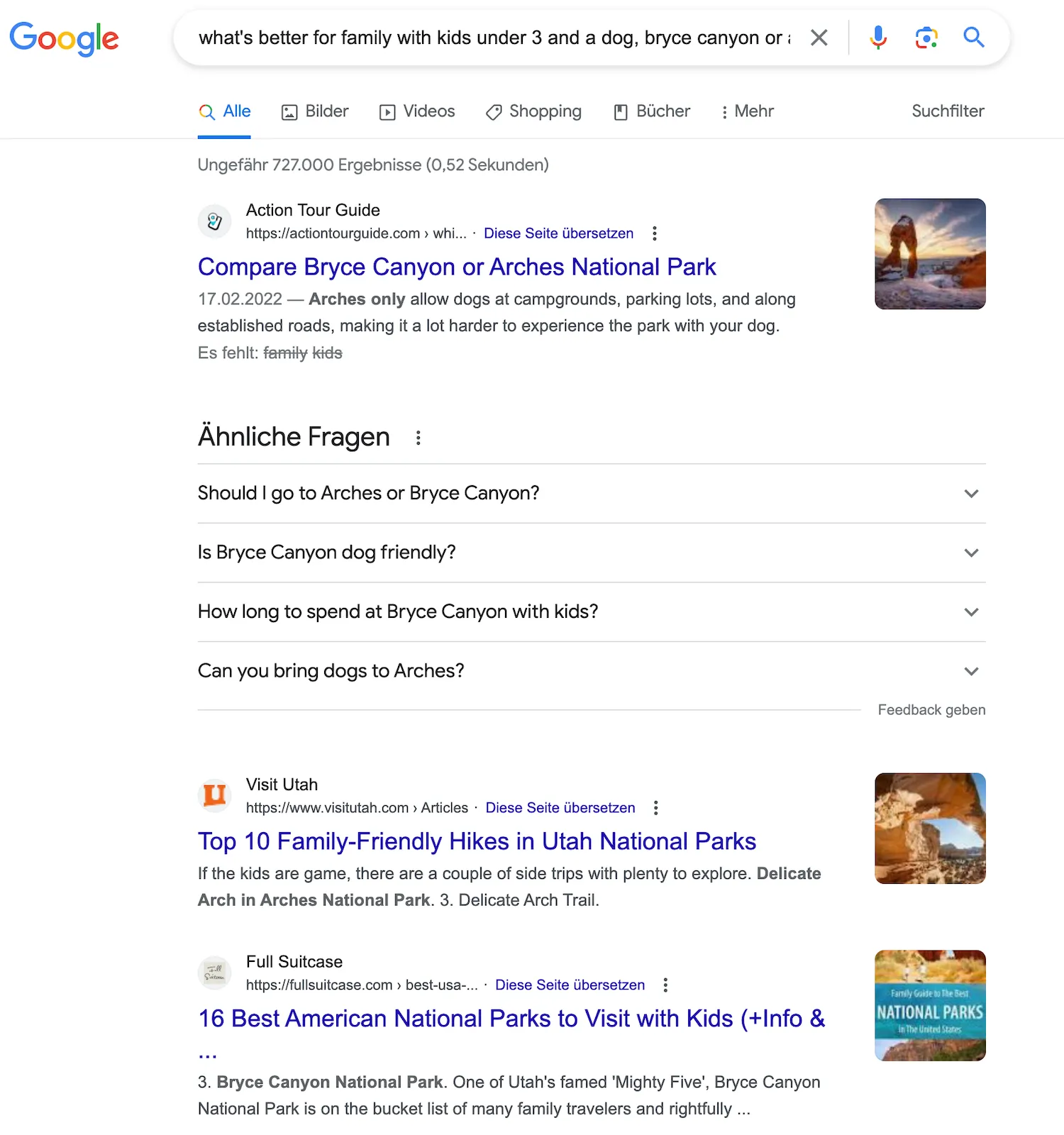
The first query is: “what is better for family with kids under 3 and a dog, bryce canyon or arche?”
This is an extremely personalized query, in which two national parks are compared with a view to children and a dog, and a recommendation is requested.
That makes clear what Google wants to show: the AI models can deliver answers to questions like that. The generated answer addresses every aspect.
In contrast to previous queries, as you can see in the comparison. Here there are websites that compare the two national parks, that discuss national parks for children in general, and in the FAQ box the aspect of taking a dog is discussed.
Until now, users have had to visit a series of different websites to clarify the various questions.
Websites are also shown inside the “Generative Search Experience”, and prominently at the top in the form of three tiles. And, much further down, in the classic 10 search results, which are pushed completely into the background.
So the question is how you get into those tiles in the future, and what you have to offer there. Google itself emphasizes that content which demonstrates “Firsthand Experience” and “Expert Knowledge” has a very good chance of ranking.
However: clicks from queries like that will be optional in the future, but no longer strictly necessary in order to get a piece of information. On the condition that the AI outputs correct answers and that users trust it, both of which we consider likely.
The second example: a search for a product
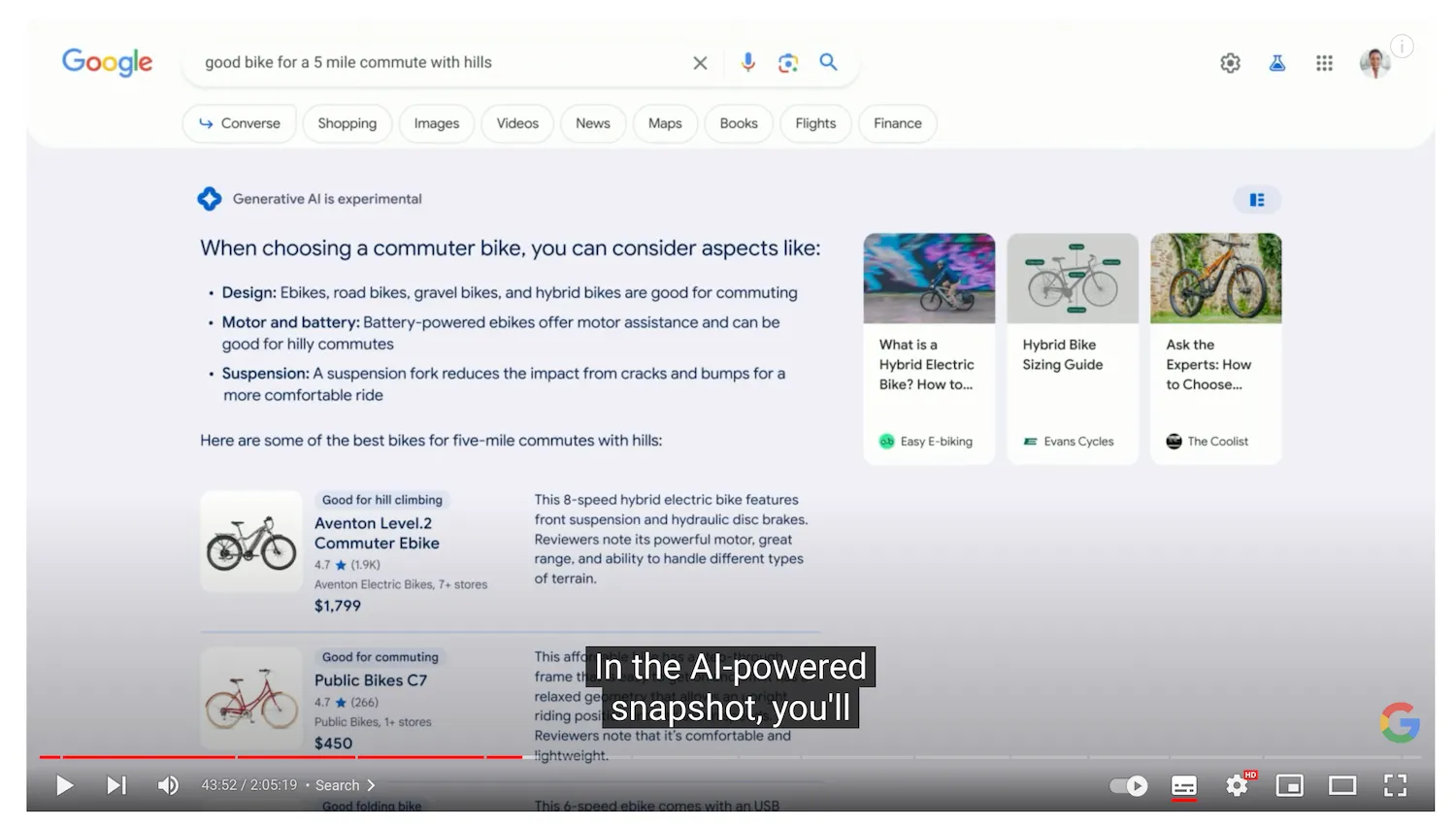
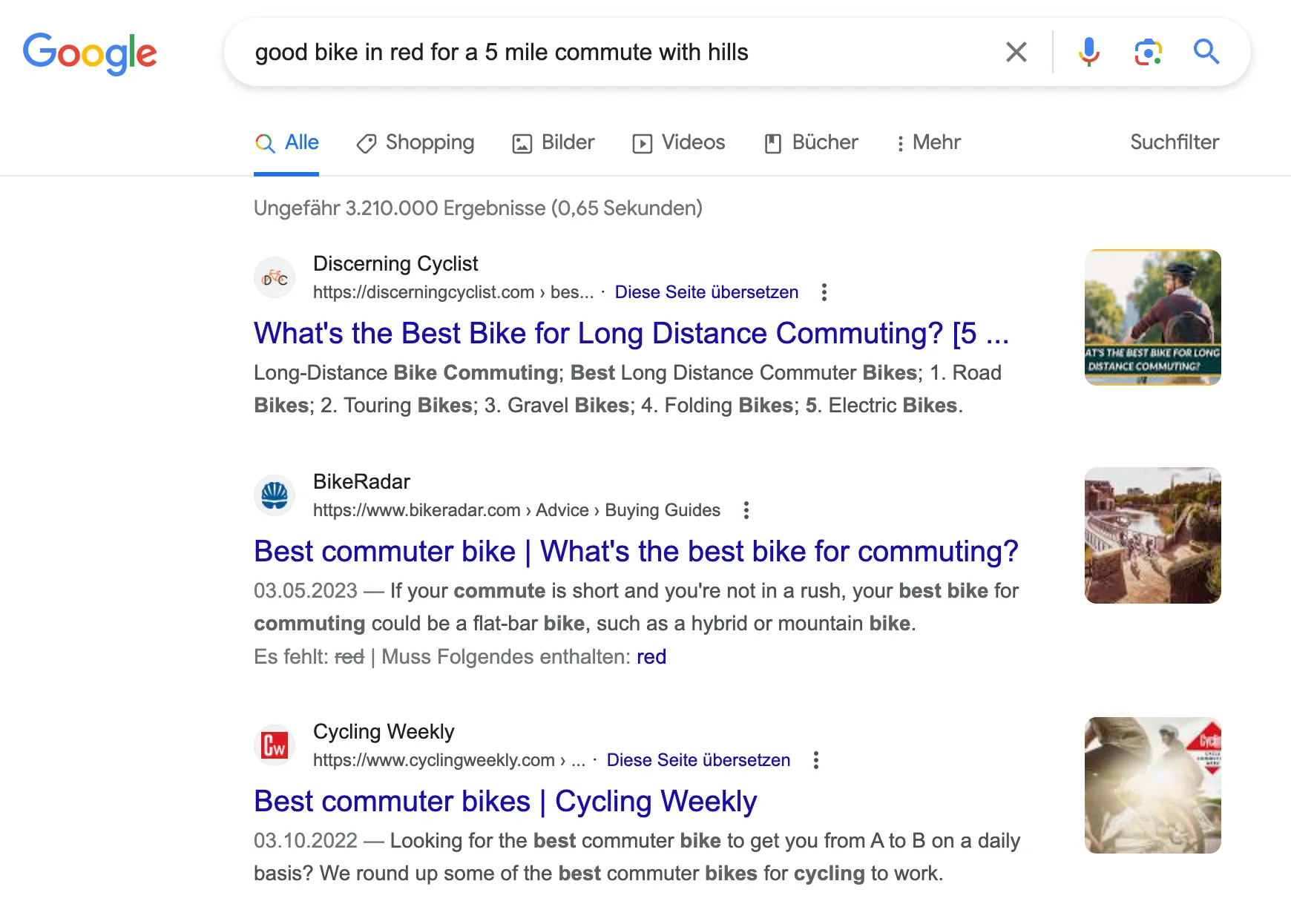
The second query in the keynote is “good bike for a 5 mile commute with hills”.
So the search is for a good bicycle, again with specific personal context: 5 miles, commuting to work, and hills.
The language model gives tips directly on what you should pay attention to. Products from the shopping feed are also embedded natively in the AI answer.
The three tiles appear again as well, and as in the previous example the headlines are cut off.
If you enter the same query today, the results are much more informational. At the front are bicycle publishers that compare bikes for commuters. The comparison is the focus.
For a query like that, the bicycle publishers would very likely lose traffic if they are not shown in the tiles in the future.
The comparison now happens through the built-in shopping feed. Especially since the search can also be refined quickly through “Conversational Mode”. In Google’s example, the search continues for the color “red”, and red bicycles that are suitable for hilly routes are shown. The language model remembers the previous queries.
The third example: a mobile search
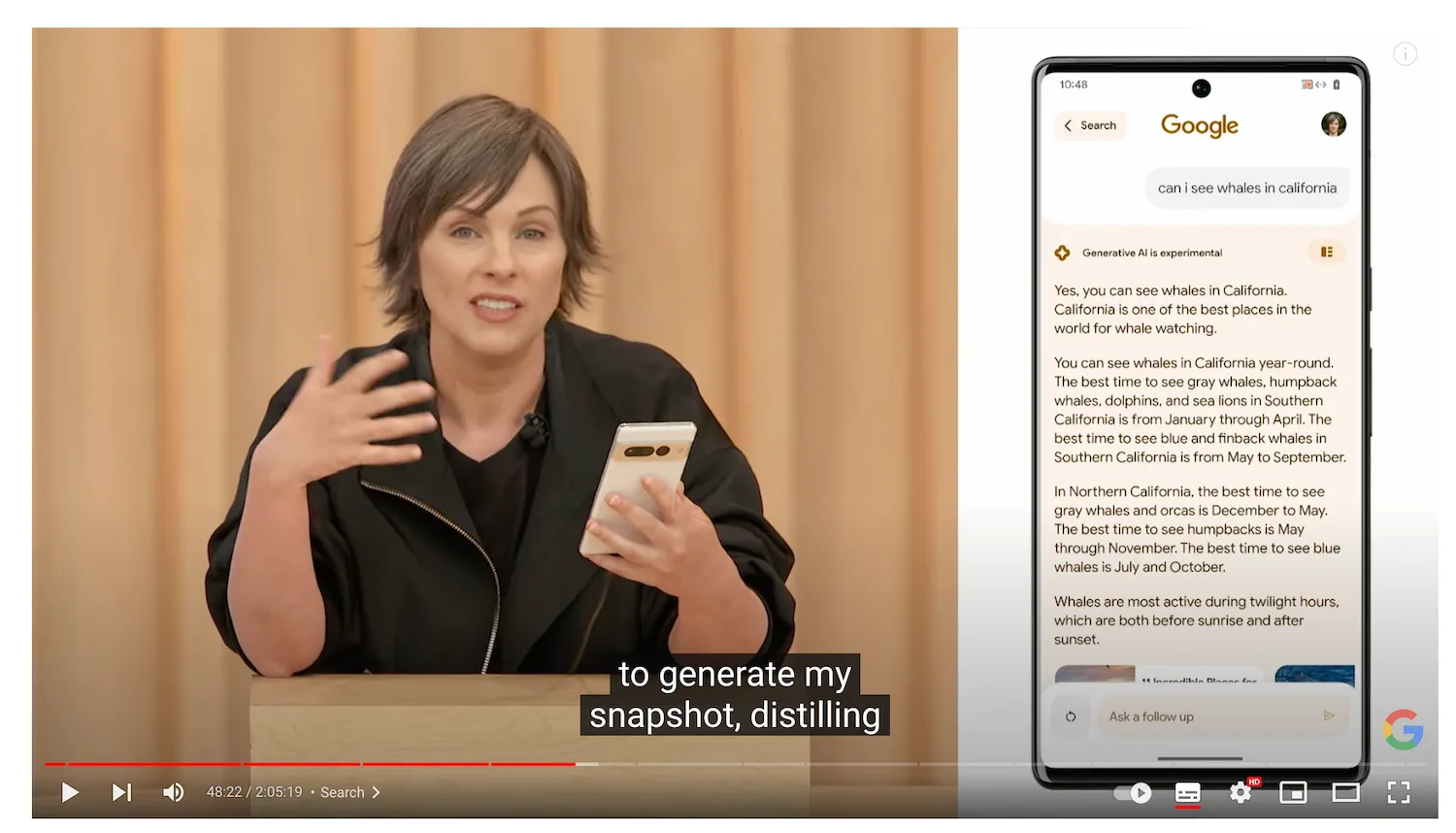
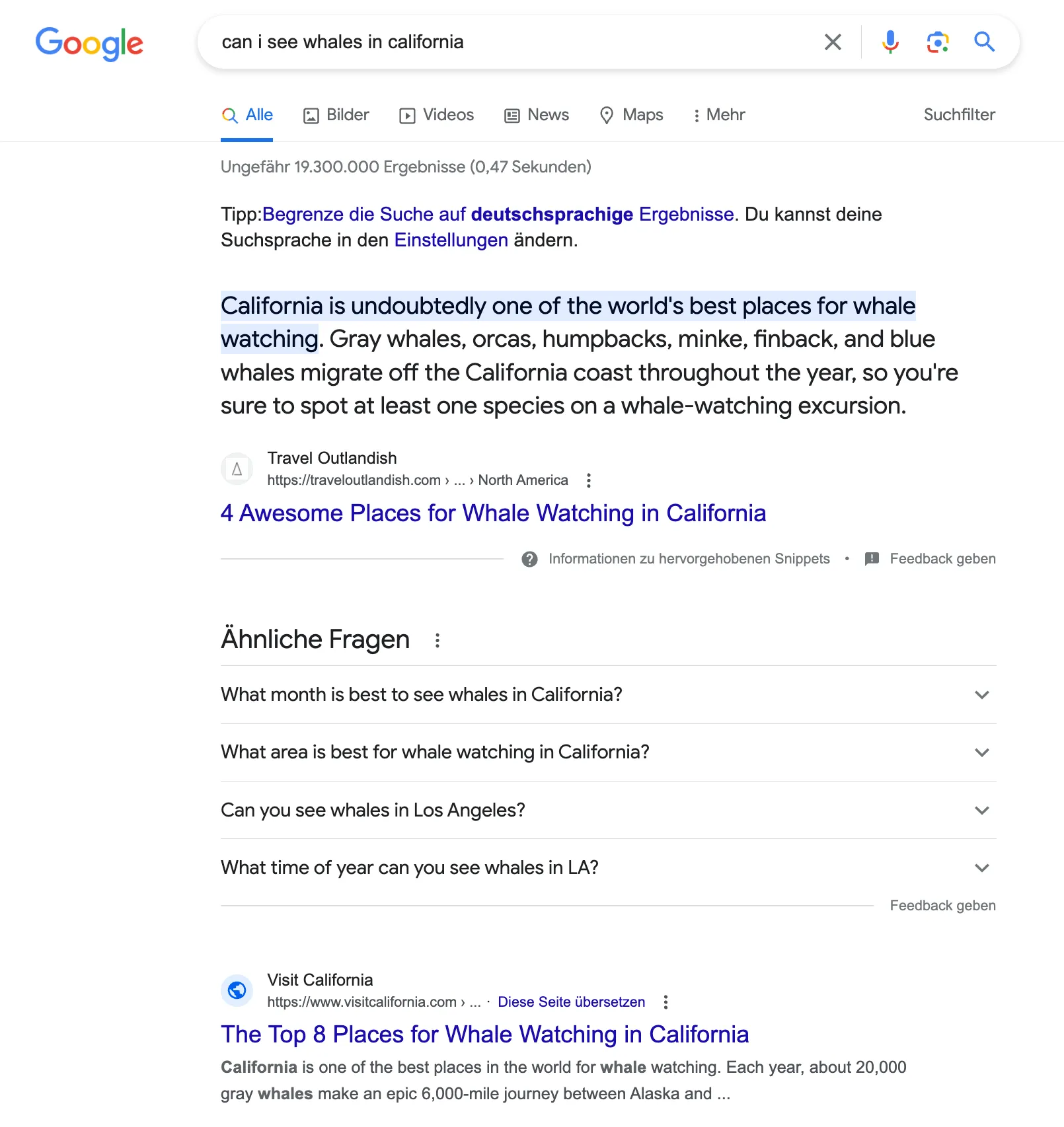
In the third example, the query “can I see whales in california” is asked.
In mobile search it is even clearer that the new AI field takes up an extreme amount of space. It more or less fills the screen.
The result strongly resembles the current form. With the difference that a featured snippet is no longer pulled from a website. The AI generates the answer itself. So this traffic from “position 0” disappears.
Here too, then, the websites and publishers behind the AI content are pushed aside. On the other hand: queries like that are usually the first step of a longer search journey.
Users will then search for cities and regions, and on site they will search more specifically again for beaches, viewpoints, or providers.
The question here is how good the AI’s answers still are then. After all, it is about concrete facts on site. It is also possible that the “AI Snapshot” is not shown then.
If it is, the tiles will certainly be shown again. And Google Ads will be included, because “whale watching” is a typical tourist offering.
Deepen your SEO knowledge: every Monday by email

SEO and content strategies for the future
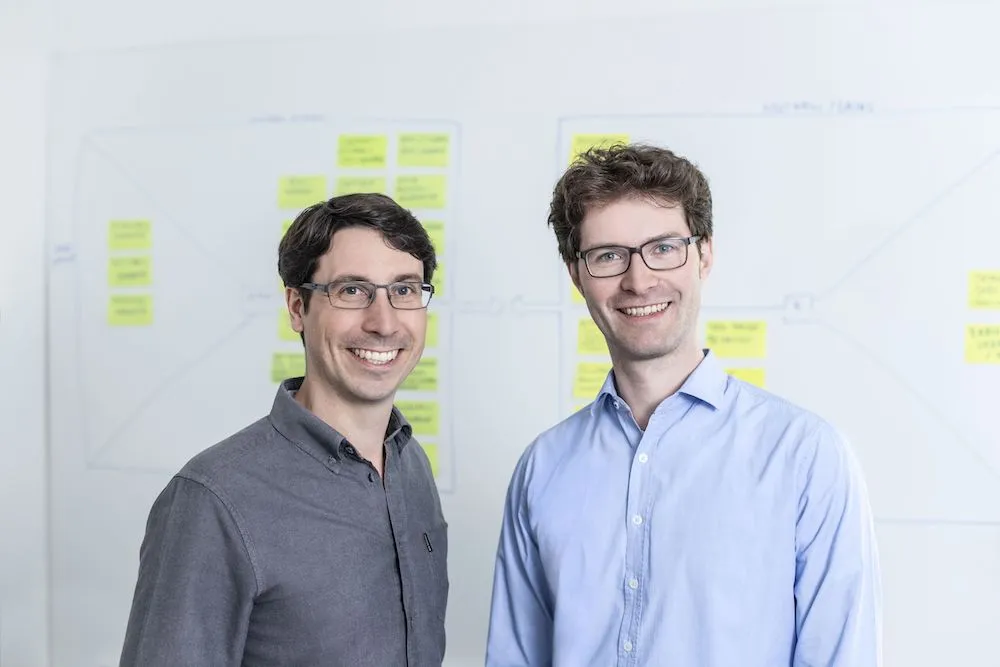
We are Fabian Jaeckert (on the right) and Benjamin O’Daniel. For many years we have worked as consultants for marketing teams. In doing so we connect two worlds: Fabian is the technical expert, Benjamin takes on every topic around content development.
With Jaeckert O’Daniel, it quickly became clear to us that we had made an excellent choice in selecting potential partners for our online marketing project. Their expertise and, above all, their ambition to thoroughly immerse themselves in our specific industry topic to provide us with the best possible support, are precisely what is now propelling us forward.
 Tobias ReitmeierF.EE Group
“How can we keep our SEO visibility in the age of AI? What opportunities does this open up for us?”
These are questions we are asked frequently at the moment.
From our point of view, companies should now look at the areas where they may suffer traffic losses, and how they adapt their SEO and content strategy to that.
We develop exactly these kinds of integrated SEO and content strategies for companies and present them in workshops, in a structured and understandable way, to the people responsible. Afterwards we support the in-house leads during implementation.
Sound interesting?
We can arrange an introductory video call (30 min.).
Our conversations with SEO professionals in the industry

SEO quality assurance: How to protect your rankings. Interview with Gianna Brachetti-Truskawa

How Südwestrundfunk (SWR) works on search experience: Interview with Sarah Stein

SEO as a growth strategy: Interview with Kevin Indig
What does an online shop need in order to rank successfully? Interview with Stefan Vorwerk
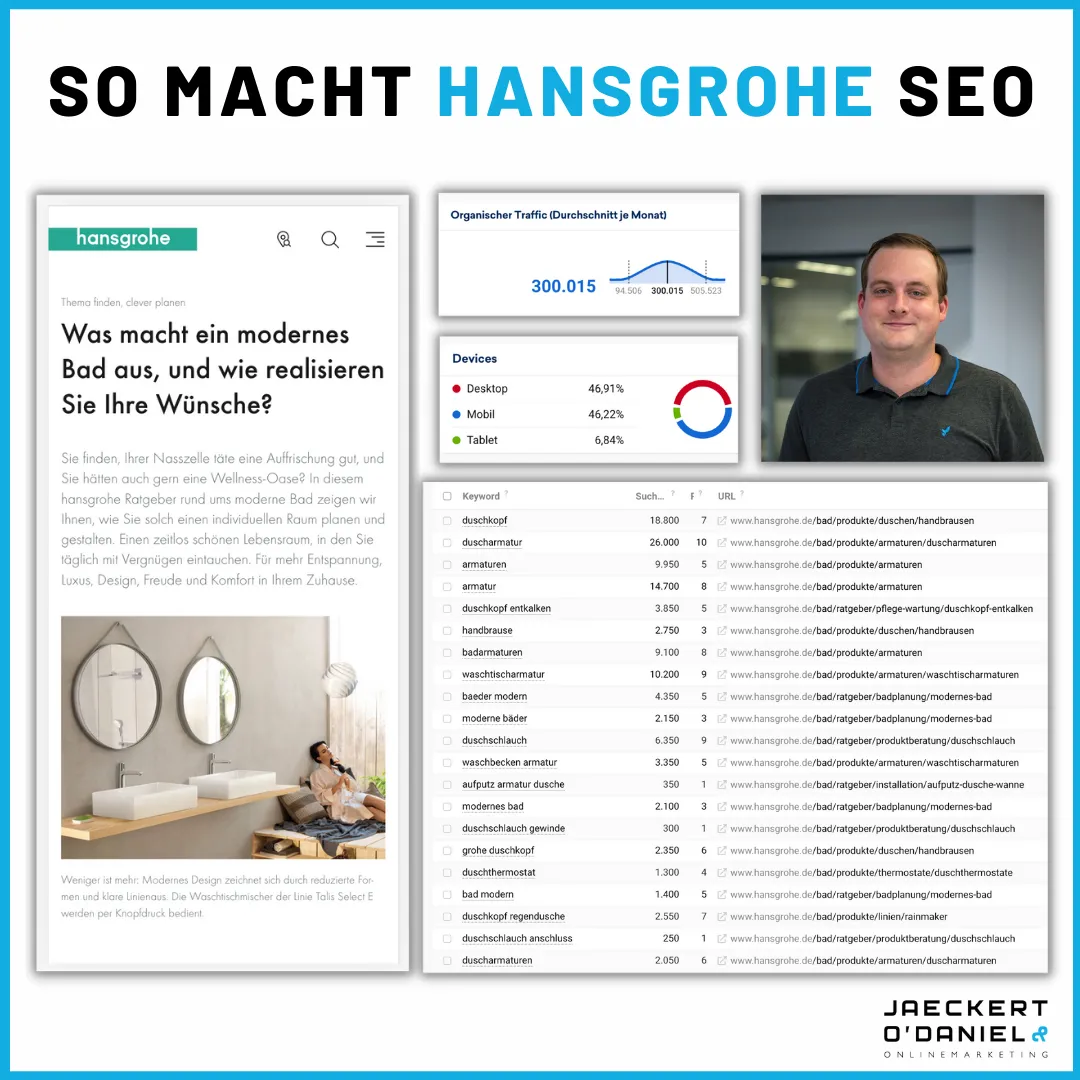
How Hansgrohe does SEO in 40 countries: Interview with Jörg Niethammer

The SEO strategy of Hubspot: Interview with Jenny Lapp

How user testing works: Interview with Astrid Kramer on UX and SEO