May 22, 2023Benjamin O’Daniel
Writing with AI for marketing: Interview with Kai Spriestersbach
ChatGPT and the technology behind it are changing marketing, on many levels. In this podcast episode we take one central aspect and talk about writing with AI tools.
When does it make sense to work with ChatGPT? For which page types? How do you go about it? We talk about that with Kai Spriestersbach.
The experienced search marketing expert and top speaker is publishing his book Richtig Texten mit KI these days. In the interview, Kai explains how language models work, when and how you can use them for your texts, and also his assessment of how this affects Google and search engine optimization.
This much up front: Kai issues a clear warning against using texts from ChatGPT one to one and putting them on your website without reading them through.
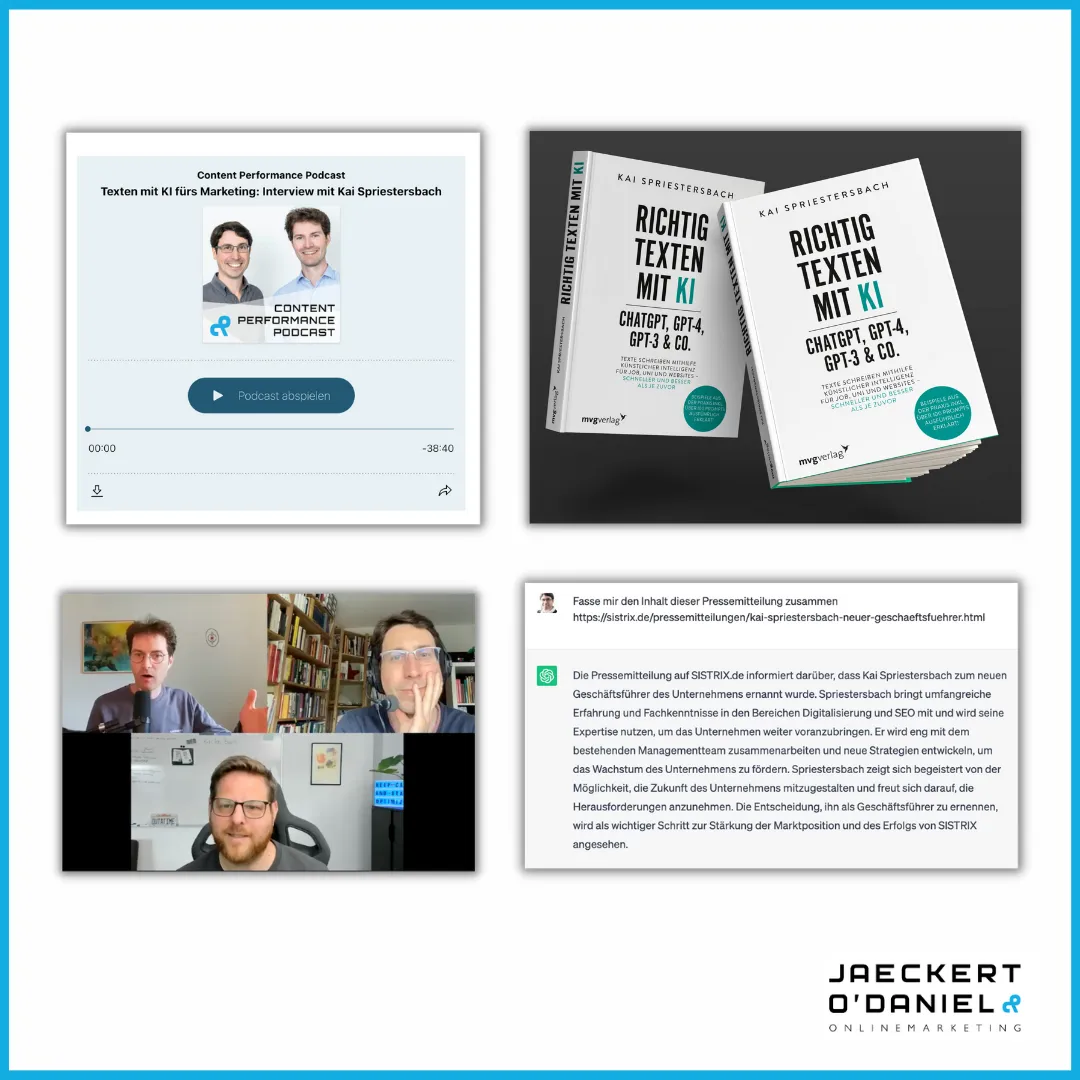
Our guest: AI writing expert Kai Spriestersbach
Kai Spriestersbach is a fixture in the SEO and online marketing industry. For many years he has spoken at conferences such as SMX in Munich, OMT in Wiesbaden, and SEOkomm in Salzburg.
Kai is a lecturer and an author in trade magazines such as Website Boosting. Kai has also been a guest on our podcast and talked with us about WordPress SEO.
In recent years, Kai has looked intensively at AI, language models, and AI writing tools such as Jasper, Frase, Neuroflash, and now ChatGPT as well.
He does not see his book simply as a guide, even though he lists and explains numerous concrete prompts there. With his book he also wants to inform people about the topic in general and warn them about pitfalls.
His credo: if you work with tools like that in an informed and clear-eyed way, you can achieve a great deal with them.

“Language models are not knowledge models”
A basic understanding of the technology behind it is essential for writing with ChatGPT and other text tools. “They are language models, and not knowledge models,” Kai says.
That means: words are generated on the basis of training data, on the basis of probability. So they are always only probable answers. “A language model has, first of all, no way to store facts in a structured way, the way Google does with its Knowledge Graph.”
A pure language model is therefore only of limited use for researching facts, for example information on a website. Above all because ChatGPT by no means always says when it is “hallucinating”, that is, inventing information.
If you have paragraphs or text modules generated and then use them, you always run the risk that your own text contains information that sounds plausible but is simply wrong. And as the author, you are the one who has to answer for it.
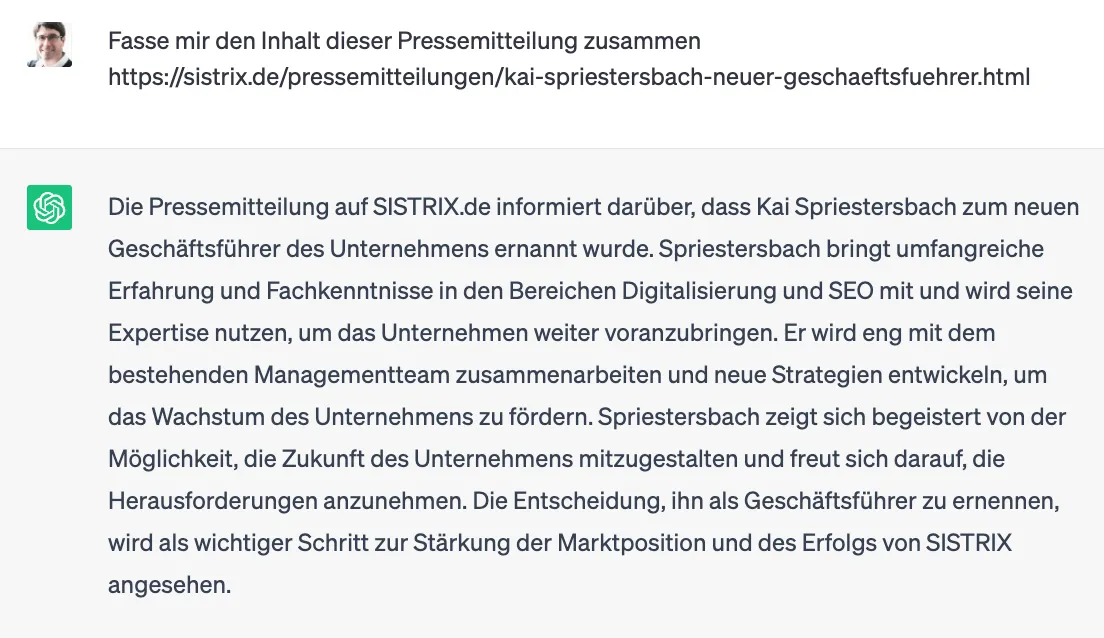
Here is an example of a “hallucination”: based on a made-up URL, ChatGPT creates a summary that sounds plausible, at least if you know nothing about the topic or the company. At the same time, ChatGPT also does not say that it cannot actually access the URL, because it is a language model and does not capture website content the way Google does.
Will this distinction last much longer?
Will the distinction between a language model and a knowledge model still hold in the future? We talked with Kai about that as well. OpenAI has now opened ChatGPT to external plugins, such as Wolfram Alpha. Then, in the future, the language model only has to recognize whether a fact check is necessary, and then let the plugin go first.
Google is opening up in the other direction as well, and recently announced at I/O 2023 that it would integrate AI answers more strongly into search (a very good analysis by Kevin Indig here). Factual accuracy is also getting better even without plugins, as Kai himself notes. One example: Kai had a list of sources created, on scientific topics he knows well. While with GPT 3.5 wrong papers and wrong names were still the rule, in his tests the information is now around 90 percent accurate. Even so, from his point of view it is essential to understand how the models work, because it can also be different at any time. Fabian also discussed the new plugins here on LinkedIn.

How can you use AI writing tools well?
Summaries
From Kai’s point of view, language models such as ChatGPT can be used perfectly and without risk when checked and cleanly researched content already exists. For example, when you have finished writing a blog article and then have teasers or summaries generated specifically for the existing text, for your own newsletter or LinkedIn. “The model does not have to develop anything new here. It only has to transform what already exists.”
Product-related texts
Texts can also be generated very well on the basis of existing product information. For example, by having sober product texts rewritten in a language that fits the audience, or by having a sales text generated from them. Another option: take several product texts and have a comparison written from them. Kai presents these and further examples in his new book as well.
General knowledge
What is called general knowledge can also be generated relatively safely by ChatGPT and other AI writing tools. It is no coincidence that the success stories discussed in the SEO industry are often definitions or glossaries. At the same time, it is also clear: a definition alone does not yet create content with which you set yourself apart. Neither for users nor for Google. In its original form it is, first of all, pure copycat content.
If everyone produces AI texts: how can you still stand out?
If purely general content can in future be generated more or less for free by AI tools, or is integrated via Google’s language model “Bard”, then companies have to ask themselves how they still want to stand out or set themselves apart.
That works, among other things, through:
- a deep understanding of customers
- expertise and experience
- exclusive data
All of that should flow into the content. Whether and how this content is usefully enriched with AI writing tools depends on the individual case. Every company needs its own individual SEO and content strategy here.
Google itself argues in exactly this direction as well.
The “Helpful Content System” has only just been strengthened. In addition, “Perspectives”, meaning individual perspectives, are supposed to be more strongly represented in the search results. Product reviews are also supposed to have a better chance of ranking if they are based on real experience.
Google does not reject AI-generated content in general. There is, however, the requirement to label content like that clearly (explicitly mentioned here: “How the content was created”).
Whether you work “in line with the guidelines” (“white hat SEO”) or not has always been, in search engine optimization, a question of approach and of appetite for risk.
More on our GEO & LLMO workshops and our GEO & LLMO consulting here. Here is an overview of AI optimization and GEO and LLMO.
SEO, AI, content: through our mailing list we send case studies, share tips, and invite you to webinars

Our conversations with SEO professionals in the industry

SEO quality assurance: How to protect your rankings. Interview with Gianna Brachetti-Truskawa

How Südwestrundfunk (SWR) works on search experience: Interview with Sarah Stein

SEO as a growth strategy: Interview with Kevin Indig

SEO for a software company: Interview with Beat Köck

What does an online shop need in order to rank successfully? Interview with Stefan Vorwerk

How Hansgrohe does SEO in 40 countries: Interview with Jörg Niethammer

The SEO strategy of Hubspot: Interview with Jenny Lapp

How user testing works: Interview with Astrid Kramer on UX and SEO