

Website structure refers to the architecture of an entire website. Every website has a hierarchy, which is reflected in its menu items or directories. Beneath each item are further subpages that should also be structured.
The core task in creating a website structure is to cluster topics and decide at which level each individual topic is visible. This determines the website’s architecture.
Subsequently, content is created for each individual subpage. We explain this on this page and in the podcast using examples.
This is where search engine optimization (SEO) comes into play. The goal of SEO is to rank for search terms and thus gain more visitors – and through that, more sales or contact inquiries.
Every single subpage can rank for hundreds of terms on Google. If – and this is the prerequisite – the website’s structuring is truly clear.
Planning Website Structure: the Topics on this Page
- What is a Website Structure?
- Website Architecture: Tips for Navigation Structure
- Is the Website Truly Search Engine Optimized?
- What a Corporate Website Should Generally Achieve
- How Should a Website Be Structured for SEO?
- Website Structure and SEO: An Example
- Expert Feedback on Planned Website Structure


What is a Website Structure?
A website structure organizes content in a logical manner, so that users automatically understand the website and easily find the content they are looking for. The organization is represented in the form of navigation, i.e., the menu items on the website.
There is a main navigation. This refers to the menu items visible at the top level. Indented within it are subpages that are thematically relevant to the menu item. These are also referred to as directories or folders.
A website structure is often a topic in a company in two situations: during the new development of a website or a microsite for a specific topic, or during a relaunch or redesign of an existing website.
For those responsible for the website, dealing with website structuring is not a simple matter, because typically, this is done only once. The topic of SEO – i.e., search engine optimization – then comes on top of that.
Many also speak of the structure of the homepage. However, in professional circles, the homepage refers to the start page. The start page also needs a structure, like every individual page, meaning an organization of the individual layout elements from top to bottom.
However, in this article, we are discussing the architecture and hierarchy of the entire website, meaning the overall organization of the website.
In professional circles, a ‘web page’ often refers to a specific subpage. Nevertheless, we often use it as a synonym for ‘website,’ meaning the entire online presence, because that is also how most people understand it.
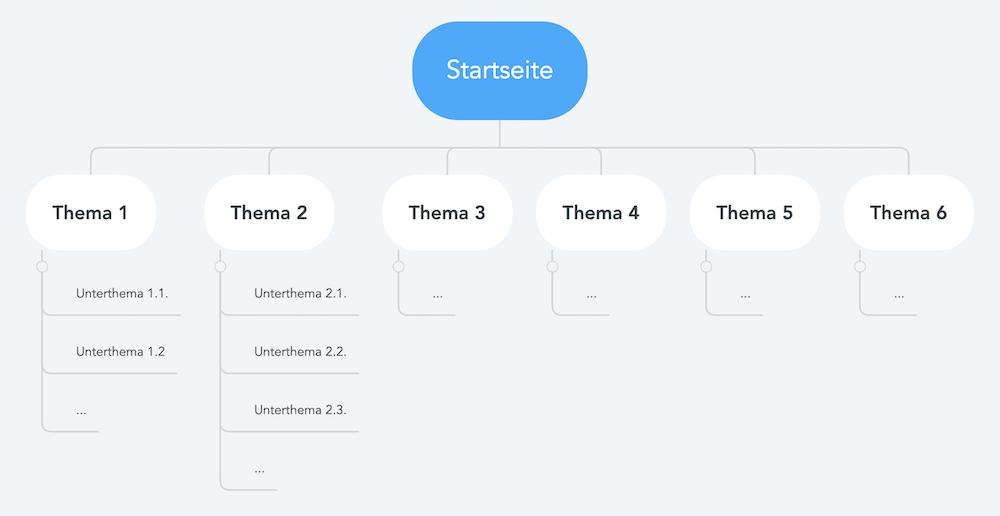
Here is a roughly visualized website structure, starting from the homepage. A “topic” is usually a category or a directory. A concrete example of this can be found further below. For structuring and visualization, we use a simple mind mapping program (here, Mindmeister). However, from our perspective, a tool is not strictly necessary.
You are currently viewing a placeholder content from Default. To access the actual content, click the button below. Please note that doing so will share data with third-party providers.
More InformationWhat a website structure looks like in practice – and how it affects Google rankings – we discussed this in this livestream using an example.
Website Architecture: Fundamentals and Tips for Navigation Structure
A website needs clear navigation so that users can immediately find their way around. This is also referred to as user experience. Here are some fundamentals regarding navigation points that, from our perspective, are mandatory for website architecture:
- About Us (Company, Team, Careers)
- Services (Products, Services)
- News (Blog)
- Topics (Guides, Content Hub)
- Contact (Contact Form)
We would therefore always categorize the typical navigation item “Careers” under “About Us” in the website architecture, because it is a sub-aspect of the company.
We would almost always separate ‘News’ and timeless topics in the website architecture. This is also because timeless topics such as guides often rank very well on Google – and are also editorially prepared differently than, for example, an internal company announcement.
We also explain the example of a website structure and the fundamentals of website organization in more detail further below.
Page Content: the Content on a Single Page
Once the basic website structure is in place, the planning of each individual page begins. Some pages are shorter, others significantly more detailed. Page elements often include:
- Factual, informative text
- Several structured paragraphs
- High-quality photos
- Two- or three-column layouts
- Expandable additional information
- Call-To-Actions (Form, Buttons)
Website content that is intended to rank successfully in search engines is usually more detailed. This is due to users, who usually want comprehensive, in-depth information.
The task in designing or conceptualizing the website is therefore also to lay out this extensive information well and structure it logically. Editorial expertise is required here.

SEO Tips and Webinars via our Newsletter

Template for a Website Structure
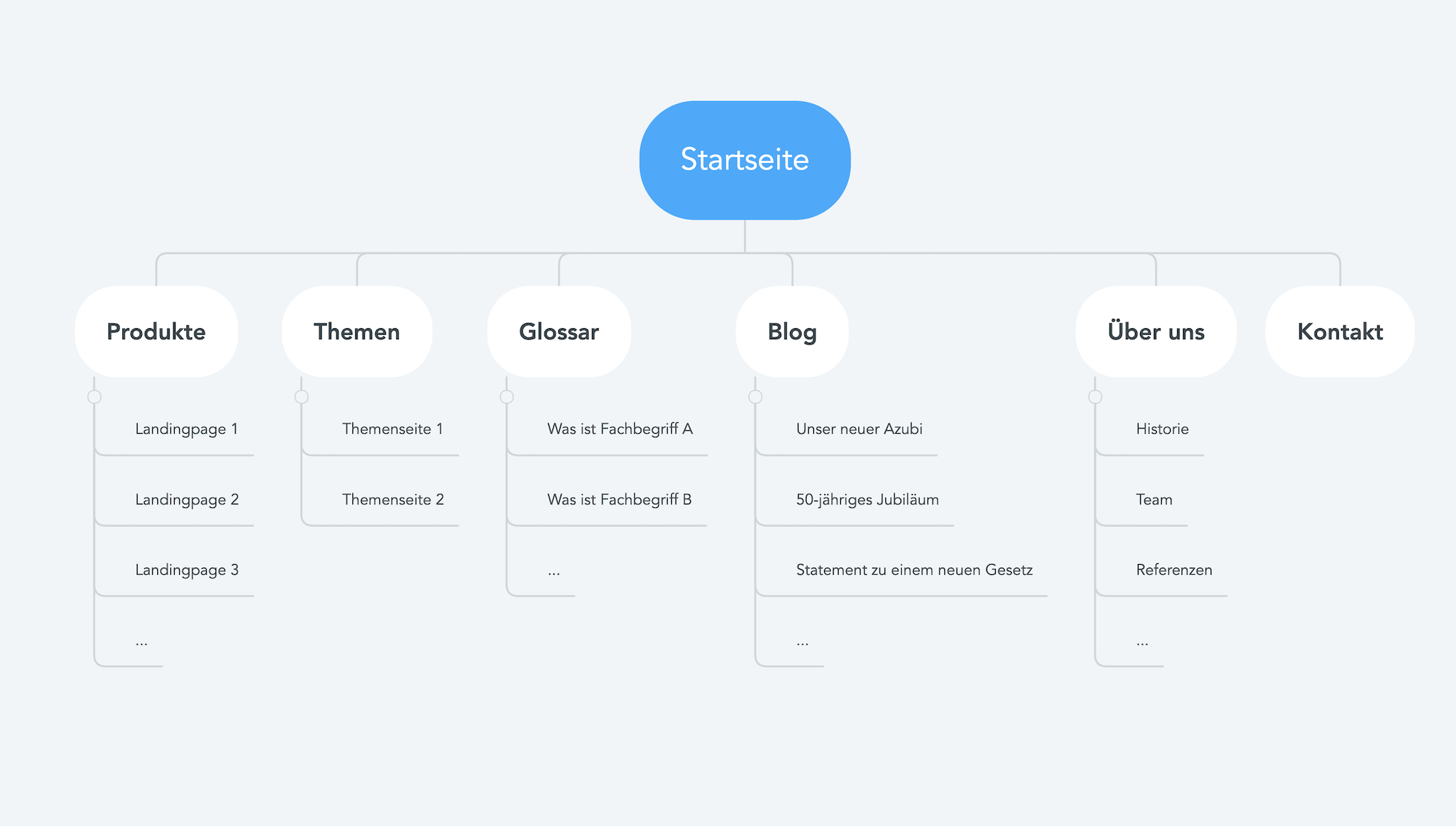
The conceptualization of a website structure starts with the homepage, i.e., the start page, shown here prominently in dark blue. There are individual items such as “About Us,” “Blog,” or “Contact” that should be part of every company’s website structure. The visualization is done using a mind mapping tool.
We discuss further practical examples in our SEO Academy, for which you can get easy access here.
In addition to these usual functional pages about the company, our template also includes several categories with a clear SEO focus. These include product pages, which are optimized for transactional keywords, and topic pages, which are optimized for general generic topic terms, as well as a glossary where technical terms are explained. Such a website structure results from keyword research, which also considers long-tail keywords and the customer’s customer journey.
For each category and individual page, a content template is required. This provides an approach for what and how much content will be built there. The homepage is also an individual page that needs to be structured.
Many marketing managers also wonder if they need to submit a sitemap, for example, in Google Search Console. If the individual subpages in the website architecture are well internally linked, a sitemap is often not necessary.
The Structure of the Website: Search Engine Optimization vs. Search Engine Friendliness
Many companies are not aware of an important distinction:
Namely, the difference between search engine friendliness and search engine optimization. We often hear the phrase: “Yes, our web agency included search engine optimization during the relaunch!”
But the reality is often: “No, they did not.”
At best, the website was made “search engine friendly” through a proper CMS, descriptive URLs, and the ability to edit meta information.
But that is only the foundation, so to speak, the toolbox without the craftsman. This alone does not lead to top rankings and traffic to the website.
Search engine optimization (SEO) is much more: SEO is a concept that strategically maps relevant search terms onto the website. SEO is content. SEO is expert personnel. SEO is a professional toolset. SEO involves iterative optimization processes.
It is utopian to expect to address the topic of SEO with a few technical adjustments. It is unprofessional to market search engine friendliness as SEO.

Fabian Jaeckert has been working as a search engine optimizer for over 15 years. He is a technical SEO with extensive experience in web development. He has analyzed and evaluated numerous website structures with regard to SEO and optimized them.
What a Structure for a Corporate Website Must Achieve
Planning Website Structure: Three Common Questions
SEO Structure: how should a Website be Structured for SEO?
Search engine optimization refers to all measures aimed at increasing visibility in search engines. The core of this is to research keywords, i.e., search terms, using a professional tool.
Those who know the search terms understand what terms potential customers are truly searching for. One understands what specific demand exists. Subsequently, this demand is met through targeted content on the website. This is where the website structure comes into play, because suitable “space” is needed on the website. This is also referred to as an SEO structure.
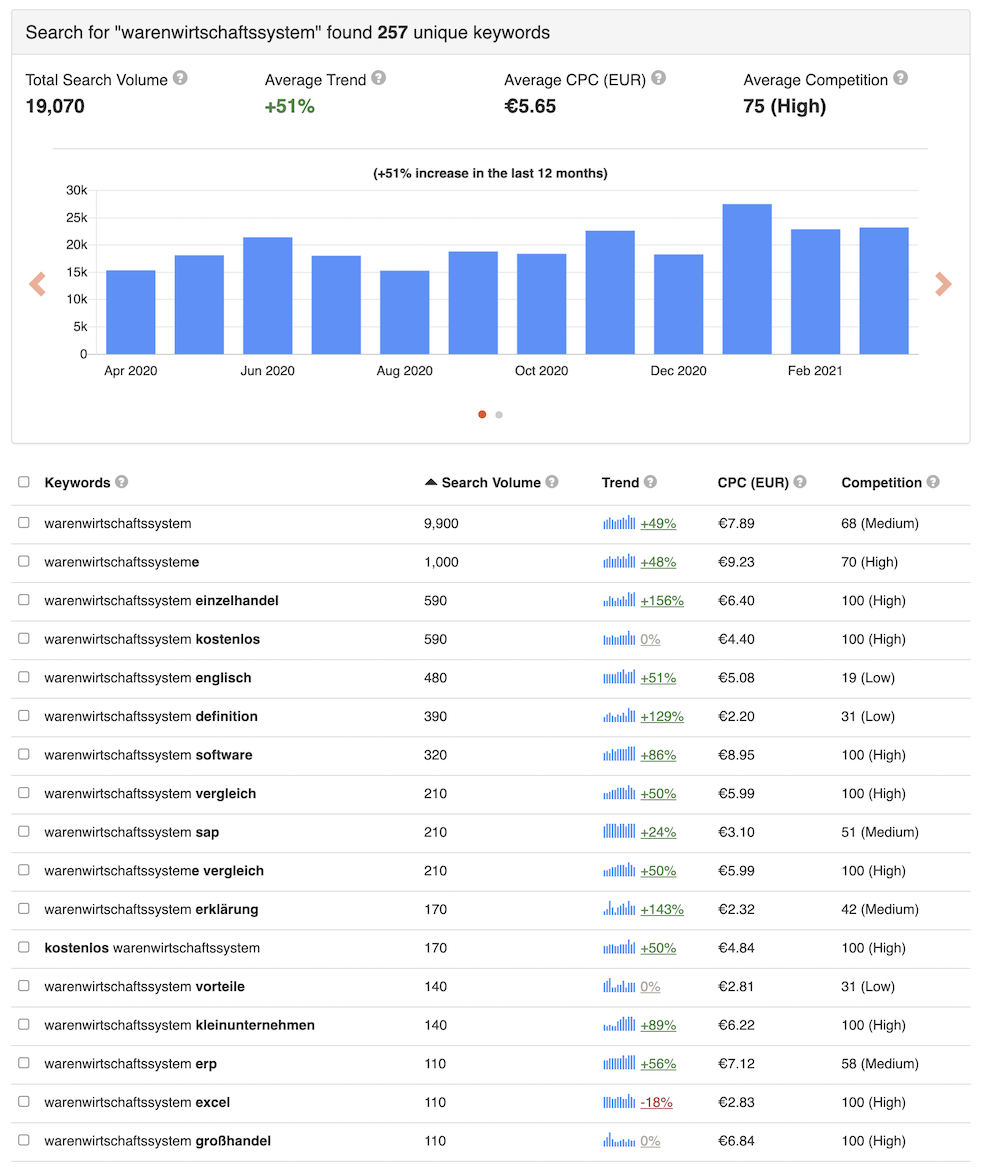
Example for Keywords (Screenshot): Around the term ‘Warenwirtschaft’ (merchandise management/ERP), there are hundreds of different search terms, some more, some less frequently searched. The CPC column shows the click price for Google Ads. This is how much one pays for a single click on Google when placing an ad for that search term. In contrast, every click that comes through SEO does not have to be paid for.
3 Reasons why a Good Website Structure Helps You Achieve Top Rankings on Google
What Visual Website Structures are there?
On this page, we discuss the conceptualization, the fundamental structure of a website. However, a website also has visual structures:
- A Header (Top Section)
- Navigation (often at the top)
- The Content Area (with texts and images)
- A Footer (End of the Website)
However, these elements concern the “visual” website structures, not the architecture, i.e., the content-related construction of the entire website. One sees once again: there are many levels to consider.
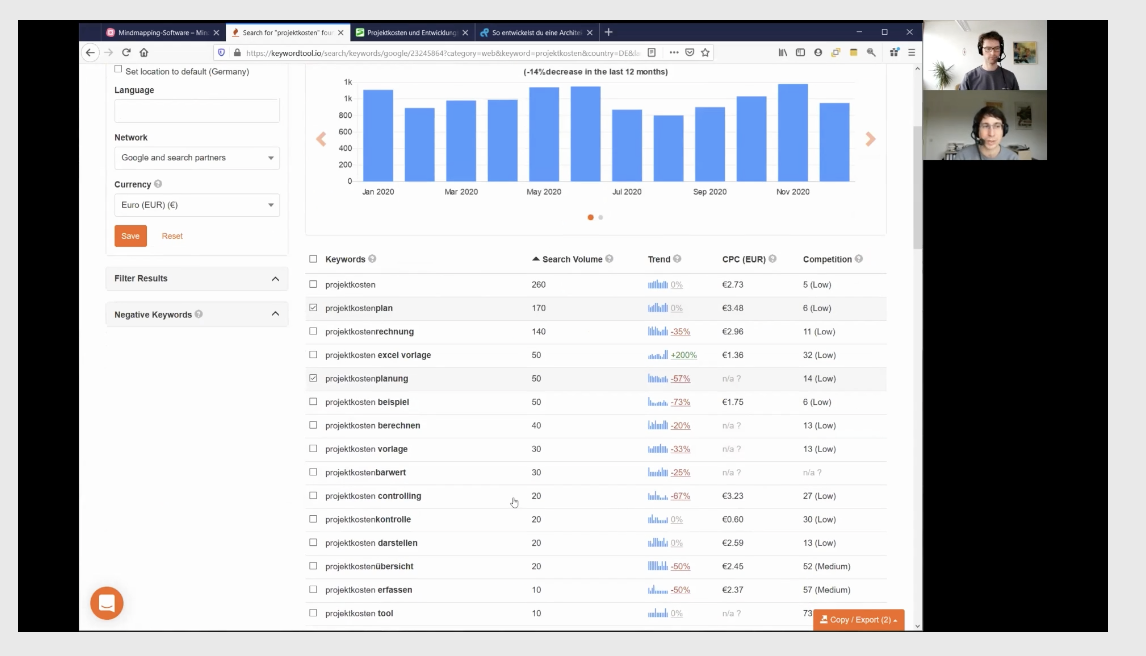
In our SEO concepts, based on a keyword analysis, we often recommend an expansion or modification of the website structure, so that the structures are aligned with users and their information needs. This is then also referred to as a supplementary SEO structure.
Feedback on Website Structure
From our perspective, every company needs at least one person who has an overview of the website and its structures. This person moderates internal requests, ensures consistency in design and wording, develops new, valuable content formats, and monitors rankings, traffic, and conversions. A huge job.
Often, these are all-round marketing managers who also handle digitalization topics. Not infrequently, sales or even the management itself are involved. In some companies, content marketing managers or online marketing managers are employed.
We support precisely these types of companies with our SEO consulting. We develop a specific concept for better rankings and more traffic and leads. The foundation for this is keywords, website structure, and content templates.
We would be pleased to connect in a Zoom call and provide you with expert feedback on your website structure plans.

This content was created by Benjamin. He is responsible for content production, including keyword research, text creation, integration into WordPress, and internal linking.
Google visitors are an important channel for us. Fabian and Benjamin helped us elevate our SEO to a new level and establish it internally, with a clear SEO strategy and innovative content.