

ChatGPT now features an integrated search engine: “ChatGPT Search”. How effective is this new AI search, which combines a language model with internet search? What do the results look like, and what is their quality?
We tested this using the major keyword categories. We examined transactional search queries, brand search queries, and informational keywords, using examples to gain an impression.
In the podcast episode and in our article, we compare the results between ChatGPT Search and Google results. A quick preview: From our perspective, Google should be concerned – if ChatGPT convinces enough people. Currently, the search function is only available in the Premium Account (as of 11/2024), so it is not yet open to the general public.


Transactional Queries in ChatGPT Search
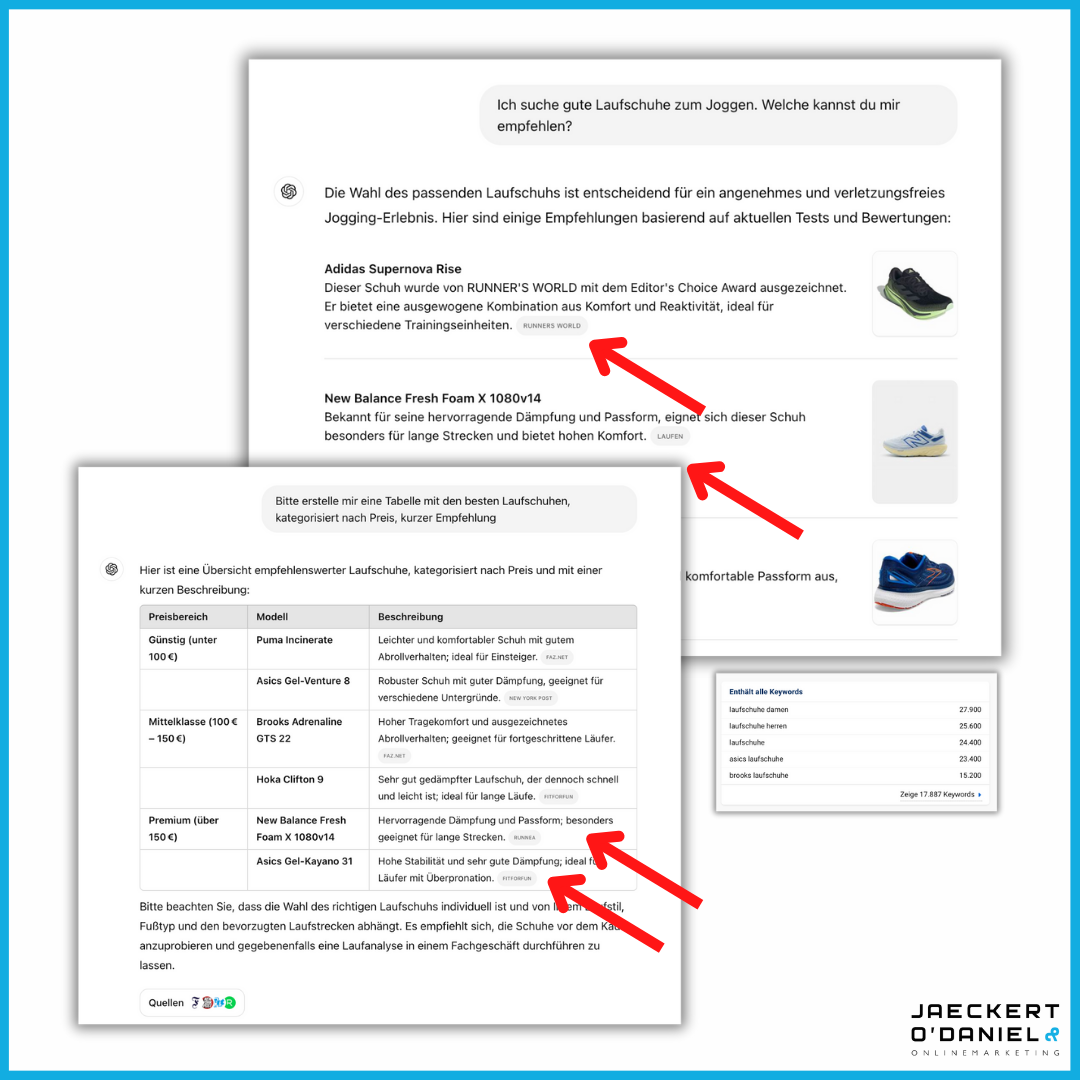
To begin, we searched for a classic, widely used product. If you check the keyword “running shoes” in SEO suites like Sistrix, you will see that there are approximately 30,000 search queries per month for it. There are around 17,000 keyword combinations, including brands, usage, prices, comparisons, etc. It is therefore likely that users will also enter such queries into ChatGPT in the future and, for example, ask for recommendations.
The result in ChatGPT Search: Very concise, clear search results. Various products from well-known manufacturers are displayed, each with links to reviews on running websites or from publishers. Very similar to a Google result.
However, the results in ChatGPT Search are completely ad-free and very streamlined. The results are separated by gray-highlighted lines. The summaries appear to be generated by the language model and are very informative. There are no integrations, such as boxes like Google’s “People also ask”.
All in all, a very useful result. In further use, one could leverage typical ChatGPT functions, such as creating an overview from the offers and sorting the shoes by price categories – which is not possible in Google.
It is not clear how often which search terms are searched for in ChatGPT. There is no data or tools available for this. Therefore, we must develop scenarios that we consider possible in the future.
Brand Queries in ChatGPT Search
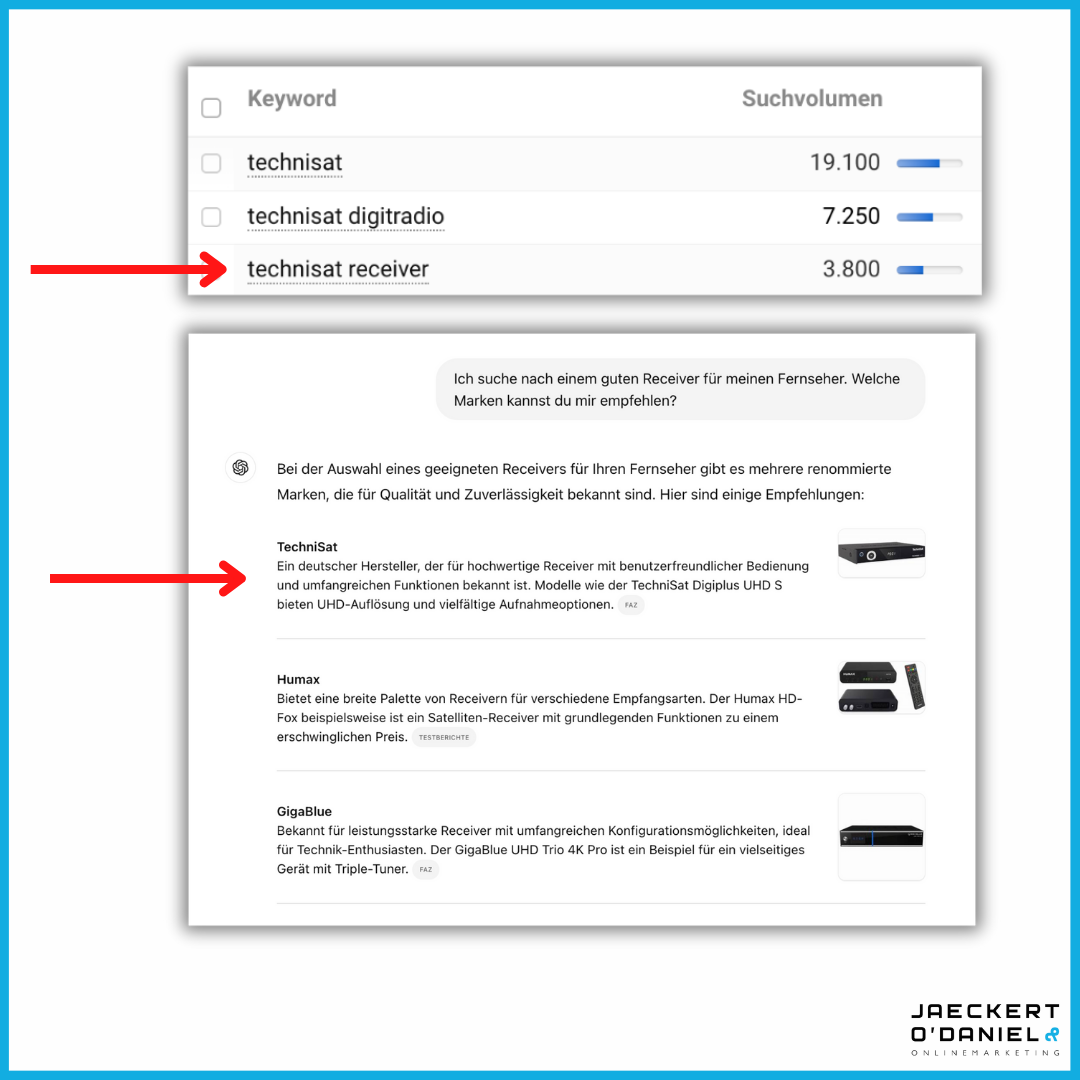
In the next step, we entered a brand keyword into ChatGPT Search – that is, a brand name. In this example, a German manufacturer of electronic products.
Such “brand keywords” are extremely common. Millions of users enter brand or company names because they do not know the exact web address or do not want to search for their desired product in specific categories. It is therefore a typical Google usage that could migrate to ChatGPT Search.
The result clearly shows: The company is briefly introduced. Below, the various product categories are correctly presented in bullet points, each with a suitable link to the website.
Here too, the overview is ad-free and free of further integrations like Google’s Knowledge Box or Shopping integration. We consider it very likely that ChatGPT users will naturally also make such navigational search queries. One immediately understands that they can reach their destination just as effectively as via Google.
From our perspective, nothing will change for companies regarding such search queries. Users will simply take a different path.
Also interesting: For “generic” search queries, for example, about receivers or digital radios plus recommendations, the company is also listed, comparable to the query for running shoes.
We observed similar findings in our tests within the startup sector. In the respective categories or industries, there are always well-known companies – whether in B2C or highly specialized B2B industries makes no difference. In SEO, this is also evident from companies being searched for in combination with products.
From our perspective, it is also clear: Companies that invest in branding, content marketing, and SEO visibility will also be mentioned significantly more often in language models.
In the future, it will be crucial to align strategies. Marketing teams face the challenge of thinking not too much in terms of departments and product categories, but rather in terms of topics and relevance across all channels and platforms.

Informational Queries in ChatGPT Search
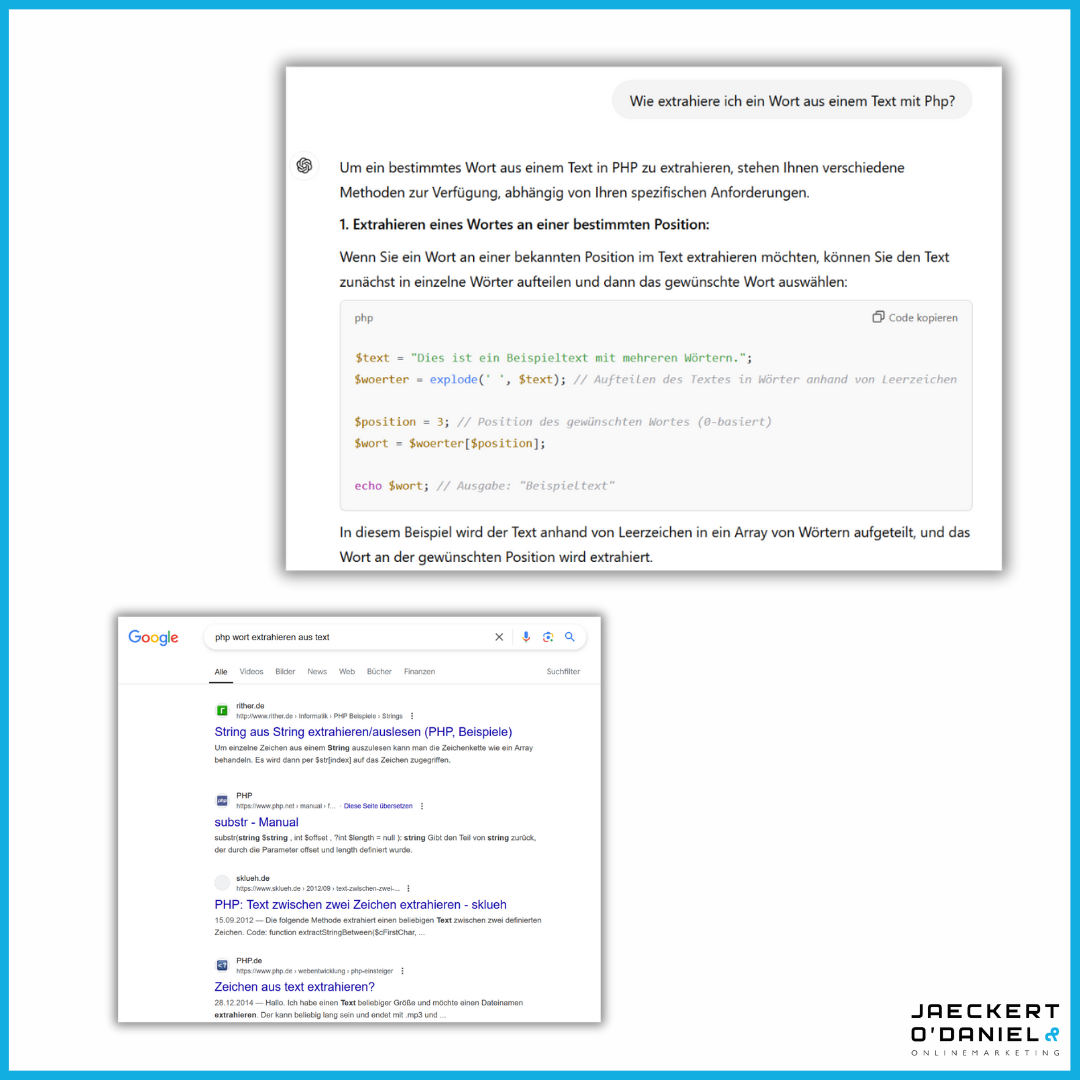
In the podcast, we discuss several informational search queries. One example is a very specific search query about programming. Fabian, as a tech expert, is knowledgeable in this area and can assess the results very well.
In comparison, ChatGPT Search clearly plays to its strengths here: The query is correctly understood, and a correct code is directly outputted. The code can be easily used via the copy function.
With Google, on the other hand, you get classic blue links. Several results are not effective or contain incorrect or unhelpful information. In direct comparison, it is also noticeable how many menu functions and buttons are now present on the Google website, including links to finance, a Google function unrelated to the query.
For other queries, ChatGPT Search first asks for clarification in a concise answer, then works with the second prompt to show results. Again, in a similarly well-structured manner.
ChatGPT Search: our Conclusion
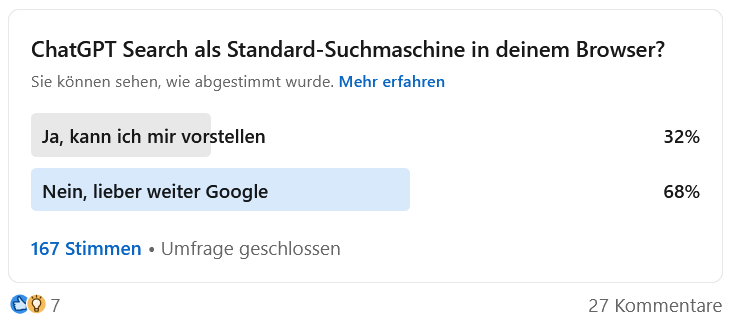
In a LinkedIn survey by Fabian, over 1/3 of participants stated
they could imagine switching to ChatGPT Search.
Deepen your SEO Knowledge: Every Monday via Email

We Advise Marketing Managers on SEO

We are Fabian Jaeckert (right) and Benjamin O’Daniel. For many years, we have worked as consultants for marketing teams. We combine two worlds: Fabian is the technical expert, and Benjamin handles all topics related to content development.
We were looking for a sparring partner who would develop an SEO strategy for us and subsequently support our team during implementation. And where do you find the best SEO specialists? On Google, of course! Because there, Jaeckert O’Daniel are in pole position for the search term ‘SEO strategy,’ and we decided to cross the finish line with them. During the analysis, both the content and our technical setup should be taken into account. Fabian Jaeckert and Benjamin O’Daniel provided excellent assistance with this. They addressed precisely the right points, developed recommendations for action, and formulated clear to-dos. All of this was presented within a very refreshing and understandable presentation for the entire team.

“How can we improve our SEO visibility?”
This fundamental question underlies every project for which we are brought on board.
It often involves reviewing existing SEO and content strategies from an external perspective and developing new levers.
This is precisely what we specialize in.
We develop SEO strategies for companies and present them in a structured and understandable manner to the responsible parties in focus workshops. Subsequently, we support the in-house managers during implementation.
Sounds interesting?
We would be happy to arrange an introductory SEO meeting via video conference (30 min.).
