
First Hand Experience: the Content Key in the New AI World

I have been writing professionally for over 15 years and I can say: I have never produced a perfect article. Every piece stands between my personal standards – and my eye on the clock. The clock almost always wins.

My insight from daily work: I can spend hours refining the last word. But the real quality lever lies elsewhere: In the development of the topic idea. If the idea is right – the topic, the keywords, the angle – then the article performs.

This is precisely what this podcast episode with Fabian and this article are about. How can you develop topic ideas that deliver results? Considering that

  • SEO competition in the top 10 is increasing
  • AI answers are being integrated into Google Search
  • alternative answer engines like ChatGPT are establishing themselves

The key lies in content with “First Hand Experience”. This is an approach that Google itself emphasizes, one that the industry is focused on, and which we want to bring to life here. For us, it is a central part of a GEO & LLMO Strategy.


What is “First Hand Experience” Content?

There are two key documents where Google uses the term “First Hand Experience” or “First Hand Expertise”:

In both documents, Google emphasizes that its ranking systems prefer content written for people – and not optimized for search. This includes content that features genuine experiences and real knowledge – and not merely compiled content.

But what does that mean specifically? Are such contents truly preferred? And how should one systematically integrate this into content development? These are the questions widely discussed in the SEO community.

Because creating such content naturally requires more work – and demands entirely new approaches in editorial planning and topic development.
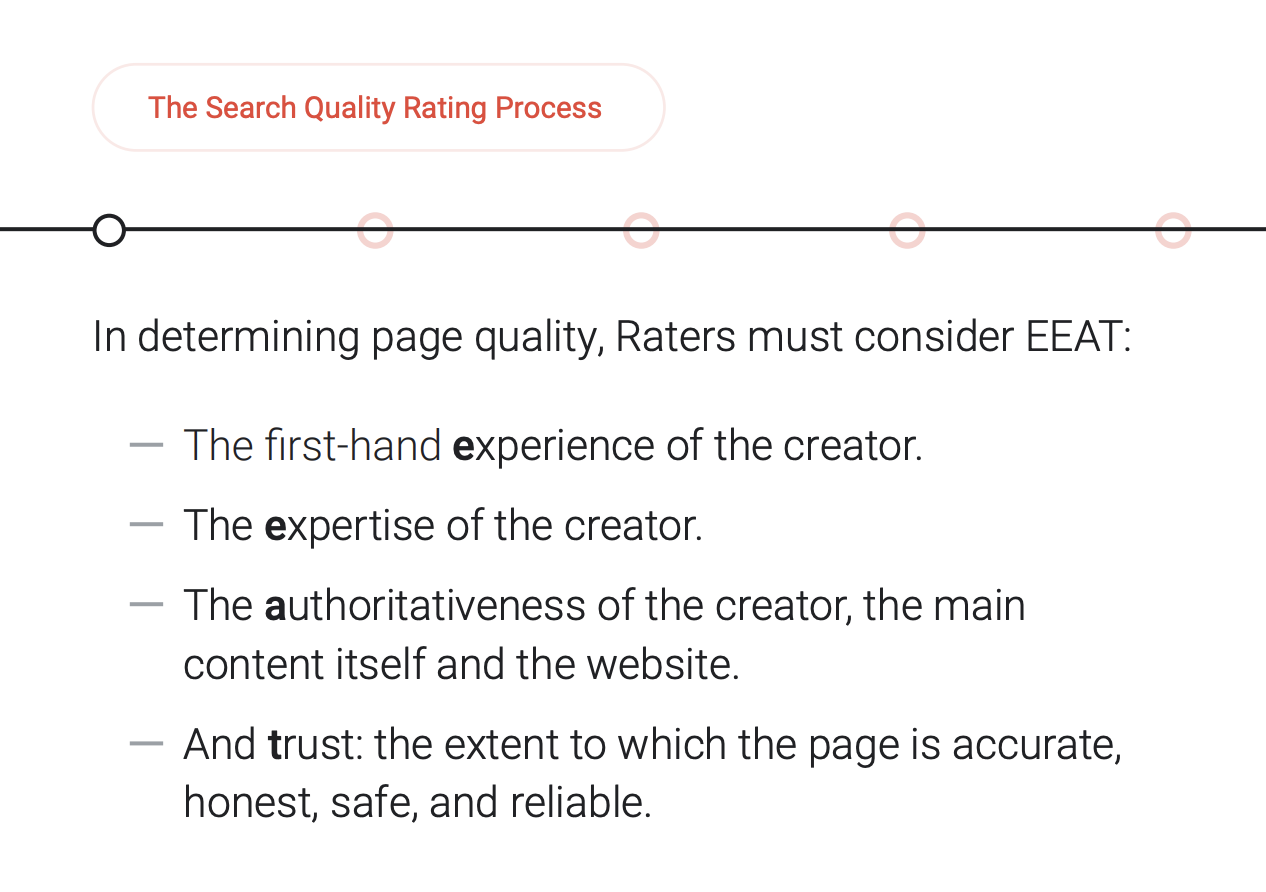
Google Quality Rater Guidelines P.25 First Hand Experience Page Quality
Google Search Central Focus on people first content

3 Challenges for Content Managers

Strong Uniformity in Top 10 Search Results

In the top 10 search results, there is often a strong uniformity. For example, regarding main terms: You won’t find just one article on “Definition”, but five to eight articles with a “What is it” heading. Because these articles rank high, more and more such articles are produced and optimized. However: If you, as a content manager, produce such an article, what chance do you have of achieving a top ranking? And will users even click on it if there’s no longer any difference? The poor click-through rates (CTR) for these terms speak for themselves. New content approaches are needed to highlight differences.

Efficiency-Optimized SEO Content Processes

Over 20 years of SEO, content processes have been increasingly optimized for efficiency. Simply put, this means: Keywords are researched and specified. Copywriters write paragraphs incorporating these keywords. This approach was long rewarded with success in the form of SEO traffic. However, such articles are achieving ranking success less and less frequently. At the same time, ChatGPT, as a text engine, can produce exactly this type of content at zero cost. But this no longer provides a competitive advantage. The process is reaching its end. The question arises of new approaches.

Traffic Successes are Increasingly Difficult to Predict

SEO as a channel has become more volatile and complex – as have all online marketing channels, by the way. Google Core Updates cause fluctuations. User signals like clicks and views are ranking factors. 75% of traffic keywords are unknown. Additionally, there is strong competition. Often, in every industry, we see a handful of players who are visible for practically all keywords. Above all, there is the question of whether Google will roll out its AI Overviews more widely. Then search queries will be answered by an AI at position 1. Those who offer the same will have a hard time. Therefore, new strategies are needed for relevant content that asserts itself in this environment.

First Hand Experience in Topic Development

So how can one systematically meet the requirement of always incorporating “First Hand Experience” into one’s topics? In the graphic, we show our approach. On the one hand, the approach focuses on the benefit for the user: What do they gain from consuming the content? On the other hand, it is about combining this with genuine experience and expertise.

We discuss examples of this in our podcast. An example from our area: The “SEO Relaunch Checklist”. There are countless general articles on this topic. We chose the approach of showing and discussing the personal SEO relaunch checklist of an experienced SEO manager from a corporation. The SEO manager used her checklist for herself and internal communication.

In our schema, it is “Action-driven content” because it supports concrete actions – in conjunction with an expert interview.

The Results: Improved Content Performance

Improved User Signals

The Google Leak regarding User Signals has definitively shown: Ultimately, the top 3 rankings indicate whether the content resonates with users. First Hand Experience Content retains users because it centers the experience and expertise of real people.

Relevant SEO Traffic

Those who rely on First Hand Experience have a new, unique approach to SEO. It is a very specific, qualified approach to addressing users. One is more resistant to Google updates and has a unique strategy against the flood of AI in search results.

Broader Performance

Those who rely on First Hand Experience move away from “SEO Content”. These are contents that work across all channels. The content ensures high click-through rates in newsletters, generates LinkedIn Impressions, and also qualified leads.

… And AI-ready in the Future

AI in Processes

To be clear: This is not a lament for AI development. AI tools can be used for a variety of process steps. For example: Idea brainstorming, developing questions for an interview, developing headlines for a blog article, proofreading, editing.

… But not as the Final Result

But it is not the approach of: “We produce paragraphs with ChatGPT or answer questions that we then embed one-to-one into our blog articles.” Any AI system can do that itself. You cannot outperform your competitors or ChatGPT if you do exactly the same thing.

How Long Did this Article Take?

I kept an eye on the clock 😉 This article, too, was created according to the “First Hand Experience” principle. How long it took us, what the process looks like, what benefits it brings, and how you can implement it for your company – we would be happy to discuss all of this.

For marketing teams, we develop individual Content Performance Programs. In our Academy, we also offer workshops on topics such as First Hand Experience.

This field is for validation purposes and should be left unchanged.
Your Name

Deepen your SEO Knowledge: Every Monday via Email

GEO SEO Newsletter


Inspiring Conversations with Industry Professionals

No results found.
No results found.