November 15, 2021Fabian Jaeckert
Measuring SEO Visibility: How We Work with Index Values
SEO visibility means how visible a website is in the Google ranking. At its core this is measured by how far up front the website stands for certain search terms (keywords). Many SEO tools derive an index value from that.
Every single page of a website can rank up front for hundreds of keywords. Each search term in turn has a certain search volume per month. That is how the SEO traffic comes about that a domain, or also individual pages (URLs) of a website, generates.
In search engine optimization (SEO) you can measure, analyze, and monitor SEO visibility. Many professional SEO tools have a central metric: an index value that calculates an average from all keyword rankings. This is called the SEO visibility index or SEO visibility.
Such index values bring advantages with them. For example, with an SEO visibility index like this you have a quick first look at the current situation of the domain or website. You can also run competitive comparisons through it, for example as part of an SEO audit.
But too strong a focus on such a central value for SEO visibility also has clear disadvantages. Because the visibility index can lead you astray. We talk about that in our podcast episode and on this topic page.
What is SEO visibility?
Measuring and analyzing SEO visibility is a complex matter. Index values exist for a reason: they want to simplify it.
A website can generally rank on Google for thousands, or also tens and hundreds of thousands, of search terms. Every single URL, meaning a single subpage, can rank for hundreds or even thousands of keywords and keyword combinations.
Across all search terms, SEO traffic comes to the website. The task of search engine optimization is to systematically increase the visibility of a website and thus raise the traffic.
SEO visibility is not an end in itself, though. It is about being visible for the relevant terms. Meaning terms that a potential customer enters, for example to get information or also to search specifically for a solution.
In this livestream we discuss how we work with the visibility index day to day. For example, how we use the index as the entry point into a deeper analysis during a core update, or for a competitive comparison.
What is a visibility index?
The term visibility index comes from the SEO suite provider Sistrix. Other SEO suites have index values like this too, but they are called something else there. At Searchmetrics the value is called “SEO Visibility”, and at Xovi the index value is called “Ovi”, to name two further examples.
In simplified terms, the index value works as follows: keywords with a high search volume and good Google rankings of the website have a greater influence on the visibility index. Keywords with a low search volume, by contrast, have a lower weighting. What comes out at the end is a kind of average.
The visibility indexes are created and output automatically. They can also be viewed retrospectively over years. Through the historical data, the long-term development of a website can be looked at. Detailed explanations here at Sistrix and at Searchmetrics.
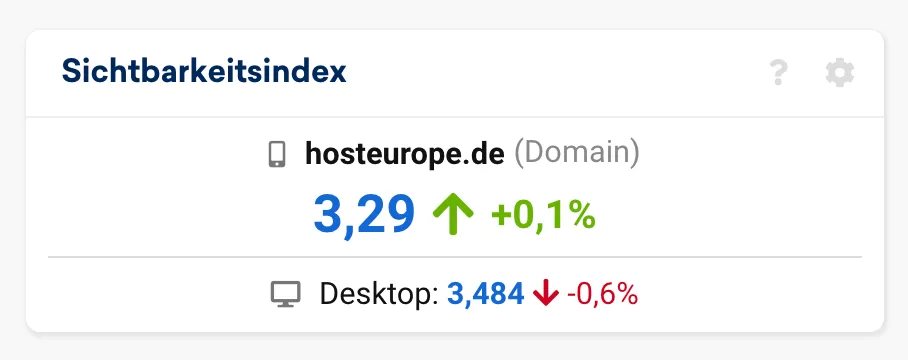
Here is an example of the visibility index from the tool provider Sistrix, which the other charts on this page also come from. Mobile visibility is the central visibility, because Google has since switched to the mobile index.
Example: comparing SEO visibility
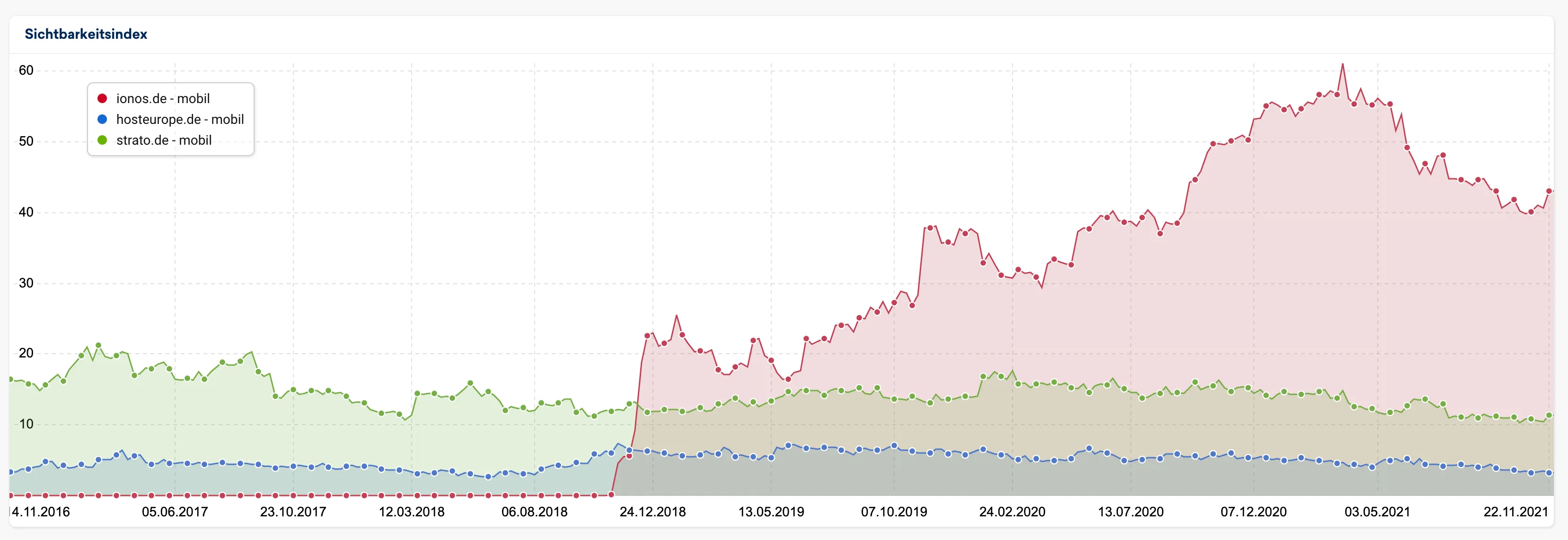
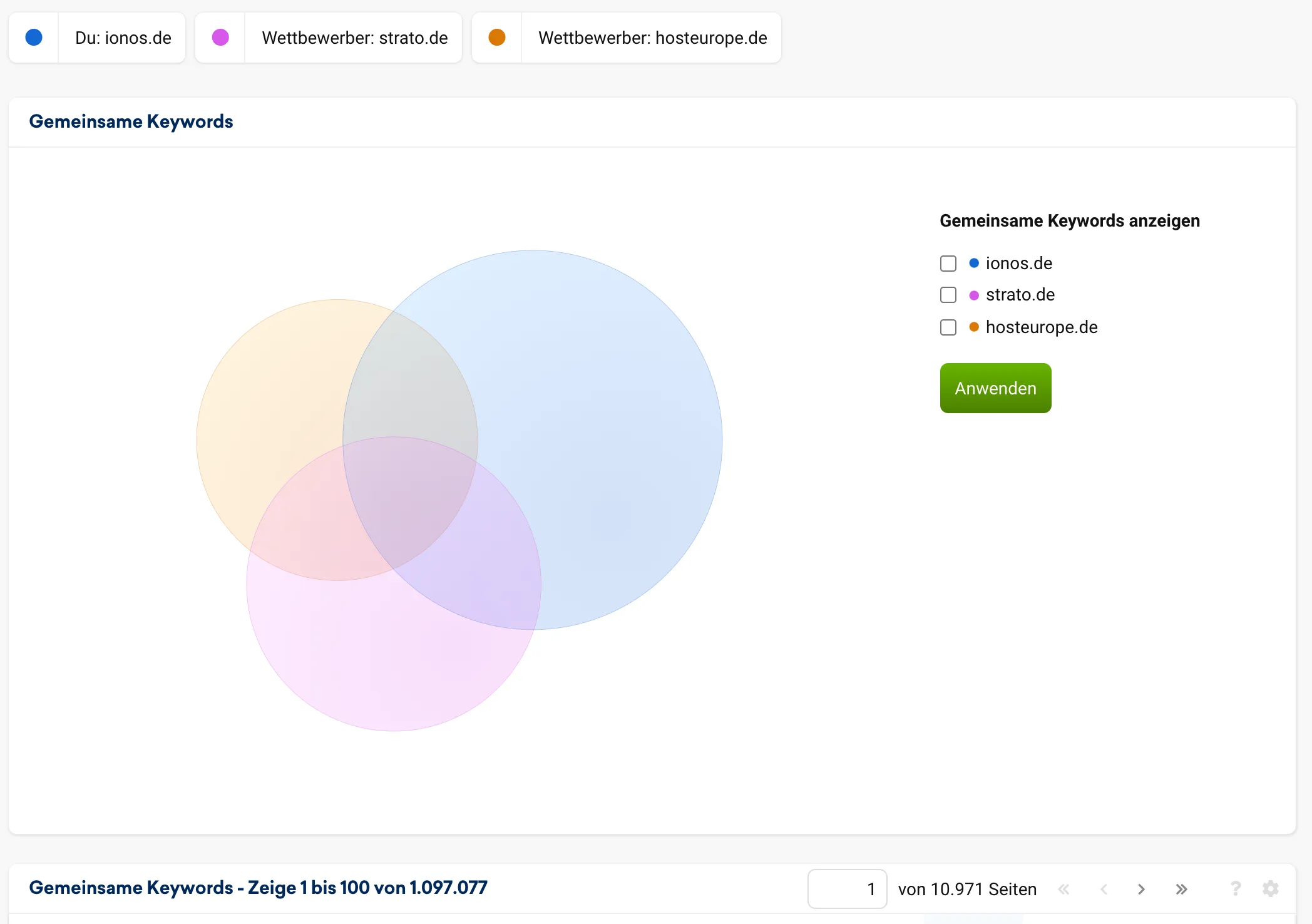
In this example we use the SEO visibility index for a competitive comparison. All three companies are active in the same industry and invest resources in search engine optimization. Even here, though, it has to be said clearly: the visibility index is calculated from the keywords the respective websites rank for. This is not yet about which keywords they are in detail, and how relevant they are for the business. Often different SEO strategies sit behind cases like this, for example whether you create content close to the business purpose or also think a bit more openly and use SEO for branding. This also shows when you compare the shared overlaps and the differences within the keyword sets. We also discuss this example in the livestream on SEO visibility, which we linked further up.
Checking SEO visibility, above all during core updates
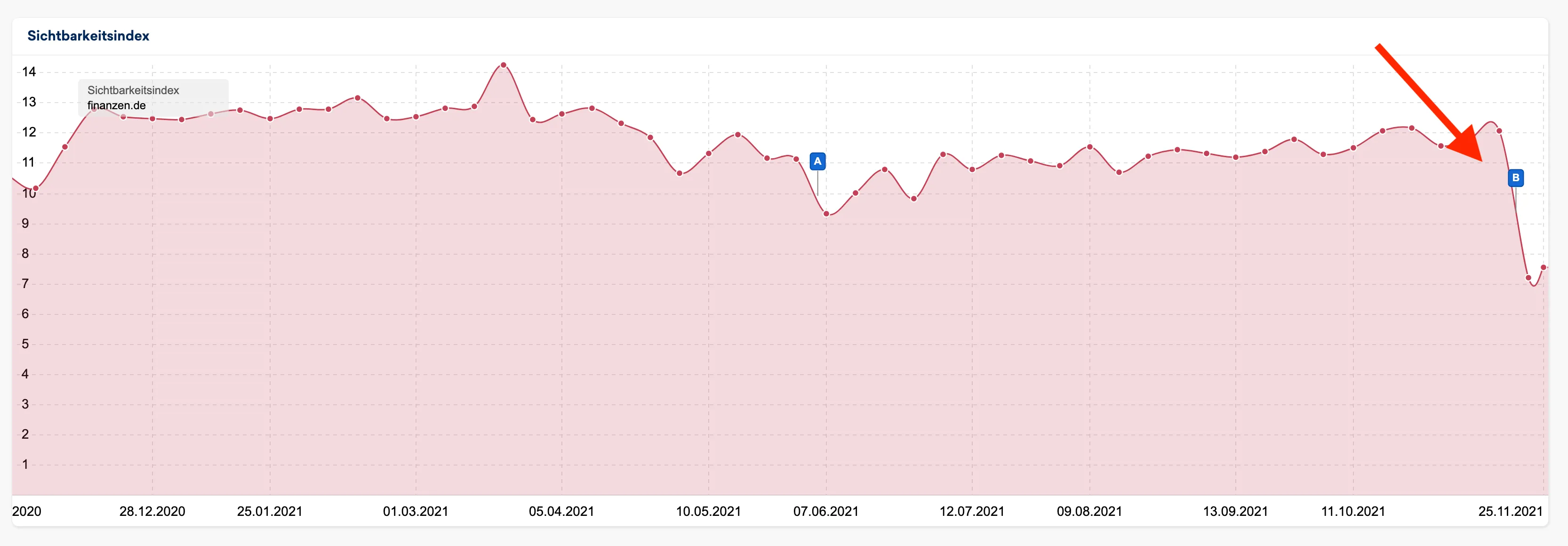
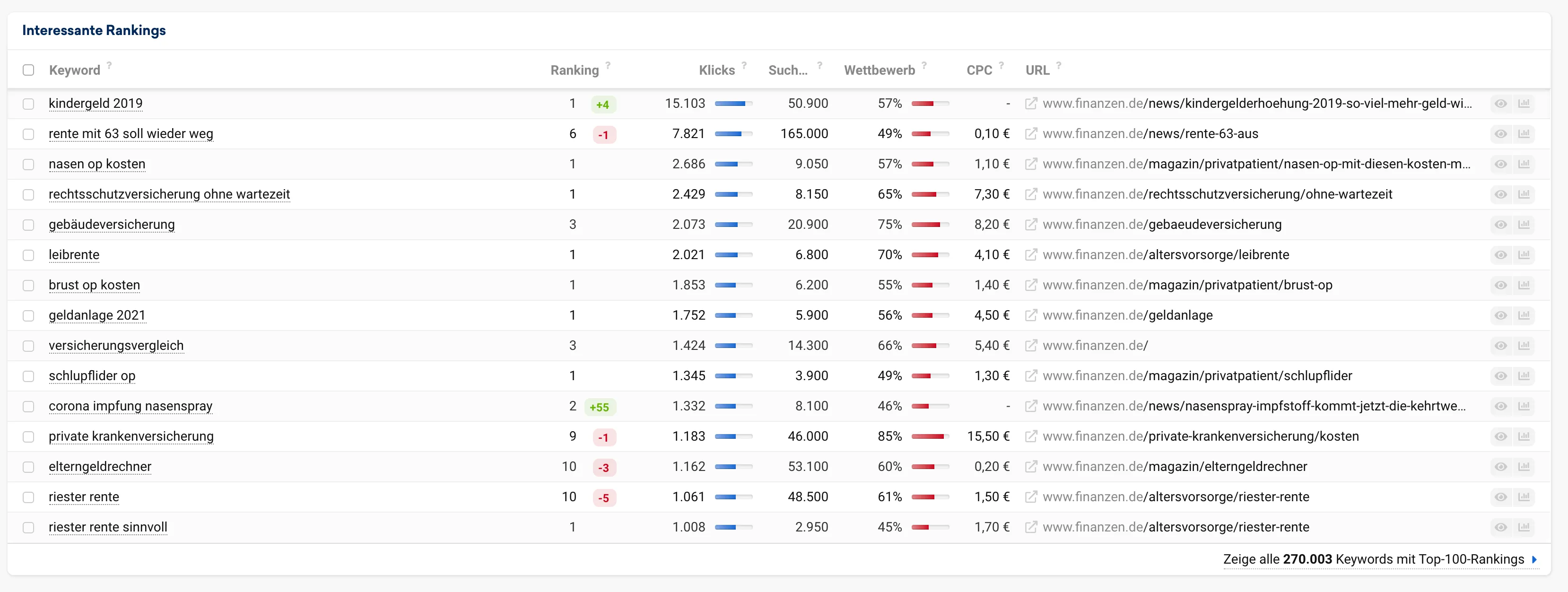
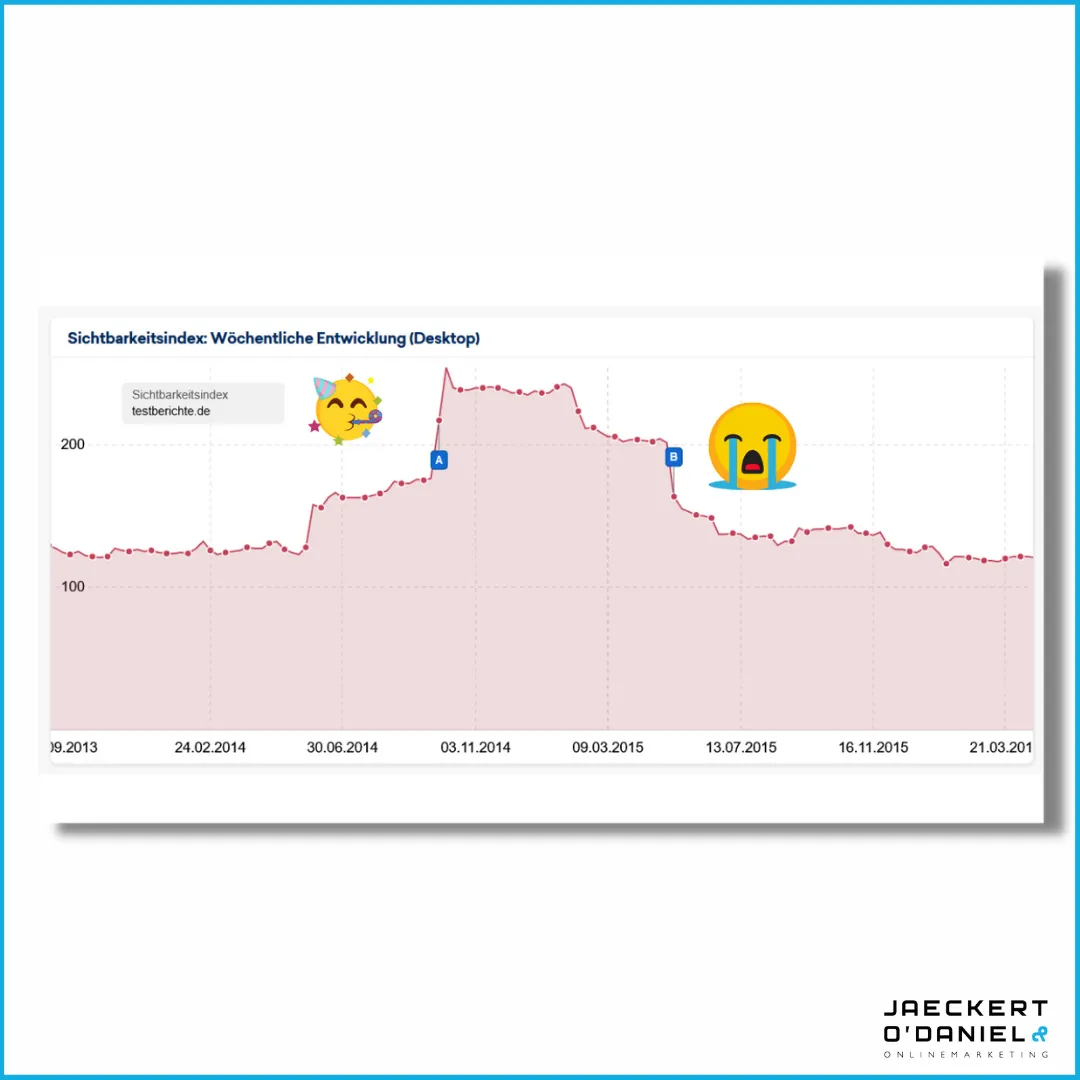
During a Google core update it can happen that websites lose SEO visibility massively. In this example a domain loses several visibility points during an update (see arrow). In the second chart you see that the website ranks for hundreds of thousands of keywords. Here too you then have to go deeper, in the form of an SEO analysis or an SEO audit, also in connection with the concrete traffic losses at keyword level. That will show again with the Helpful Content Update as well.
Three disadvantages of the index values for SEO visibility
Large fluctuations
Companies often have Google rankings for a few search terms with a very high search volume. That then creates an imbalance in the calculation of the index values. Example: a website loses something like double digits on the visibility index. But actually the page has only slipped a few positions for one “heavy” term, meaning one with a strong search volume. A crash in Google traffic does not always follow from that. You should therefore always also cross-check the index value with the actual traffic, which can be determined for example through Google Analytics and Google Search Console.
No general index
Every company is active in a very specific topic field. These topic fields are searched to very different degrees. In B2C, traditionally, far more people search through Google. The consequence: there the search volumes are much higher, and so the index values are much higher too. In B2B SEO, by contrast, it is often the case that the index values are very low. Yet the companies behind them are still very successful in SEO, because they target very specific, valuable search terms. A comparison only makes sense if the companies want to achieve rankings in the same industry and, in SEO terms, also in a similar topic field, meaning keyword set.
Not a suitable value for internal communication
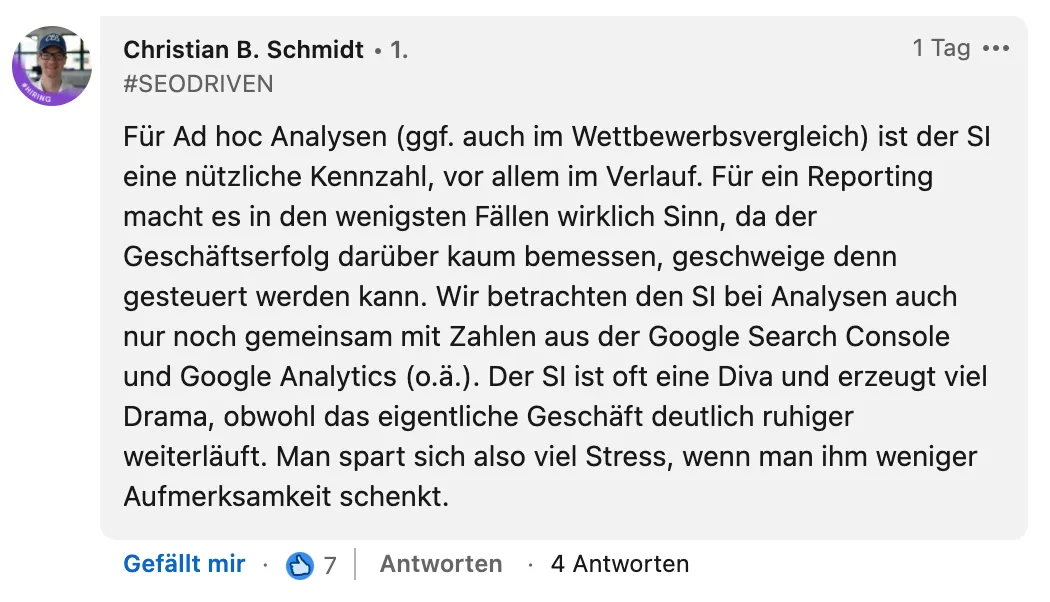
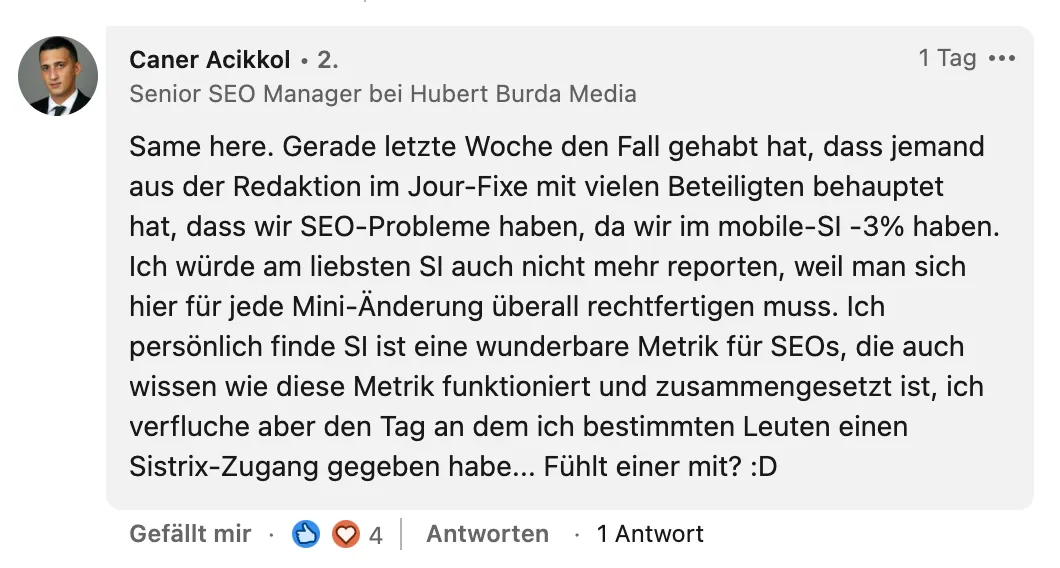
Marketing managers are often responsible for SEO. They need KPIs they can report to the leadership level. The management wants to know what a website brings in return. Anyone who relies on visibility indexes here quickly gets into trouble. Because the index values fluctuate strongly and, in detail, say little. If, for example, you invested heavily in SEO in the first year and argued at leadership level with the rising index value, it becomes very difficult when fluctuations occur.
These are the experiences SEO managers have with the visibility index
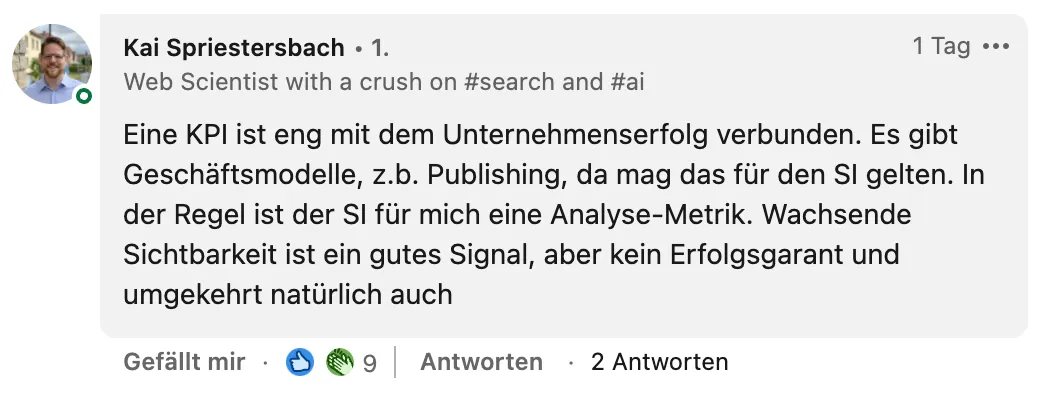
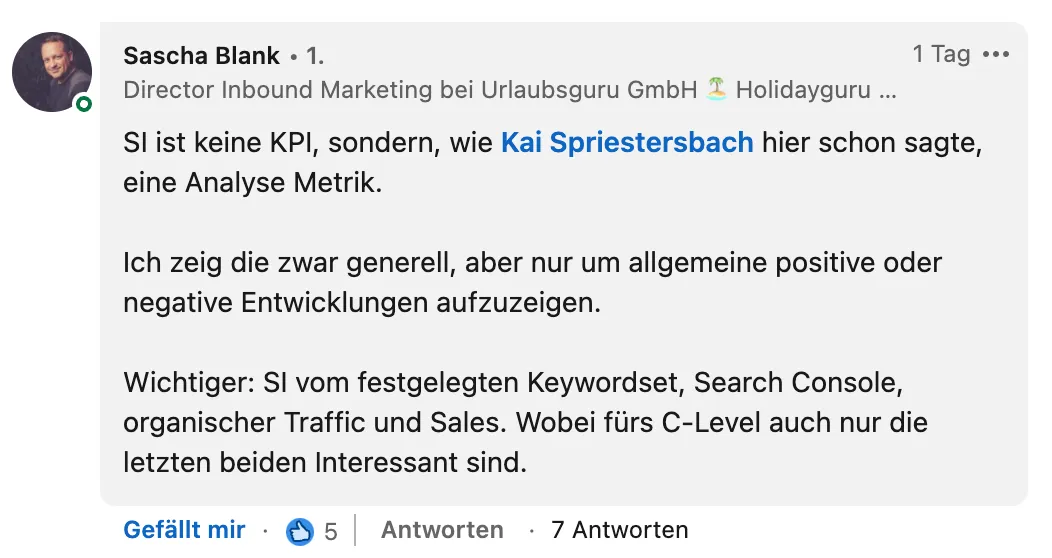
On LinkedIn, Fabian shared our experiences with the SEO visibility index. Under his post numerous experienced SEO professionals commented on how they handle the visibility index (SI) as a metric. A few comments:
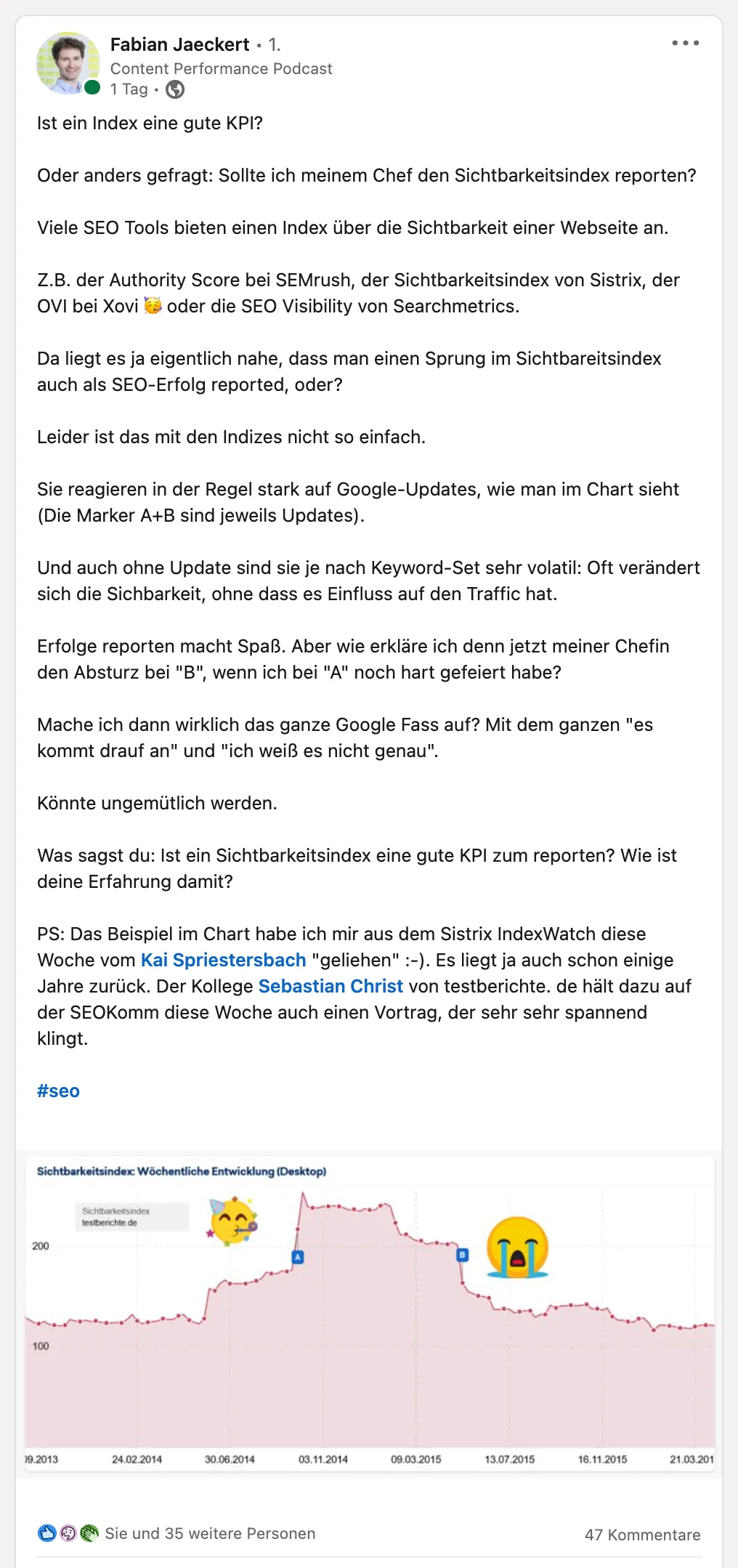
Three advantages in how we work with visibility indexes
Use the SI for a first read on SEO visibility
We use visibility index values to get a first impression quickly. For example, how the company’s website has developed from an SEO point of view over recent years. Whether there was a sideways movement, or a rise, or a decline. From this first impression we then go into depth, for example when we start an SEO audit or an SEO concept.
Index for a competitive comparison
Sometimes you need one central chart. Visibility indexes are sometimes suited to that. For example when you compare direct competitors with regard to their visibility in a certain topic field. In some markets, companies rely on similar SEO strategies and accordingly work on similar keyword sets. Here the SI can then give an impression of how visibility develops over a longer time frame.
SI during core updates
Many professional SEO suites also indicate when Google has carried out a larger core update. It happens again and again that individual websites lose a great deal of SEO visibility. You can see this connection very well through the visibility indexes. But here too that is then the starting point for a deeper analysis.
We support marketing leads in raising the website’s SEO visibility

We are Fabian Jaeckert (on the right) and Benjamin O’Daniel. For many years we have advised mid-sized companies on how they get more visitors through Google and turn that traffic into inquiries and sales. So that the website becomes a measure that supports sales. Through high-quality content.
With Jaeckert O’Daniel, it quickly became clear to us that we had made an excellent choice in selecting potential partners for our online marketing project. Their expertise and, above all, their ambition to thoroughly immerse themselves in our specific industry topic to provide us with the best possible support, are precisely what is now propelling us forward.
 Tobias ReitmeierF.EE Group
Marketing managers have many projects on the table. They know that search engine optimization is relevant. But the concrete implementation, above all the development of a well-founded SEO strategy, is very hard for them.
At the same time there is often the clear requirement to raise SEO visibility and to provide more traffic and leads. The website is, above all in B2B, a measure that supports sales.
That is exactly what we have specialized in. We develop SEO strategies for companies and present them to the people in charge in a structured and understandable way. Afterwards we accompany the in-house leads during implementation.
Because often, for example for content creation, many internal things have to be taken into account. For example in B2B SEO: companies in the B2B sector have complex projects that need a lot of explanation. Here you need internal subject expertise and, at the same time, a well-founded B2B SEO strategy.
At the same time it is especially important here that the content, which took a lot of effort to create, also yields as much as possible. Lasting SEO traffic is a value driver here.
Sound interesting? We can arrange an SEO intro call by video conference (30 min.).
Measuring SEO visibility with an individual dashboard
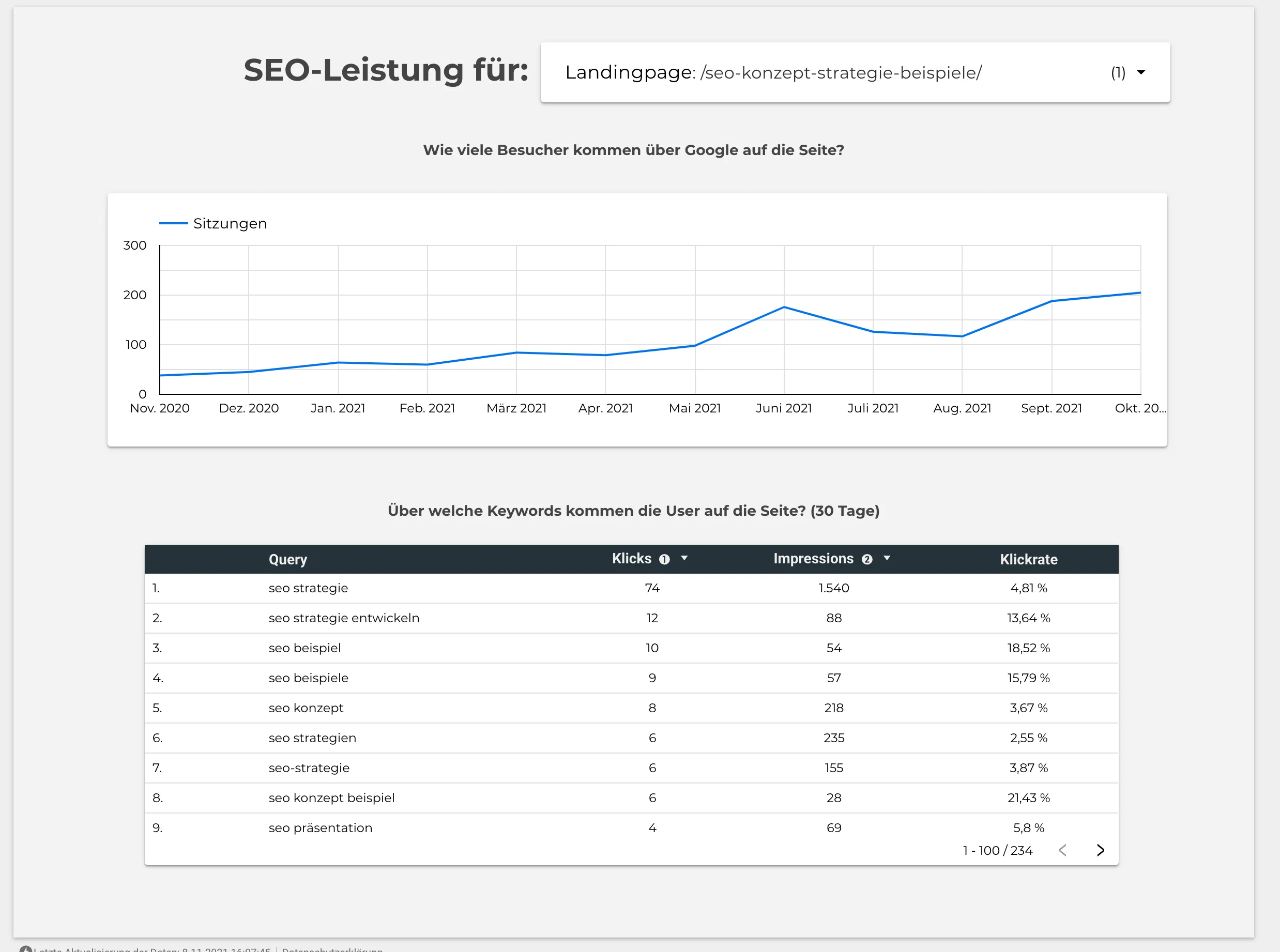
Here is an example of the SEO visibility of a single URL from our site. The data comes from Google Search Console and was visualized with Data Studio.
From our point of view, marketing leads need a central dashboard for the company’s SEO visibility. For the analysis and optimization within search engine optimization. But also for internal communication with the leadership level.
We develop dashboards like this as part of our SEO mentoring. It is included in the package. For this we use Google Data Studio, drawing on metrics from Google Search Console and Google Analytics.
A dashboard includes values such as traffic and conversions of the domain overall, but also the visibility of central URLs that are important for the company.
Frequent questions about SEO visibility
How can you raise SEO visibility?
To raise SEO visibility you need an SEO strategy, among other things with an extensive keyword set, and a concrete action plan, often in the form of content that should be created or revised. The website structure often has to be adapted or expanded as well. Link building, or digital PR, also pays into SEO, and thus into visibility on Google.
How fast can you raise your SEO visibility?
Search engine optimization usually has a medium- to long-term effect. Above all in heavily contested areas, it takes time until you have reached top positions. We have found that you should count on at least half a year to a year. That is also the reason why many companies do not invest in SEO. They pursue short-term marketing goals. With SEO, though, you build a lasting value.
What does it cost to build SEO visibility?
Companies face two options for building SEO visibility: either they hire external service providers (above all SEO agencies), or they build their own SEO know-how. As SEO consultants, we support companies in building internal resources. Because we have found that many companies are more successful that way.
What does SEO include?
Search engine optimization (SEO) consists of two large areas of work: off-page SEO and on-page SEO. Off-page SEO means all signals you build outside your own website. These include links, among other things, but above all branding and topical authority. On-page SEO covers everything that concerns the website directly. That can be technical topics (for example load times, Core Web Vitals), keywords, and content.
Do I have a problem if our visibility index is low?
There are many companies that are very successful in SEO and still show a very low visibility index in the tools. The most common reason: the company is at home in the B2B world. There the search volumes per search term are very low, and accordingly so are the indexes calculated from them. But even a keyword that is searched only 100 times a month can be very valuable.
What to do when the visibility index fluctuates very strongly?
Strong fluctuations in the visibility index are not unusual. Above all when overall visibility is relatively low. Because then the index calculation often hangs on a few very strong search terms. Marketing leads are often irritated then. But in essence nothing has really happened in the website’s Google ranking.
SEO visibility from practice: our interviews with SEO professionals in the field



SEO for a software company: interview with Beat Köck



The SEO strategy of Reishunger.de: interview with Benni Uhlmann

The art of crawling: interview with SEO Markus Hövener

SEO visibility: case studies, tips, webinars: through our list