May 3, 2021Benjamin O’Daniel
What Is a Microsite Worth? Definition, Examples, and SEO
A microsite is a lean website with only a few subpages. Often such a microsite runs in parallel to a company’s main web presence. For example for a particular target group or a new product.
On this page and in the podcast we talk about the consequences of this common practice of constantly creating new microsites, and of having to look after them afterwards as well. Because such micro websites create a lot of effort down the line and often earn little return.
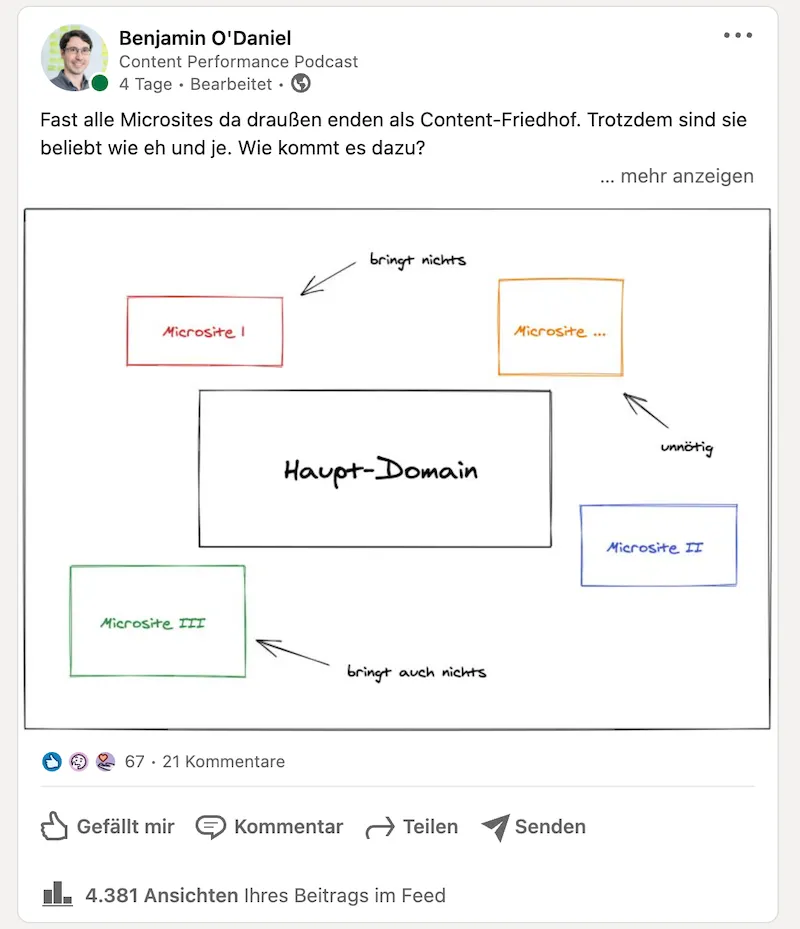
The problem: many microsites end up as content graveyards. One reason lies in search engine optimization (SEO): the mini websites almost never achieve a real Google ranking, and therefore no lasting traffic.
What is a microsite? (Definition)
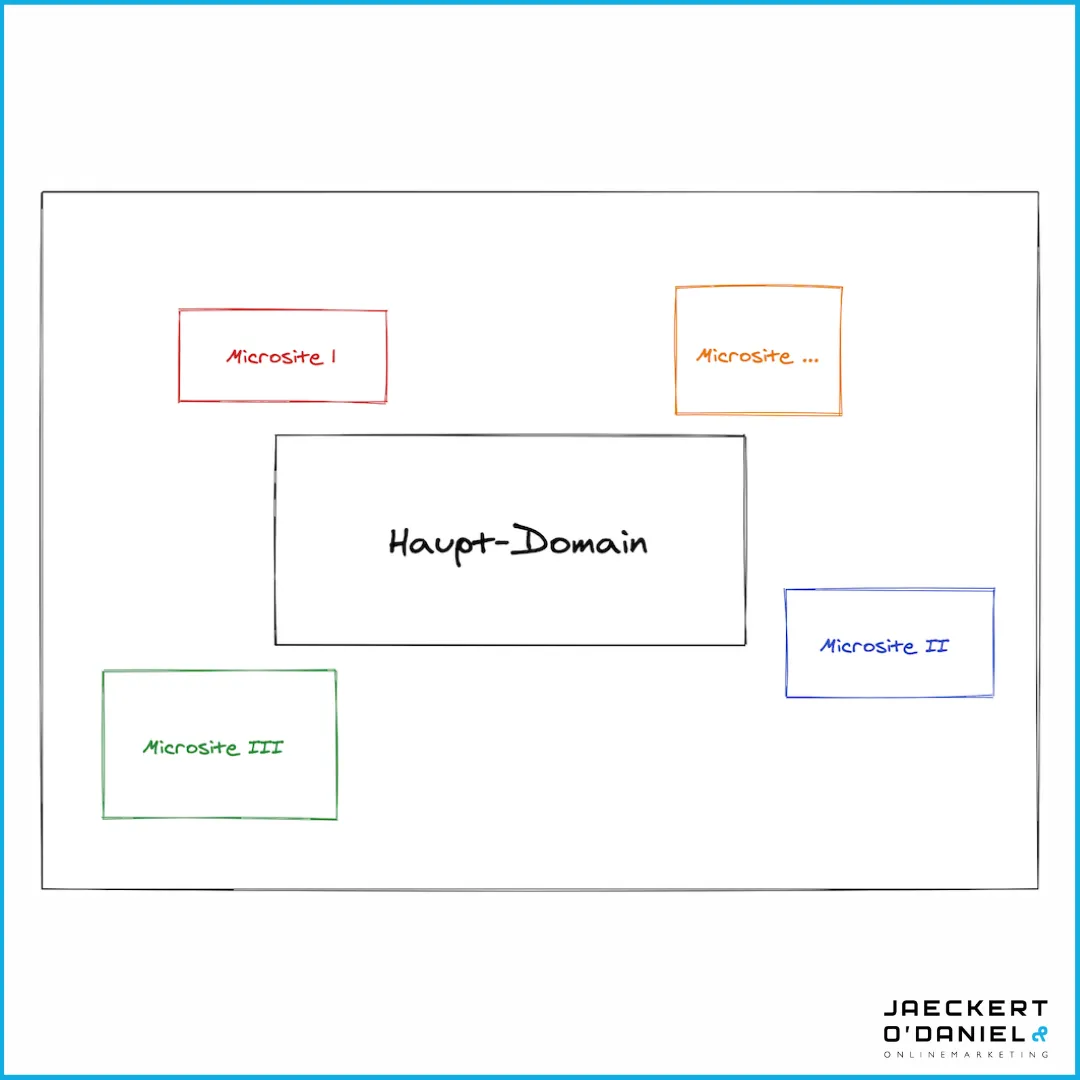
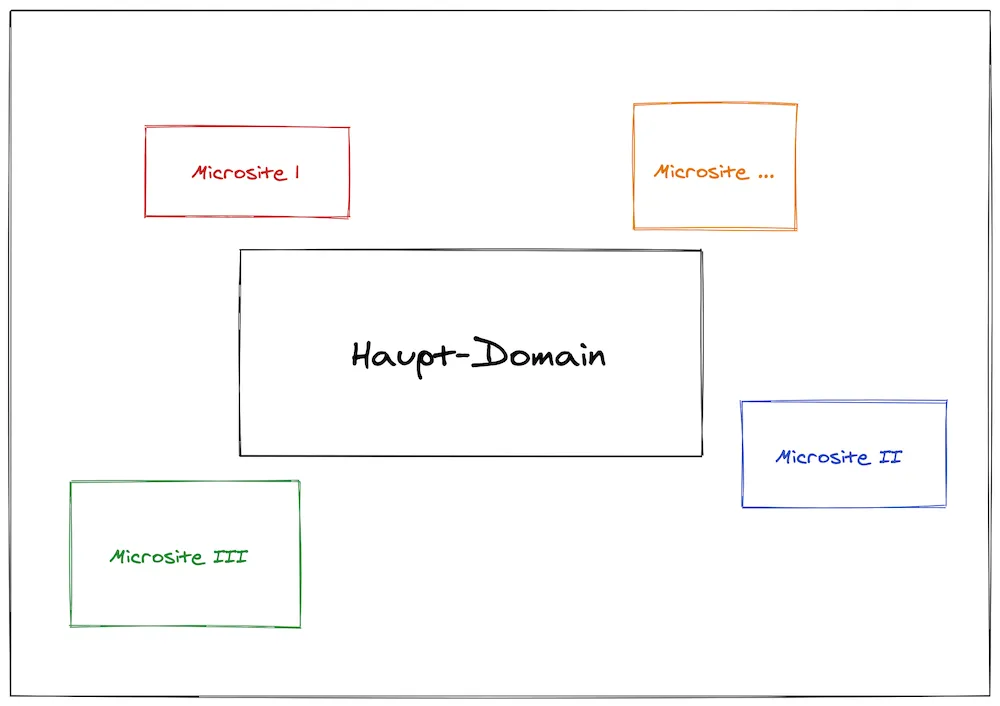
A microsite is a website that belongs to a company but, for various reasons, sits on its own, separate domain. The microsite therefore exists alongside the company’s main website. It is often filled with very little content and covers only one topic.
Microsites often have an independent design and also run on an independent content management system such as WordPress. It frequently differs from the CMS of the parent website.
A microsite is also often called a micro website, or a one-pager when all the content sits on a single page only, for example on the homepage with jump links. As a format, a microsite is often created by marketing departments, but also by freelancers.
What is the difference between a microsite and a website?
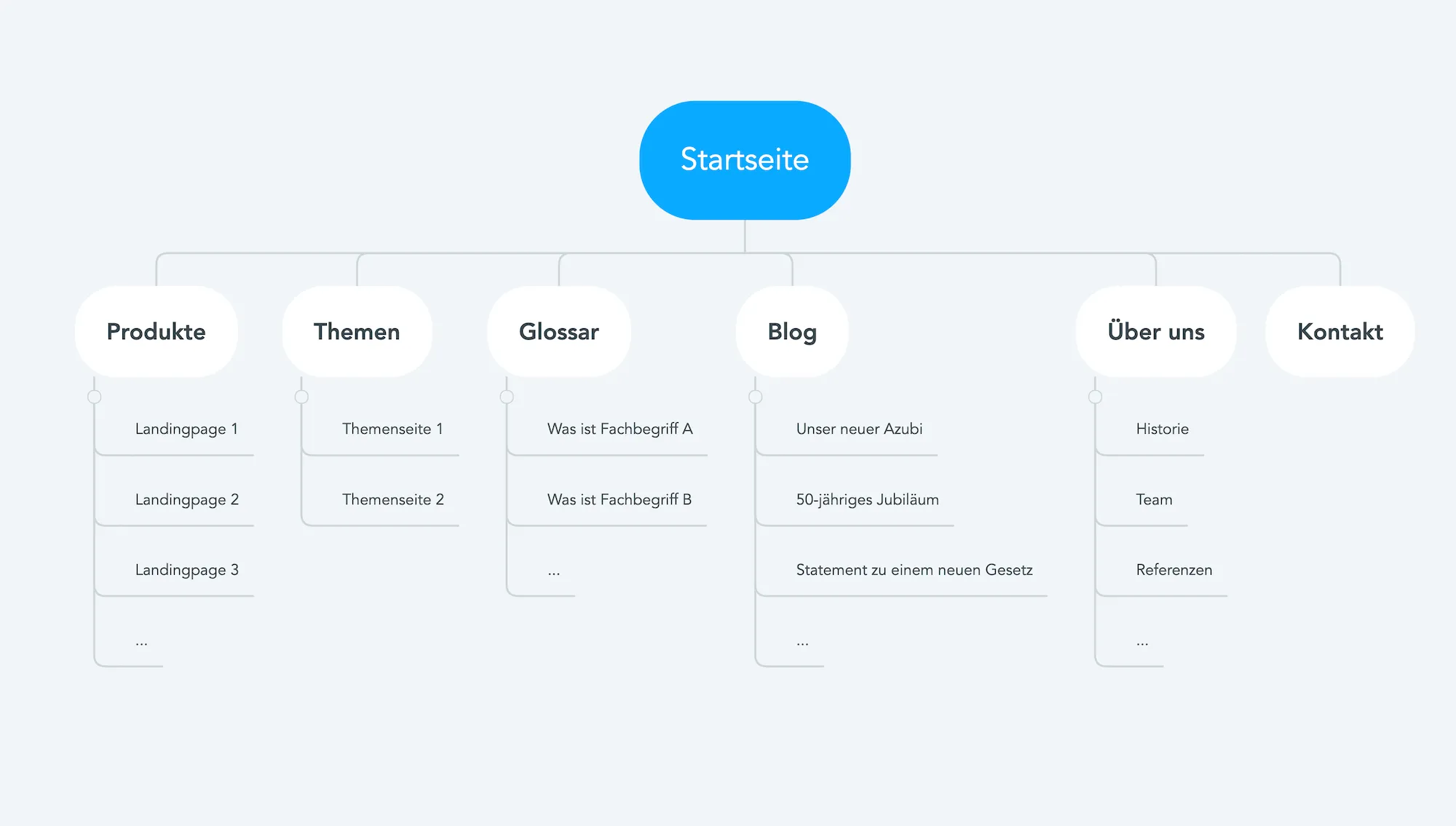
In our understanding, a website is clearly more extensive than a microsite. It is the central web presence, with information about the company, about all products, and often with further helpful content, for example in the form of a content hub.
Such long-established and extensive “parent websites” have very large ranking potential from the perspective of search engine optimization. The reason: the websites are often already many years old and very well linked. They therefore have high authority from Google’s point of view. Even so, many marketing leads prefer to switch to microsites, because they have more “room to move” in the design there. The central web presence is often also very “political” territory, for example over which department is how visible on the homepage.
What is the difference between a microsite and a landing page?
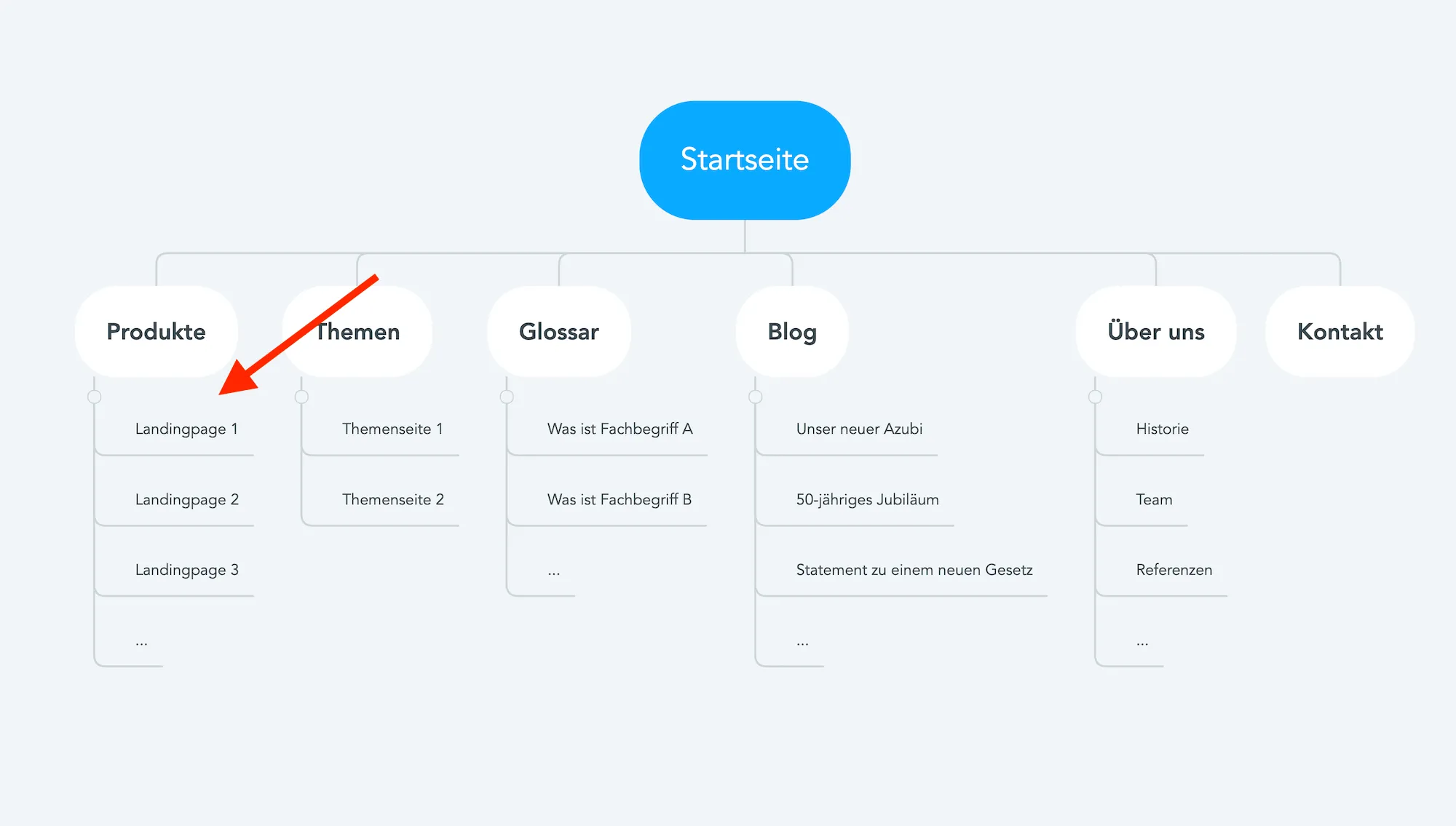
The terms microsite and landing page are often used as synonyms, but they have one central difference. A microsite sits on its own domain, that is, its own www address.
A landing page often has its own layout as well, but it is anchored inside the main website, for example in the category “Services” or “Products”. A landing page is therefore a single subpage on the same domain.
Confusion, or rather mix-ups, often happen because both microsites and landing pages are frequently developed for campaigns. For example for larger TV campaigns, but also for Google Ads or social media campaigns. The traffic you buy is then directed specifically to the respective page, landing page or microsite. Because both types, as a rule, generate no organic SEO traffic.
SEO strategies, tips, and webinars: via our SEO newsletter

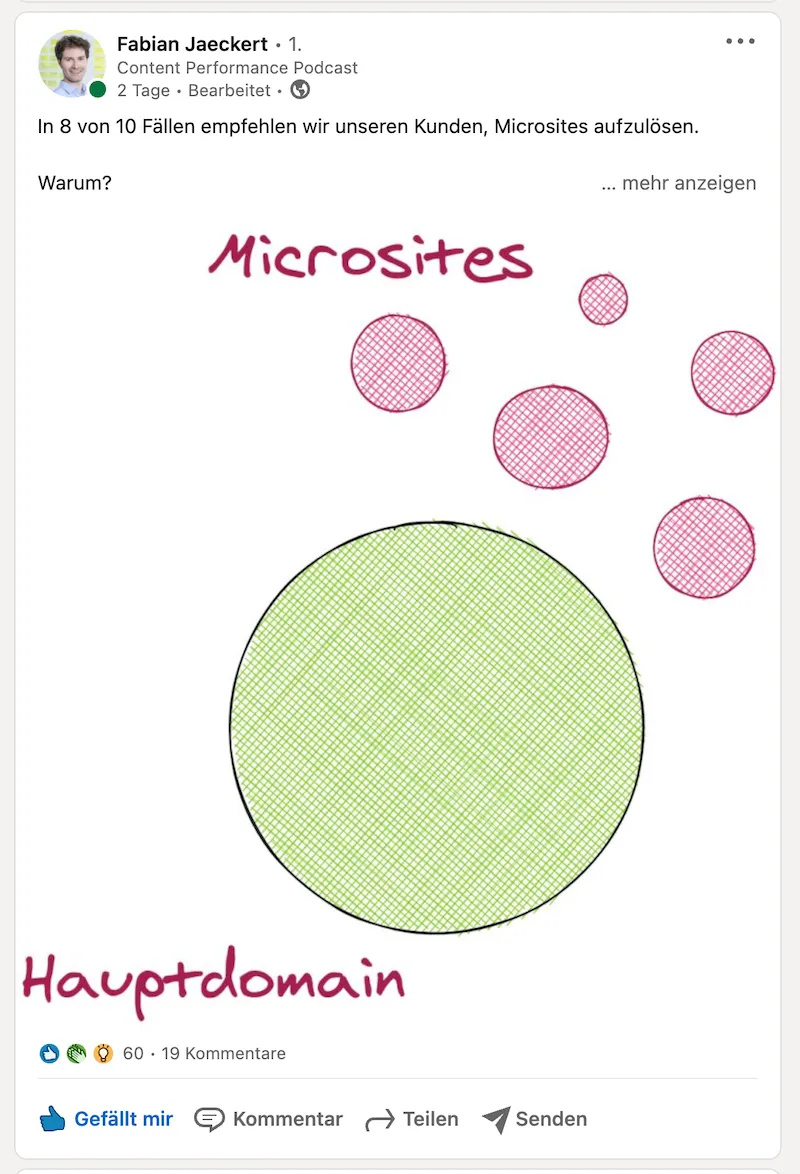
Creating a microsite: discussions on LinkedIn
Our podcast is heard by thousands of marketing leads. They are all professionals in their field. That is why we like to discuss our topics with our listeners on LinkedIn. The same goes for this topic around microsite marketing, and the pros and cons of creating microsites.
What does a microsite cost?
Inexpensive microsites cost a few thousand euros. But costs of 50,000 euros to more than 100,000 euros have also been named to us in conversations with marketing leads. It depends very much on the company and the individual requirements. We ourselves are not a web agency, but we work with many mid-sized companies that in turn commission web agencies to develop and design microsites.
The thinking often goes that a microsite with WordPress is cheaper than with more elaborate content management systems such as Typo3. But it is and remains an elaborate project, and not a “micro” topic. And a microsite with WordPress also has to be designed, adapted, and maintained. Hosting, by contrast, is usually a negligible cost factor.
A central flaw in the costing of micro sites: it is not included that there also has to be an SEO strategy and content in depth, so that such a micro website ranks with Google over the long term and generates traffic (see advantages and disadvantages further on). The cost calculation consists purely of programming and design. All the more bitter, afterwards, is the realization that no user comes to this microsite on their own, no matter how much you have invested in the look. More on this topic, by the way: what does SEO cost?
An example of a microsite
We are deliberately taking an example from a company we have nothing to do with. Benjamin discussed this example with students as part of his content marketing seminar at TH Köln.
This is a health insurance fund that had an independent microsite developed for a campaign. Which agency implemented it is not known to us, and it does not matter either, because we want to discuss the phenomenon in principle. We also discuss the example in more detail in the video.
You can see very clearly from the screenshots that the microsite is meant to address a young target group, and in a very uncompromising and clear way. In the look, but also in the language. The topic “healthy living” is in the foreground, and not the health insurance fund as a company.
We cannot and do not want to judge how the campaign went. What we do see clearly from an SEO perspective: the microsite has only a few successful Google rankings. Only one blog article really ranks well. In this example the microsite will generate little organic traffic, and therefore little SEO value.

The microsite “Gesundes-Miteinander”.
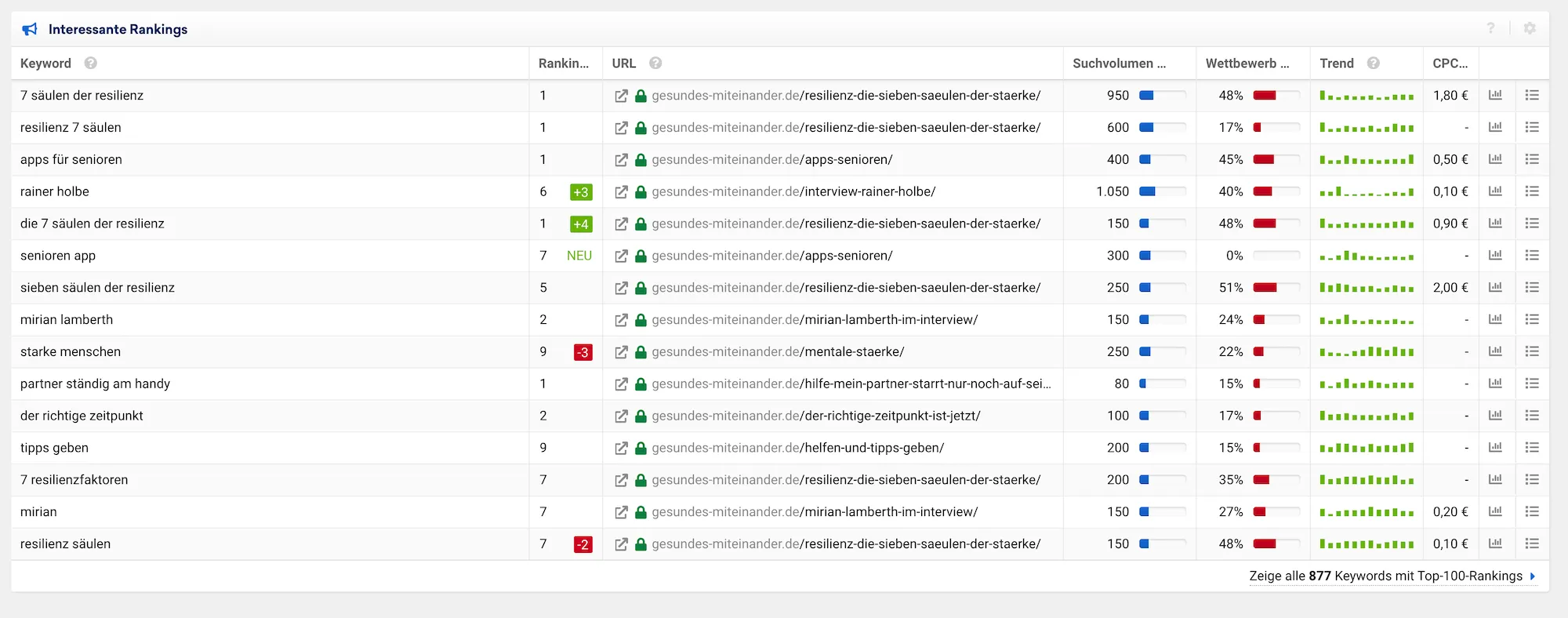
Excerpt of the microsite’s Google rankings

A quarter of all rankings are based on a single blog article. After that, visibility drops quickly. In total there are more than 100 articles.
Pro: what are the advantages of a microsite?
There are some situations in which marketing leads decide to have microsites developed. These advantages include:
- Complete focus on a particular target group
- The new product is at the center
- Greater freedom in design
- The main website does not have to be adapted
All of these advantages, though, mainly concern the starting point inside the company. The medium- to long-term consequences and the economic viability of the microsite are rarely discussed.
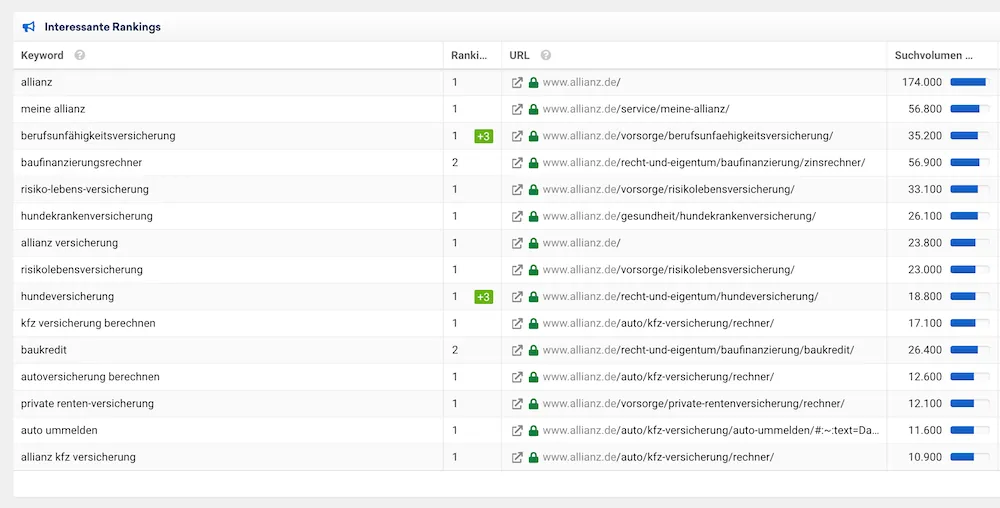
Example: the main website of this company has very good Google rankings. Because the company is a brand and has built up a lot of content and trust over years. Essential Google ranking factors that do not apply to microsites.
Contra: what are the disadvantages of a microsite?
There are a number of disadvantages that speak against a microsite. They include:
- High costs for design, programming, and maintenance of the microsite
- Often no Google rankings from microsites
- Often no traffic and no leads via microsites
- More laborious content management because of different systems
- Higher complexity in resource planning for content
- The main domain is neglected and not valued
The microsite therefore looks attractive in the short term. But further down the line many problems and disadvantages arise. The disappointment is often great later, that the microsite “yielded” so little, meaning that it contributed little to hard goals (leads, sales) but also to softer goals (attention, traffic).

Microsites and SEO: the assessment
We regularly analyze and assess existing microsites for our clients from an SEO perspective. The result in eight out of ten cases: a microsite almost never achieves a good Google ranking. There is too little content and also too few other signals for top rankings, and therefore for traffic.
But: do you really dissolve a microsite now? And if so, how? Or do you keep the microsite and expand it in a targeted way, in order to get better Google rankings, more traffic, and also leads? That depends on the individual case.
We analyze that kind of thing as part of SEO consulting. We are happy to meet and talk about how such consulting works (30-minute video call).
For many years we have worked as SEO consultants for mid-sized companies. Here are some references.

We work digitally with marketing leads across Germany, and also in Switzerland and Austria. As consultants and sparring partners we give concrete recommendations and instructions that the people responsible can then continue working with. With the certainty that things are heading in the right direction on SEO.
The “SEO Mentoring” format is perfect for me. I have been working project-specifically with both of them for three years now and have been able to learn and benefit a great deal “on the fly”. With SEO Mentoring, I can address my concerns very specifically and efficiently in advance and receive tailor-made answers to my questions in numerous areas (SEO, technology, best practice, etc.) during the workshop. Additionally, I gain valuable suggestions and practical examples based on their numerous interview guests and experiences. I receive the workshop results afterwards in the form of the workshop recording and a mind map, which then assist me with implementation.
 Markus EberhardManaging Director, FineSolutions Customs Consulting
Our podcast interviews: professionals from content marketing and SEO talk about their websites here

SEO for a software company: interview with Beat Köck

1 million users a month – with the right content strategy: interview with Jan Brakebusch

SEO case study: how Urlaubsguru works – interview with Sascha Blank

WordPress SEO: interview with Kai Spriestersbach

How to build a successful startup: interview with Johannes Kliesch

The art of crawling: interview with SEO Markus Hövener

Search intent: what makes your users tick? Interview with Johannes Beus of Sistrix

The SEO strategy of Reishunger.de: interview with Benni Uhlmann
A few tips for further reading
Search engine optimization
In the podcast and on this website we discuss numerous topics from search engine optimization in depth. From keyword research, through content audits and carrying out SEO audits, to craft topics such as writing website texts, formulating a Google snippet, or the use of headings in SEO. One focus of ours is B2B SEO.
Content marketing
We connect two worlds: technical SEO and the view from the perspective of content marketing. That is why, in the podcast, we also often look beyond our own field: we talk about Clubhouse, community management, about B2B influencers, and much more. On LinkedIn marketing we also share a lot of experience, for example on the LinkedIn SSI.