July 3, 2017Fabian Jaeckert
Dwell Time and SEO: The Underestimated Factor
What is this about?
Why dwell time on the website matters for SEO, how we work with it, and how you measure it. On content flying blind and wrong values in Google Analytics.
Who is this episode for?
This episode is for webmasters and SEOs who work with Google Analytics every day and want to analyze and optimize the performance of their content.
SEO from practice: tips and examples through our newsletter

Dwell time and SEO: our three tips
Keep the metric in view
Dwell time lets you measure the content quality of individual URLs against each other and against the domain as a whole. That shows you where the content still needs work.
Find the right tool
Google Analytics measures the value only imprecisely. One-click visitors are not captured. Analytics therefore has to be extended with scripts, or you use other tools.
Treat it as a ranking factor
Google has not confirmed that dwell time is a ranking factor. Our experience, though, shows a positive correlation. From our point of view, improving dwell time is part of the SEO craft.

Other topics we work on
Online marketing
Admittedly, dwell time is a tough subject. But it matters a lot for the discussion of content performance and successful SEO. Here is an overview of the big topics and channels in online marketing.
LinkedIn and dwell time
An interesting parallel to SEO: dwell time also plays an important role on LinkedIn. Posts with a higher dwell time get a greater reach. More here on LinkedIn content strategies and our LinkedIn workshop.
SEO sparring
We work as an SEO sparring partner for many mid-sized companies. We analyze keywords, rankings, SEO traffic, and content, and we derive levers and strategies from that. Our focus is on B2B companies. Here are some references.
Dwell time and search engine optimization: the key points
Dwell time
- Time span a visitor spends on a URL or on the whole website
- Value in minutes and seconds
- Dwell time (English): to dwell, to stay
- Value in Google Analytics
Dwell time as an SEO ranking factor
- Discussion in search engine optimization
- Possibly part of a deeper SEO analysis
- Not confirmed by Google
- A guess at what Google measures
- For example, time spent away from the search result
- Our conviction: positive ranking signals
- A felt correlation between engagement and Google ranking
Dwell time as a conversion factor
- The longer the dwell time, the better the content
- The higher the chance of a conversion
- It builds trust and a positive image
Dwell time as an analysis tool
- Comparison values between different URLs
- Comparison with the domain as a whole
- A tool for analyzing content quality
The Google Analytics problem
- Google Analytics produces imprecise values
- Measurement between two page views
- The time between the two points is what gets measured
- All single-page views drop out
- A large share falls out of the measurement
- One-pagers as a major trend
A practical solution
- Check the values critically
- Which URLs produce which values
- Study the Analytics documentation
- Measure scroll depth with other tools such as Hotjar
- Improve internal linking so you get two page views
Using Analytics scripts
- Use Analytics scripts
- Fire events in order to measure
- But the history gets changed
- Load times get worse
- A quick-and-dirty solution
- Caution is called for
SEO and dwell time: conclusion
- Pay attention to dwell time
- Put practical solutions in place
- Extend the tool set, or extend Analytics
Dwell time and SEO: our experience
B: Today we are taking on a topic we have touched on quite often, always in half a sentence, and we simply want to discuss it in depth now. It is about dwell time on the website, the time span a visitor stays on a single subpage or on the website as a whole. A topic that later fed into the Core Web Vitals and that also plays a role in Google core updates. #00:00:59-0#
F: Exactly. #00:01:00-0#
B: Yes, I think this will be interesting. #00:01:01-0#
F: Definitely. #00:01:04-0#
B: What you learn in this episode is: what kind of metric is this in the first place? Why does it matter, especially for SEO? How do we work with it, and how do you measure this value properly? Why does it belong in an SEO strategy? It is not a simple thing. There are quite a few hurdles and pitfalls on the technical side. We discuss that and also explain a few solutions. #00:01:24-0#
F: Yes, exactly. #00:01:26-0#
B: Great, as a start. (unv.) #00:01:30-0#
F: As a start. Dwell time. #00:01:31-0#
B: Explain it, explain in the first place what kind of metric this is. Where does it come from at all? #00:01:35-0#
F: Yes, in our recent episodes we have often talked about dwell time on the website as a content performance metric, because that is exactly our topic. And the metric itself comes from web analytics. It exists in almost every tool. If you take Google Analytics as the reference, dwell time is given in seconds or in minutes. For individual subpages, meaning how long someone stays on a single subpage, and of course domain-wide, meaning the average dwell time of a visitor on a domain across all URLs. In English the term is dwell time, from to dwell, to stay. And the term was discussed a bit more intensely, I assume about four or five years ago, because someone talked about it on the Mods blog: what the new ranking factors for a Google ranking actually are. He said that one of them is the click-through rate in the search results, and the other is dwell time. And that is how the discussion started about whether it is a ranking factor at Google as well. #00:02:50-0#
B: So the idea is, the longer people stay on a page, the better the ranking? #00:02:56-0#
F: Exactly. #00:02:57-0#
B: Put that simply for now. There are other (unv.) factors too. #00:03:01-0#
F: As a performance ranking factor. Performance, or engagement, was the topic or the term back then. How engaged is someone on the website, someone who visits the page? Are they highly engaged, do they click a lot, do they stay there a long time, or are they not very engaged and click the back button right away and land back on the search result? The guess was also that Google measures the time someone is not on the search result. I search for something, click the result, leave, and when I come back, how long was I on that single web page? And the guess was that Google measures that time to see how long the person was on the content, or whether they come back at all. Since we are not Google and we are not the search engine, and we cannot measure that ourselves, dwell time is the value we can measure on our own site. That means the guess was that a good dwell time is also a positive signal to Google. The page works well. The visitor finds what they were looking for, so they get a bonus, a ranking bonus. #00:04:21-0#
B: Now, this question of whether it is a ranking factor. That is always a look into the crystal ball for every SEO manager. What is your assessment? #00:04:27-0#
F: As far as I know, Google has not confirmed it to this day. Or rather, they have even denied it. They say, we do not do that. We do not measure this time. That is Google’s statement, whatever you make of it. My experience is that it very much is a ranking factor. I would say it is relevant, but as I said, Google is a crystal ball. You do not know whether it is confirmed or not. I would say that a good dwell time sends positive ranking signals. That is what I would say. #00:05:08-0#
B: There is also a correlation in a certain sense. You had that too. We have definitely talked about it a few times. #00:05:15-0#
F: There is a felt correlation. Yes, you would have to measure so much and collect so much data to prove it. But when we look at our projects, there is definitely a correlation between engagement on the page and the ranking factor. And not between the ranking factor and a good ranking. That way around. #00:05:37-0#
B: Though I also always think that whether Google confirms it or does not confirm it is somehow, that is somehow this SEO industry. I really, I come from the content side, and I am always amazed when people say Google said this and that and everyone takes it at face value. Just because they do not confirm it does not mean it plays no role. #00:6:07-0#
F: I think so too. #00:06:07-0#
B: On the contrary, if something is important, I would, from Google’s point of view, rather keep it quiet. #00:06:13-0#
F: Exactly. #00:06:13-0#
B: Because Google is not interested in having results manipulated. #00:06:18-0#
F: Yes, exactly. Google also uses the PR machinery politically. It has always been the case that some things were simply exaggerated and everyone panicked. And when something is not exaggerated but rather swept under the rug, that is actually a sign that it is important. You are right. I see it the same way. #00:06:39-0#
B: That is the ranking factor, and the second factor is still the performance-oriented one? Or what else would you say? #00:06:46-0#
F: Setting search engines aside, why does it make sense for me personally to improve dwell time? Someone who stays on the page longer also has more purchase potential. Or they engage more intensively with my content and with my company. That visitor is more valuable to me, and the better I perform there, the longer I keep them on the page, the more brand effect I have. It is also a factor that, apart from search engines, helps me and my company make more revenue online, I think. #00:07:32-0#
B: Absolutely. That is also what is immediately obvious to me from a marketing point of view. Suppose you have a small shop in the city center, you sell something, and someone is inside for only twenty seconds. How is that person supposed to get a real overview of the products in twenty seconds, or buy anything in twenty seconds? Very few people do that. By contrast, if I have them for two minutes or three minutes in my nice retail shop, then with every second and every minute the chance rises that they will reach for something. I absolutely agree that, once you already have the visitors on your page, you simply try to increase this value, improve the content, and, as we will discuss later, simply keep this value in view. #00:08:33-0#
F: Exactly, and it is simply a good comparison value. A comparison value between URLs. If you look at several URLs on a domain, what is the dwell time on one, and what is it on the other? How do they differ? Or how does the dwell time of a URL compare with the average domain dwell time? Is it better than the average or worse than the average? Those are starting points for optimization. It is actually a good metric for finding out which pages work well and which work badly, so you can then optimize them. #00:09:09-0#
B: Exactly. You have a certain subpage where a topic is discussed, and there you might have three minutes of dwell time, or four minutes, or five minutes, something like that. Then you have another page where it is only one minute. You do ask yourself why the visitor turns away so quickly here. #00:09:27-0#
F: Exactly, in comparison with each other. Or the domain has an average dwell time of three minutes and one page has only ten seconds. That is definitely too little compared with the other pages, so thin content or old SEO texts, for example. You can use it to find thin content, or rather to find which pages are not well stocked and do not work well. Yes, definitely. #00:09:50-0#
B: We have tried to explain why this matters. Now let us go a bit into the technology, because measuring this value is not entirely simple, is it? #00:10:04-0#
F: Exactly. The big problem is that dwell time is a value that is technically hard to measure. And since many webmasters, or most webmasters, work with Google Analytics, I would simply take that as the reference to explain it briefly. When I talk to colleagues, or actually for years at conferences and so on, the statement is always: somehow these are strange values that I have for dwell time in Google Analytics. They are either huge or tiny. The differences between pages are huge. That is why it is a metric people instinctively do not like working with, because the values are so odd. And these values are odd because the measurement is imprecise, due to the technical conditions you simply have on a website. To explain it very briefly: dwell time is measured between page views. When I call up a page, the counter starts, the stopwatch starts. When I call up the next page, the stopwatch is stopped, so to speak, and started again for the next measurement. And this period between the first and the second view is then used as the dwell time. The first problem is already in this measurement. I always need a second page view to measure this time. That means everyone who has only one page view drops out of the measurement completely. And the fact is that on most websites the people and visitors who have only one page view are by far the largest group. So this large group of single-page visitors always drops out of the measurement completely. And when a large part of your base drops out of the measurement, you get odd values, because the people who make two or three or four page views are simply far fewer. And the range is much larger, and someone who stays a very long time then distorts this small group again. That is a bit of statistics too. That is actually the main problem with this imprecise measurement. To make it a bit more concrete: there are more and more so-called one-pagers, a website that is basically one long scroll on which all the information is shown. Many agencies have these new page formats. That means I have a page with a great deal of content, with detailed content, but I also have only this one page. So this format of the one-pager produces these single page views. And that is not bad at all. It is also intended that people stay on this page, inform themselves fully, and then call me, for example. And none of them are measured with this system. That means I do not notice at all how people interact with this one-pager and what the dwell time is, because they all drop out, because none of them make a second page view. I do not know whether that came across? #00:13:20-0#
B: Yes, absolutely. Shocked silence on my side. (unv.) Data and everything is totally easy to measure, and then you suddenly have completely distorted results. That is really brutal, above all because you also use values like these to make decisions. Optimization decisions. #00:13:48-0#
F: We have also talked a lot about holistic content, about large content, our high-performance content. The format they develop is also very detailed, and we also have the aim of putting all the information the user needs on one page. That means you do not only have the problem if you have a one-pager. You also have the problem if you have holistic content, that it is not measured properly, because you basically always have only one page view and after that maybe only a phone call happens. #00:14:23-0#
B: We then have people who stay on a page for a very long time. That is exactly our goal. #00:14:26-0#
F: Exactly. #00:14:28-0#
B: And that means we have done good work in that sense, but the data tells us something completely wrong and/ #00:14:35-0#
F: Yes, they do not even have to say something wrong, because someone who then clicks somewhere else was usually on the page for a long time too. So it does not have to be that you get a small time value because of this. But you simply get an imprecise value. I would actually like to know, is someone here, I would like to analyze these one-click people precisely. I would like to know whether they read for thirty seconds or sixty seconds or ninety seconds. That is what I actually want to know. And not only the five people who then stay on the page for ten minutes. That looks good, but that is not really what I want to know either. For the individual piece of content I want to know how the performance is, also compared with the others. And the way dwell time is measured at the moment in Google Analytics, I do not know exactly about other systems, but it is simply the most popular system. That is simply a problem, because I do not get sensible numbers there. #00:15:35-0#
B: We have had dwell time on our agenda for quite a while as an instrument and as part of our work. Explain the practical solution. Have you built a solution for us, for our projects and for our clients? #00:15:53-0#
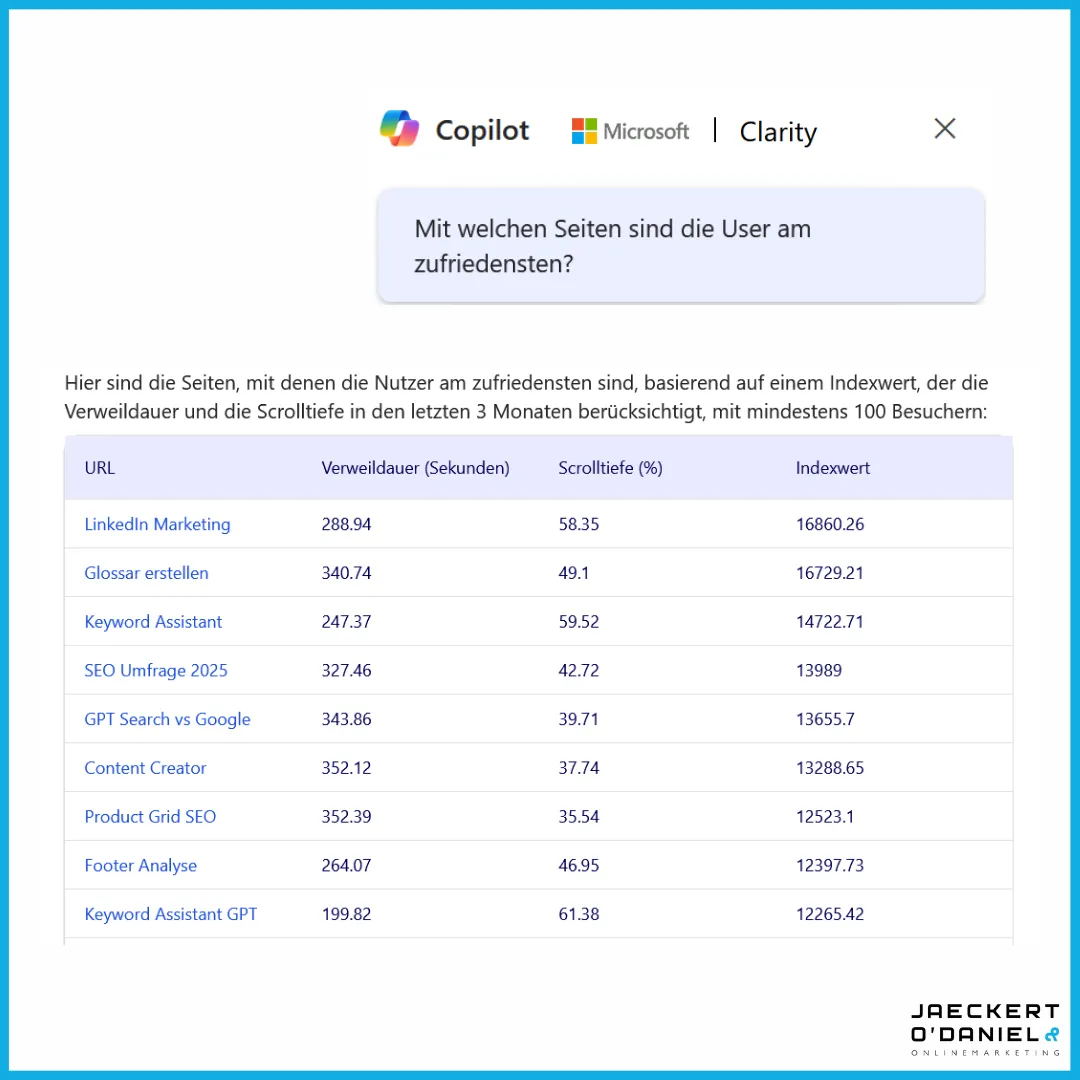
F: I split this in two while preparing this episode, because as part of the practical solution I of course also developed a technical solution for us that goes into a lot of detail. And often you can already produce good results with the practical solution. So I would like to split it a bit, so that you also have a simple, hands-on way to roll up your sleeves and get started right away. I think the most important thing is first simply to look at these values again, to open Google Analytics with an SEO lens, to open your web analytics and first look at which pages produce which values. There are, for example, pages that are so-called hub pages. In our example, we talk a lot about SEO portals. There we have the homepage, which immediately routes people to the business plan and to the funding and so on. You are immediately on a page that encourages people to go deeper. That means the page actually has a relatively short dwell time.
That looks bad at first, but it is not, because it is a click-through page where many people fan out again. Whereas you really also have to look at whether you have pages with longer content and how they perform. What is their dwell time? So you look at it carefully again and also get clear on which format is on each page. That is the first thing. And the second is that you look at the Analytics documentation again and look at how the thing is actually measured, because that is something I notice many people do not know precisely. What I just said about the second page, that there is a second view, that there may be a third view. Which formula is applied, also in combination with the bounce rate, how that is measured, because it is directly connected. You get clear again on how it actually works. Because that is somehow important for knowing which optimization you might make later, on a technical basis too, especially as an SEO.
So I would recommend that all SEOs, or SEO teams, really dig into this whole measurement story for a day or two. Once you have figured that out, you are still not a step further. You then know what does not work, but how do I do it now? And there, we already pointed out in one of the recent episodes that there are other tools that offer other metrics that cover this a bit. And there we talked about scroll depth, for example, which we measured. And in the end that has nothing to do with dwell time at that point, but it delivers similar results. #00:18:47-0#
B: Heatmaps and recordings. Here we presented our learnings on how we use a tool like that to look more closely at dwell time or scroll depth and things like that. #00:19:01-0#
F: I do not even know exactly whether dwell time is measured there/ #00:19:04-0#
B: Yes, exactly. #00:19:04-0#
F: But it was about the performance of content, setting conversion measurements and so on aside, and about how I get in between. And scroll depth is just as much a metric where I see how deep someone goes into the content, and that is what I actually want to find out with dwell time too. I mean, it is actually the same result I want from it, so that I can compare how deep someone goes in.
What percentage are still there when I am at the very bottom? And that is again a value I can compare, where I can compare URLs with each other. And that is the practical solution I would offer now if you have odd values in Analytics: first look at other tools. #00:19:52-0#
B: That is the practical solution for the short term, and maybe I also find it interesting if you describe this technical solution a bit without us getting too techie, but it is extremely important and relevant. #00:20:10-0#
F: Yes, exactly. It is highly relevant. The technical solution of course refers to this measurement in Analytics, to this one page view, to the second page view, and to somehow trying to manipulate that. The warning I want to send to everyone who now immediately runs off and looks for some solution in a hurry is that you of course distort the data in Analytics that way. You cannot change it afterwards. Data that has been measured in the system cannot be changed afterwards. That means you distort the data if you now use some scripts in Analytics or something like that. You have to be aware of that. You have to make yourself aware that if you simply slap something onto the page, you probably also break and change your history. First it is measured normally, then you measure differently somehow, and then you can no longer compare this year’s numbers with last year’s, because they are simply measured differently. #00:21:28-0#
B: So once more for me. I am not a techie, I am a creative. That means you then include a script in Google Analytics in order to get better data out? #00:21:41-0#
F: Exactly. The background is that you can trigger so-called events on the website relatively easily, and this event is then counted by Google Analytics like a page view as far as this time measurement is concerned. Google Analytics does not only use page views for this time measurement. If you fire a so-called event, it uses that too. An event can be a click on a button, for example, or a submitted form. You can measure that with Analytics too if you fire these events regularly. Then it counts for the measurement just like a page view, and Analytics can measure more precisely between the individual measurement points. It is a bit like the browser constantly sending back: “I’m still here. I’m still here. I’m still here.” Over a longer period. But that is first of all an intervention in the website. It also has something to do with load time. It is a performance issue. If you constantly fire scripts, that also affects the performance of the website, the website load time, and it distorts the data in Analytics, because nothing is actually happening in that sense. It is not a real event. You are only testing again and again whether the person is still there. Those are the quick-and-dirty scripts you find to fix this problem. #00:23:08-0#
B: Nice. #00:23:08-0#
F: You can do that. I mean, if you have some test projects, you can definitely do it. But if I really have my company website, a corporate site, and I start tinkering with something like that, I would simply be careful. #00:23:21-0#
B: I can understand that. Then rather use other SEO tools? #00:23:24-0#
F: Then I would start with scroll-depth measurement and see, because you want a result. In the end you want to know which content you need to revise. And if I can get that result from somewhere else, I would be careful about simply running off and getting some hacked Analytics solution. The second thing is that there are technical solutions that do not have this problem of the data being distorted. There are other solutions, but that really goes a bit too far and too deep, I think, for this podcast. So I thought, if someone is interested, they can write me a personal email and I will send it straight over. #00:24:11-0#
B: Great. #00:24:12-0#
F: There are a few links, two or three comments on it, so that you get sensible values with Analytics. You also have to evaluate them afterwards. None of it is entirely simple, but then you usually do not distort your property, your account. #00:24:31-0#
B: Personally I have to say I am very glad that you take care of all these technical topics, because I really have no head for them at all, and I would rather let loose on the content itself with the help of your data. #00:24:55-0#
F: Exactly, but you also somehow need (unv.) the feedback. Where there is a need to act and where there is not. #00:25:00-0#
B: Absolutely. We already discussed that with these heatmaps and recordings. When the scroll depth has a value in it where you see, ah, look, about thirty percent of all visitors drop off here, at a certain subheading or something, then it is totally clear that you can really work on that content element again. But those are values I need, otherwise it is flying blind. #00:25:26-0#
F: It may even be the better metric compared with dwell time. Dwell time, I have also used these scripts for us, or rather we also use them in a modified form in our content performance tools, where we then use the real dwell time, for example to find out how a page behaves in relation to all the other pages. If you really have a properly measured dwell-time average across the whole domain, then you can say for the individual page that it performs better or worse than the average. Those are statements you can actually make, and then you can say we will actually look at the page, because if it really has significantly worse times than the average of the whole domain, you should take a look. But you can only do that if you really have excellent data you can rely on as far as dwell time is concerned. If you have that, it is no problem. If you do not, then, as you already said, scroll depth also offers a great starting point if you want to improve content. #00:26:35-0#
B: Okay, great. Shall we put a lid on the technical solution? #00:26:40-0#
F: Yes, I would say so too. #00:26:44-0#
B: And draw a short conclusion? Or go on. #00:26:44-0#
F: One tool. I mean, while preparing the episode we also talked about Chartbeat. That is also a tool used in the content field that, I believe, has its own measurement. We have talked about Hotjar. I do not know. Do you want to touch on that again? #00:20:10-0#
B: I do not know. Chartbeat is used a lot by publishers. I know that for sure. But I would say we do a separate episode on that once we have done our tests there too. #00:27:14-0#
F: Mhm (affirmative). Okay. #00:27:14-0#
B: Great. Then let us draw a conclusion. I would say I will try to draw one. First of all: pay attention to dwell time as a metric. Even if it is an unconfirmed ranking factor, we still see a clear connection, and later on for conversion as well. It is clear: the longer someone is on a single subpage, the higher the chance that something happens afterwards, that they sign up for the newsletter or fill out a contact form or something else, that some conversion takes place on the page. In the short term we talked about a practical solution, and then also the technical solutions and the problems with Google Analytics and further tools you can use, right? #00:28:11-0#
F: Exactly, well summarized. #00:28:14-0#
B: Nice. Given that I do SEO consulting but I am not a techie. Maybe to close. As always, we are glad if you like this podcast, and we would be very glad if you recommend it to one, two, three people around you who might also be interested in learning more about online marketing. With that, take care, and see you next week. #00:28:40-0#