

Every keyword has a search volume. We know how often a search term is entered into Google.
But what about prompts? Do we also know what users enter into AI systems? Which terms are used how often? The new AI analysis tools are working on precisely these questions. However, the data situation for prompts is poor – and is being hotly debated in the industry.
In this podcast episode, Fabian Jaeckert and Benjamin O’Daniel summarize the current situation. The trigger was a tool that shows concrete figures for the first time: Profound displays prompt volume. Concrete figures on individual terms.
So: How is prompt search volume determined?


What is prompt search volume – and what does it look like in the tools?
There are a number of new AI analysis tools or GEO monitoring software on the market. These include Peec AI, Rankscale or Mentions. In the USA, Profound is very common. This tool provider has been showing a prompt search volume for several weeks.
There, for example, the keyword “Social Listening Tool” has a prompt volume of 26,000 searches. This approach has been heavily criticized by SEO experts from the USA. It was simply described as a scam, i.e. as fraud. Examples include Steve Toth’s LinkedIn posting and William Alvarez’s posting.
Both have compared the prompt search volume with classic keyword search volume, which is significantly lower. The prompt search volume therefore differs drastically from the previous data available in the SEO world.
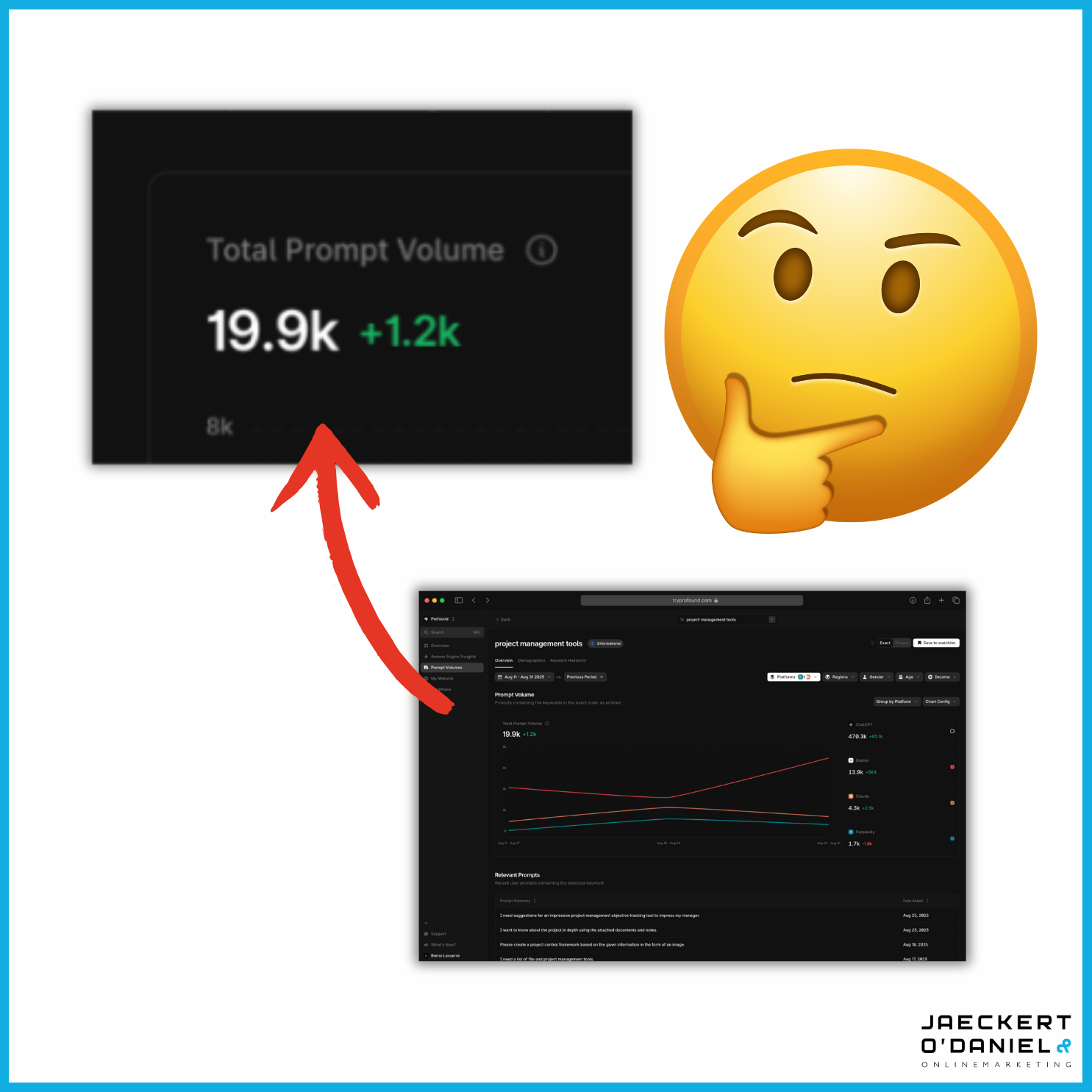
These are the criticisms of prompt search volume
Our conclusion: Prompt search volume has no reliable database

Our conclusion is therefore sobering: Prompt search volume is an interesting approach, but currently not a reliable control variable. The database is too narrow, the extrapolations too prone to errors and the necessary corrections – Generative Intent, Conversation Volume, Match logics – are based on assumptions, not on reliable measurements. The reported figures look precise, but convey a pseudo-accuracy that is strategically massively prone to errors.
At the same time, we believe it is important not to dismiss the approach prematurely. The fact that tool providers are trying to make prompt usage measurable is a necessary step towards GEO or LLMO. The discussion shows very clearly that AI systems function differently than search engines – dialogically, contextually, iteratively. Anyone who takes these differences seriously will inevitably reach the limits of classic volume logics.
For our work, this means: We do not prioritize according to prompt search volume, but according to relevance, criteria logic and visibility in real AI Response Pages (more on Prompt Monitoring and Analysis here). Instead of asking how often a prompt is asked, we ask when and why systems use certain brands, content or sources.
Free GEO Online Training
- Current Developments in AI Visibility
- From SEO to GEO
- How to Optimize for AI Systems

Our Conversations with SEO and GEO Professionals


Deepen your GEO Knowledge: Every Monday via Email

We Advise Marketing Managers on SEO & GEO
For anyone seeking an SEO sparring partner or comprehensive SEO consulting, Fabian and Benjamin are the perfect choice. As an in-house SEO expert, I sought competent SEO support and found it with them. During a very pleasant introductory meeting, we jointly developed an approach to establish SEO among the individual stakeholders and thereby gain more internal visibility for the subject. Based on this initial discussion and a joint kick-off with the stakeholders, they developed a sound SEO and content strategy for a product area. Since then, they have both supported me as sparring partners during implementation.
The collaboration with Fabian and Benjamin is a great pleasure for me and all project participants, as they are masters of their craft and bring immense passion for SEO. This combination is infectious and motivates everyone to achieve peak performance.

I look back with great satisfaction on the SEO project that we carried out with Benjamin and Fabian. Firstly, the collaboration was on a very pleasant, goal-oriented level. Secondly, the consultation was structured in such a way that we could immediately start with the implementation. We received very concrete optimization suggestions that were tailored to our internal capacities and therefore realistically implementable. Even though only a few months have passed, we can already see the first results of our work in the Google rankings. Traffic for our relevant keywords is steadily increasing, and we still have enough concrete work packages from Benjamin in the pipeline to boost our site. Furthermore, through the consultation, we have acquired so much internal SEO know-how that we can now optimize our site independently. And most importantly: Visitor numbers have doubled – with correspondingly positive effects on sales.