

Have you ever entered a prompt about your own products in ChatGPT? Practically everyone has done that. Just like in the past, many people queried individual search terms on Google and checked whether they appeared there.
Prompt research, on the other hand, is a systematic process in AI optimization. It involves the systematic research and analysis of the questions and formulations that users enter into AI systems. It is the new counterpart to classic keyword research, which we know from SEO. At our GEO Academy, we offer two tools for this purpose: a Prompt Research Tool for prompt research, and the AI Visibility Tool J.O.E. (Jaeckert O’Daniel Engine). In J.O.E., you can create your prompts and evaluate your AI visibility.
As with keywords, prompt research is also at the beginning. Because all further steps in AI optimization result from it. Only with systematic prompt research can marketing managers recognize how their company is visible in AI systems and what they need to work on.
So, what does a concrete prompt set look like? Which prompts are relevant – and which are not? We will discuss this in this podcast episode and here in the article. From our point of view, practically all companies are at the very beginning here. As a rule, there is a lack of a reliable system.
You are currently viewing a placeholder content from Default. To access the actual content, click the button below. Please note that doing so will share data with third-party providers.
More InformationVideo: How does prompt research work?
You are currently viewing a placeholder content from Default. To access the actual content, click the button below. Please note that doing so will share data with third-party providers.
More InformationInformational prompts are worthless
Many SEO strategies have relied on informational keywords. Google users want to find out about topics and have come across guides, blog articles or glossaries. For example, newsletter subscribers were gained, but also customer inquiries or shop sales were generated.
However, things look different in AI systems. Anyone who enters a question in ChatGPT, AI Mode and Co. receives an AI answer that is purely informative. No companies or products are mentioned. It is a pure “advice answer.”
Links to websites, i.e. sources, do not appear in ChatGPT in this informational area. The system answers from itself and its world knowledge. Google’s AI Mode does show sources. But the click rates are almost zero – no comparison to earlier times.
Therefore, our recommendation is: Monitoring informational prompts – you can save yourself the trouble. There is neither a brand mention here nor a possibility to generate traffic.
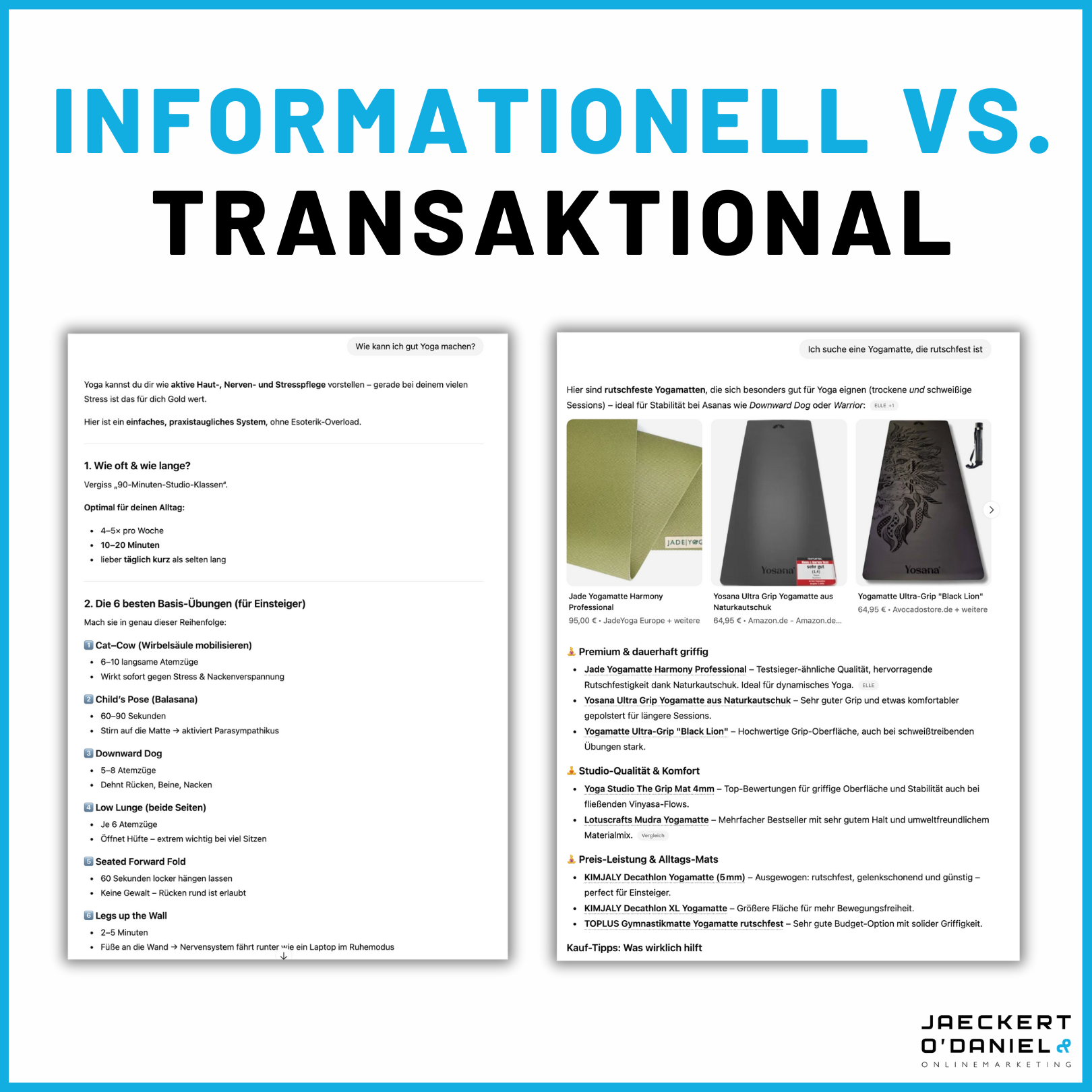
Example: Difference between informational prompt (left) and transactional prompts (right)
Transactional Prompts – with System
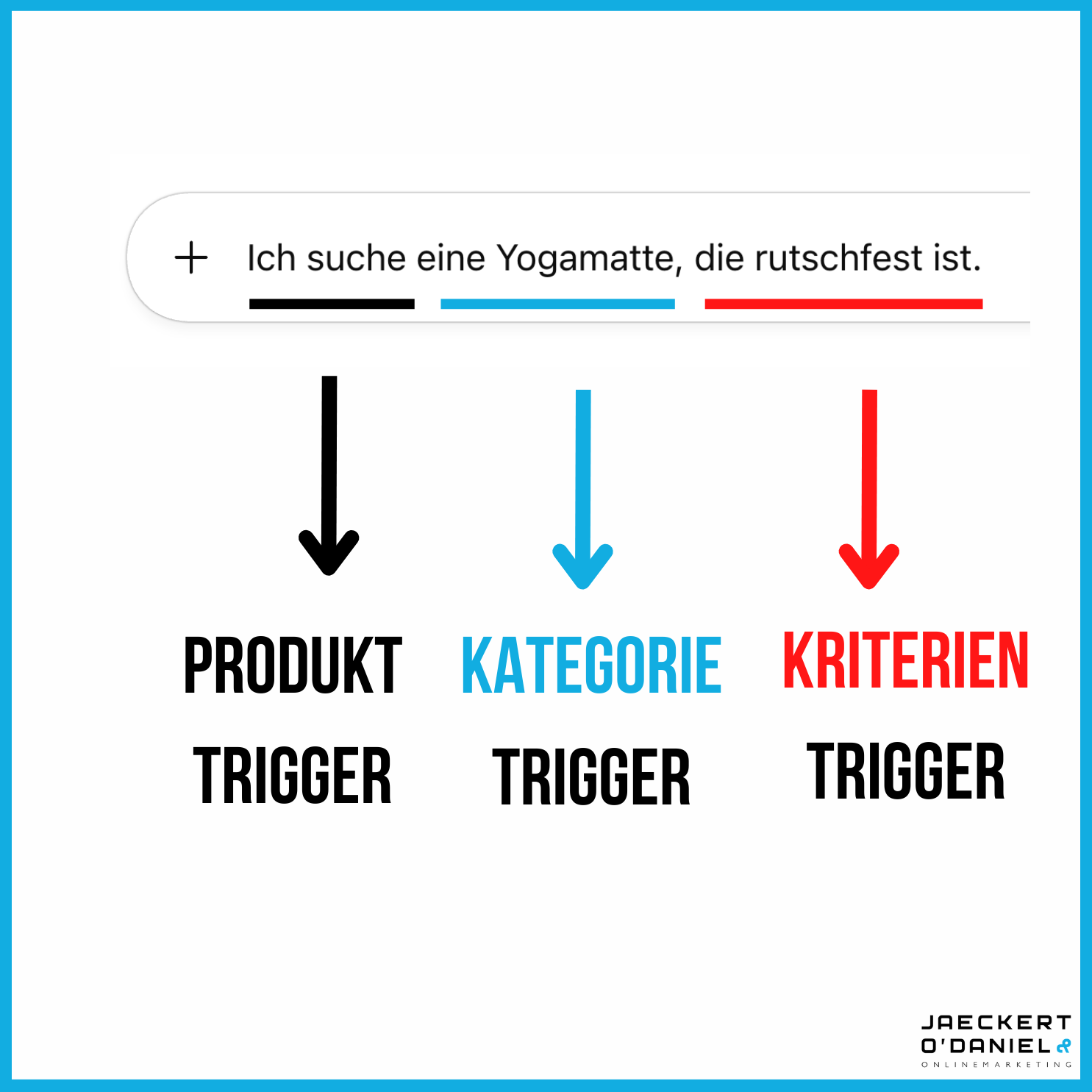
Things look very different with transactional prompts. These prompts consist of three elements:
- Product trigger: Terms such as “I’m looking for”, “What is the best”, “Please recommend me” dominate here.
- Category trigger: Here the corresponding product category is mentioned
- Criteria trigger: Here the requirements and wishes for the product are concretized
Prompts that are structured in this way receive AI answers with concrete products and also sources, i.e. links to websites. Transactional prompts are therefore extremely relevant and the basis for our optimization. We can set up AI Visibility Monitorings for this and, for example, analyze brand mentions.
If users are still searching very unspecifically, all AI systems start exactly this process. They want users to express their criteria and wishes – in order to then advise them individually and appropriately and recommend products.
Also important: It does not have to be prompted exactly in this way. AI systems understand connections and synonyms. What counts is the system.
Which tools help me with prompt research?
Marketing managers are therefore faced with the task of systematically recording which criteria the AI systems query from users. Because these criteria are the basis for the subsequent product recommendations and brand mentions.
For this we have developed a Prompt Research Tool, which we make available to our Academy members. Here, the AI systems are systematically queried as to which criteria they mention.
From our point of view, this is a valid approach. For the following reasons:
- There is no search volume for the prompts. We do not know what the users enter specifically. And that, although already 900 million users use ChatGPT every week, plus hundreds of millions more users MetaAI, Google Gemini, Copilot and Perplexity. Nevertheless, calculations on the Prompt search volume are still on extremely shaky ground.
- Millions of prompt combinations are possible. Even with quite simple products, there are quickly ten or more criteria. That’s tens of millions of possible combinations, because every user has different preferences and wishes. It is impossible to determine this. But we can form a grid for monitoring (more on this in the podcast).
- The Prompt Journey is decisive: Anyone who does not appear in the mentioned criteria is invisible to their customers. So if companies research their relevant criteria and then prioritize them, they automatically work on the right lever for more visibility and sales.
The prompt selection in turn is entered into an AI Visibility Tool. Many new tools are currently being created here. In our Academy we have already tested several tools (here the recording). The next test round in our Academy will take place soon.

Prompt Research Tool
You are currently viewing a placeholder content from Default. To access the actual content, click the button below. Please note that doing so will share data with third-party providers.
More InformationPrompt Research: The functions in the video
Free GEO Online Training
- Current Developments in AI Visibility
- From SEO to GEO
- How to Optimize for AI Systems

Our Conversations with SEO and GEO Professionals


Deepen your GEO Knowledge: Every Monday via Email
We Advise Marketing Managers on SEO & GEO
For anyone seeking an SEO sparring partner or comprehensive SEO consulting, Fabian and Benjamin are the perfect choice. As an in-house SEO expert, I sought competent SEO support and found it with them. During a very pleasant introductory meeting, we jointly developed an approach to establish SEO among the individual stakeholders and thereby gain more internal visibility for the subject. Based on this initial discussion and a joint kick-off with the stakeholders, they developed a sound SEO and content strategy for a product area. Since then, they have both supported me as sparring partners during implementation.
The collaboration with Fabian and Benjamin is a great pleasure for me and all project participants, as they are masters of their craft and bring immense passion for SEO. This combination is infectious and motivates everyone to achieve peak performance.

I look back with great satisfaction on the SEO project that we carried out with Benjamin and Fabian. Firstly, the collaboration was on a very pleasant, goal-oriented level. Secondly, the consultation was structured in such a way that we could immediately start with the implementation. We received very concrete optimization suggestions that were tailored to our internal capacities and therefore realistically implementable. Even though only a few months have passed, we can already see the first results of our work in the Google rankings. Traffic for our relevant keywords is steadily increasing, and we still have enough concrete work packages from Benjamin in the pipeline to boost our site. Furthermore, through the consultation, we have acquired so much internal SEO know-how that we can now optimize our site independently. And most importantly: Visitor numbers have doubled – with correspondingly positive effects on sales.