December 9, 2019Fabian Jaeckert
SEO Concept: These Are the Key Building Blocks
An SEO concept is the starting point when companies get into search engine optimization. It is the basis for all further SEO measures on the website.
In an SEO concept, the existing Google rankings are analyzed, the website structure and the content are reviewed, the relevant keywords are researched, and an SEO strategy is developed from that.
This also includes, as we understand it, a clear roadmap of which SEO measures should be implemented in concrete terms in order to improve the ranking. A technical SEO check should also be part of an SEO concept.
Our experience as SEO consultants: an SEO concept like this is a particularly good fit when the company has marketing leads who look after the website. They can then implement our recommendations, and they have much more certainty.
What is an SEO concept?
An SEO concept consists of a technical SEO check, a ranking analysis, and keyword research. Concrete SEO measures are derived from that. A roadmap and an effort estimate for the implementation are part of it as well.
An SEO concept is delivered as a clear and structured presentation, which is introduced and discussed in an online workshop. It is a one-off piece of work. Further collaboration is optional, but not required.
How do you create an SEO concept?
There is a proven approach for creating, or developing, an SEO concept. This includes an audit and, in the next step, the development of an SEO strategy. Concrete steps are:
- Crawling the website
- Identifying possible indexing problems
- Analysis of the existing Google rankings
- Analysis of the existing content
- Thorough keyword research
- Mapping onto the existing website structure
- Development of an SEO roadmap
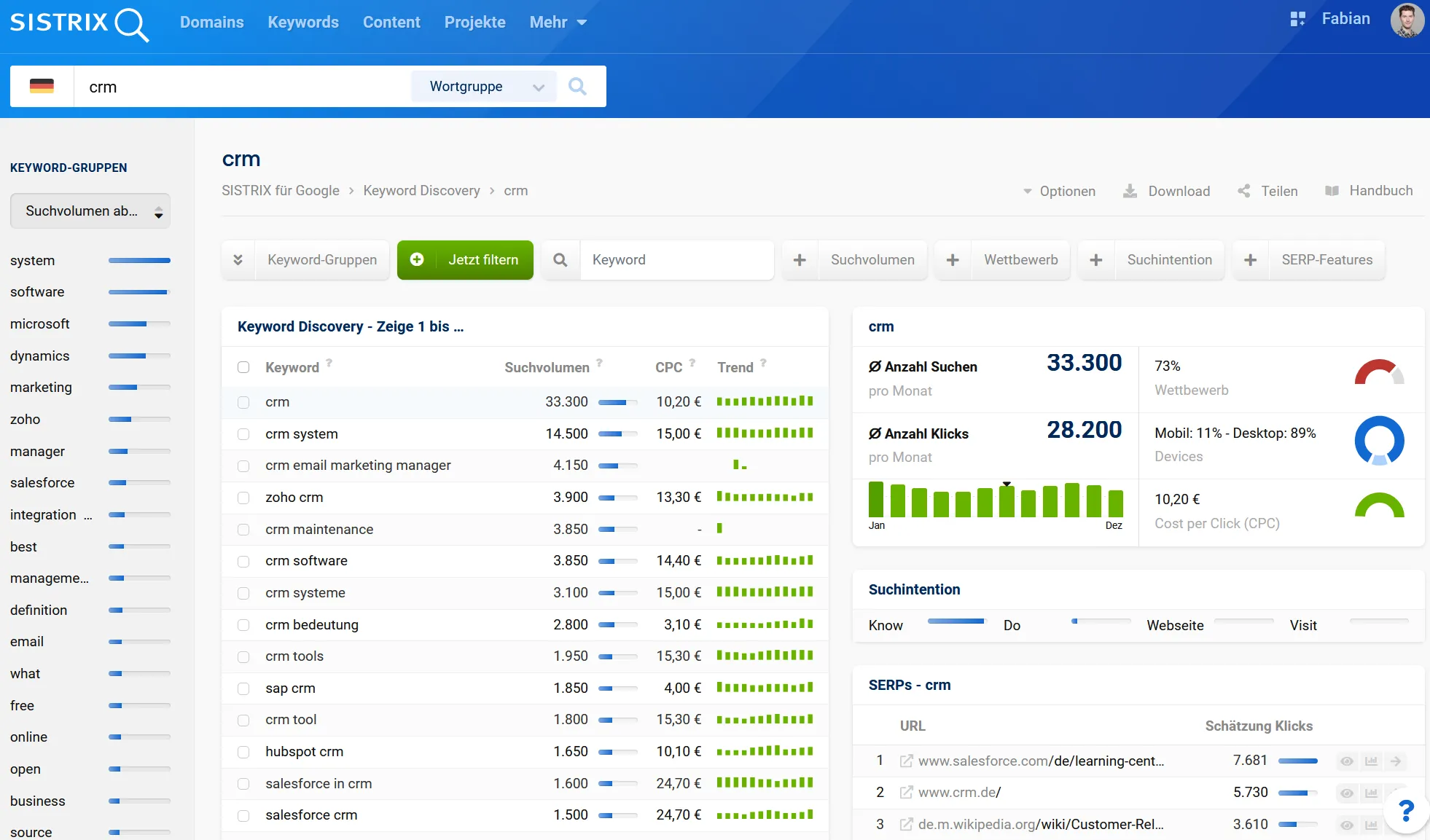
With professional SEO analysis software, search terms can be researched in depth and clustered. A website can rank for thousands of search terms.
What does an SEO concept deliver?
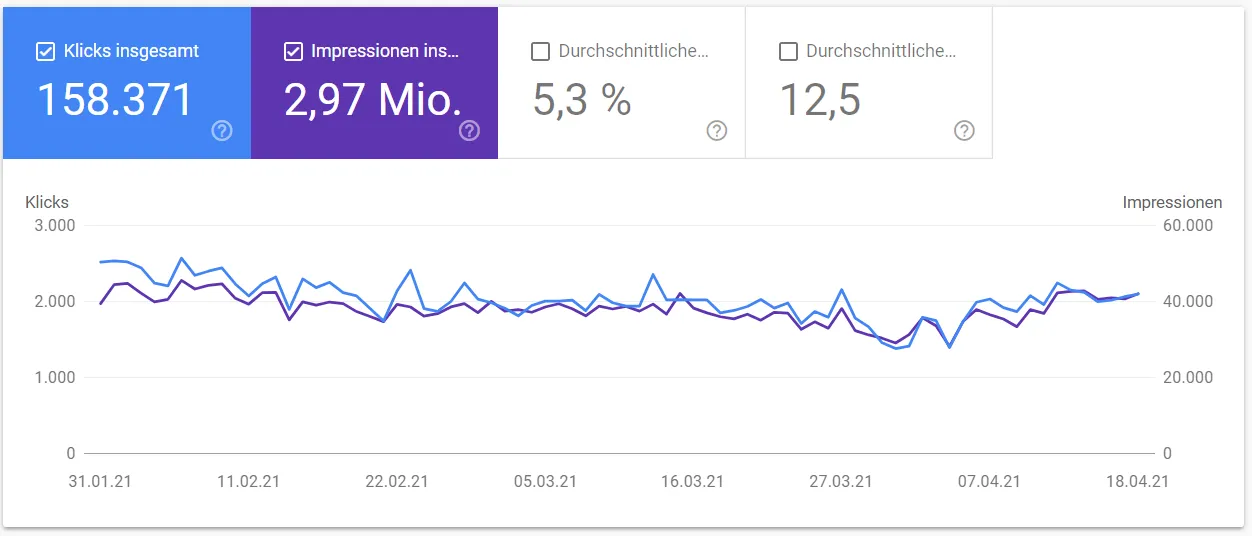
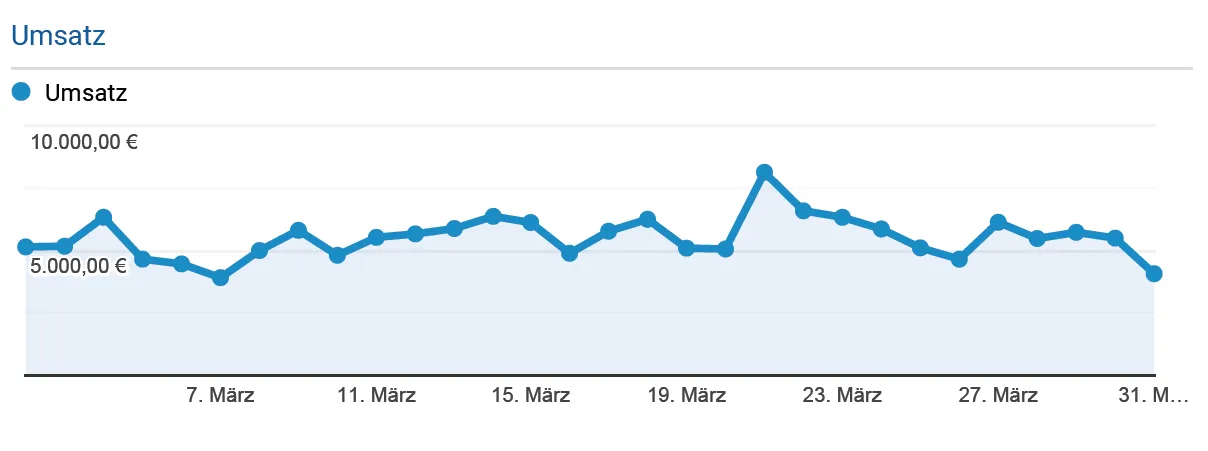
With an SEO concept, the marketing leads know that they are working in the right direction. They have the certainty that they are improving the Google ranking of the website in a targeted way, and with that, over the long term, providing more visitors, more revenue, or more leads.
These two charts illustrate that. The website of a mid-sized company has around 150,000 visitors per quarter on the website. An online shop makes around 5,000 euros in revenue per day.
Many companies are not there yet. But they want to take it on. We can gladly meet in a video conference and look at your website.
What does an SEO concept cost?
From our experience, providers offer an SEO concept for between 5,000 and 15,000 euros. There is no predefined scope for an SEO concept. Because of that, the costs also differ very clearly.
The dilemma: the marketing leads in the companies do not know what is needed for a solid SEO concept. Otherwise they would not commission one. So they have to make a decision without really being experts.
Another point is the business model of the SEO provider. Many SEO agencies, for example, price an SEO concept very cheaply, but combine it with a year of ongoing support.
Many companies do not want a year of ongoing support, though. They first want to know where they stand at all, and what needs to be done. This initial effort is very large, though. That is why many SEO providers do not offer an SEO concept as a standalone offer at all.
Our approach is different, though. We offer an SEO concept as a service you can book on its own. Afterwards we can optionally keep advising the marketing leads and accompany them during implementation.
After a website relaunch, we as a brand wanted to tackle SEO. For this, we specifically sought support. Benjamin and Fabian developed technical optimizations and an SEO strategy with a content roadmap. Many thanks for your valuable input.
 Anja HornBarilla Deutschland GmbH
More references here, on what our customers say about us.
Which tools do you need for an SEO concept?
Creating an SEO concept requires professional SEO tools. Because the software supplies the data basis, and with that the basis for decisions on the SEO strategy and all further SEO measures. SEO tools include:
- Google Search Console
- SEO crawlers such as Screaming Frog
- SEO suites such as Sistrix
With the extensive SEO suites such as Sistrix, but also SEMrush and ahrefs, you can analyze Google rankings, research keywords, and do backlink research.
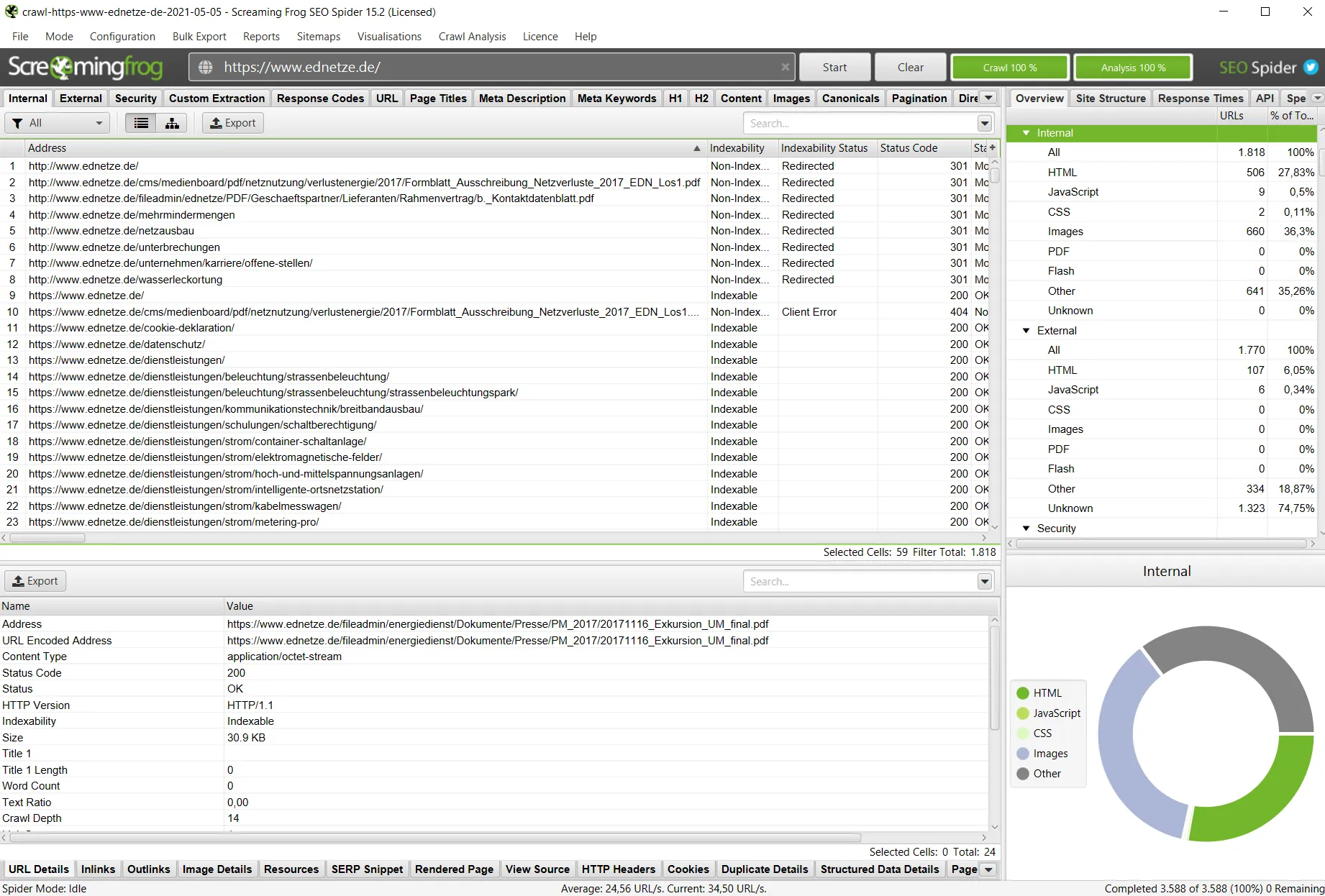
With the crawling software Screaming Frog, URLs are identified, among other things, and internal linking and possible errors in redirects are analyzed as well. Here we explain in more detail what a website crawl for SEO covers.
We develop SEO concepts for companies
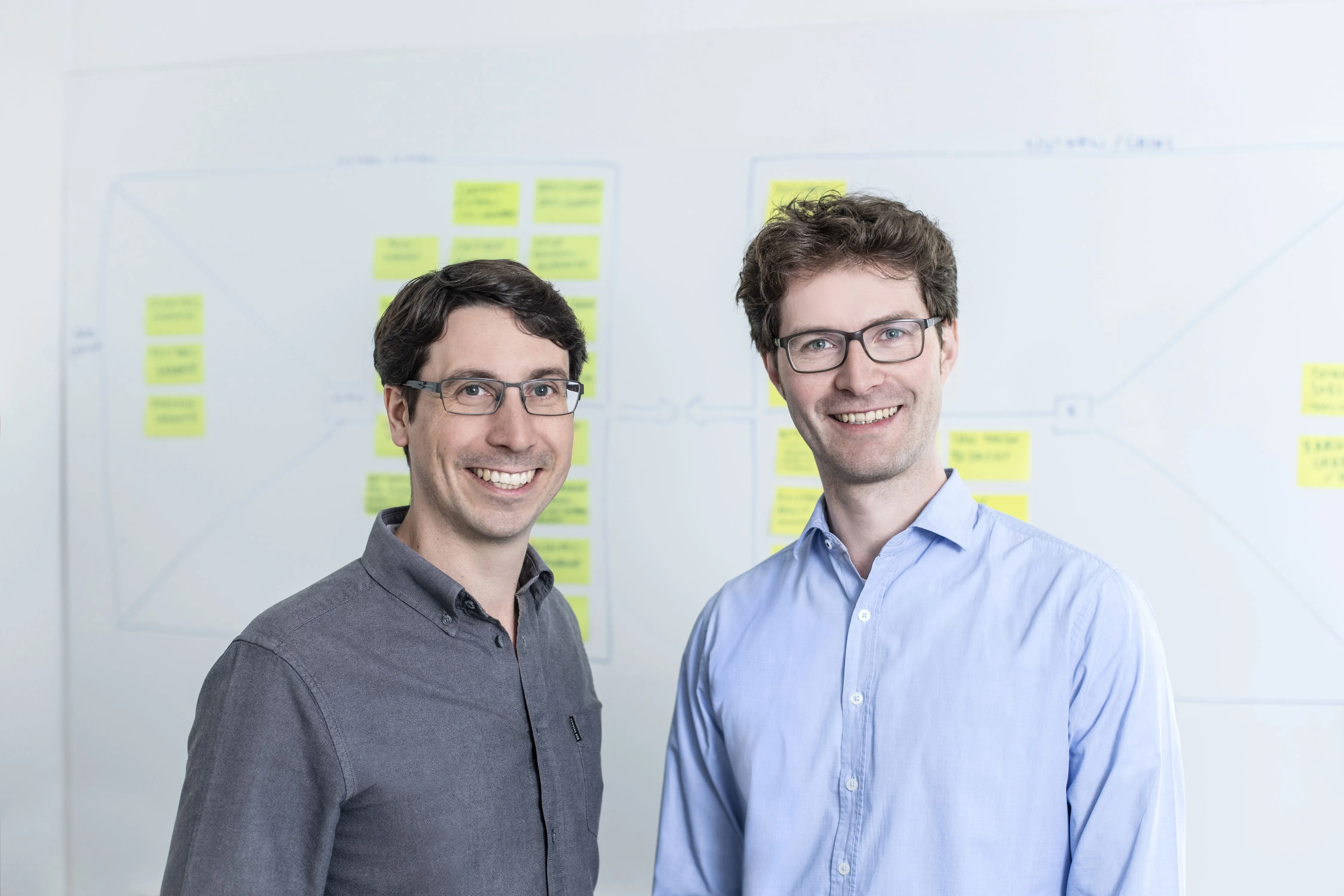
We are Benjamin O’Daniel (left) and Fabian Jaeckert. For many years we have worked as SEO consultants. We create SEO concepts for mid-sized companies. Afterwards we advise and accompany the in-house marketing leads during implementation. For that we share all of our knowledge.
After a website relaunch, we as a brand wanted to tackle SEO. For this, we specifically sought support. Benjamin and Fabian developed technical optimizations and an SEO strategy with a content roadmap. Many thanks for your valuable input.
Anja HornBarilla Deutschland GmbH
Marketing leads in companies usually have a great deal on their plate. They know that search engine optimization is relevant, but they lack the know-how, the tools, the experience, and the time to take on the SEO concept development themselves.
This is where we come in as SEO consultants. We develop individual SEO concepts for companies and present them in a workshop. If needed, we then accompany the in-house leads during implementation.
Our approach: we share all of our knowledge. So that the people responsible in the companies get sustainably better at SEO. In our podcast, too, we discuss numerous specialist topics in depth. On LinkedIn we discuss them with our listeners.
We can gladly set up an SEO introduction (30 min. video conference).
How is an SEO concept delivered?
From our point of view, a central point that is often not considered. From our point of view, it does no good to pack an SEO concept into a 50-page PDF and send it through.
That is why we always present the SEO concept in person. A two-hour meeting via Zoom or Microsoft Teams has proved very productive here, because we can explain the data and many questions can be clarified.

Examples of what an SEO concept contains
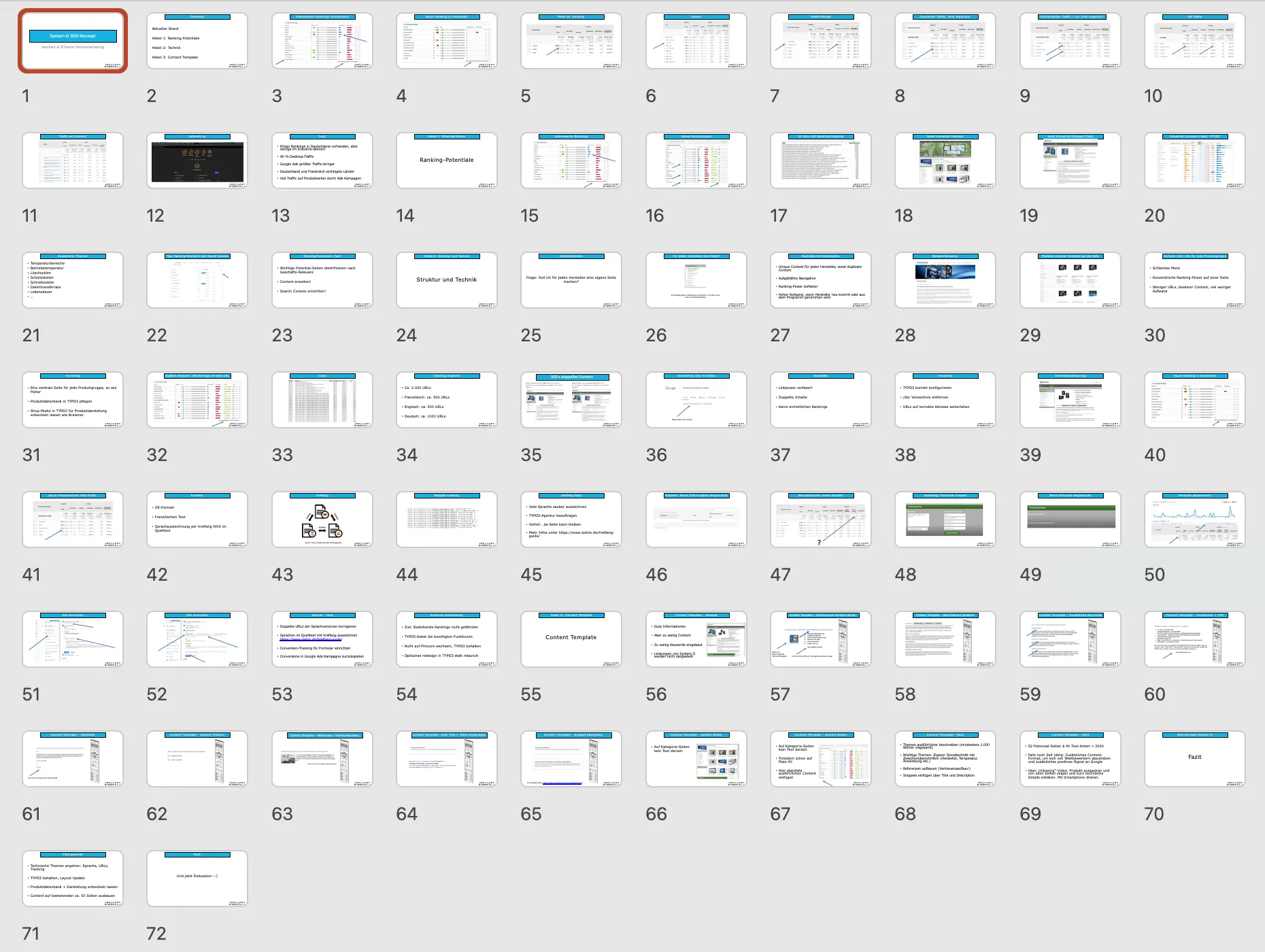
Every SEO concept is created individually. That is why the contents differ. Because many of the people responsible lack a picture of it, here are three screenshots from SEO concepts we have carried out. We ask for your understanding that we cannot go into more detail here.
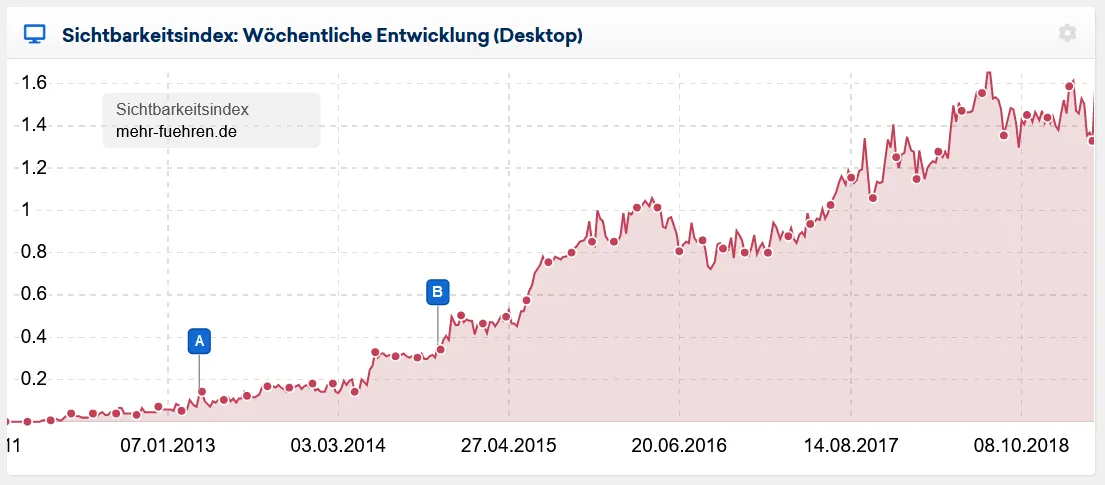
Visibility on Google over a longer period
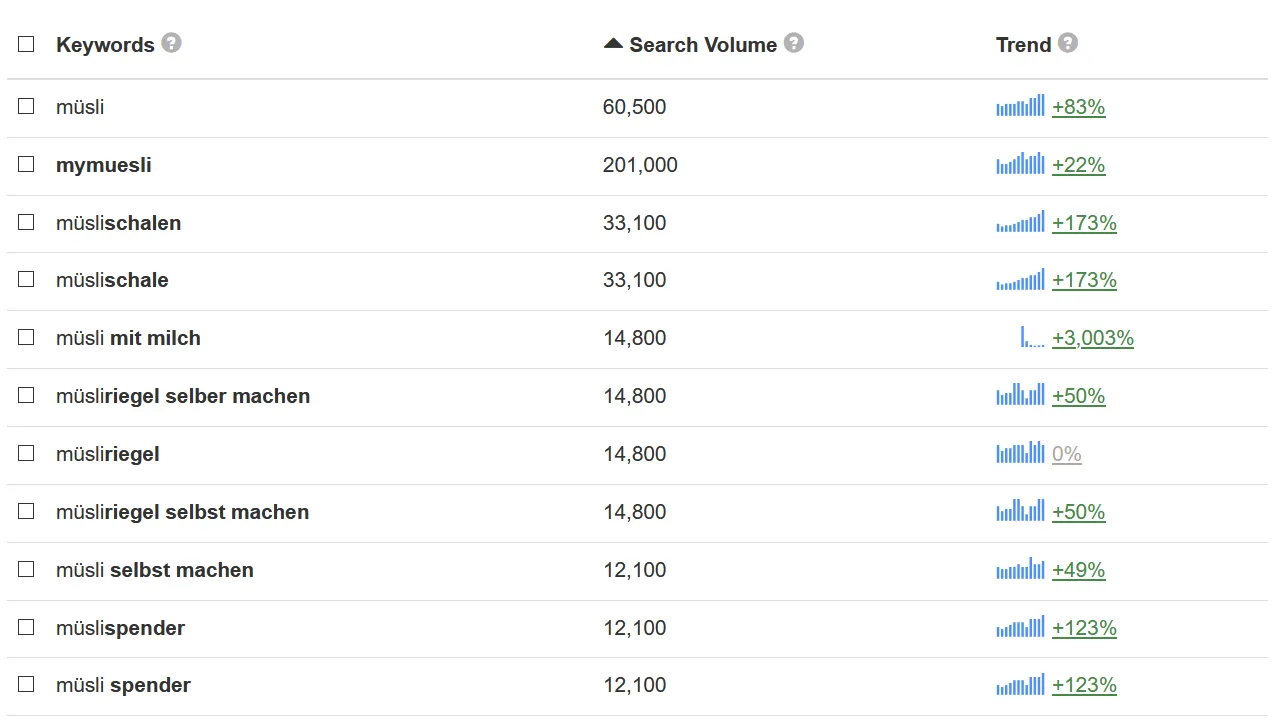
Keyword analysis with search volume
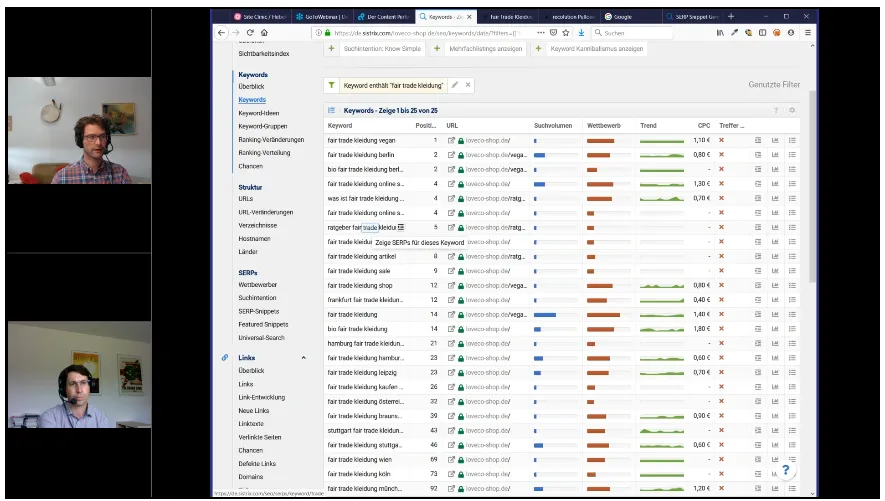
Ranking analysis during the online presentation of an SEO concept
In these 3 podcast episodes we deal with the SEO concept
A professional SEO concept starts with an audit. Website structure, competitors, keywords, and rankings are analyzed, and prepared so they are understandable. Various tools supply the data basis for that. That way you see where you stand and in which areas you have weak points.
The strategy is derived from the audit. An example: search terms are defined for which you have the goal of being findable with specific subpages. Certain measures are needed for that, such as building content. There are again various options here. We explain it using various examples.
The implementation plan
Who does what by when, and how much does it cost? These questions are settled in the implementation plan. Coordination processes, for example between the agency, IT, and internal contacts, are settled there as well. Because the best SEO concept only helps if it is also implemented.
Three problems with a request for proposals
Missing expertise
Especially with overarching SEO concepts, the expertise is often missing in the companies. As a result, the decision is most often made by price, or on the basis of personal contacts.
Unclear scope
What is inside an SEO concept? What do the specialist terms mean? There are many gray areas here. That is why everyone should ask precisely what you receive in the SEO concept. So that the offers are comparable.
No suitable provider
For overarching, general SEO concepts there are a great many providers. Here it is hard to choose the right ones. For specialist concepts, on the other hand, there are only very few agencies. Here the problem is that the agency also has to have the necessary specialist knowledge.
SEO concept: experience we have had
Planning brings certainty
At the beginning there is always an SEO concept. It is the basis for setting the right priorities. Otherwise you often work on the wrong things. A stark example: you work on headings, but you have bought links and you are in a filter. The roadmap for the coming months, or even years, comes out of the SEO concept.
Success comes with time
Because search engine optimization is about staying with it. Many optimizations only take effect in the medium to long term. You also have to adjust many different places, which then add up to the ranking in total. But the result is worth it. Because success in the ranking brings visitors over the long term.
With Google instead of against Google
In many SEO agencies, people work with technical tricks. With a lot of success in the past. This also carries the risk, though, that you put your entire ranking at stake. We, by contrast, bet on clean search engine optimization. That is often more laborious. But it comes with clearly less risk. Our motto is: with Google instead of against Google.
SEO concepts and analyses, live in webinars

Learn what matters
The three big building blocks
To say it up front: you will not find simple answers plus a simple template here. From our point of view, the topic is too complex for that. We describe which big building blocks there are that you have to clarify for yourself: the audit, the strategy development, and the implementation plan. We discuss all three topics using examples. We share our experience, honestly and openly. That way you get an overview. You can better judge what you should work on.
So that it fits the company
Every company is set up differently. A company with 10 employees has different resources from a 1,000-person company. A regional company has different starting points from a mid-sized company with an international clientele, keyword international SEO. Some companies have specialists in online marketing, others do not yet have suitable staff. So the SEO concept also has to fit your resources. It has to be feasible and implementable. Otherwise it does no good. That is also our approach when we develop a concept like this. We are glad to advise you on this in person.
Go deeper
In text form you get the overview here quickly. In our podcast we explain in several episodes, in detail, what matters in an SEO concept from our point of view. Each episode lasts about half an hour. Many people listen to our episodes on the way to work. With a podcast app you can load the episodes onto your smartphone.
SEO concept: transcript of the episode
B: Today we are talking about the SEO concept. At heart it is about how you plan your overall SEO success. Plan it once, systematically. And there we have three core problems that we keep running into. And we want to describe our approach to you. This is what it looks like. #00:00:37-2#
F: This is what it looks like. So for one or the other of you there may be a small surprise in a moment, when we get into the problems. Because they are probably not the ones that otherwise cross your path in SEO, I could imagine. Because I always find that we are also a bit different now for this episode. The topics that get discussed out there are not necessarily the ones that are really important at the beginning, right. I mean, load times and SEO, for example, is also always a very popular topic in the SEO scene.
But those are really things you can also save for later. Sure, you need a good load time, but first you have to take care of the basis, take care of the foundation. Yes, and there all these topics that are being discussed on the platforms right now can fog the view a bit, I find, of the things you actually ought to take care of first. And that is what we want to talk about a bit today. Which problems you have at first when you start, and, yes, what you can do to approach strategic SEO, to approach the topic of SEO. #00:01:41-5#
B: I think you notice that again and again. So we also discussed CTR optimization recently. That really is such a, yes, that is simply a topic for advanced users, in quotation marks, or for the SEO scene. And you could also hear a bit there, I think, you also shake your head about it sometimes, yes, because in everyday work we really often notice that for many people this basic strategy, so the basic roadmap, is simply missing.
And that is what you work out with an SEO concept. And that really is, from our point of view, THE lever, so that all the energy afterwards really goes in the right direction. Yes, and that is why we have now taken this on, that we talk about the three, yes, core topics or core problems and our approach. Yes. Shall we just dive straight in? #00:02:30-8#
A central keyword set is missing
F: Yes, gladly. So the first problem is that often there are no keywords at all that you can optimize for. Yes, so that maybe the person who is responsible for the website maybe has a rough idea of which topics they want a good ranking for. Often it is also the case that you yourself check the Google results a bit for the product names you have, or, right, when you have some special names, that you look at how you stand on Google, because that is what your customers might search for.
But there is no strategy behind it, and above all there is also no completeness. Yes, so there is no complete overview of all the search terms your customers could potentially search for. Yes, and it is also somehow, sometimes the wrong terms are in there too, wrong in the sense that there may also be synonyms that are also searched for in other areas and that are not relevant at all for my business. Yes, so, and yes, that leads to the fact, because it has not been researched professionally, that there is also no search volume behind the terms. That means there is also no prioritization.
That means online you also have no feel for in which areas there is which demand. Yes, so that is often the case in B2B companies. There, of course, sales has a feel for where you can sell your products well. But online there is actually no feel for in which search spaces, with which terms, there is which volume. And yes, how the customers tick, right, and what they search for. That is // quite often the problem. #00:04:10-7#
B: I also think, // so it is often just by keyword, right. Then a keyword comes up, but behind it there is a whole search space with, I don’t know, fifty, a hundred, or several hundred terms, which overall are then really also connected with a large search volume. And researching that in depth once and having it clear, that is often what is missing. #00:04:35-6#
F: Yes, or it is the case that you keep tinkering and working on a term that is actually not in very strong demand. Or, often the demand is also self-made, yes. So the company itself often searches for this one term, and the competition also often searches for this one term, because they are specialist terms. But the customers do not search for it at all, yes. So they search for other terms. #00:04:58-5#
B: Very simple terms, often, right. You notice that again and again, right. And I think what is of course also behind it is that for a proper keyword research in depth, and in the keyword analysis, you need tools and you need experience, in order to really research it quickly. So, or also to research it systematically. And then a very classic thing is simply missing too. It is also a classic know-how question, right. Which SEO tools do we use, where is the data basis good as well? You deal with that all the time too. What do these tools actually draw on? Do they deliver usable results, and, yes, can we research and work up keywords systematically there? #00:05:46-0#
F: Exactly. So just as an example now: which market do I want to play in? That is very important when choosing tools, because the tools have a different data basis depending on which countries you are in, right. There are tools that are totally great for the German market, totally excellent, but many companies operate internationally, and there you need other tools that then deliver better data. And of course that is difficult to distinguish and to differentiate, and to make a choice there. And the tools also cost money, right, so there is often also a reluctance to free up a budget for that at first. You also do not yet know exactly what the tool will then bring you. So there is a lot of uncertainty there often too, yes. Exactly, that is the one thing. But out of these keywords an architecture for the website then develops as well, right? #00:06:34-9#
Website architecture is not geared to SEO
B: Exactly. And that is, so to speak, already the second topic. Many companies invest in their website, and it is often also a very good showcase. So we have a good design. A lot has really been put into it, from the layout. It looks good. And you are proud of the website too, rightly so, yes. But it still has nothing really to do with SEO, yes.
Often there are product pages that have been set up. And on the product pages there is also a bit of text, for example, that was produced at some point. And then you know, yes, okay, but we maybe also want to do a few topics around that. And somehow with SEO we also need more extensive, holistic content.
Then a blog often gets attached, or a magazine, as it is called now. And then articles get published there too. And that is often the starting situation. But what we understand by an architecture is that all these keywords, once we have systematized them, researched and systematized them, get their place on a website. So a website structure for SEO. And that is often simply not there yet. There is no architecture in the sense that you say: ah, okay, we have this many subpages and the keywords go there. Instead it is simply a classic showcase. And, yes, and this architecture that we need, it does not exist yet. Because afterwards the customer enters two or three search terms somehow, and we then also want to be at the front with a specific subpage. And all of that is then usually not in place yet. #00:08:17-9#
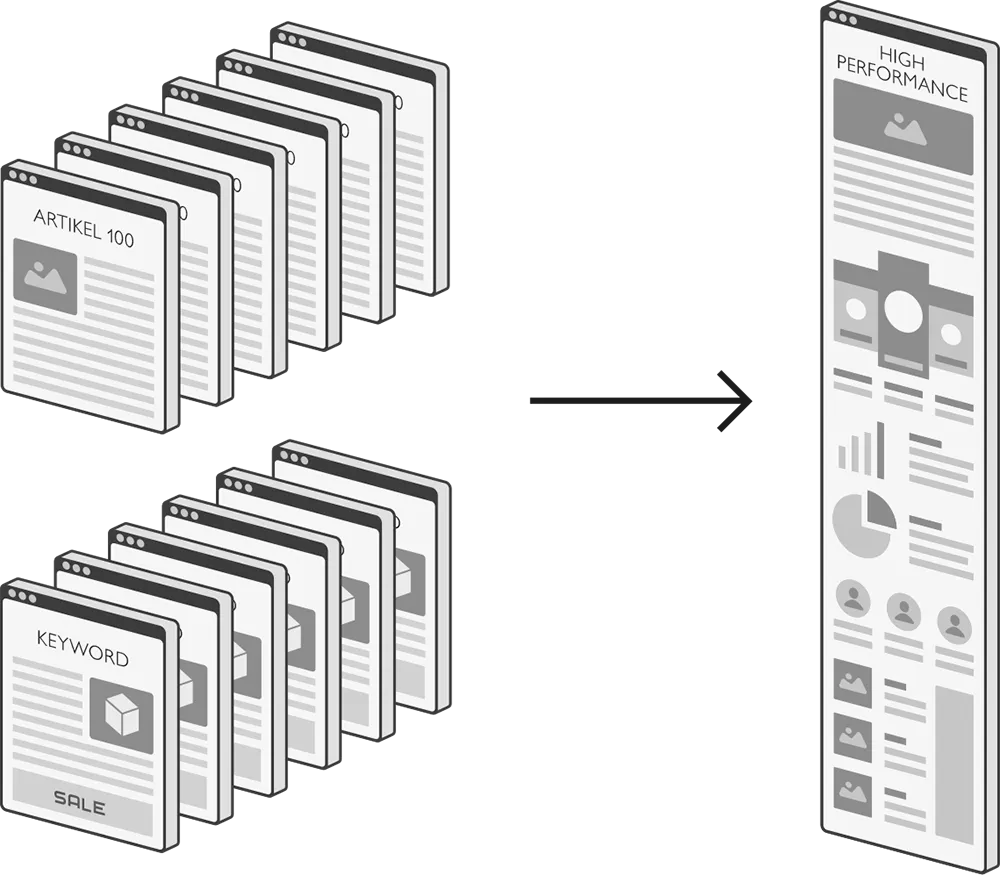
F: Yes, often it is also the case that the structure is also prescribed to some extent by the search terms. And the experience we have had with that is that it is actually also quite rewarding, that you finally have a performance approach for your content marketing that shows you the way a bit, how the page is structured afterwards, right. But we will get to that in a moment. We still have a third problem. #00:08:40-2#
B: Very briefly still: I also think there is often a bit of frustration in it, right. Because the website has of course really cost a lot of money as a rule. And then, when it is standing there, then this question comes: yes, and what does that bring us now? How do we get visitors onto it now? Yes, so at the beginning it is: yes, we need a good, smart, modern website that then also works on mobile, for example, all these requirements. But when that is then there, at the latest then it is: yes, but now, we want visitors on it, yes. And that frustration, we do feel it often, right. And the thing is smart, but how do we now also get a revenue lever on it, yes. And that is a bit the crux. And then you also go into the architecture. #00:09:26-8#
F: I also think it is justified. So the question is asked with good reason, often also by the management: yes, what do we do with the page now? It was expensive. Yes, what is happening there now? And on the other side you also need a basis for the budget, I think, yes. So if you free up staff in marketing, and do not free them up onto the job market (laughs), but free them up to work on a page, or hire them, or release budget for it, then a plan also has to be on the table: what do we do with it now, yes? And I also find it a bit too little then to say, yes, then we do a magazine, like that. Without a performance approach, right, so. Instead the question also has to be answerable: what do we want to achieve with it? What visibility do we want to get with it? Visitors, and maybe even leads and revenue afterwards. #00:10:14-4#
B: Yes, and how do we measure that too? #00:10:16-2#
F: And how do we measure that? And there a concept is simply incredibly helpful and important, that you say: this is our battle plan for now. This is the direction we would like to go. That is really super important. #00:10:29-3#
Missing content design
B: And the third point, we can actually attach that very nicely now. You already said earlier: so, yes, a blog. Many people say, ah, okay, if we do SEO now, then we do a wall of text and pour a whole lot of text in there now. And this text gets delivered by someone somehow. And you already notice, everyone tenses up, yes. So what do we do now? How do we get these keywords into the website now? And we still have the companies, as a rule they are, we also work for brand companies, yes. There it is also a great deal, it is highly political. How do we communicate to the outside? And how do we want to be visible in the market, or present ourselves to the outside? Those are all these questions that come together there. And in the end it is often the case that there is then no real, we call it, content design, yes. So what does a single subpage then look like? How is it structured? How is the opening? How is the middle part? How is the ending, yes? And how do I get keywords in there and at the same time also get my brand topics in? And that is what is often missing too. And then you sit there and say: yes, how do we take the term now and make it into an H2 heading, or? Right, like that. (laughs) #00:11:51-2#
F: Yes, so technical then, right? Such an SEO-text approach, yes. #00:11:54-6#
B: A bit like that. And, right, at the same time the problem is also that you really do not know then, how do I approach a single topic now? And for that, yes, there is simply no structure. There is no template according to which I, so to speak, work through a single subpage or a single topic as a content manager. And that is the third big problem. #00:12:15-5#
F: Yes, funnily enough SEO then stops at some point before that, right, for many people. So keywords, okay, architecture, hmm, maybe still, but in the end this third part is, as you already said, often also the most important one politically. That the people, or that the companies say, so not only brands, but all companies say, yes but, there cannot just be anything on my page. It also has to look like something. It also has to take on our company language, our corporate identity, our color spaces, right, our design. Yes, so it does not stop there, but I think you then also have to think the process through to the end and say: in the end the finished result has to be on the page. And that also has to be covered conceptually right through to the end. That you say: this is also what the result looks like afterwards, right. So from that point of view, if that is then missing, then a piece on the way to the goal is somehow also missing, on the home straight, so to speak. #00:13:09-4#
B: Yes, those are the three core problems that we see. Now we go over, or further, and we always say “over” because we always have a mind map (laughs). And on the mind map that is, so to speak, on the other side. That is why we always say “over”. But actually it is “let us go over” to the solution corner, so to speak. And the first topic is, we said there are no keywords. And the solution, or our approach, is that there really is a central keyword list. Fabian, you tell it. You are the one who creates it, who researches it and does it. #00:13:45-9#
F: Yes, that is a central working document, yes, that is created by me as part of the SEO concept. That is a finished Excel table. It can actually be that there are thousands of terms in it, all of which are relevant for the company and for the product. And these terms do not simply stand there sorted alphabetically, they are clustered. They are ordered by topic. Behind them is the search volume, in the best case even the prices you might pay on Google Ads if you run ads for them. Simply in order to get a weighting: how important are these terms? How important are the individual topics? If you sort the terms into topics, then an importance for the topic also emerges from this total search volume. Those are also very exciting findings often. Which topic is asked for how often in the market?
That is the basis for discussion that you can talk about, so that the customer then says: yes but, no, that topic does not fit technically, yes. Also in order to draw boundaries. Simply so that you have a central document once, where the complete search space of the company is covered, that you can discuss, and from which you can then derive further steps. That is incredibly important. It is a lot of work at first to research that, we already said that, via the tools for example, and to work it up. But once you have it lying there, a lot also follows from it for later. // That is very important. #00:15:16-1#
B: That is the basis on which we then also say, for example: okay, we would put energy into these topic areas, because we see great potential there. Or, right, also, how is the competition? So on this data basis you then make decisions into which, afterwards, all the working time and the energy also flow. And a central document, and the Excel table, I always have the impression, I do not know, maybe it is also only because I am the content person here, Excel tables do not really excite me, yes (laughs), so I am always glad that you do that. And when it is then finished, and then to discuss it and to evaluate it and to think about it, that is fun for me again. But messing around in Excel, there I am, yes, that does not come easily to me, and it is also not that much fun for me, // to be honest. #00:16:15-5#
F: You also have to // develop a certain passion for it. I have also dealt a lot with databases. In the end it is nothing other than a database that you fill and that you structure and sort, simply in order to get clarity afterwards. And yes, I enjoy it. I have to say that quite honestly. I enjoy it, having that clarity in front of me at some point, in order to also be able to back everything up in the argument, that, right, we just said: often the search terms are not that clear at all, and they are felt, right, a felt reality. And there the reality becomes tangible and real. And then you can say: no, sorry, but in that area there are not that many searches at all. Those are other areas, other topics. And that then also helps in the discussion about the content, about the architecture later, in order to back up this roadmap in the argument too. That you say: we actually have to work in that direction, so that we have the greatest effect for the company. #00:17:10-9#
B: Exactly. And from that, the next step is precisely this architecture that we develop. So what do we do now with all these keywords? Do we put them, for example, on ten subpages and then have ten different topics, and each topic covers this many keywords? Or will it be fifty, or will it be a hundred? But we then develop an, or we also take the existing structure and then work into this existing structure.
Maybe there are already subpages that maybe already rank quite well. We do not know that. You always have to look at that, depending on the project. But out of that, basically, an architecture develops where we say: okay, we now have our, yes, areas, our subpages here, and we then work on those. And through the keyword list we can also estimate the search volume then: is the topic big, is the topic small? Also, what business relevance does that have for the company? That is also a super exciting question. If you say, yes, we make a very high margin there, yes, then maybe we also start there, yes. And then we develop this architecture once. And that is something quite different from when you say, for example, yes, we do two blog articles every week. And then suddenly you have this huge mess, yes, and you actually do not even know what it has brought. And we argue for saying: one topic area, so to speak, one subpage, and then you have a set of subpages and you work on those. You also optimize them further down the line. #00:18:52-1#
F: Yes. So you can simply optimize those much better than a blog that has a thousand articles in it, right. Because it is simply a limited set of content that you have lying there and that you can optimize again and again. One point you named, I also find particularly important. All of this sounds very structured and constraining now. But it is quite the opposite. It also gives you a great freedom, and also the freedom to say: we already have three or four pages, right, that maybe already rank quite well. That you do not throw that away, but that you also keep working on it, right.
That you also develop the existing page that is already there further, and do not simply do everything all over again. It can also come out of a concept like this that you simply refine content once more, right, on the basis of this keyword list. Yes, so that is also highly individual every time, I find, what gets worked out there. And it also always has a lot to do with the customer’s business, the company’s. What also really happens often is that it is mirrored back from the companies, from the specialist departments: this topic is not relevant for us. The product cannot cover that at all. Yes, that means, through this structured approach you also have feedback that excludes possibly irrelevant traffic from the outset. Yes, so that is spoken a bit negatively now, but in the end it is also a good result, that you say very clearly, as you already say: these topics have a high margin, a high business impact, we take those on, we start with those. And these topics, our product cannot cover them at all, we take those out. That only works if you prepare in a structured way, if an architecture is also developed from the keywords, that you can discuss again. Yes. Exactly. And that you can also monitor further down the line, right. Where you can also look at how the rankings develop on the individual URLs, and so on. #00:20:44-8#
B: Yes, and the third thing is then what we call a content template. So if I now have a single subpage, a single topic or subtopic. And then I have my ten, fifty, a hundred keywords there, what do I do with them now? Yes, and what do I do with my brand content or with my product content. How do I combine that on a subpage like that? And there, in our opinion, you do not have to reinvent the wheel every time. Instead you develop once, or we develop once, a template and say: okay, how is the opening? How is the middle part? How do we argue there? Where do we work with subheadings, for example, and how? So that you have a template, so to speak, that you can also work into. That we also either work into, or our customers, if they have copywriters or marketing managers, or PR people, who then also operationally write texts, for example, yes. But this template, this frame that you work into, right, and then that ten times, fifty times, or a hundred times, or a thousand times. That depends on how big and how extensive everything is. But that you simply have this template. And I find that super important, what you also just mentioned. That does not stand in opposition to the existing website or to the existing brand. Often you have the feeling there, yes, a company stands there and has a certain history and has a certain range of services or range of products. And then the SEOs come and slap some keywords in on the left and the right. That does not help, right, because you have to unite it with the brand. Or with the company and the services. And for that you need a template. So. And that is the third big thing that, for us, belongs to the SEO concept. #00:22:43-9#
F: What always comes to mind for me, that is the point I always look forward to the most when we discuss our concept with the customers: when you present your text samples. So the examples you develop in order to show a feel for it, in order to give the customer a feel for how it could look later. Yes, so a really strong opening. This is how you could do it. And often the statement then is: wow, can we put them in directly? Can we put this online right away, or something? Because it is simply such an “oh, it can work like that?”, yes, “you can also do it like that?”
But then the customer’s wording is still taken over, right. So not somehow a promotional text then either, but simply this, okay, keyword placed, strong opening, and, yes, this is how we want to do it, right, this is how it should be. That is miles away from what an SEO text used to be. That is always a cool moment, I find, where it also becomes clear that you also have to give the content a frame in order to be successful later. That it is not only about this technical SEO, but also about developing a cool result on the page afterwards, together with the team, together with the people responsible, or also by us, we deliver that too, right. But that is always nice. // I always look forward to it. #00:24:02-8#
B: You have // the different people who are also still sitting at the table, right. I am rather the one there who talks with the marketing manager about the brand, or about the style, yes, and everything, also the advantages, the strengths of the company, things like that. And you are rather the one, when IT then raises a hand and asks some question, that you can then answer at eye level, because you also, I don’t know, are a TYPO3 programmer and do all the technical stuff. (laughs) // (unintelligible) #00:24:32-6#
F: So I have to correct that now. // I am not a TYPO3 programmer. #00:24:34-9#
B: Oh, sorry. Yes, so from my point of view (laughs). #00:24:36-4#
F: I would call myself a web developer. And I have also already worked a lot with TYPO3, yes. A copywriter explains my job, exactly (laughter). #00:24:46-0#
B: (laughs) From my point of view you are a programmer. I always say: something is broken (laughs), what is it down to, and then you know. #00:24:52-7#
F: Do a bit of TYPO3 programming, yes, all good. #00:24:56-1#
B: So that is the SEO concept, so to speak. I always compare it with this: if you build a house, then you need an architect who plans it once. You cannot simply start laying tiles somewhere and there is still no roof up top, or I don’t know how. Yes, there is the architect once, who develops a proper plan, and the various trades then work on that. And that is what is important to us. And that is what the SEO concept delivers, and the basis, and from our point of view I would also say, really the central boost, or the thing that also brings you the success. #00:25:33-3#
F: Yes. But that is not simply just a concept. Instead, the mere fact that there is also a keyword list behind it, and a content template, and an architecture, makes it more, right. But it also deals precisely with the central ranking factor at Google. That is the content, yes. So this is not simply something theoretical. It is one of the most important ranking factors, that you get your content under control and align it strategically for success. That is the goal, and very concrete. And we are also not doing this for the first time. We also show you, or the team, results that we have already achieved, cases of where it can go, what it looks like later, and also examples where it has run very successfully, right. That you have really worked out this concept once beforehand. #00:26:30-9#
B: Yes, now that you say it. So if you want to see examples, then just write us an email or a message on LinkedIn. Then we can gladly phone together or meet on Zoom or somewhere else. And then we will show you a few examples of a content template like that. We can gladly do that. What I also find important is: the whole afterwards, yes, so, from that, once you have it, an editorial plan or a topic plan develops, for example. Or afterwards we can also talk about content formats, yes. #00:27:03-6#
F: Or about link building, for example, too. #00:27:05-3#
B: Or about link building, yes. Or also about the small hacks and the big hacks that are still out there somehow. You can do all of that afterwards. But this has to stand. This is the house, so to speak the plan on which the house is built. If you want a balcony on it afterwards, yes, or the garden to be cool, yes, all of that comes afterwards, so, yes. But this SEO concept is the basis, so to speak. Yes, and if you want to see examples of it, then just write to us. We are actually always easy to reach, and we are always glad when listeners get in touch. #00:27:38-6#
F: Exactly. #00:27:39-3#
B: Good. I would say that was it. Yes, if you liked it, get in touch or recommend us on. #00:27:48-0#
F: Or if you know someone who has a need for conceptual advice, right. Exactly. Send it on. #00:27:53-9#
B: And otherwise, I would say, we will simply hear each other next week. Until then. Ciao. #00:27:58-2#