May 25, 2020Fabian Jaeckert
The SEO Strategy of Reishunger.de: Interview with Benni Uhlmann
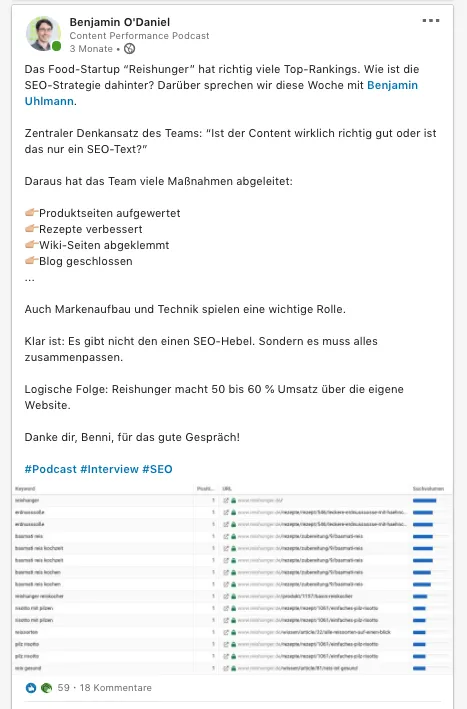
The startup “Reishunger” has built a large organic reach. We talk with Benni Uhlmann, who works there as Head of Marketing.
How did the startup build so many top rankings? What are he and his team working on? This much in advance: in this case study everything fits together: brand building, high-quality content, and technological understanding.
On this page
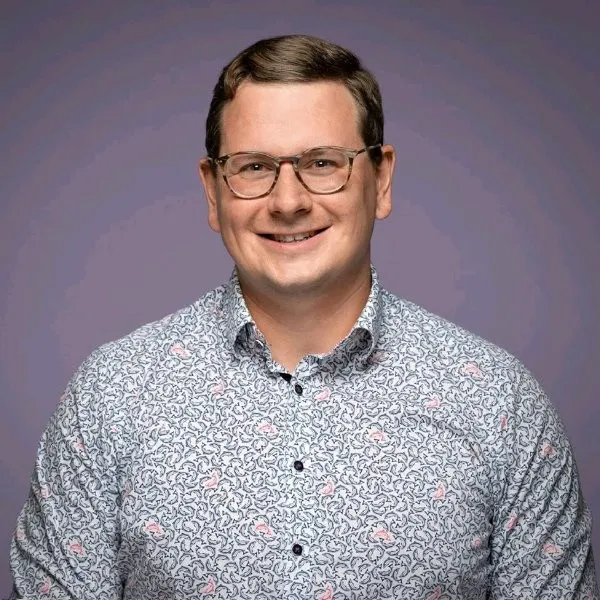
Our interview guest: Benjamin (Benni) Uhlmann
Benni Uhlmann is Head of Marketing at Reishunger. His team includes 20 people in total. Reishunger itself has around 100 employees (as of 2020). SEO is looked after by a project manager and a student assistant, among others, plus external service providers for IT.
Here is Benni’s LinkedIn profile. He is happy to answer further questions via LinkedIn.
SEO strategies and practical examples in our live webinars
Transcript: Our conversation with Benjamin Uhlmann about SEO, content, and branding
Benjamin: Yes, today we have a guest, Benjamin, or Benni Uhlmann, who is Head of Marketing at Reishunger. Reishunger is a startup and a brand in the food sector. And, yes, you work incredibly well with your content and have achieved a lot of really good rankings through it. Yes, and how you do that is what we would like to talk about with you now. Thank you for taking the time. #00:00:41-6#
Benni Uhlmann: Yes, thank you already for the advance praise. I hope I can live up to it over the course of the conversation. I am very happy to take a bit of time for the podcast. Thank you, thank you, thank you in any case for the invitation. I am glad I get to be here. #00:00:53-3#
Fabian: Yes, gladly, cool that you are here, Benni. I have to be a bit careful. I now have one Benjamin and one Benni, so I do not mix up your names. But if you like, tell us a bit about your company, about Reishunger, about your product, and can you also say something about your size? #00:01:12-6#
Benni Uhlmann: For us, as the name suggests, everything revolves around the grain of rice. That means we are a retailer of food and of equipment, everything related to rice. That means, of course, the product itself, but also the whole variety of ingredients that exists around this rice cosmos.
There are many, many billions of people in the world who live mainly on rice, and of course they have a variety of recipes in their countries that we here sometimes cannot even grasp. We simply try to bring that variety into German kitchens with Reishunger: the sushi world, the curry world, South American ingredients. And the whole range is rounded off by products such as our rice cookers or by small, well, kitchen essentials.
To come back to your question about how big we are, by the end of the year we will probably be heading toward 100 employees. They are split in roughly equal parts between our logistics, where we do almost everything ourselves, and our office. We do not release revenue figures. So I unfortunately have to put a small lock on that here. I can, however, let a small sneak peek shine through, namely that the current crisis, as bad as it may be, has given us a strong economic tailwind. Online grocery retail, I think that is on everyone’s lips in online marketing right now, and the train has not passed us by either. #00:02:58-9#
F: Yes, I saw that on LinkedIn. You also posted a chart there showing that your sales have also increased massively now because of corona. #00:03:08-4#
Benjamin Uhlmann: That was still right at the beginning of the crisis. We could see very strong panic buying. The chart you mean referred to the sale of large packs. So we have our rice products from 200 grams up to nine kilograms in the range. And precisely these nine-kilogram packs increased extremely, yes, during that panic-buying period.
But, yes, that effect faded very quickly afterward. So you could not rest on it for long at all. What was actually much more important afterward was that the people who think rationally, the ones who did not hoard so wildly, at some point started asking whether this principle of buying groceries online can work. And with these people we have grown very strongly over the last few weeks, but no longer with these panic purchases. #00:04:00-1#
B: Yes, very exciting. And through which channels do you sell? So you are also on Amazon, you have a very strong shop of your own, I believe, yes. Can you also say something about the split or about your channels? #00:04:13-9#
Benjamin Uhlmann: So 50 to 60 percent of revenue we make through our own website. We are now starting with Austria and Switzerland and then looking further toward Western Europe. So 50, 60 percent website. Then we also have the marketplaces, of course above all Amazon, which make up another good third of company revenue. And we fill the rest with various B2B contracts, where we cooperate directly with, yes, grocery retail or also with meal-kit manufacturers. #00:04:57-5#
F: So of course we would like to talk with you about your website, because from a search engine optimization perspective that is of course the most interesting part for us. You have worked your way to a great many top rankings when you analyze your site. And you can also see that your visibility has grown continuously. That means you clearly have an SEO strategy behind it. Do you want to briefly tell us what your success factors are, especially with regard to content now? How did you design your strategy in order to reach these rankings? #00:05:31-3#
B: That is of course a very big question, (laughs) because of course there is never this one traceable lever. I think everyone who has already dealt with SEO a bit more deeply knows that. #00:05:40-6#
F: But your top three, then? #00:05:45-0#
Benni Uhlmann: Yes, the top 3 SEO hacks. That is how it is. (laughs) So the topic of relevance is of course totally important. From my point of view that is also the top SEO criterion of all. And under the topic of relevance we permanently evaluate our content on the website through a very simple lens and ask ourselves: is what we are doing here still great, yes? Is it great for the user? Or is this just an SEO text that was hammered in? And from this big point of relevance we have also derived a lot of measures in recent months. A simple example is, we had quite a lot of knowledge pages that all came out of a keyword research. And we had top rankings with them, and people came to our site, found a great answer to the question, for example, can you freeze rice, but then they were gone again. That of course does not really help either. So what did we do?
We took this content, moved parts of it over to our category and knowledge pages, maybe no longer have quite such good rankings, but the people who come to us no longer perceive us as a wiki, but as a retailer. Another simple measure was also slimming down the websites, so that we only rely on relevant pages.
In that case that was, for example, closing our blog. So with the rise of social media, the big blogs have actually lost 95 percent of their relevance, because people get their news somewhere else. And at some point we recognized that too and simply shut the blog down, and that was it.
Another topic of relevance is also that we now have, I think, around 2,200 recipes on the website. And the recipes were simply hard to find. And what did we simply do? We looked at it from the user’s point of view: how do I get to the recipes? We restructured them, built new category and overview pages, and boom, the rankings suddenly went up again there.
That means the whole topic of relevance is totally important for us. Although we also always have to say that we occupy a niche in which the competition is not yet as strong as in other industries or verticals. That means it was of course not easy to build these rankings, but it was perhaps not quite as hard as in, I don’t know, the travel sector or something similar. #00:08:10-0#
F: But you still prevailed there, and prevailed in the long term. So to summarize again, you shut down your blog, you slimmed down the site, you made great text. So we actually have to invite you to our SEO podcast every week now. #00:08:21-6#
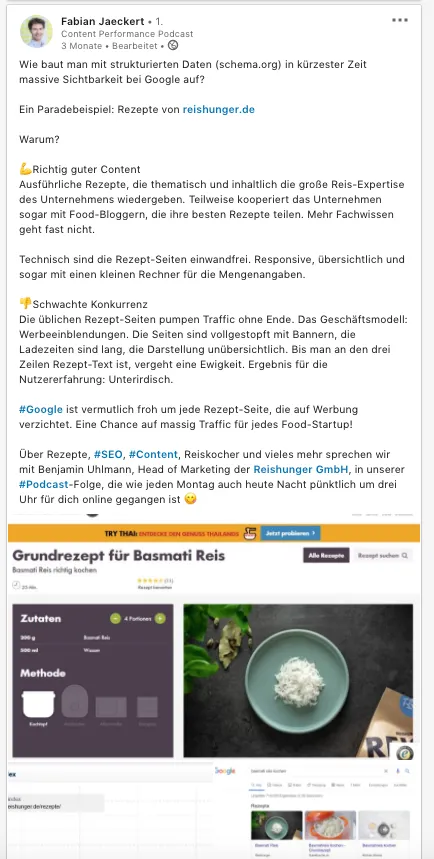
B: (laughs) That was only the topic of relevance. What for me are still the two other big pillars is that we permanently rely on a good technical structure. For example, last week we rolled out a page speed update, and on desktop we now have a Google page speed score of 97 to 98 for our product pages! That is relatively high in e-commerce.
In the end, our SEO strategy is that we want to make our users as satisfied as we possibly can.
I also have to say: on mobile, ha, it does not look quite as good yet. I think that has a bit to do with the amount of data you pass across. But we are still working on it. But alongside all this relevant content we build, we also permanently make sure that we of course have, yes, the best and most current technical setup. We are also sitting down again right now with AMP for our recipe pages, in order to bring a bit more speed in there and satisfy the user need even better. So in the end, our SEO strategy, brought to one point, is that we want to make our users as satisfied as we possibly can. #00:09:27-3#
B: So relevance and technical structure. Those are these two points, and was there something else? #00:09:33-1#
B.U.: The third one is a trivial point afterward, namely that you simply permanently need new content. We achieve that very well through our recipe pages. As I said, here we have 2,200 recipes. Many of them have few views, some of them have very many views. But you actually cannot really predict recipes.
So of course, as an SEO in the content area, I can build and strengthen certain pages of which I say: hey, you are going to be a really big page for me someday. But especially with recipes, the competition is so impossible to survey that you can almost only go via volume and then via structural levers. #00:10:14-3#
B: And can you tell us something about who creates the recipes? So when I am on a recipe page like that, I also partly see influencers who, so to speak, created these recipes. Somebody has to develop these recipes too. Can you tell us something about how you build this content? #00:10:32-9#
Benni Uhlmann: Sure. Good question, we get asked it very often. And we work here with a great many recipe partners whose recipes we put on our website. But we also take these recipes and put them on our Instagram channel. So. We now have 75,000 followers on Instagram, which is already quite okay for such a small B2C startup, and we also share the recipes here from the small channels that provide them to us, and we try to push our partners a bit with that, bring them more followers, give them more attention. In return they often give us content. Of course we also often buy it in the classic way, but as a rule we do not make it ourselves in this area. #00:11:16-2#
F: You said just now that you worked on your page speed. That suggests that you also have a large IT department, or rather people who really look after your technology full-time, let me put it that way. What kind of CMS do you have? Is it a custom development? Or do you have some solution running there? #00:11:37-2#
B.U.: Well spotted that our developers are developers full-time and do not (laughs) do it on the side. Our CMS is largely custom-built. It currently still runs on CodeIgniter, but we are just moving it over to Laravel. And sure, we use a framework somewhere here, but on the other hand that is really only a very rough framework, and I already have to do a lot by hand myself. That means here we largely have a custom build, and our shop system is the shop engine that was developed by our agency Brainspin from Freiburg. Shout-out to the guys. And in this combination we have now been on the road for, wow, almost eight years. #00:12:23-7#
B: You can see that, I think, on the product pages too. They are simply incredibly good. And specifically, I find a normal one, when you are on a category page or something, then you see endless content going down, and right at the bottom the SEO text is slapped on, yes? That is exactly what we regularly get upset about here on the podcast. #00:12:43-5#
B.U.: (laughs) #00:12:42-8#
F: You mean the products are at the top, right? #00:12:44-6#
B: The products are at the top, exactly, and the SEO text is slapped on at the bottom so that as few people as possible see it. And with you, I think you have found a very smart solution, so that you feature products, but you also really have good content on the page, an exciting tutorial video or sometimes something designed graphically. Did you develop that quite deliberately with the perspective that you want to rank well with it? Or how did that come about? #00:13:20-7#
Benjamin Uhlmann: Well, you have to say, product pages have a very, very, very high relevance in e-commerce, of course, because they stand, so to speak, at the lower end of the customer journey and I actually want to persuade people here to complete the purchase. And the relevance of these product pages is correspondingly high for us internally in the marketing team. And if you look at them now, they are, yes, very complex. Many people often also say that they are slightly overloaded. And they are, yes, very well suited from our point of view. We test a lot here with A/B tests, and we make sure we give the information the users want.
But overall this is really already the result of years of work, I would say. Especially this wealth of content that is played onto them cannot be used from one day to the next. Of course we also started with these SEO texts at some point. With what else, to be honest? When you are somehow a bit new in the business, you do not yet have these really smart solutions ready.
And we too still partly have (laughing) our SEO texts standing at the lower end of the page, simply picking up a few pieces of information again. Be that as it may. Nonetheless the pages are actually the result of years of further development. Now, however, we also have to, that is the big challenge, simply look again at whether one element or another has become too much on the page and whether we cannot bring a bit more simplicity onto the page. But, yes, that is of course very difficult to assess. We will see what develops over the coming weeks and months. #00:14:55-7#
F: A big draw for you is also the rice cooker page. And I have to say, that is what struck me first about you years ago, that you came up with the idea for that page that this product comparison of the rice cookers is not one under the other or tiled, but side by side. I always thought that was great.
That was somehow a really fresh product presentation. If I now search for rice cooker comparison on Google, for example, then you are no longer at the front the way you used to be. Instead publishers like Süddeutsche and Stern or ComputerBild are there, and they somehow have affiliate links, among others actually to you too, but also to many others. Personally I have to say I do not actually find that such a good development, yes, because it is simply super comparable, and these are actually run-of-the-mill affiliate pages. Is it not frustrating for you that they now stand ahead of you and do not really have the expertise and the relevance, as you say, in that area? #00:15:56-8#
B.U.: Yes, it does annoy me, of course, that we have not taken a further step here yet. So you see a lot of publishers here, yes, who in their core business simply (laughing) fail massively from day to day and just try to keep themselves above water with every straw, squeezing out a few affiliate revenues here and there. But in general, the big problem for me is, if we did not see these comparison pages, what should Google actually display then? The only alternative that would exist from my point of view would be that Google integrates its own solution into search, the way they have done with hotels.
That means that I would actually have a technical product comparison here. That, yes, has very many, very many sources of error. I already see massive scope for fraud here. That is why I somehow do not see this solution either, especially since all the product data would also have to flow in centrally somewhere. And I actually would not know at all, if we did not have these affiliate pages and the rice cooker comparison, what we would then have on page one? #00:17:08-2#
F: Yes, I find that exciting. From the search function side, right? #00:17:11-8#
B.U.: Yes, it already seems to be the best thing Google has found there, because nothing better actually occurs to me now either. Sure, on our site we also have a comparison, but hand on heart, that is the comparison where we compare our own rice cookers with our own rice cookers. #00:17:24-4#
F: Only your own products. #00:17:24-5#
B.U.: Yes. (laughs) So it is not really objective afterward either. #00:17:31-0#
B: I think you also see that across many other industries. The moment it goes into comparison, so search terms with comparison, with test and so on, then the publishers or info portals are shown at the front, whereas, so to speak, when the search is generic, right? For rice cooker, then Google says: yes, okay, which brand is there? Right? And you are a rice brand that you have built. But maybe also briefly again for understanding, I would like to insert this once more, you have a lot of rice expertise, so to speak. How is your SEO and content team set up? So what do you buy in, what do you develop yourselves? Can you also say a bit about how you are, yes, set up? #00:18:15-4#
B.U.: So at the core that is my project manager Jakob and me. We both come from the same SEO agency, (laughing) actually sat next to each other there for a long time, and we understand each other almost blindly, so to speak. And in addition we currently also have a working student who writes the texts, and of course also our developers, who keep bringing in good know-how from the technical side. It really is not much more than that.
Our content was built up over several years, partly also by our product management, which of course holds the whole knowledge. Recipes, as I said, we bring in a lot from external partners. And that simply led to us now having reached a point where we can no longer create so much content that is relevant. So it is actually enough for us now if we establish texts together with a student working 20 hours and rather look after the structural topics of the site, the technical background topics. #00:19:18-0#
B: Because you have been building content for eight years? #00:19:22-0#
B.U.: Exactly. Because at some point, you have to say, the topic is also exhausted. Of course we regularly run a research again and look at what is happening in the market, but, pff, yes, we cannot conjure up that many relevant topics there. It actually always gets more exciting when our product management opens up new food areas. For example when we started with our curry pastes. A totally popular product. We did not really have it on the site before, not that present. Now we suddenly have the opportunity to build completely new content worlds around the topic of curry and so on. And the same applies to the sushi topics.
The more products we integrate into our shop in these areas, the more content we can also build for them, without losing relevance here, because we might build content that no longer has anything at all to do with our products, our brand Reishunger. #00:20:15-7#
F: What I also find exciting in another way, which you have also done, is that you have expanded horizontally, so to speak, with the recipes. That is also something Google took up a few years ago as a new search integration in the search results, where you have also worked your way to a really great ranking. So to speak, you already stand well organically, and then you simply add another horizontal level in the search results with the recipe integration. That is also a way of working with new content on existing pages, is it not? #00:20:53-3#
B.U.: Definitely. And we are only talking about Google search here. Recipe search also goes much further via YouTube, for example, and partly via Instagram too. Everywhere there we also try to place ourselves with the recipes. And if someone had told me three years ago: hey, just put a few recipes on your site, I would actually, to be quite honest, have shaken my head and said: listen, there are so many big publishers out there who are already working their way through recipes and who have hundreds of recipes on their site. We are never going to compete with that. #00:21:28-9#
F: And what do you think it was down to that you managed it anyway? #00:21:34-1#
B.U.: That is a very good question. I simply assume that it is largely down to our specialization, that we move within this rice cosmos, that we also place our recipes within this cosmos, and that we therefore probably also get a big, yes, trust bonus from Google on the topic. #00:22:00-1#
I2: You are a rice entity, Olaf Kopp would say. #00:22:01-4#
B: We are a rice entity, so to speak. (laughs) Exactly. But I also simply believe that we offer users a better experience than most recipe pages. Because quite honestly, at the weekend I was on one of the top three big recipe pages and just wanted to look at the recipe there, or I wanted to pick out a few grilling tips, and they blast their page full of so much advertising that keeps reloading somewhere and shifts the page for you and all that. Hey, you simply cannot look at recipes there anymore! At some point I broke off in frustration and looked at the recipes on Edeka or something, because it simply did not work! It simply did not work. #00:22:39-4#
B: You are, and we would like to talk a bit more about this now, your own brand in the niche through specialization, as you say. And this topic of brand search, or branding in general, is also a really important ranking factor, as you know. And I looked it up. I think over 50,000 a month search for Reishunger or something like that. I do not even know exactly. Can you describe what the pillars of your branding are? So how do you think about the topic? #00:23:10-9#
We know our brand identity and we live it too.
B: So in April we had 66,000 impressions for Reishunger on Google and 150,000 impressions for Reishunger on Amazon in our ads, just to show you briefly what power Amazon actually has, by the way. As a rule you do not get numbers out, except from advertising. And, yes, how did we manage that? For one thing it is totally important for us that we know our brand identity and that we also live it. That across all channels we actually try to spread our one brand identity, Reishunger. And we are actually in the middle of a big process right now where we want to break down once more what this identity actually is.
A male colleague and a female colleague of mine are dealing intensively with this topic right now and want to take us many big steps forward here. The second important point for us is definitely that we know our target group. We have now aggregated so much data that we can actually see pretty well who our target group is, who buys what, and where we can also achieve a good placement with which messages. And the third important point for us, alongside brand identity and alongside the target group, is that we have clear communication rules, both inward to our employees and outward to our customers, which pays off above all in the long term. So we are actually talking here about customer journeys where many, many months can pass between different purchases for us, because of course we sell food that people buy to stock up. And here it is totally important that we deliver the same brand experience to the user again and again, yes, so that in the long term they have anything at all to hold on to when they hear the word Reishunger. That may all sound a bit cryptic now. That is often the case with branding, because you cannot capture it so easily in numbers. But I would say that these three pillars, brand identity, target group, and clear communication rules, have led to us having, yes, such a strong brand today. #00:25:30-0#
F: And how do you keep your customers, or how do you reactivate them again? Do you have a big newsletter? #00:25:35-0#
B.U.: That is actually one of our points where I would say we still have a small weak spot. You have to say in advance that the best customer retention is our product. So if we can convince users with our products, if they are tasty, if they are easy to prepare, if it is simply fun to handle them in the kitchen and they also taste good later, then the customers come back too. That means nothing would work without that. Of course we then also have these CRM points, viewed technically: our newsletter. We have an editorial newsletter every week that our design team redesigns every time, and of course also various automated newsletters that leave the building at certain points of a customer journey.
In parallel we also run social ads so that we reach users on various channels with the same message, and right now we are also testing how physical advertising materials can have an effect within the customer journey. So actually everything that can land in the mailbox. #00:26:43-1#
B: Cool. We are already quite far along. Now, to close, we would like once more, there are a great many B2C startups out there. Right. And you have really made it. And what are your three tips for what you really have to tackle as a B2C startup? #00:27:02-3#
B.U.: Yes, my three tips? I came into the company very late, so I would not necessarily say now that I am the expert to give tips like that. But I would still like to try. And my first tip would definitely be that you should test a lot, and always according to the Pareto principle. Perfectionism is a very, very rare luxury in performance marketing, one you absolutely have to do without as long as it is not necessary.
The second important tip from my point of view is that you have to bring in smart minds very early. Whether you park them in-house or externally does not matter at all. The only important thing is that you very quickly bring in the right knowledge for your company, in order to set the course from the start so that you can benefit from it in the long term.
And the third really important tip is, there are no quick hacks. There are only long processes that consist of a great many small steps. For that you have to read a lot, keep educating yourself a lot, learn to understand a lot. And at some point you have then, yes, created something where others perhaps, yes, feel a bit of awe at how you managed it. As a rule, though, that does not happen overnight, and it does not happen through some odd quick hacks that people somehow want to promise you, but actually only through smart, long-term solutions. Yes. And through belief in your own product. #00:28:22-4#
B: Yes, great, that was a perfect closing word, Benni. Thank you for taking the time. #00:28:32-1#
Benni Uhlmann: Gladly. Thank you for letting me be part of it. I hope there was one thing or another in there for the listeners out there, or for you too, and I am definitely happy about anyone who maybe gets in touch with me via LinkedIn. If there are any follow-up questions on certain topics, you can write to me at any time. I answer every message in the shortest time. (laughs) #00:28:52-2#
F: Well, that is an offer. You should definitely do that. #00:28:52-6#
B: Cool, perfect, our listeners will be happy about that. All right, then take care and see you soon. Ciao. #00:28:56-1#
F: Benni, thanks again from me too. Ciao. #00:28:59-6#
B.U.: Thanks, ciao. #00:29:00-0#
Go deeper? Matching topics and episodes for this interview
Our view of SEO
SEO has changed a lot in recent years. Branding, content, and PR play an ever larger role. Branding is a ranking factor, as you can see again and again. Also in this example, in which Reishunger prevails against large market players such as Chefkoch. But technical SEO is and remains an important factor too, for example when it comes to load times. Here we have summarized our view of search engine optimization.
Our podcast interviews
In our podcast we talk every week about how SEO is changing and how to respond to it. We regularly talk with exciting interview guests from online marketing. Among them many SEO experts, entrepreneurs, and executives. For example with Kevin Indig, SEO at G2, or Dominik Schwarz of HomeToGo. Here is the overview of all episodes of our SEO podcast.
Our discussions on LinkedIn
On LinkedIn we regularly share our thoughts on online marketing and discuss them with our listeners. Here is Fabian’s profile, who tends to discuss technical topics. And here is Benjamin’s profile, who tends to start content topics. It is perfect if you also write a short message with the connection request. Then we know what is going on. By the way: here we have summarized many thoughts on LinkedIn marketing strategies.