October 9, 2017Fabian Jaeckert
What Is an SEO Analysis?
An SEO analysis is a central task in search engine optimization. SEO tools are used to analyze how visible a website is in the Google rankings for certain keywords. Technical errors are also recorded as part of an SEO analysis.
The core problem:
Automated SEO analyses are often carried out that the people responsible for marketing cannot do anything with.
There is also no defined standard for SEO analyses and the concrete approach. That leads to everyone understanding something different by it.
Our view:
A professional SEO analysis is meant to recommend concrete SEO measures.
With the goal of increasing visibility and thereby generating more visitors (traffic), leads, and sales.
On this page we show how we carry out SEO analyses in practice.
Which tools are used in an SEO analysis?
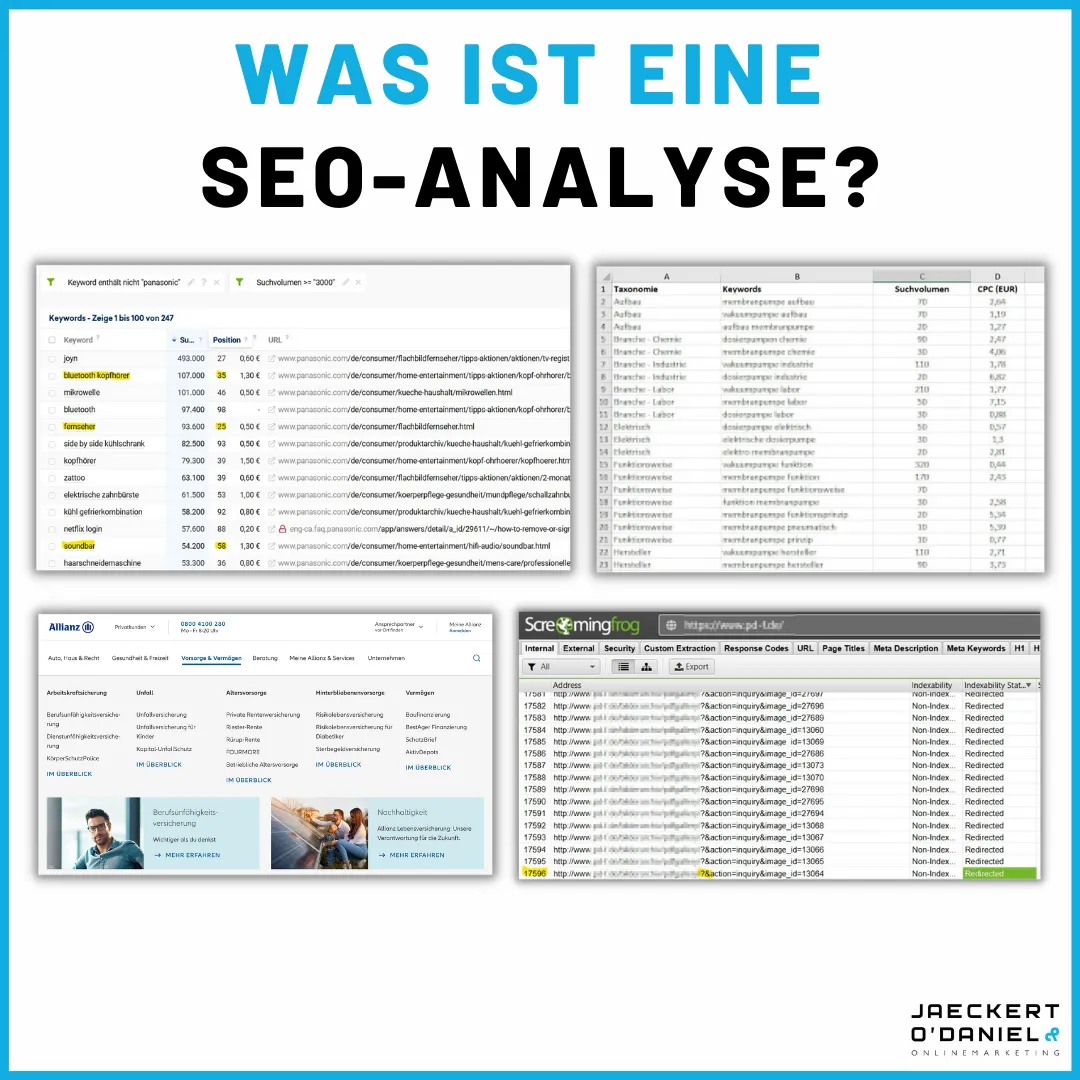
In search engine optimization there are different areas of work, for which different SEO tools are used in the analysis. They include:
- Google Search Console
- Web analytics such as Matomo or Plausible
- SEO suites such as Sistrix, Ahrefs, or SERanking
- Crawlers such as Screaming Frog
SEO software suites are very well suited to keyword research, a backlink analysis, or a competitor analysis. They have a large data set of search terms. And you can check your competitors’ Google rankings and derive strategies from that.
Google Search Console and the software Screaming Frog are very well suited to the technology of a website. You can use them, for example, to check whether the website meets Google’s technical requirements and whether the individual pages are indexed correctly.
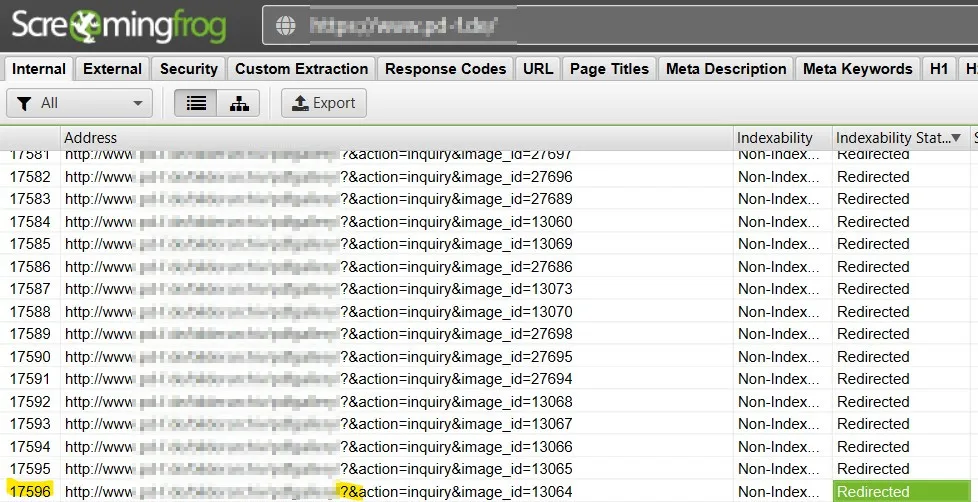
An example from an SEO analysis: with the software Screaming Frog we found that there were thousands of faulty redirects. That created problems with indexing. The pages were not captured by Google in the first place. From our point of view, crawling is part of a complete SEO analysis.
More on this in our AcademyWhat insights do you draw from an SEO analysis?
A fundamental problem of many SEO analyses: they happen automatically. Meaning: someone lets an SEO tool “run” over the website, and the result is an endless report that nobody understands. Error messages are often issued:
- The ALT tags should be filled in
- Redirects were not set correctly
- An SEO score is at 70
But what are you supposed to do with information like that? Our experience: there is often a lack of a fundamental SEO strategy. Meaning: it is not clear what the important search terms are and how you represent them on the website with which content. Or what the backlink structure of a page looks like. A concrete roadmap with priorities is also missing from the result.
An automated (often free) SEO analysis therefore almost never helps. That is why, for example, we carry out individual SEO analyses and derive strategies and concrete recommendations for action from them. More on that here.
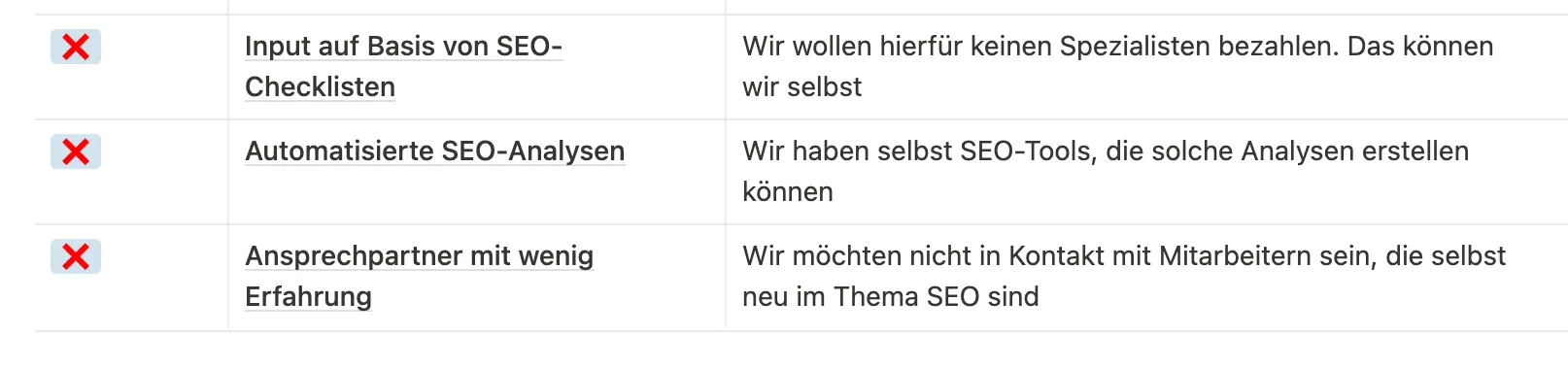
An example from an inquiry that reached us. It explicitly asks us not to deliver automated SEO analyses. No wonder, because marketing leads can almost never do anything with them. The evaluations are incomprehensible, unsorted, and almost always not the most important lever for more SEO visibility.
To the SEO AcademyWhat does an SEO ranking analysis look like?
A central part of an SEO analysis is evaluating the existing Google rankings. That includes:
- The most important search terms (keywords)
- The URL, meaning the subpage that ranks for them
- The position in the search results
In the example chart you can see that a very well-known mail-order retailer ranks in position 1 for the keyword Boxspringbett. The term is searched more than 200,000 times a month.
Large websites rank for hundreds of thousands of search terms in the search engines. And in that way they get Google traffic every day on many subpages.
Analyses like these can be carried out with SEO software solutions such as Sistrix. These tools are also suited to competitor research.
The concrete traffic on the website, by contrast, is determined and evaluated with Google Search Console and Google Analytics. The external SEO suites have no access to that, although interfaces (APIs) are often offered here.
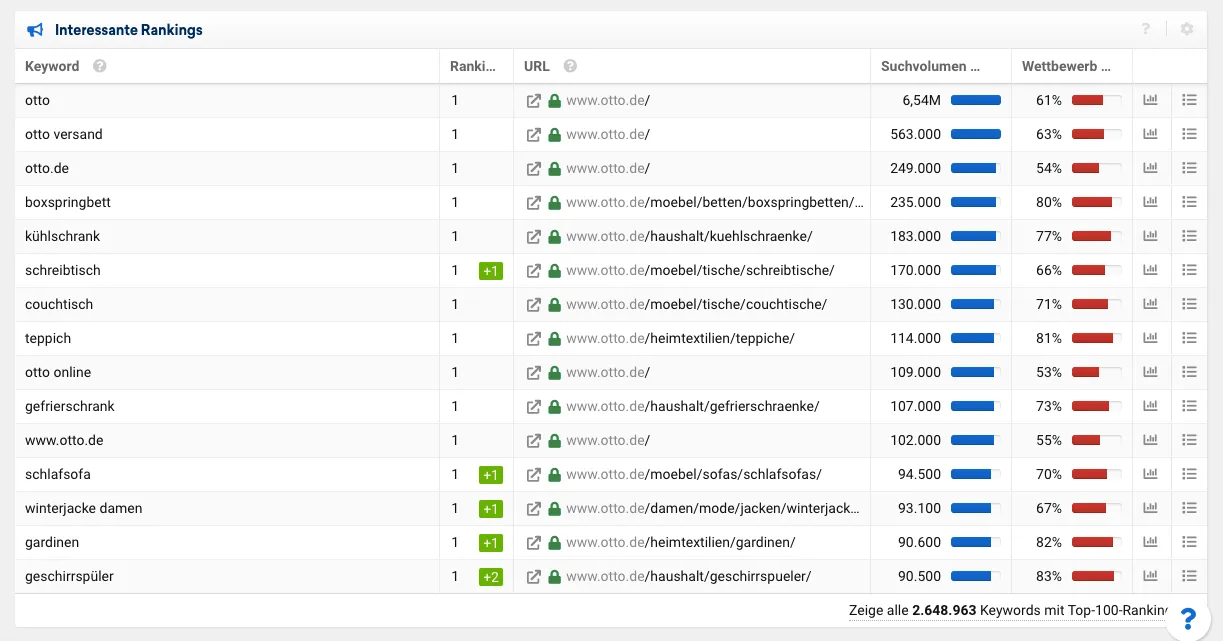
This online shop, admittedly a very prominent one, ranks in position 1 for numerous generic search terms. And it does so with the respective subpages of its online shop. Overall, the website ranks for more than 2.5 million different keywords. One example of many that shows how much power there is in search engine optimization when you approach it professionally.
What is an SEO keyword analysis?
The keyword analysis is a core task in search engine optimization. The relevant search terms are researched with a professional SEO tool and clustered. Topics emerge from the clusters, and you represent them on the website in the form of articles or pages (for example landing pages).
From our point of view, every company needs a fundamental keyword analysis.
In general: before content is produced, an SEO analysis is always carried out for the topic in question. That makes sure you also capture the greatest possible potential.
The content can be a guide article, a category page, a product page, or a glossary article. Here too there are very different options, which are defined as part of an SEO strategy or in content marketing.
You can turn it however you like: creating content is time-consuming. But in return you produce a lasting asset. An article or a content page that ranks well creates a large, lasting value. Otherwise the visitors would have to be bought via Google Ads or other advertising channels.
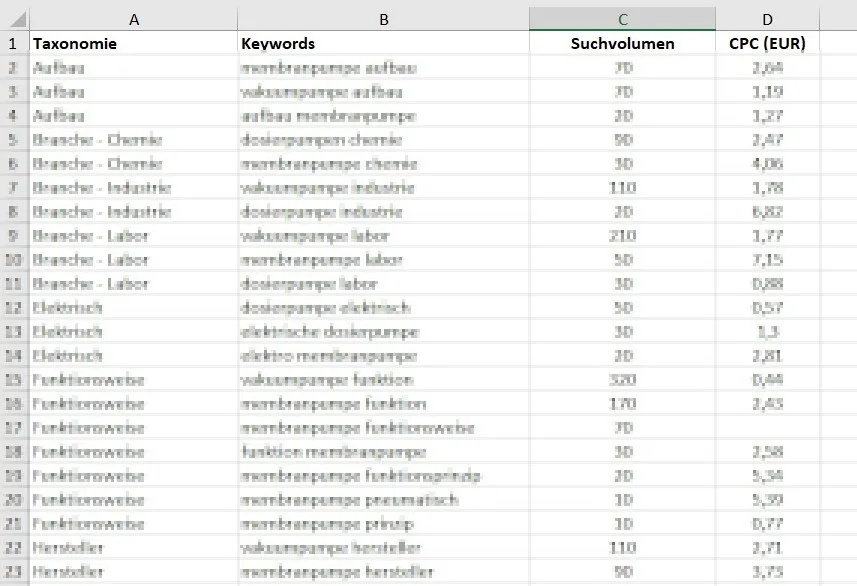
As part of our SEO consulting we carry out keyword analyses and present them to the people responsible for marketing. We also explain how you represent the keywords on your website in the form of high-quality content. So that you have content that convinces search engines and visitors.
SEO analysis approach: our tips
What belongs in a meaningful SEO analysis? How should you proceed? The following tips, briefly:
- Automated SEO lists do not help
- Carry out a technical SEO review
- Analyze Google rankings
- Research keywords
- Expand the website structure
- Develop a content roadmap
- Plan further SEO measures
We advise against blindly following technical recommendations that came from automated evaluations. You should always ask whether that is really the central lever for more visibility.
The reverse is also true: if there is a serious technical SEO problem, it has to be solved first. So that basic indexing is possible.

We are Fabian Jaeckert (right) and Benjamin O’Daniel. For many years we have worked as SEO consultants for mid-sized companies. Here are some references.
For our marketing team, we specifically sought a sparring partner for SEO and content. Our goal was to gain new external insights to better leverage our ranking potential as a well-known brand in our market segment. Fabian and Benjamin delved deeply into our needs, and thanks to their comprehensive, data-driven analysis, they were able to provide us with concrete optimization suggestions for our SEO strategy. We particularly appreciated that we could achieve our goal with existing resources and focused testing.
 Bernd GüntherSage
Three frequent questions about SEO analyses
What is SEO?
SEO is the English abbreviation for search engine optimization. In this discipline the point is to gain as much visibility as possible on Google, for search terms that are relevant to the company. There are around 200 ranking factors in total that determine whether, and which, page ranks at the top for a term. There is no ranking guarantee. But there are experience-based indicators of when a website has a good chance of ranking.
Why is an SEO analysis important?
An SEO analysis is the basis for further work on the website and on the content. Without a prior analysis there is a risk that you work on subpages or on content without it delivering anything. You are working in the wrong place. Another frequent case is that something on the website is changed and an existing SEO ranking is destroyed.
What does an SEO analysis cost?
A professional SEO analysis usually costs several thousand euros. As always, though, it depends on what is in the analysis. Many SEO tools offer automated SEO checks. That is often free or available for a few hundred euros. As a long-standing SEO consultancy we often argue for an SEO concept with a strategy, a keyword set, and a measure plan for the further implementation.
Carrying out an SEO analysis for an entire website
This is how we understand an SEO analysis for a website: in a comprehensive SEO concept we analyze the website, for example for a B2B company in the software field.
That includes a technical SEO review, an evaluation of the Google rankings, detailed keyword research on the most important product range, a proposal for a sensible expansion or change of the website structure, a template for the content, and a roadmap for the further implementation. A range of different SEO tools are used for this.
We then present this in an online workshop. The subsequent implementation is done internally by the marketing team. In this case an SEO analysis is not a spot check of a single topic, but an overall concept.
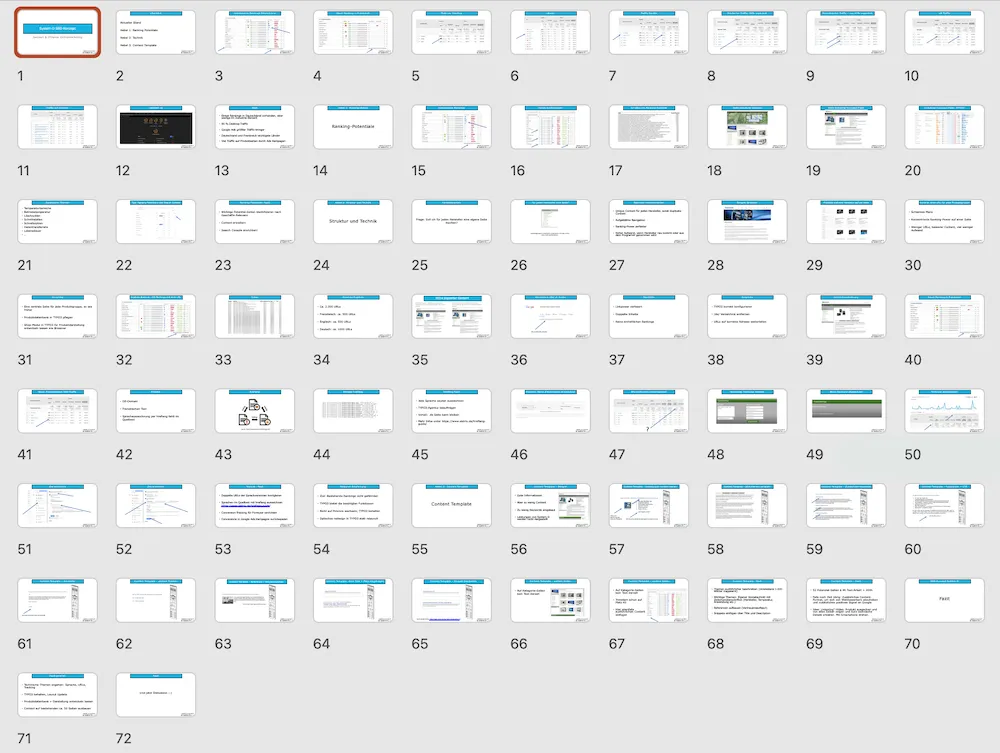
Specific SEO analyses of individual SEO areas
SEO competitor analysis
Competitors can also be analyzed with SEO tools. Meaning recognizing in depth which terms other companies rank for, and in which positions on Google. An SEO competitor analysis can be part of an SEO concept. Or a specific assignment when it is about an extensive competitor analysis, for example when several competitors are involved or in international SEO.
SEO content audit
Some websites have already built up a great deal of content over many years. Grown website structures prevail here, with many consequences for the content and the Google ranking. There is content of low quality, for example, or with very few visitors. As part of a content audit with an SEO focus, the content is analyzed and a proposal is developed for whether and how the content can be merged and strengthened, in order to improve the ranking that way.
Why an SEO analysis should always come first: key points
Relevance of the SEO analysis
- SEO analysis as the foundation of the portal
- Search terms are audience problems
- Keyword research in depth
- Also a topic in the SEO workshop
Challenges of the SEO analysis
- A lot of Excel work
- Getting up to speed on the topic, and coordination
- Hardly possible with free tools
- Data often inconsistent
- Clean work as the basis for later success
Tools for an SEO analysis
- Many different tools on the market
- AdWords Keyword Planner only of limited use
- Sistrix Toolbox
- Keywordtool.io with question keywords
Developing the information architecture
- Build the structure from search terms
- Cluster keywords into sections and subpages
- Define keywords for subpages
Visualizing the structure
- Develop a mind map
- For example with Mindmeister
- Mind map in the cloud
- Share with clients and project partners
Conclusion
- SEO analysis as preparation for the editorial meeting
- Keywords are the working basis
- But not set in stone
- Keyword-based pages also appeal to Google