December 7, 2020Benjamin O’Daniel
Content Audit and SEO: Approach, Tools, Examples
A content audit takes place in content marketing and in search engine optimization (SEO) and is the systematic analysis and assessment of all content that is on a company’s website.
In a content audit like this, the point is to identify qualitatively weaker content and to develop a plan to improve the content.
For example, a content audit for SEO is carried out when a relaunch is coming up, when the site is switched to a new content management system (CMS), or when the marketing leads in general want to increase the visibility of the website and have more traffic on the website.
Many companies already work with various content formats, such as landing pages, content hubs, or glossaries, which however achieve too few Google rankings and therefore no lasting value.
How we proceed with a content audit for SEO like this is what we describe in this podcast episode and on this page.
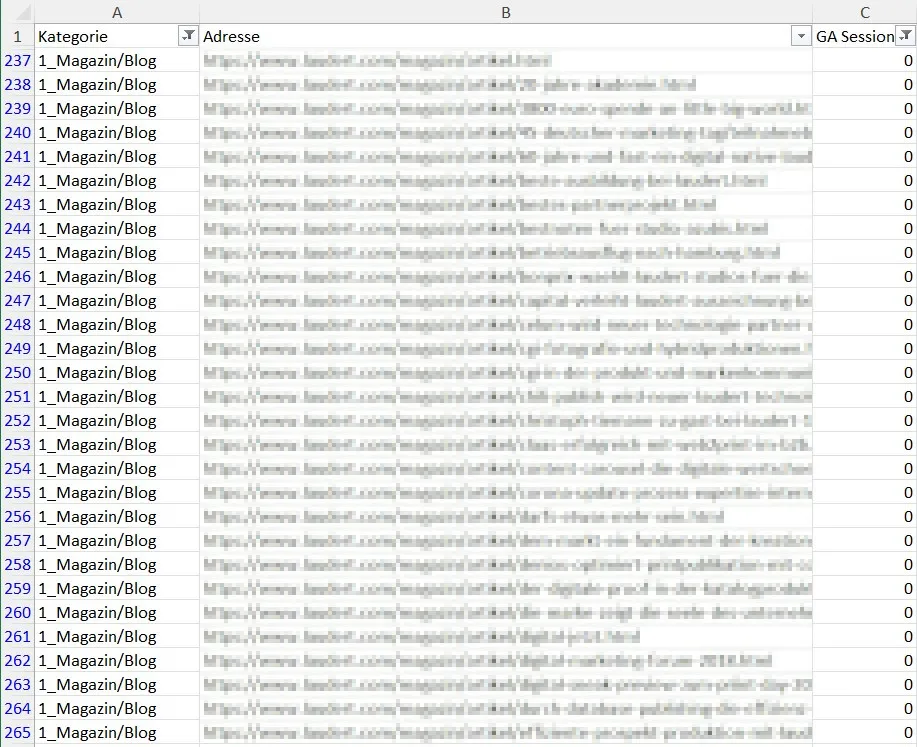
Example of a content audit of a website
Many companies have already developed a lot of content, but are unhappy with the performance of the content. Overall, too few visitors come to the website.
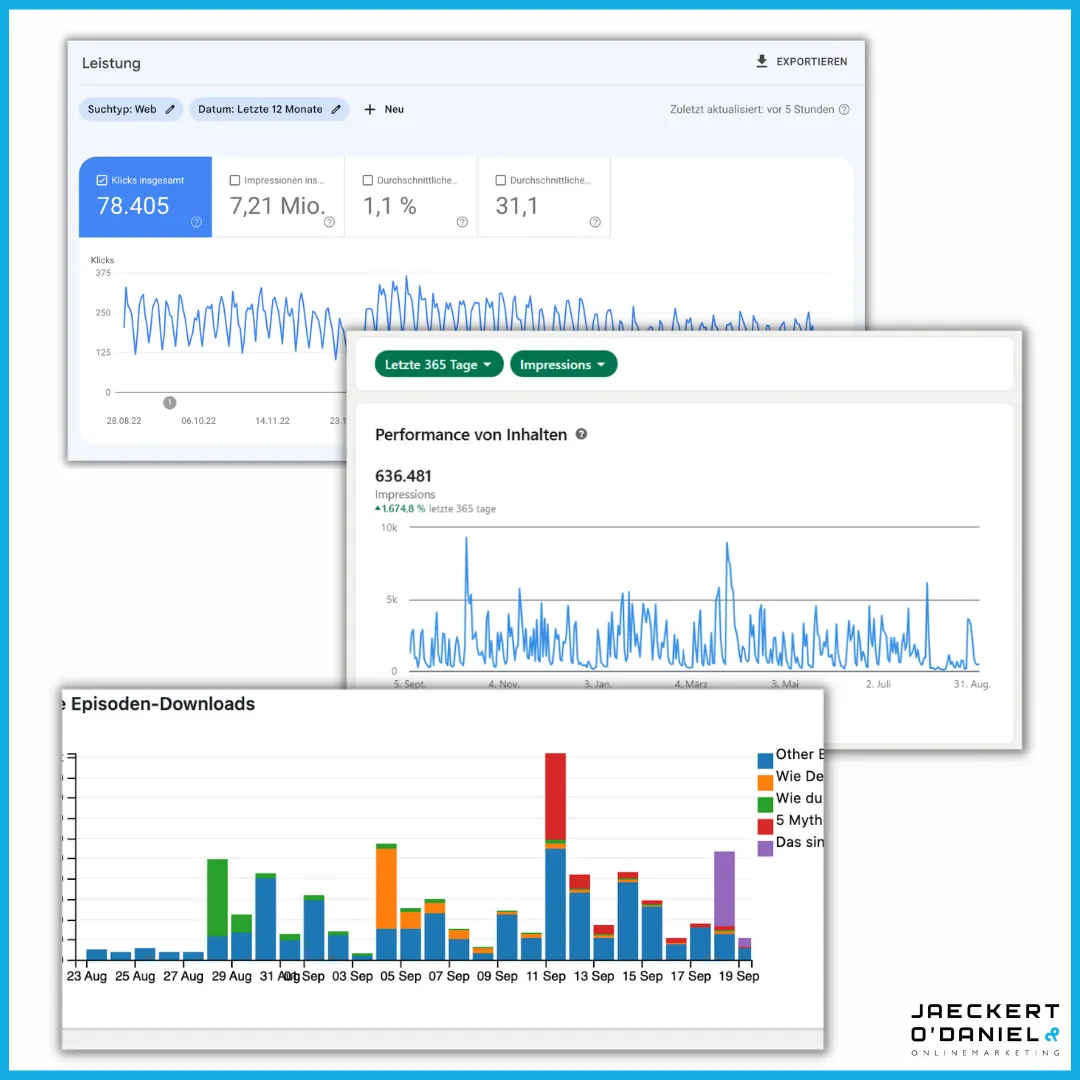
That is also the case in this example, where a company has published several hundred blog articles. An analysis via Google Analytics showed that more than 80 percent of the articles had no traffic in the last three months.
The cause behind it: the articles were not developed on the basis of central keyword research. Instead, the topics were planned through a purely editorial lens. Put casually, that leads to a content graveyard.
We often see the situation that articles like these do generate traffic in the short term. For example after publication and promotion through a newsletter.
But they do not generate lasting traffic the way articles do that also have a successful SEO ranking and rank at the top for numerous relevant search terms that are searched for continuously every month.
High-quality content always means effort as well. That is why we argue that articles like these should also meet SEO requirements, and so pay off more later on.
Content SEO audit
The focus of our work is, on the one hand, on the SEO visibility of the existing content. On the other hand, on the potential that is there.
We often work for well-known brand companies. In talks we also analyze well-known companies.
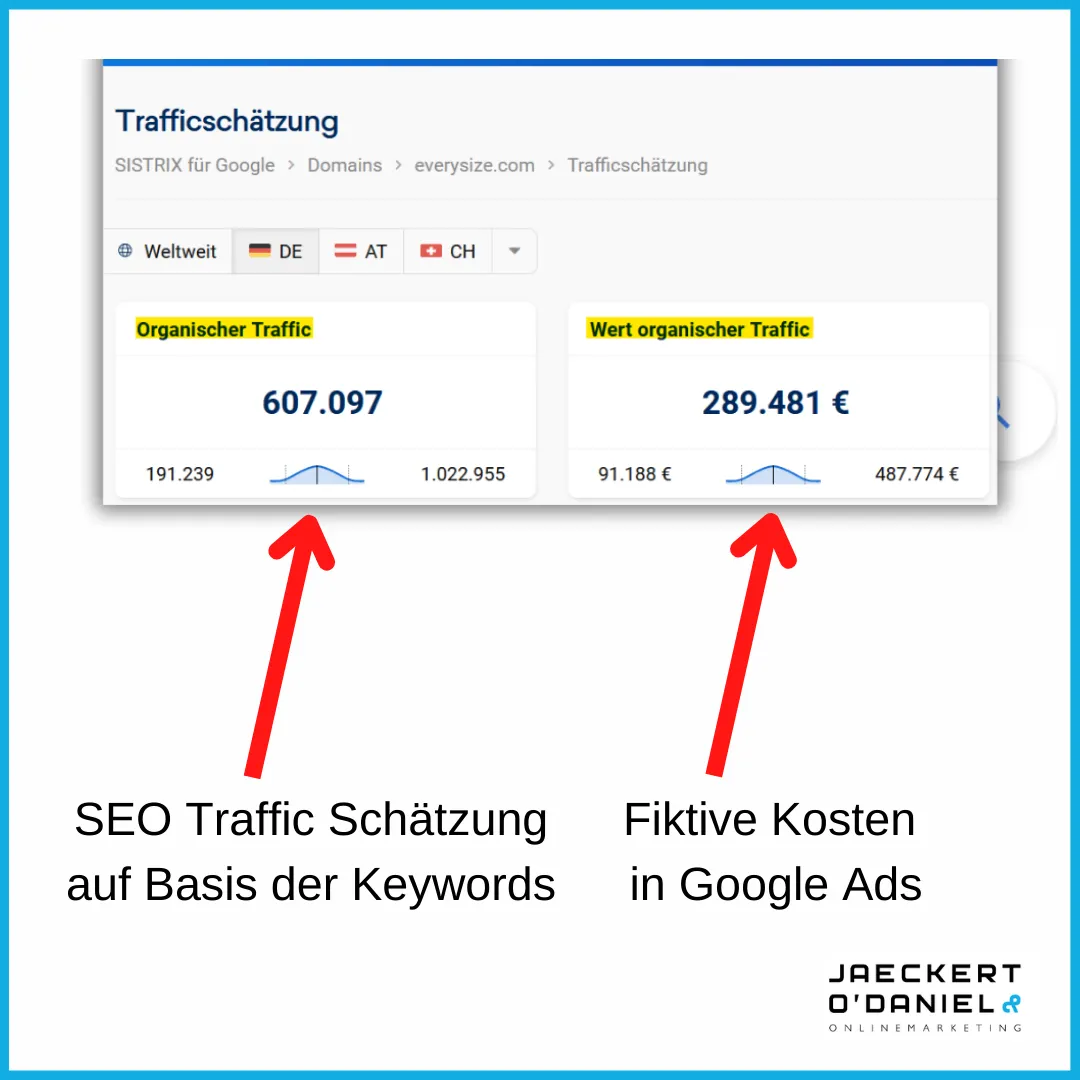
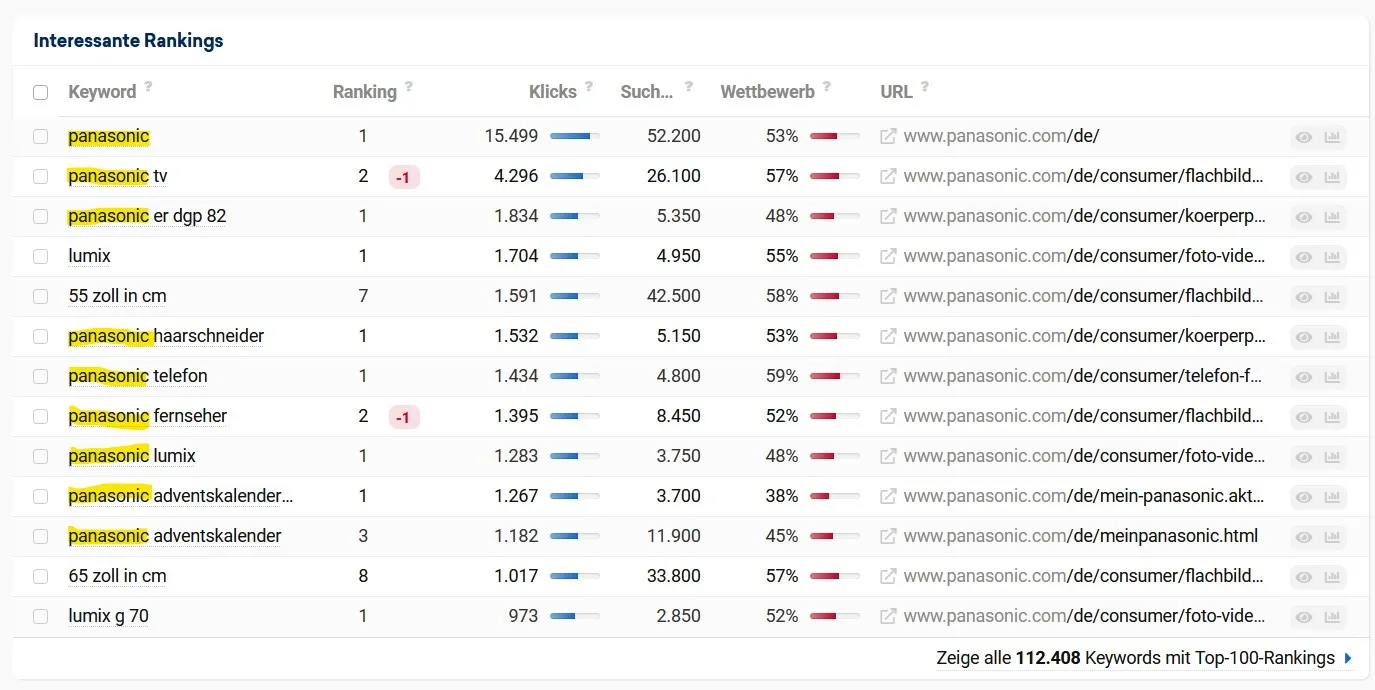
As in this example. The company is known to everyone and will certainly have a great deal of traffic on the website. The visitors, however, come to a large extent through so-called brand searches. Users enter the company’s brand and steer specifically toward the website.
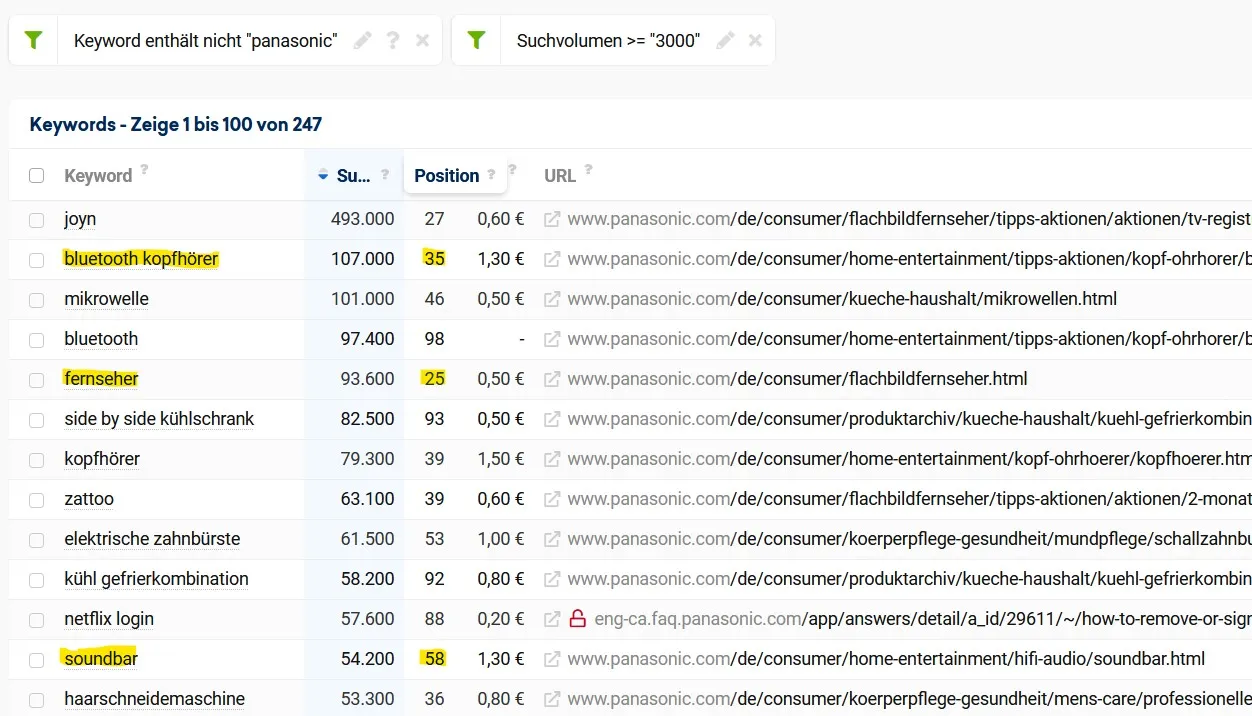
SEO is about something else. The goal is that users enter general terms and do not yet want to steer toward a destination or a specific brand. They are still open in their customer journey in the purchase decision. Here it is particularly valuable for companies to rank at the top.
The analysis (see charts) shows: here the company is in the back positions on Google for numerous highly relevant terms.
Further down, more about our work. In the video we carry out a competitor comparison and compare two well-known companies, their Google rankings, and their content with each other.
Tools for a content audit
For a content audit we use various tools. These include:
- Google Analytics
- Google Search Console
- Screaming Frog
- SEO suites such as Sistrix
- Special tools such as Termlabs
Roughly speaking, three perspectives are covered with that in a content audit or content SEO audit: the technology, the Google rankings, and the traffic on the website. First levers for optimization often already emerge from this analysis.
Here we also describe concrete examples of SEO audits.
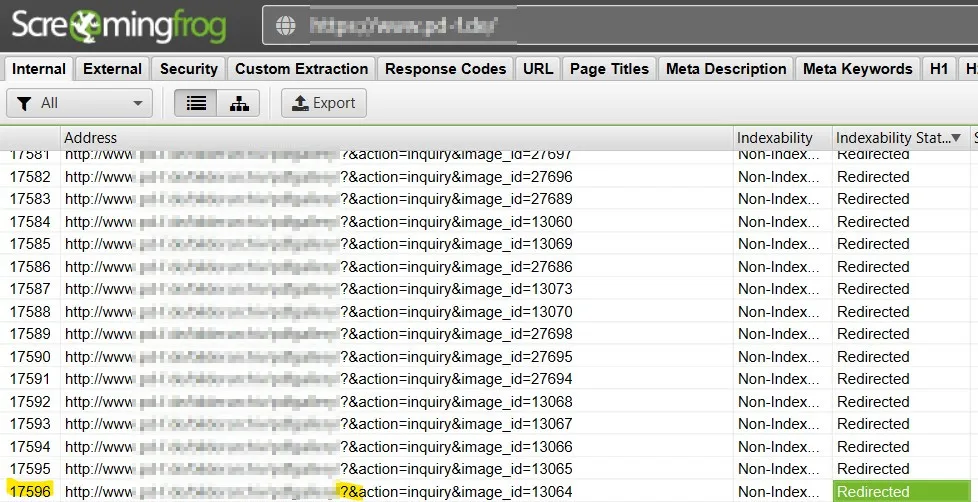
In this example, a website crawl showed that thousands of unnecessary redirects had been set. That means a high effort for Google to capture the website correctly. We see technical errors like these relatively often, because IT and web agencies can program and design, but are rarely trained in SEO.
We carry out content SEO audits
We have worked as SEO consultants for many years. We combine three large areas of work that are necessary for a successful content audit:
- Technical know-how
- SEO knowledge in depth
- Content knowledge in depth
Fabian Jaeckert has worked in search engine optimization for more than 15 years. His focus is on the technical topics and tools. Benjamin O’Daniel is a trained editor and writer. His focus is on content and on content formats.
Together we carry out SEO content audits and develop SEO strategies from them for more traffic on the website.
Interested? Then we can gladly arrange a get-to-know-you conversation (30 min. Zoom call).

For our marketing team, we specifically sought a sparring partner for SEO and content. Our goal was to gain new external insights to better leverage our ranking potential as a well-known brand in our market segment. Fabian and Benjamin delved deeply into our needs, and thanks to their comprehensive, data-driven analysis, they were able to provide us with concrete optimization suggestions for our SEO strategy. We particularly appreciated that we could achieve our goal with existing resources and focused testing.
 Bernd GüntherSage
Content audit for a better SEO ranking: this is often the starting point
Structures that have grown
Many corporate websites literally sprawl. Over time, more and more online projects are built into the website. Often, different people are also responsible for the website or for certain SEO content. On top of that: there is often only a rudimentary toolset. Nobody in the company is an expert in Google Analytics with regard to SEO. Other SEO tools are rarely in use as well. Now it is unclear: where are the essential levers for us? How can we bring holistic content and SEO into line? This question often comes up with an upcoming relaunch as well.
A formal view of content
Websites are often the responsibility of the management, or, in larger companies, of digital marketing managers or SEO managers. The people responsible often have an organizational relationship to the content, also because their focus is more on project management or on the commercial side. The consequence: the quality of the content, meaning whether a text is actually good, is not in focus at all. From an SEO point of view that is a very important point, because a lot revolves around search intent, meaning whether the users’ questions are answered.
Endless PDF reports
When people think of a content audit, endless PDF evaluations come to mind for many of the people responsible. And reports like these are in fact delivered regularly. For example, on which URLs meta descriptions are missing. Only those are almost never the central SEO levers. Or long lists on a qualitative level: whether the content is good, medium, or bad. Only as a person responsible you can do very little with that. In the worst case it comes down to assigning blame. What is missing is an analysis, a bringing together with SEO, and above all clear instructions for action.
SEO and content from practice: tips, strategies, webinars

Content audit for SEO: how we proceed with a website
SEO analysis
For an SEO analysis we combine a range of tools. We crawl the website in order to capture scope and structure. Individual starting points are added, depending on the requirement. For example keywords, traffic, or the content performance of individual URLs. The enriched keyword list is in Excel format, because you can work with it very well operationally later.
Content analysis
In the qualitative content analysis we often proceed by example. What does the content in a certain category look like? How is the text written, how do further content formats work? What is it lacking, from the user’s point of view and from the SEO perspective? An example of a qualitative discussion: our interview with copywriter Daniela Rorig.
Conclusions
A content audit does nothing if it is not clear afterwards how the content should be improved. So it is always also about setting priorities and drafting a roadmap. A rough calculation of how much work should be invested in which content is part of it from our point of view as well. It is often also about who does it, in-house or external writers.
Content audit and search engine optimization: case studies


1 million users a month, with the right content strategy: interview with Jan Brakebusch

Sales psychology and SEO: interview with Matthias Niggehoff

Twice as visible as AirBnB: interview with Dominik Schwarz

How to build a successful startup: interview with Johannes Kliesch

The art of crawling: interview with SEO Markus Hövener

SEO for publishers: interview with Jens Fauldrath

Are you relevant enough for Google? Interview with Olaf Kopp on the entity model
Want to read on? Gladly. More topics on our website
SEO in depth
SEO has many facets. We discuss all of them. For an introduction to SEO: our topic page on search engine optimization. What belongs in an SEO concept. What an SEO strategy looks like. Go deeper into SEO: SEO along the customer journey, long-tail keywords, and the place of SEO in the online marketing strategy.
Content in depth
Content is a cross-cutting topic. It affects almost all online channels. No wonder that a field of its own has emerged around it with content marketing. In the podcast we talk, for example, here about video content. But also about formats such as glossaries, SEO landing pages, or blogs.