March 14, 2022Benjamin O’Daniel
3 SEO Myths That Musikhaus Thomann Disproves
SEO keeps changing, all the time. It is always interesting to see the different approaches companies use to work their way to top rankings, and with them to traffic, leads, and sales.
In this podcast episode we discuss three central topics that also affect many online shops. We do it through a case study. We analyzed the website of Musikhaus Thomann. The online shop disproves three common SEO myths at once.
Thomann has been very successful online for a long time. Founded in the 1960s by a traveling musician, Thomann today has more than 1,500 employees and makes about 850 million euros in revenue (source).
The online shop went live back in 1996. And in recent years Thomann has expanded its SEO visibility once again, markedly.
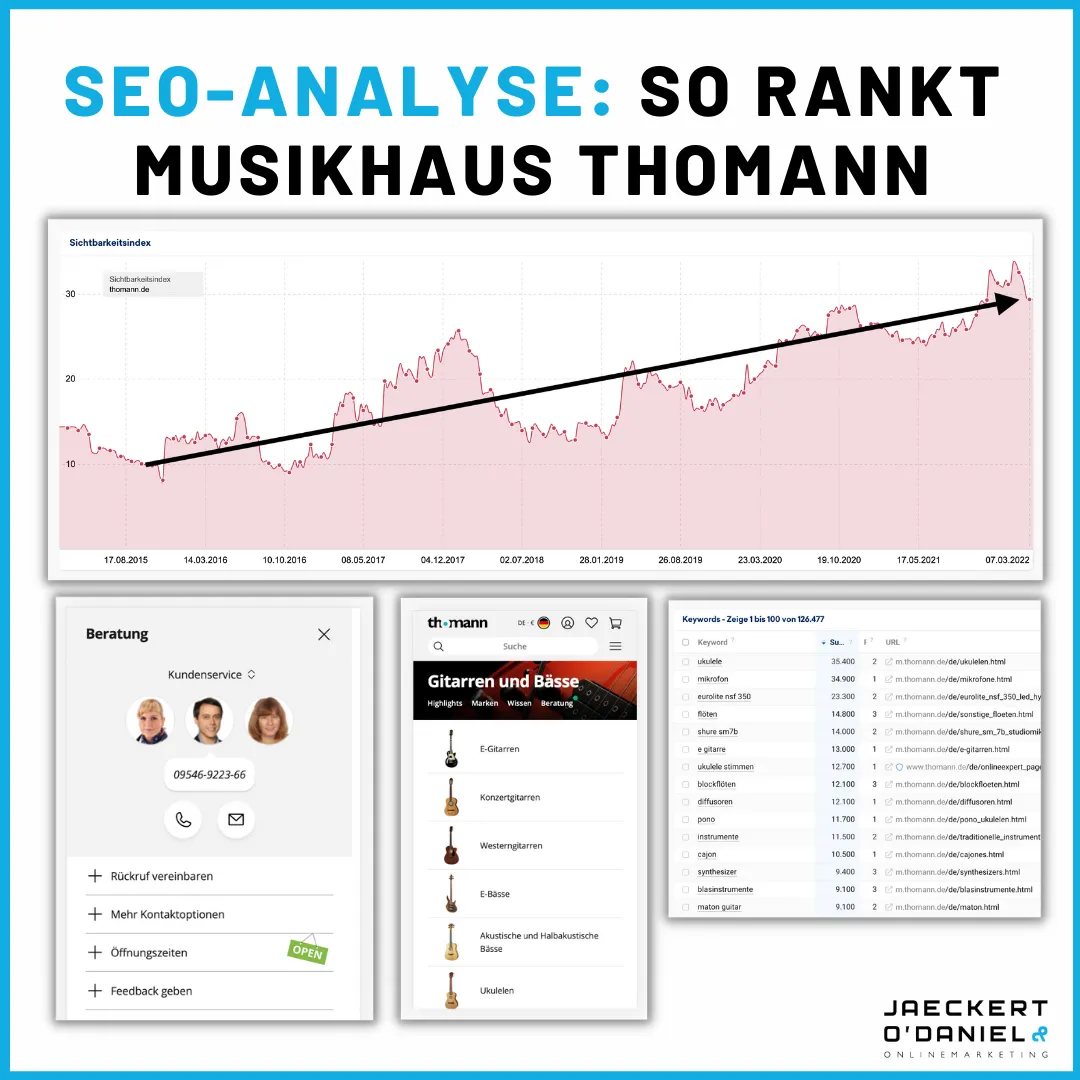
The online shop has tripled its SEO visibility
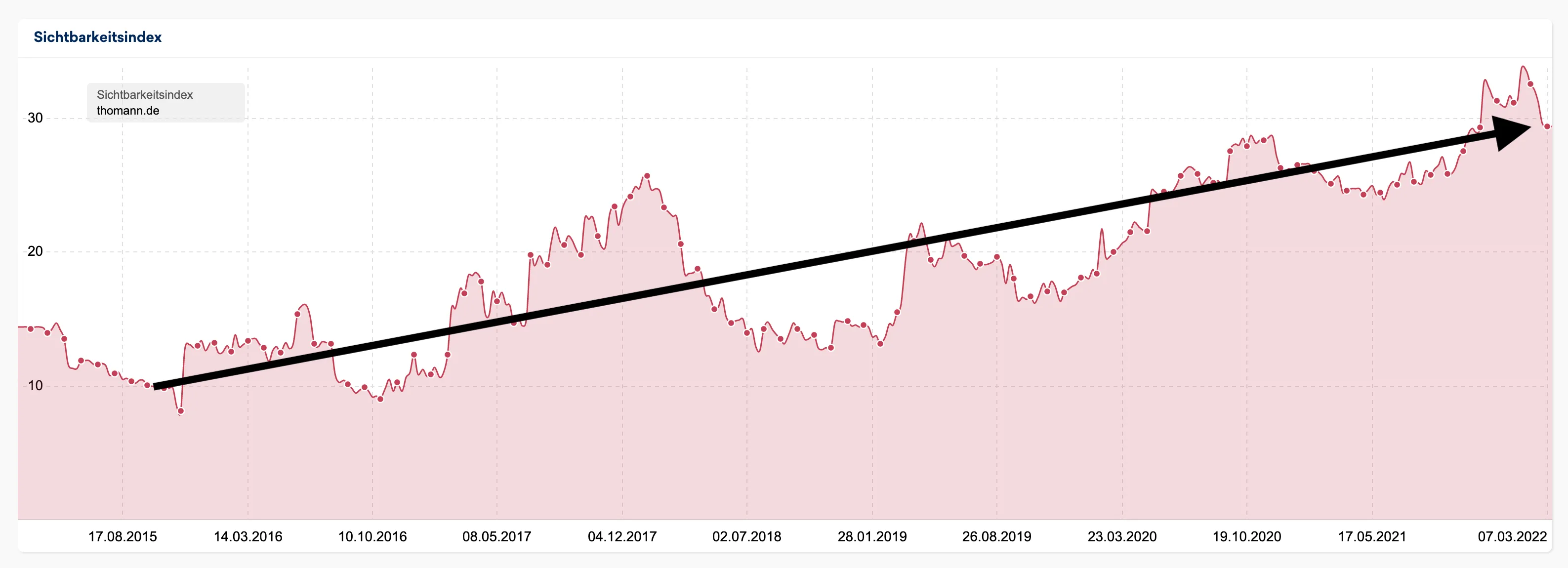
The organic SEO visibility of Thomann.de has been growing steadily for years. Compared with seven years ago, visibility has tripled. That is a clear sign that search engine optimization is firmly anchored internally as well. The visibility index, here in the SEO tool Sistrix, is an index value that, put simply, shows overall visibility based on all keywords and rankings. Here we talk in more detail about how we work with index values like these for SEO visibility.
In our Sistrix SEO duel on YouTube we compare Thomann’s SEO strategy with Music Store, another very successful online shop for musical instruments.
More than 120,000 top-3 rankings
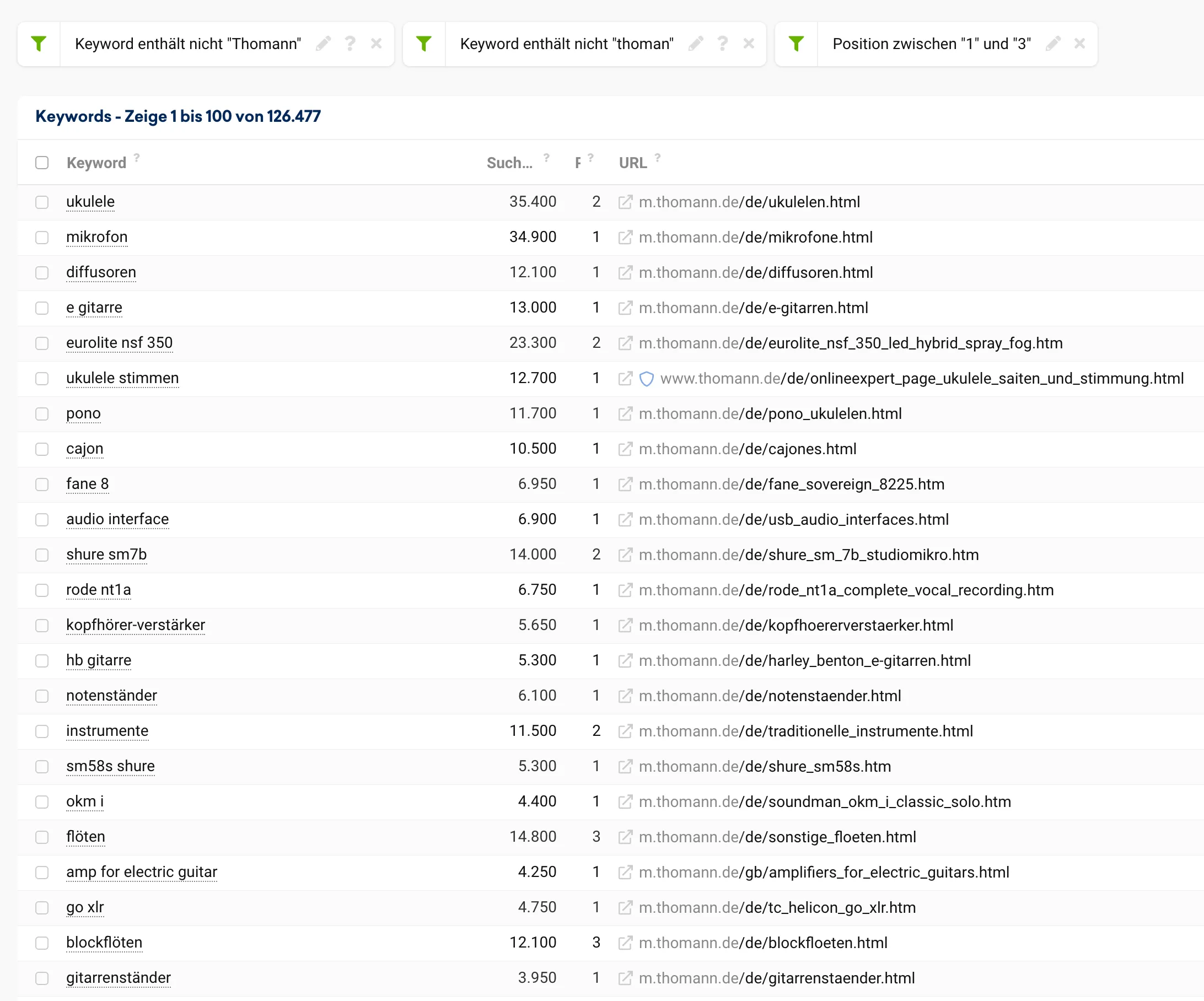
The website ranks for about 500,000 keywords in total. Of those, over 120,000 keywords are in the top 3. These positions are extremely valuable, because a large share of the clicks is distributed across these top positions. The lower places usually receive far fewer clicks.
The chart makes it clear: these are generic search terms. Users here are not yet searching for the Thomann brand. They want to inform themselves in general, or buy a product.
One example from the chart, to make this concrete: about 34,900 users search for “Mikrofon” per month. Thomann is in position 1 here.
Many users also search specifically for an instrument brand or a device, such as “sm 58s shure”. Thomann is in position 1 here as well.
Deepen your SEO knowledge: every Monday by email

SEO myth 1: Do you absolutely need SEO texts on your category pages?
The typical category page in an online shop has this structure: a short text introduction, then all the products in the category, then an SEO text at the end that nobody reads, but that is supposedly important for the search engine.
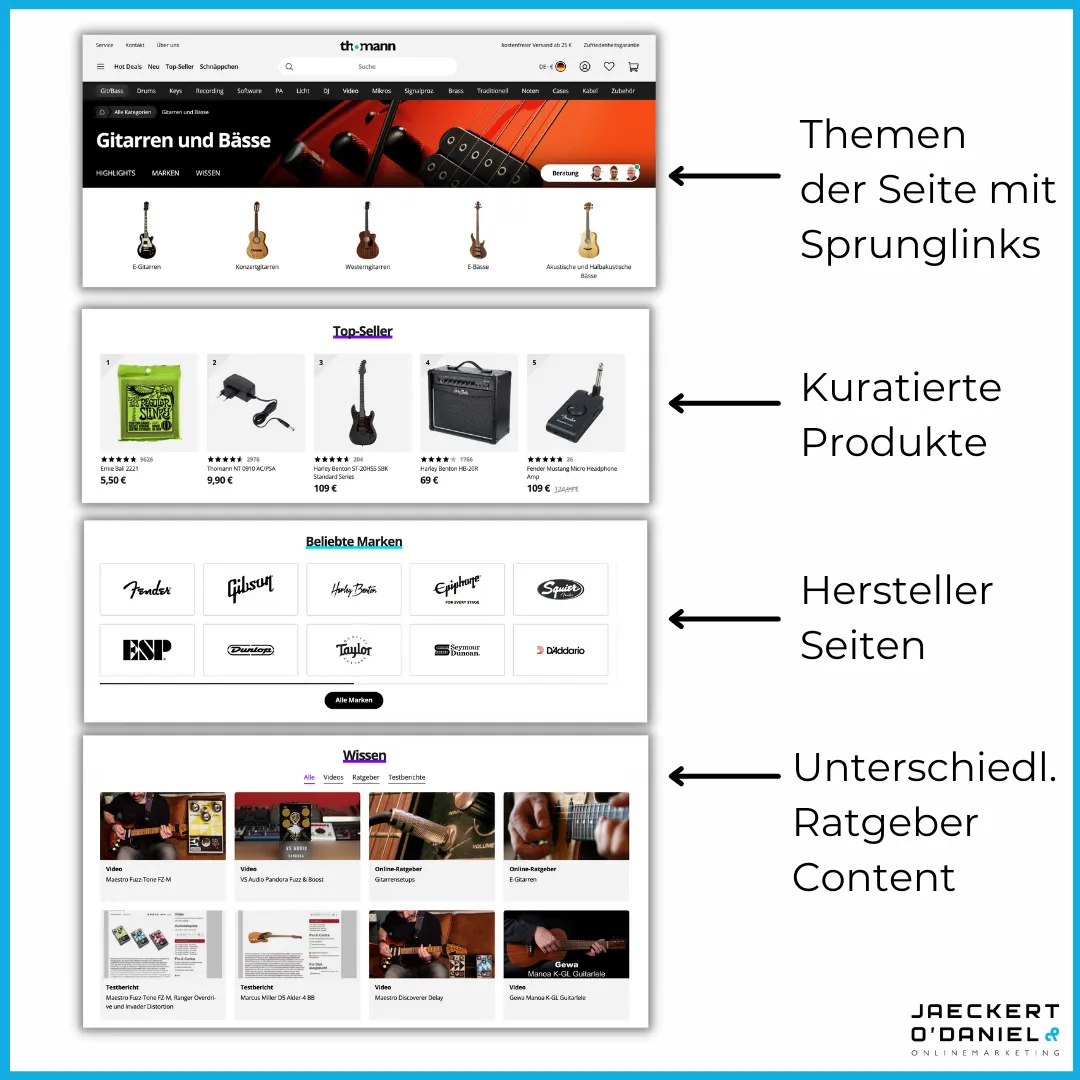
Thomann does it completely differently. On many category pages there is not a single sentence. This page type still ranks outstandingly well. Why is that? Of course the music store is an established name in the industry. It definitely has a brand bonus. Google, after all, wants to guarantee the highest possible quality at the top of the search results. Even so, the question remains why the category pages rank very well with no content at all. Our thesis: because the central search intents are met. Through the table of contents with jump links, users get everything important: a selection of highlights, an entry via the brands, and also the option to inform themselves. Every important search intent, from informing yourself through to buying, is met on this page.
SEO myth 2: Do you need directories for top rankings?
Content on large websites is usually structured in directories. In music, that would be the various instruments, stored in categories and therefore in website directories.
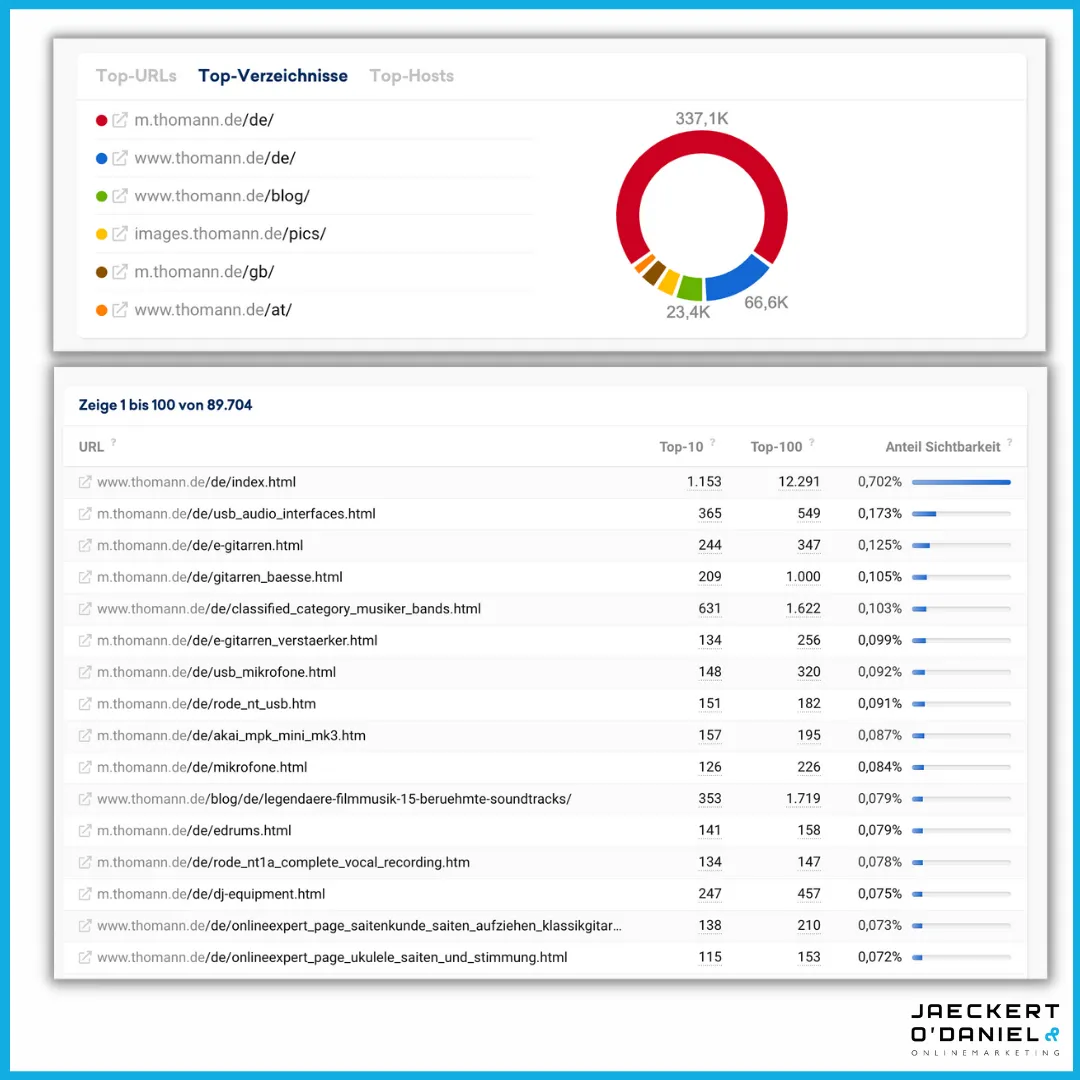
But Thomann does without a structure like that entirely. Instead there is an extremely flat website hierarchy. The individual pages still have outstanding Google rankings.
The example shows: it also works without directories. You do have to make sure the many pages are well linked internally. And you have to keep the overview.
Conclusion: a demanding website architecture, the one Thomann chose. But it works.
SEO myth 3: Do guide articles have to run to several thousand words?
Yes, guide articles should be thorough. Users usually want a lot of knowledge, after all. And a single article can rank for hundreds of keywords.
Even so, this topic has also led to excesses in the SEO world. On the principle: the article at the very top has 3,000 words, so we produce 6,000 words. As if volume by itself meant a ranking bonus.
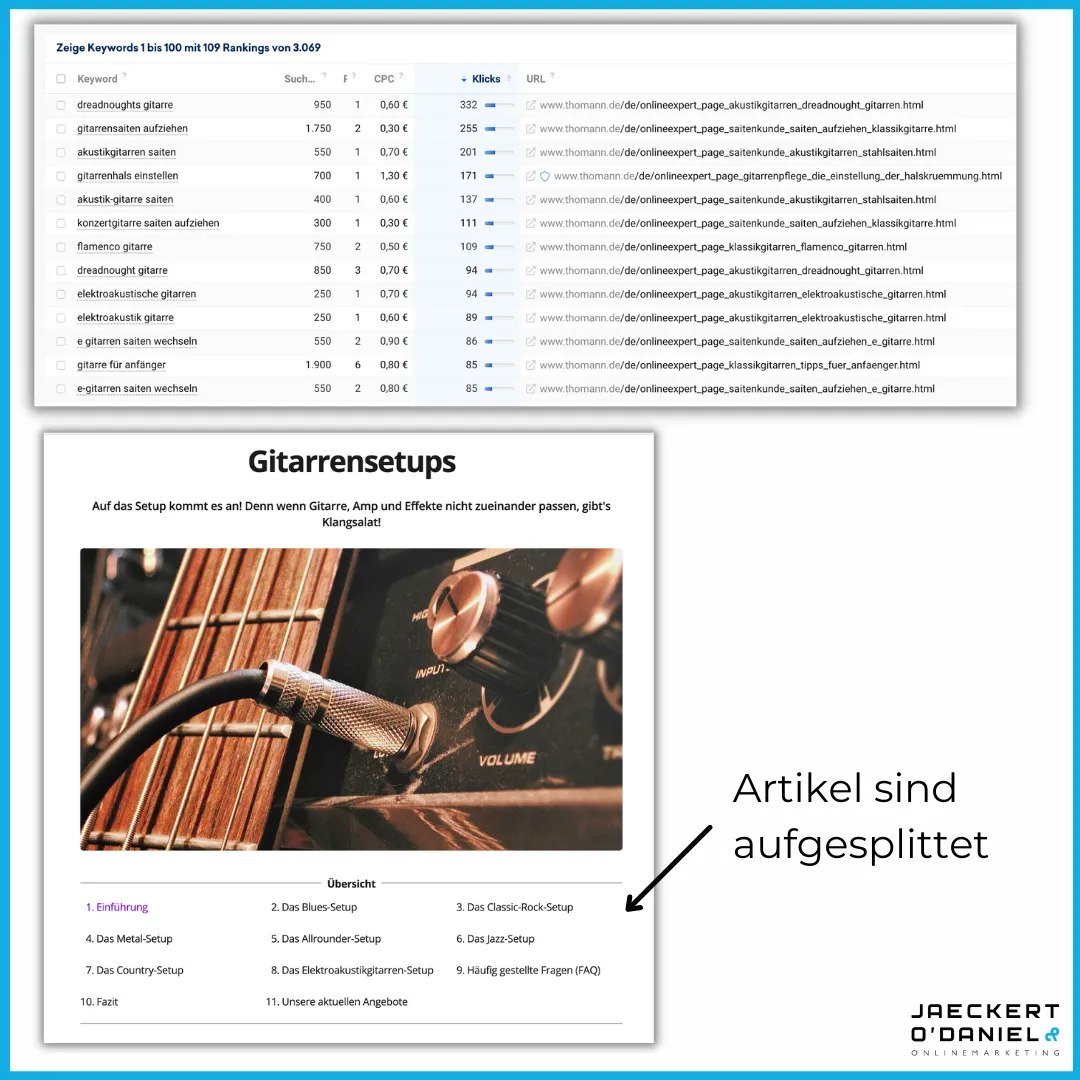
Thomann is completely different: the guide articles are often split up. Individual articles sometimes have only a few hundred words and answer very specific questions. They took the trouble here, even though the search volume is sometimes very low. And here, too, you can see that the articles achieve very solid Google rankings. In total they will generate a lot of traffic.
You would still have to analyze in more depth whether this is really the best SEO strategy. But one thing is certain: here again, Thomann takes a path entirely of its own.
Our podcast interviews with SEO practitioners in the field


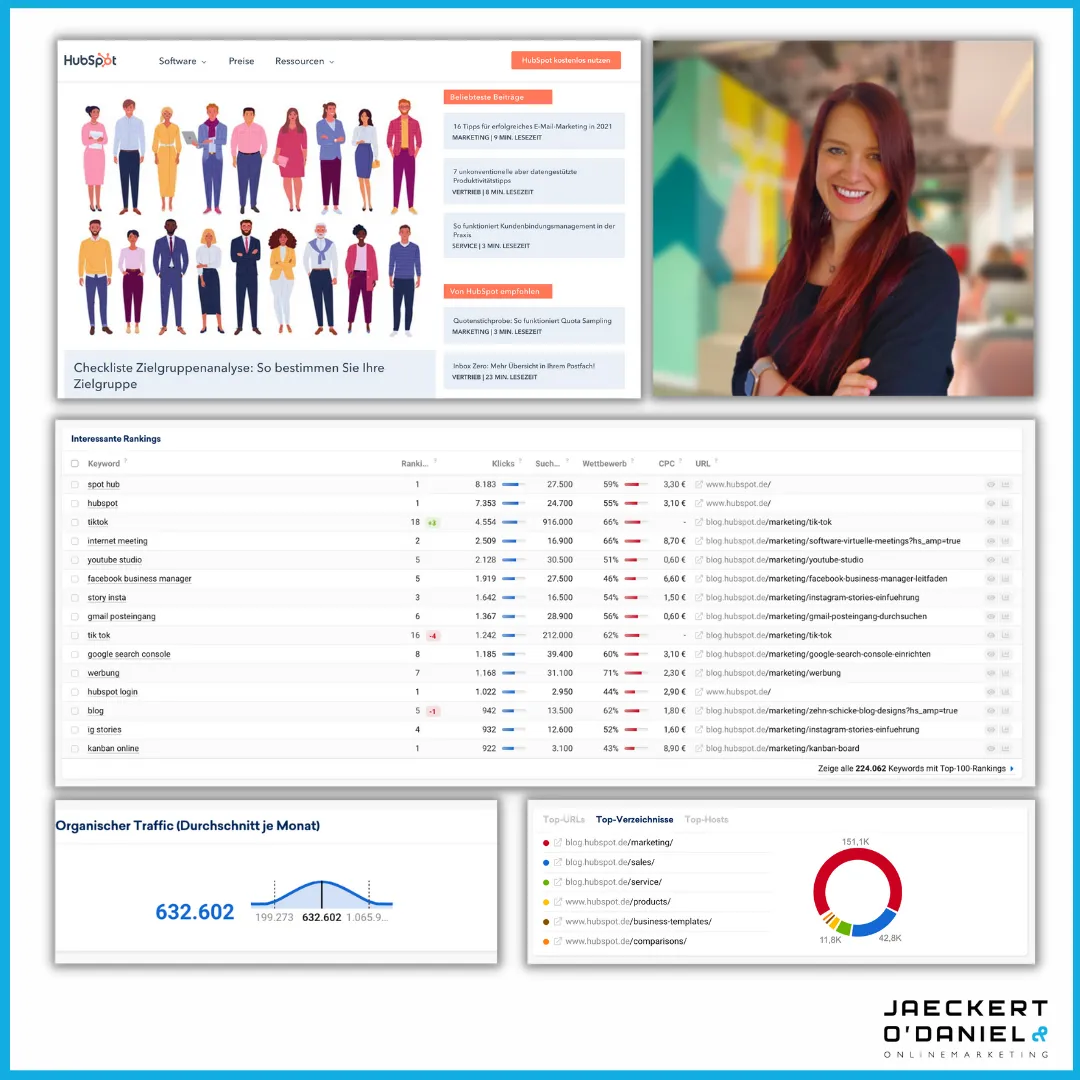
SEO for a software company: interview with Beat Köck


Are you relevant enough for Google? Interview with Olaf Kopp on the entity model

We advise marketing leads on SEO

We are Fabian Jaeckert (on the right) and Benjamin O’Daniel. For many years we have advised mid-sized companies on how to get more visitors through Google and turn that traffic into inquiries and sales, so that the website becomes a measure that supports sales. Through high-quality content.
For our marketing team, we specifically sought a sparring partner for SEO and content. Our goal was to gain new external insights to better leverage our ranking potential as a well-known brand in our market segment. Fabian and Benjamin delved deeply into our needs, and thanks to their comprehensive, data-driven analysis, they were able to provide us with concrete optimization suggestions for our SEO strategy. We particularly appreciated that we could achieve our goal with existing resources and focused testing.
 Bernd GüntherSage
Marketing teams have many projects on the table. They know that search engine optimization matters. But the concrete implementation, above all developing or further developing a solid SEO strategy, often falls behind.
That is exactly what we specialize in.
We develop SEO strategies for companies and present them to the people responsible in a structured and understandable way. We describe our approach here.
We then support the in-house leads during implementation. As part of SEO mentoring like this, we also develop a dashboard, so there is a data-based basis for discussions.
Sound interesting? We can set up an SEO intro call by video (30 min.).