November 9, 2020Benjamin O’Daniel
Longtail Keywords: How Professional SEOs Work
Longtail keywords are a central key to success in search engine optimization. Every professional SEO strategy relies on longtail keywords, and therefore also on longtail content.
But what are longtail keywords, or long-term keywords? How do you research the search terms, and how do you build them into the website? That is what this article and the podcast episode are about.
This much up front: a single article on a website can rank for hundreds or thousands of longtail terms. Only through this long tail of phrases and word combinations does the full power of search engine optimization emerge. Because visitors arrive through every combination of terms.
What are longtail keywords?
Longtail keywords are search terms made up of several words or word combinations. Because they are several words, phrases, or even questions, the search volume is usually lower than for shorter searches.
The term longtail is a combination of “long” and “tail”. In German, people also talk about dragging a rat’s tail behind you. It works the same way with Google and longtail searches. The term “long-term keywords” is sometimes used as well.
The opposite of the longtail is the “short head”. That means the one-word terms that have a very high search volume.
You include the longtail terms in the text. Seen that way, it is longtail content that you produce on purpose.
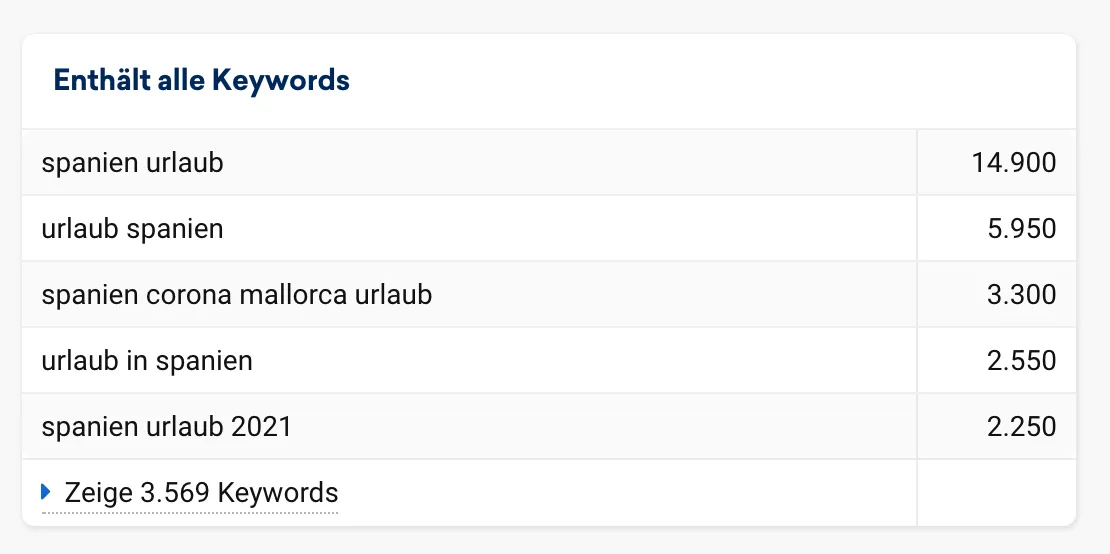
This two-word search query has a large longtail. In total, the tool shows more than 3,500 combinations, for this one search query alone. Often used as a synonym: niche keywords.
What is an example of longtail keywords?
With a longtail search, users want to specify or narrow their need for information. They want more targeted answers. You can see that in this example: the more specific the search query, the more tightly bounded the topic is. And the smaller the search volume becomes as well.
If you have exactly the right offer for the search query, though, the longtail search term is extremely relevant.
SEO training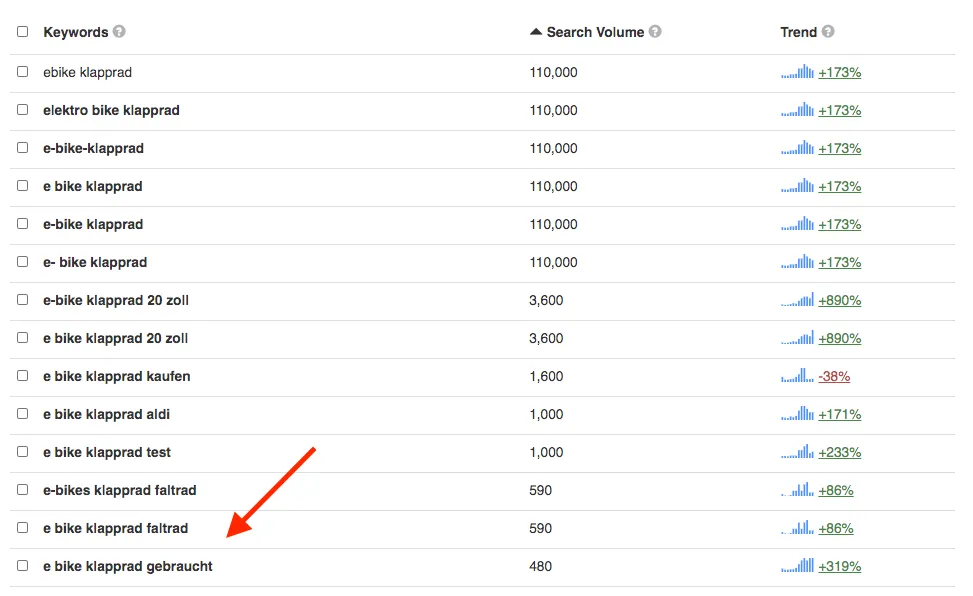
Why is longtail content important for SEO?
Less competition
Longtail keywords have a lower search volume and are therefore often not the focus of SEO strategies. Because of the lower competition, it is easier, and you have a better chance of Google rankings and therefore of traffic.
More specific users
The big one-word terms do have a high search volume. But users are often still right at the beginning. The more specifically users search, the further along they are in the customer journey. Longtail traffic can therefore be very valuable.
Faster rankings
Because competition for longtail search terms is often lower, you usually move forward faster. You produce results faster. Top positions for one-word terms, by contrast, usually take longer (a year and more).
Longtail SEO strategies from practice
In our SEO Academy we show how SEO works in practice. We explain SEO tools, show content strategies, and talk about concrete examples. From more than 15 years of experience. Clear instructions. Tutorial videos. And monthly live calls.
For everyone who wants to learn SEO.
More about our SEO Academy
Researching longtail search terms: what is a good SEO tool for that?
There are a great many keyword tools and SEO tools on the market. These include free products such as Keyword Planner, specialist keyword tools, and SEO suites.
At the core, it is about how good the data basis is. That is especially true for longtail keywords. Because if you cannot see them, you cannot work on them either. We ourselves use the SEO suite Sistrix and Keywordtool.io, among others. Both offers are paid.
In our Academy we show how to work with professional SEO tools, when you need them, and when you can cancel them. The goal is to use the tools when you need them.
How do you place the long-term keywords on the website?
It is an essential part of the SEO strategy to research these terms and to plan where you place them on the website. Which texts you have to write, and where those texts are “hooked in” within the information architecture.
That also applies to long-term search terms. Put simply, keyword research produces a series of topics. Each topic consists of a series of terms, including the longtail. Just as described in the examples above.
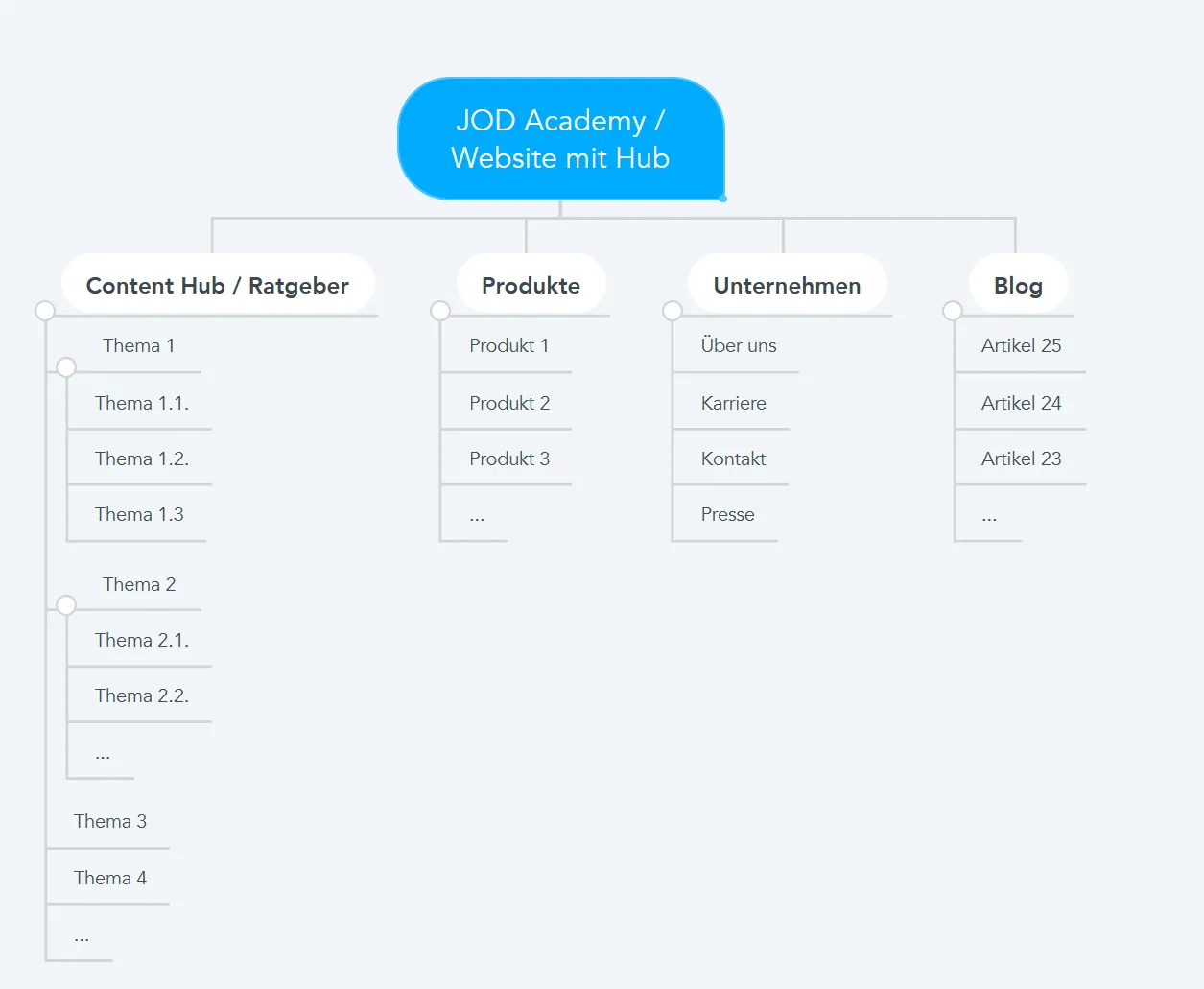
This example comes from our SEO Academy. The question also comes up regularly in our Q&A calls.
Current tips, examples, experience, through our mailing list


Longtail strategies from practice: our podcast interviews with SEO professionals



SEO for a software company: interview with Beat Köck


Are you relevant enough for Google? Interview with Olaf Kopp on the entity model

The SEO strategy of Reishunger.de: interview with Benni Uhlmann

The art of crawling: interview with SEO Markus Hövener

Why so few people take care of their longtail terms
No longtail tools
Professional search engine optimization includes a matching toolset for keyword research. Part of the toolset is a keyword tool. Here the data basis is decisive. The more keywords are captured, the more effort it is for the tool provider. The result: longtail tools with a good data basis cost a certain sum per month. Usually from a hundred euros upward. It also depends on how good the data basis is in which country, especially for international SEO abroad.
Unclear website architecture
Where do I place all the longtail keywords? Do I produce rather little holistic content? Do I catch the keywords with a glossary? Or in the shop on my category pages, or in a guide section after all? Questions like these belong to website architecture and to content strategy. This much is clear: each long-tail keyword needs a clear place, also to prevent keyword cannibalism. It makes sense to clarify this once at the beginning and then start content production.
No content processes
Longtail keywords are characterized by there being very many terms with low search volume. That quickly raises the cost-benefit question. Is the effort worth it for a detailed keyword research or a later optimization? Many people in charge get stuck in an analysis-paralysis loop here. They know the value, but they do not know how to implement it. Prioritization and content processes are missing. Our advice: do not rely on cheap SEO texts, but on quality. Because competition is getting stronger in the longtail as well.
Long-tail keywords: how we proceed
Central keyword list
Many content owners work only with plugins for their WordPress SEO, keep an eye on just a few terms, or simply work by feel. What is missing: a central keyword list, for example in Excel. That is where the short-tail keywords stand, but also the longtail terms. In Excel you can filter and segment, and look at the keywords in a targeted way. At the same time you always have an overview of the basic taxonomy, meaning recurring combinations in the respective search space.
Website architecture
A frequent way into SEO or into content marketing is: keep writing more blog articles. The result: you produce countless articles, of which very many often do not rank. We argue for an overall perspective: which keywords do I want to cover at all, and where is the right place for them? That can also be product pages, or a limited content hub with topic pages. And then a focus on high-quality website texts. Here is an example of such an SEO strategy.
Proven content templates
Creating content is and remains laborious. That also applies to supposed SEO content. Especially because quality has to be right in longtail SEO as well. After all, behind every click there is a person and a potential customer here too. What helps with content production: a content template. A model of what a piece of content should look like. So that you work into the website structure and the formats. The keyword research beforehand and the monitoring afterward also have to be settled. So that you can see the successes and assess them.
In closing: these are the advantages of longtail keyword strategies
There are many advantages to betting on longtail keywords. The most important advantages at a glance:
- Clear search intent of users
- More targeted address
- Less competition
- Stable ranking
- More opportunities to test
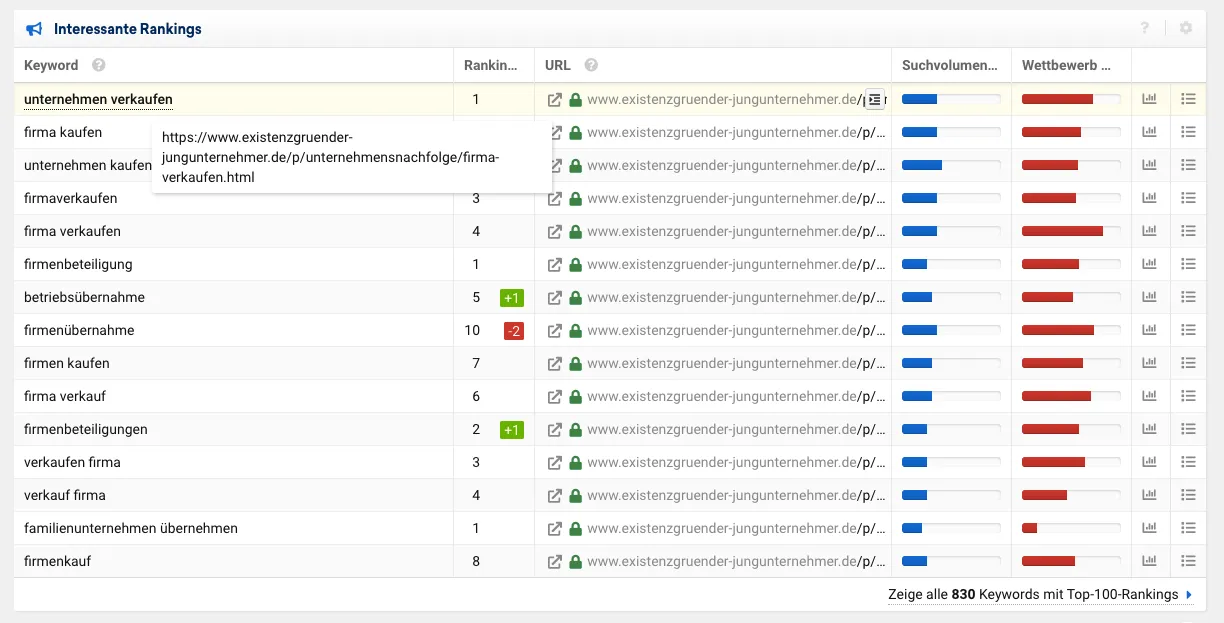
A single URL ranks for hundreds of longtail keywords. Through the volume, many visitors arrive on the individual subpage. The example comes from our SEO Academy.
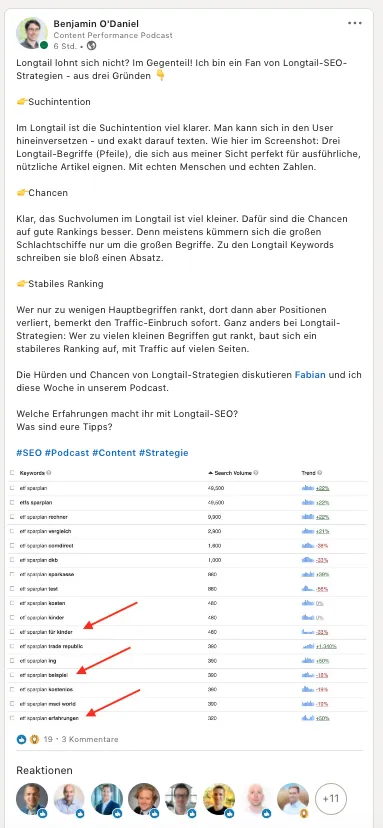

Further questions about longtail search terms for SEO
How is the longtail developing?
The longtail has been growing for years. Users have understood that the more specifically they search, the better the results are. At the same time, it is a major challenge for SEO and content work. Because you develop content that, looking ahead, will reach very few users. In the analysis it is therefore very important to research the longtail keywords that are truly valuable.
Why are longtail keywords valuable?
In the longtail you usually have less competition than in the short tail. Simply fewer companies optimize for these search terms. So you have better ranking chances. A calculation example: a term is searched 1,000 times a month and you are in position 9. There you receive on average only 2.5% of all clicks, so 25 clicks a month or 300 clicks a year. For a longtail term that is searched only 100 times a month, by contrast, you are in position 1. You receive on average 30% of all clicks, so 30 clicks a month or 360 clicks a year. For a web analysis like that you need a suitable dashboard, or at least Google Analytics.