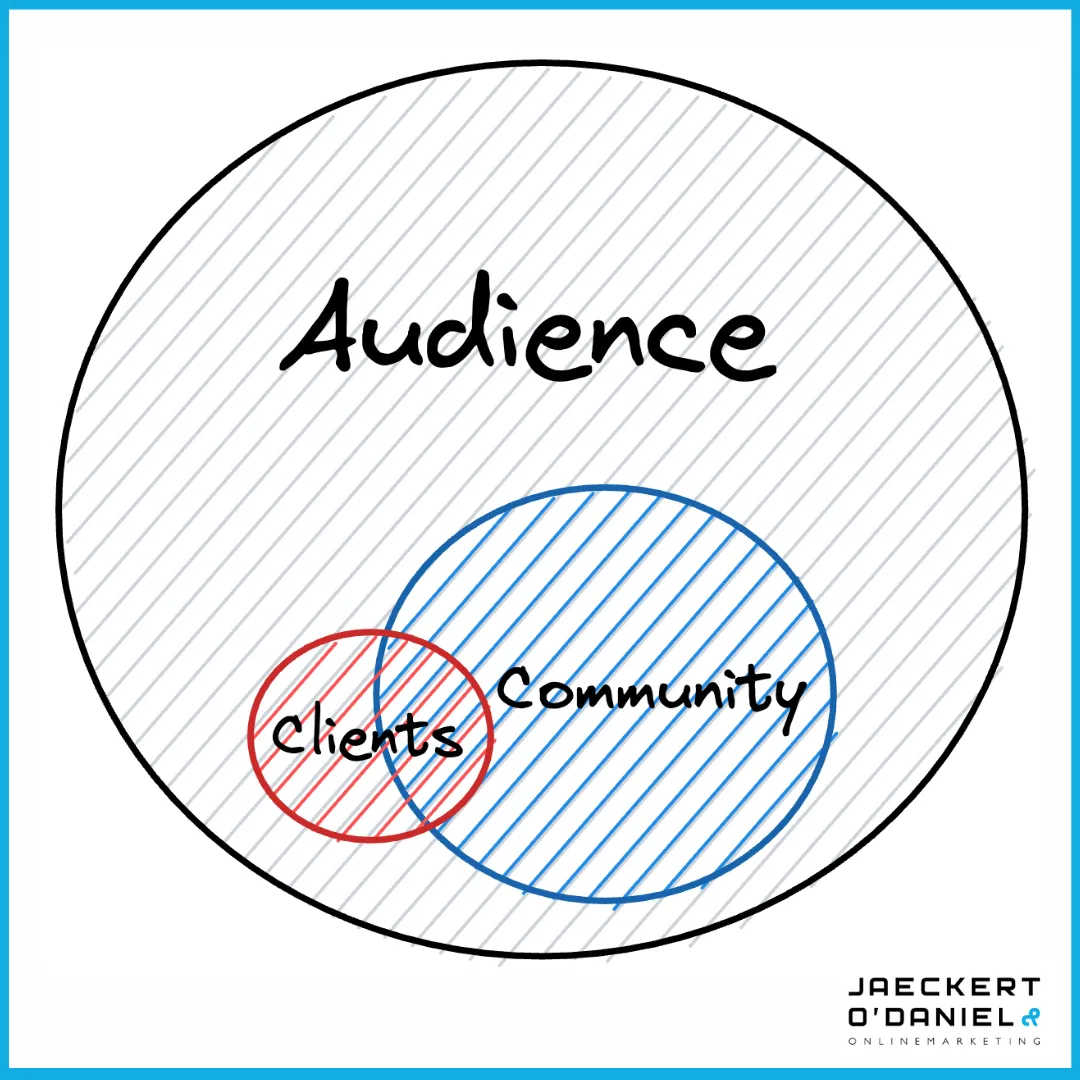
May 18, 2020Fabian Jaeckert
What Is Good Content Management?
What is content management? Which tasks fall under it? And who enters the content?
Entering the text on the website sounds simple.
But in reality a lot of problems arise here.
You need editorial know-how, but also technical understanding, for example of how to handle the content management system that is used, such as Typo3 or WordPress.
An editorial plan with an SEO focus gives you confidence that you are working in the right direction. Added to that is a feel for design and visuals.
Important: content management also plays an important role for search engine optimization. For example because internal linking is an important ranking factor.
The core problem behind it: companies often have no clear processes and no templates. We talk about how content, SEO, and web development can work together better.
Content management: our topics
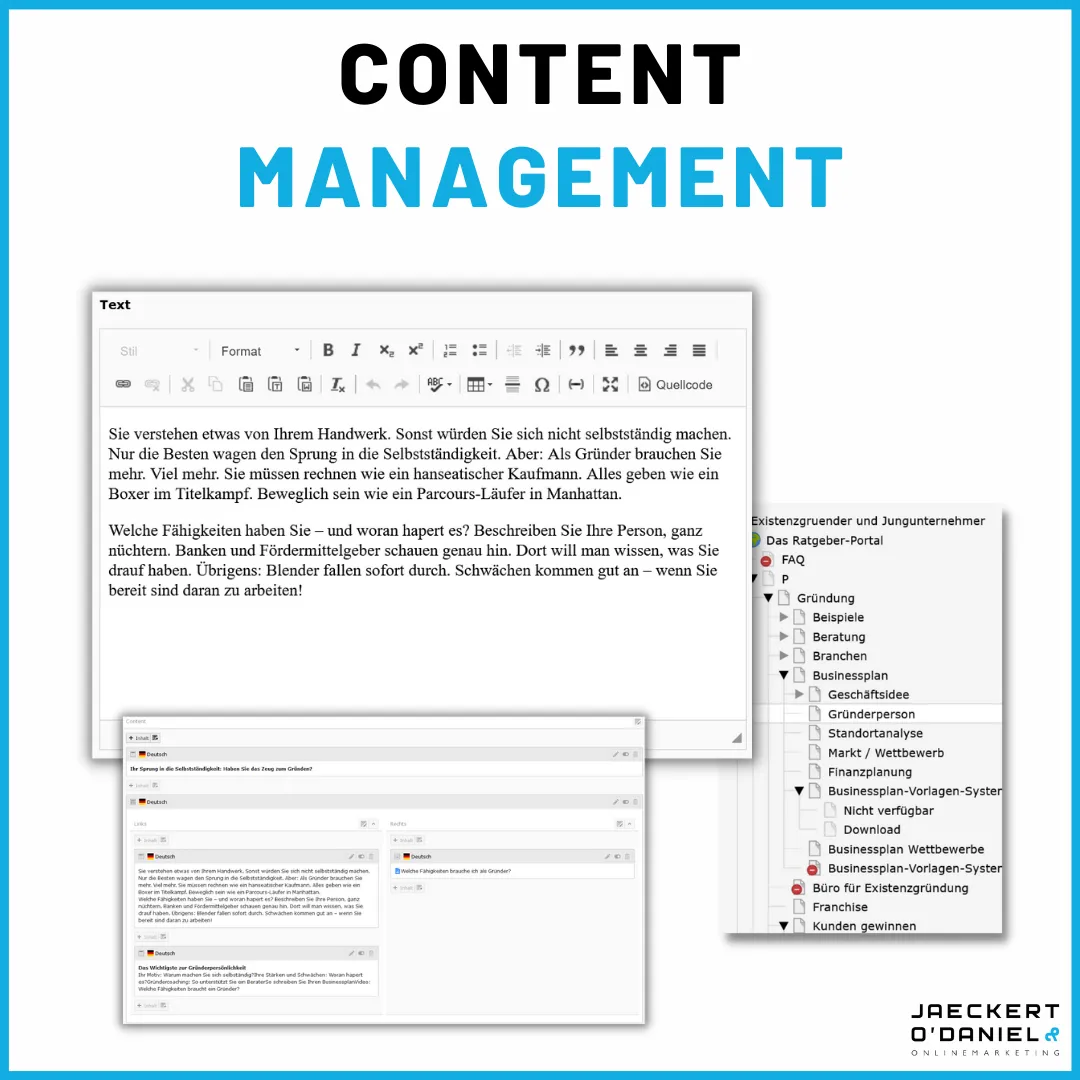
What belongs to content management?
Content management means all editorial work in a content management system (CMS). So entering and editing content. Content can be products, but also website texts, videos, and much more.
Whether content creation is also part of the work is something people see differently. The profession itself is not clearly defined or protected.
Content managers, content marketing managers, or marketing managers often look after content management. It is part of their job to develop and publish content. This is also called content production.
Pure content management has a strong technical focus. Alongside the operational work, it is also about developing the content management system further together with IT.
Topics such as developing a website structure, project support for a relaunch or redesign, and the conceptual development of elements such as landing pages are also often on a content manager’s task list.
Someone who looks after a website in a purely technical way more often has the job of an administrator or webmaster.
Which content management systems are there?
The market for content management systems is very fragmented. Companies are often dependent on their web agencies, which specialize in certain systems. Widely used systems include, for example:
- Typo3
- WordPress
- Drupal
- Joomla
During a relaunch, the question often comes up whether you should stay with a certain CMS or not.
We personally are very cautious about switching content management systems. We see with our clients that this takes a great deal of time, and often does not deliver the success they wanted.
A company is also often more dissatisfied with the technical setup of the system than with the system itself.
A CMS switch also often has negative effects on SEO visibility, because elementary SEO requirements are not observed, such as a correct redirect of existing pages (URLs).
What is the difference between content management and content strategy?
Content management refers to the editorial entering of content. Content strategy, by contrast, is about the fundamental question of which content should be developed, why, and how.
Content management is therefore the operational implementation. And also only “at the end” in the content production process.
A content strategy starts on a completely different level. It is about questions such as: who are our customers? With which content and formats do we want to reach and convince our customers? Which concrete goals do we connect with that?
We always connect a content strategy with an SEO strategy. Here, keywords are researched first and a content plan is developed from them.
SEO tips from practice, for everyone working in content management

Entering content: how you get your content online
Clarify the CMS options in advance
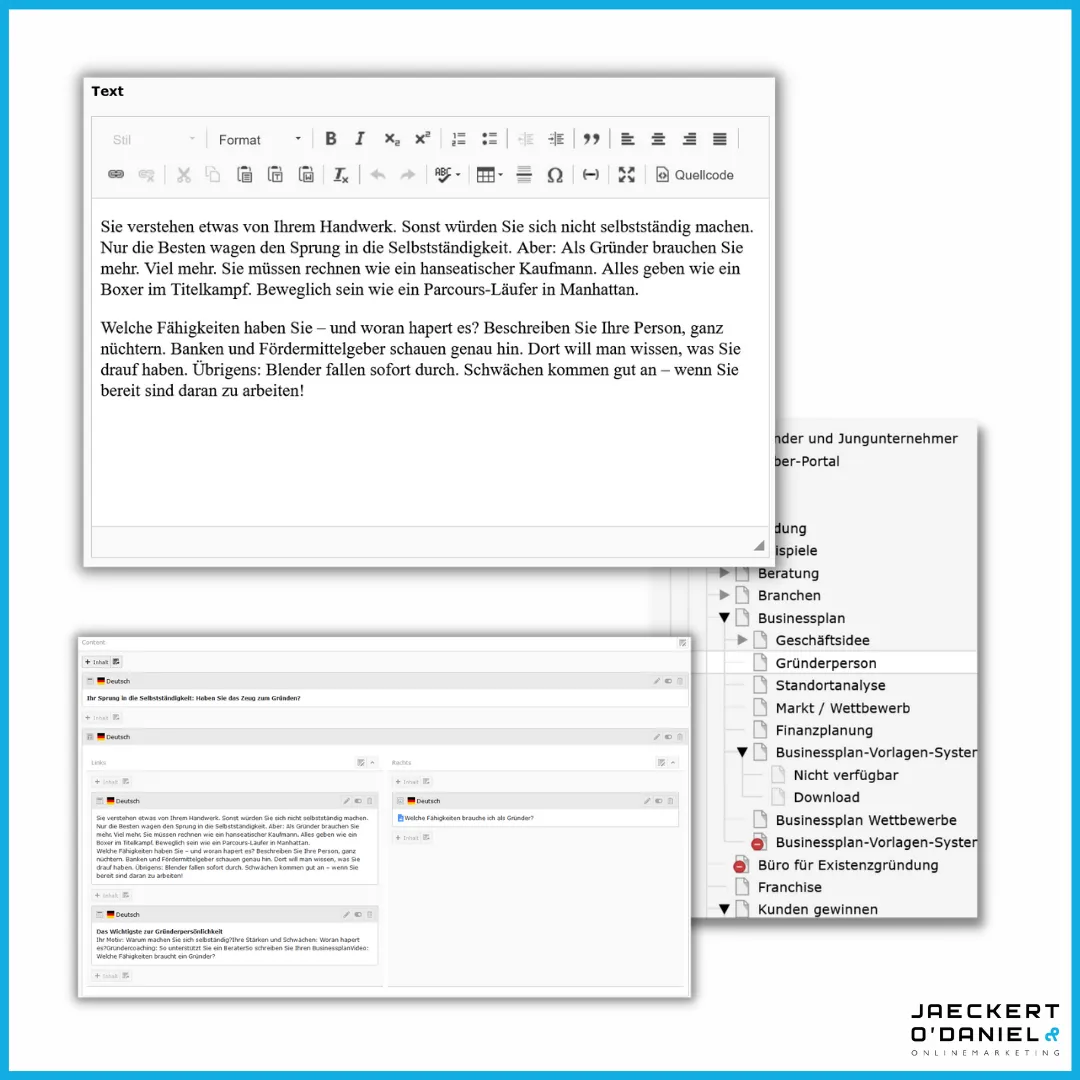
First you have to clarify which options you currently have at all for building in and designing your content:
- Which layout variants are available? Possible examples are grid layout, accordion, info boxes, text-graphic combinations, forms, CTA elements
- Which content formats can I implement? Alongside blog articles there are, for example, glossaries / encyclopedias, landing pages, or product pages.
That way you can use existing elements to design your content. If you notice that important elements and formats are missing, you should discuss this with IT or your webmaster. In the short term you can still plan your content according to your options.
Develop a content template
If you want to optimize your content specifically for search terms, we recommend developing high performance content. That is content which meets the requirements of the search engines and convinces the user of your product or offer. High performance content is built in modules and can be used more than once, like a template.
A big advantage of modular content is that you can develop texts so that individual text sections “map” onto layout elements, meaning they can be written specifically for them. That makes creating the text easier, and building it in easier too, because the developed content “fits” the layout directly.
Set up a content and SEO process
Content often fails to get built in because there are no fixed responsibilities. That is why we recommend defining clearly who builds in the content. Ideally the build-in is done in-house and not externally. That removes time-consuming intermediate steps, and content management knowledge becomes anchored in the company.
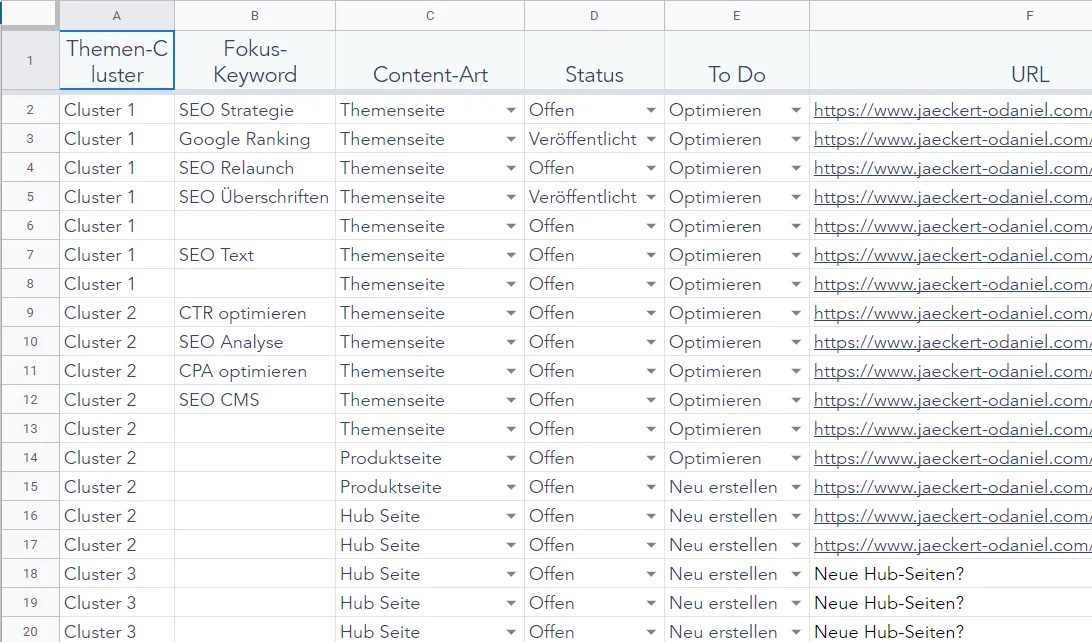
Through a content plan or editorial plan (see graphic), an SEO strategy can be transferred directly into the content. It states which keywords are to be covered with which URLs, and what still has to be done for that.
Further questions that often come up in the content process:
- Does someone else still have to approve / sign off?
- Are all the graphics in?
- Are the internal links set?
- Who helps when technical problems come up?
We develop SEO strategies for companies

We are Benjamin O’Daniel (left) and Fabian Jaeckert. For many years we have been working as SEO consultants and combining technical search engine optimization with content marketing.
After a website relaunch, we as a brand wanted to tackle SEO. For this, we specifically sought support. Benjamin and Fabian developed technical optimizations and an SEO strategy with a content roadmap. Many thanks for your valuable input.
 Anja HornBarilla Deutschland GmbH
Marketing leads in companies usually have a great deal on their plate, for example content management. They know that search engine optimization is relevant, but they lack the know-how, experience, and time to take on SEO strategy development themselves.
This is where we come in as SEO consultants. We develop individual SEO strategies for companies and present them in a workshop. For example in the form of an SEO concept. If needed, we then support the in-house leads during implementation.
Our approach: we share all of our knowledge. So that the people responsible in the companies get sustainably better at SEO. In our podcast, too, we discuss numerous specialist topics in depth. On LinkedIn we discuss with our listeners.
We can arrange an SEO introduction (30 min. video conference).
CMS and SEO: our tips
Online marketing
For more than ten years we have been working as SEO consultants in online marketing. In our Content Performance Podcast we talk with experts from numerous specialist fields and with people responsible in companies, such as heads of marketing, SEOs, and managing directors. In the podcast and on our website we share our knowledge from online marketing.
Blog marketing
When it comes to content, almost everyone thinks of blog systems. With WordPress it is relatively easy to get content onto the website. Content management becomes very complex further down the line, though. In addition, many people responsible are caught in a hamster wheel of always producing new content. A successful ranking can rarely be built that way, let alone improved. More on blog marketing.
LinkedIn strategies
Many companies develop extensive content for their own website. An important basis for ranking better. But the content can still be used on further channels. After all, it costs time and effort to develop the content. On LinkedIn, for example. Here you need a sensible LinkedIn content strategy. More also in our LinkedIn workshop.